Completist?
My reading habits have changed over the years, partly because I’m not as willing as I was when younger to stick out a book I am not enjoying, and partly because (I like to think) I’ve become a bit less of a control freak. It used to be that if I found an author I liked, I had to read absolutely every book they had ever written, so as to know their complete catalog. I learned that this was sometimes a mistake; it can become disillusioning if you have idealized or even idolized that author to read, for instance, one of their early, less well formed works, or (in the case of some long-time authors) one of the later ones when they quit trying and phoned it in. So I have become more interested in reviews, and I look for red flags to warn me off certain books.
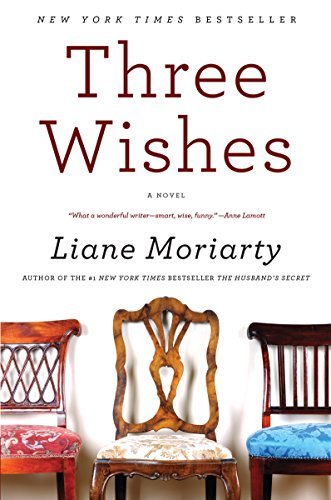
I missed that cue on a book I read lately, and it wasn’t a catastrophe—I enjoyed the book for what it was—but when I belatedly looked it up on Goodreads and found out that Three Wishes was Liane Moriarty’s first novel, I wasn’t surprised.
The book is about the Kettle sisters, Lynn, Cat, and Gemma—
a set of triplets who have just turned 33—and follows the lives of each of them as they confront challenges separately and together. Moriarty also cleverly includes in the narrative some “remote” views of the triplets at various ages from the perspective of outsiders who run into them at the park or see them in a restaurant and then comment about the experience to someone else.
Although I found all the various relationships—between the sisters, with their spouses, children, parents, outsiders—involving, there were a few things not to like about the book, that echoed my response to the early works of another novelist, Jenny Colgan. Whenever I recommend Colgan’s books, which I like very much, I always add hastily, read everything after 2012. That seemed to be a turning point for her, when she quit writing about shallow, artificial, unlikeable characters and started embracing her now-trademark touching, empathetic, and charming ones. I’m not saying she went over the sappy line, just that they quit being actively annoying and started exhibiting positive qualities. That was the main problem I had with Three Wishes: I didn’t much like any of the three sisters, so it was hard to invest and sometimes even to keep reading about them. I also felt like one of them got a raw deal from the other two that didn’t get resolved by the end, and since she was the one with whom I had the most sympathy, that was off-putting.
There’s none of the intrigue or thrill of Big Little Lies or the unexpected plot twist of What Alice Forgot here; it’s a simple relationship novel. (I did prefer it to Nine Perfect Strangers, however!) There’s nothing wrong with that; I have just come to expect a little something extra from Moriarty. But I’d say it’s worth reading, with the words “first novel” always in the back of your mind.
Discover more from The Book Adept
Subscribe to get the latest posts sent to your email.

 The Book Adept