Person, place, thing
I wrapped up my wallow through the writings of familiar authors by reading two books that I really should have saved for six weeks or so but, once discovered, I couldn’t resist them. These were Jenny Colgan’s latest, a two-parter with the same characters and location, The Christmas Bookshop and Midnight at the Christmas Bookshop. Colgan has made a habit out of returning to the scene of a previous novel but setting the action at Christmas (Christmas at the Cupcake Café, Christmas on the Island, Christmas at Rosie Hopkins’ Sweetshop, etc.) but these sequels usually arrive after she has segued to another story or two and then returned. This two-fer is an almost-continuous tale all taking place within about a one-year period bracketed by Christmas seasons, so I was glad that I discovered them both at once and could read straight through from page one of #1 to the last page of #2.

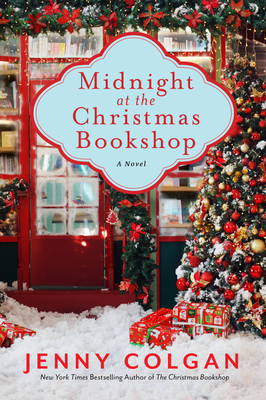
My title for this review takes into account a particular skill of Colgan’s, which is to present us with compelling characters with a specific objective in a spectacular setting that becomes every bit as important to the story as the protagonists. In this case it’s the city of Edinburgh, specifically the Old Town shopping district, so far holding out (for the most part) against the store chains and gimmicky tourist fare to present an authentic experience of one-off original shops, from a hardware store to a chic dress shop to a witch’s herbarium. The focus for Colgan’s bevy of characters is, as frequently happens in her books, a bookshop, in this instance a failing one. Mr. McCredie’s ancestors started the rare book store on the rambling bottom floor of their home, and he has lived and worked there his whole life but, despite his affinity for and encyclopedic knowledge about every sort of book, he’s a terrible salesman, a worse marketer, and is on the verge of forfeiting everything. Enter Carmen Hogan.
Carmen has, in rapid succession, lost her boyfriend, her job, and her apartment, and has been living in a state of denial at her parents’ place, tediously and repetitively grousing about everything and eating way too much junk food. Carmen’s parents are rather desperate to get her out of their house and back on her feet, and enlist Carmen’s sister, Sofia, to help them.
Sofia and Carmen have always been polar opposites: Sofia is the elder type A overachiever, and is now a successful lawyer with a happy marriage, three children (and another on the way), and a beautiful home in Edinburgh, and Mr. McCredie is one of her clients at the law firm. Carmen decided to skip college, and has worked in retail in a large department store since high school until the store closed and made her redundant. Sofia somewhat reluctantly asks Carmen to come live with her family, telling Carmen there is a job for her revamping an Edinburgh rare bookshop; what she doesn’t tell Carmen is that the sole objective is to get the store to turn enough of a profit during the next three months so as to make it an appealing prospect to a buyer, and that as soon as a sale takes place, Carmen will again be out of a job (and presumably a place to live).
While initially reluctant to go live with her sister, Carmen sees that she needs a change, and she loves books, so off she goes to Edinburgh. She is horrified by the magnitude of the job she has taken on: The store is in an advanced state of disrepair and disorganization, and Mr. McCredie is absolutely no use unless someone comes in looking for that one eclectic title about which he happens to know something. But she takes a deep breath and pitches in, and starts to make some headway, particularly when she is able to get a famous writer of self-help books to do a signing at the store. This guy and a student/lecturer at the college are the two love interests in the story, and Carmen goes back and forth between the glamour of the first, with his casual attention and expensive dinners, and the quiet regard of the second, a young Quaker with an intensity she has never experienced.
Carmen and Sofia continue to be mostly at odds, but Carmen discovers an affinity for children, specifically her young nieces and nephew, that she didn’t expect, and bonds particularly with the second daughter, Phoebe, who shares many character similarities with her Auntie Carmen.
There are other fun, although somewhat over the top, characters such as Skylar, Sofia’s yogini nanny, and Jackson, the millionaire who is out to ruin the quaint shopping district by remaking all the stores into purveyors of cheap “tourist tat” sporting too much Scottish tartan, and there are a few improbable story elements that made me say “hmm.” But…
I was truly astounded to see a bunch of two- and three-star ratings of these books on Goodreads, where Colgan normally has solid fours and fives. I thoroughly enjoyed both of them; the magical descriptions of Edinburgh in winter at Christmas made me want to go there despite an almost pathological dislike of cold weather; the children were funny and endearing and memorable; the bookshop’s problems and mysteries were involving; and I liked Carmen as the protagonist and driver of the narrative. I was totally immersed in this two-part story for four days, and was sorry when it ended. I’m hoping, as she occasionally does, that Colgan will go back for a third installment set in this world with these people, because I’d love to know what happens in their next chapters. If you’re looking for something to read to put you in the holiday mood, look no further.

Discover more from The Book Adept
Subscribe to get the latest posts sent to your email.

 The Book Adept