Book pharmacy
The pandemic did something to our libraries from which I’m not sure they will ever recover completely: It made the in-person experience first precarious, then impossible, and then precarious again, as libraries first changed policies to prevent close contact, then completely closed their doors, and finally opened again only to discover that their patrons were either still being cautious or had completely changed their methods of book access and weren’t readily returning to their former habits.

My experience has been particularly acute, since, in the year after the formal lockdown when we were all mostly still staying away from any public place with more than half a dozen people in it, my disability began to ramp up to the point where making my weekly rounds to the market, the post office, the feed store, and the library became at first painful and then fairly impossible. The only time I go to the library nowadays is if I am booked to teach an art workshop at one of the local branches, and it takes me two hours to get ready and a double dose of Tylenol to weather climbing in and out of the car four times (leave-arrive, leave-arrive) and walking from the parking lot to the meeting room to set up for contour drawing or watercolor or T-shirt stenciling.
My previous library habits were filled with serendipity for my reading life; I had a particular routine that varied but usually included most of the same checkpoints. I would return my books and then look at the return shelves to see what “everyone else” had been reading and whether any of it looked intriguing to me. I would check the new books shelves and grab at least one or two unknown and untried authors. I would look to see if the latest volume in half a dozen mystery series I read had arrived, or if there was new science fiction, and I would visit the YA section for fantasy, because some of the best fantasy writers live there. And if all that failed to garner me at least half a dozen books to take home, I would stroll languidly up and down the aisles, looking for beloved authors, and would consider re-reading one of their books; but then I would also look around them on the shelves to see who I might discover because they were shelved close by. That’s how, while looking to see if there were any Rumer Goddens I hadn’t read, I noticed and borrowed the books of Robert Goddard. That’s how, while standing by the shelf containing Betty Smith and Dodie Smith, I found A Simple Plan, by Scott Smith. The books of Robert Heinlein led me to the Dune saga by Frank Herbert “next door.” In short, I can’t say enough about the expansion of one’s reading life through the luxury of browsing.
In my readers’ advisory class at UCLA, I used the book Reading Still Matters, by Catherine Sheldrick Ross, as one of the texts; Ross and her colleagues did multiple in-depth surveys and studies of thousands of readers to discover how they select, but I never realized, until I just now took the time to describe my own exact experience, that I almost perfectly characterize the habits of the successful readers she catalogues. Part of that book is also dedicated to the purpose of discovering what happens when a person’s own habits and methods fail them and they are flailing about trying to find a book. And now, I can relate to that, too….
These days, being so nearly housebound as I am, my choices suffer from a certain paucity. Although I belong to a couple of Facebook groups of avid readers, most of the time they all seem to be reading the same two dozen or so books, many of which are not to my taste. I have never been a peruser of the bestseller or award-winner lists in the newspaper or online, mostly because long experience has shown me that the former are not as good as their publisher’s blurbs declare, while the latter have won awards simply because some esoteric bunch of people decided they should, and we apparently have little in common! So without my library routine, I struggle to find what I want, just as much as any more naive reader with fewer developed resources. I wasn’t conscious of this until my annual Goodreads challenge (how many books you read in a year) began to number fewer and fewer books, mostly because I am not finding the ones that would hold my attention and keep me reading on a continuous basis. One year, while working full-time (at the library) with a long commute, I nonetheless managed to clock more than 150 books; but last year I struggled to complete 80, despite being retired and mostly at loose ends. Part of it, of course, is a certain lack of concentration that comes with my physical challenges, but I blame most of it on the functional lack of choice.
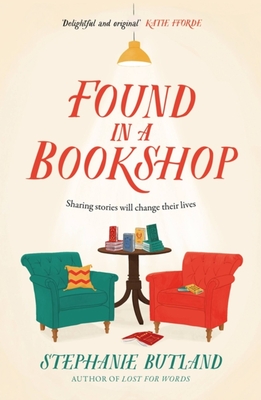
Being a readers’ advisor carries a certain amount of responsibility with it to keep up with current literary output while having a deep base of older choices on which to fall back, and I confess that I’m not as good at it as I have been in the past. But I still manage, in the Facebook reading groups (and sometimes on Goodreads) to find the books people want, if they give the slightest bit of personal information that would lead me to their preferences. And that brings me to the book I am currently reading (at last! you may be exclaiming with relief), which is called Found in a Bookshop, by Stephanie Butland, and which is resonating so closely with certain parts of my own personal experience that I am finding it positively cathartic.
I didn’t know, until I had already reached chapter 11, that it is actually a sequel to Butland’s book The Lost for Words Bookshop. But several Goodreads reviewers said you could read the second as a stand-alone, and I somehow couldn’t bring myself to stop, once started, so I’ll get to the first one when I am done with the second. (EDITED TO ADD: I apparently did read the first book, back in 2018, and gave it five stars. I didn’t review it here, since I hadn’t yet started this blog, and I don’t remember a thing about it! That’s kinda scary….)
A couple of Goodreads reviewers groused about the book being set during the Covid lockdown (“outdated” said one, while the other elaborated: “Boring. Too many characters. Hate Covid books. Could do without the author’s opinions. Glad I only spent 99 cents.”) but that was precisely what I loved most about it. Butland so perfectly captures the feeling of being isolated from everyone, from standing on one side of a door but not allowed to open it, the nervous retreat from other people when encountering them in public places, the quiet of the streets with nothing but essential traffic…it brought the whole thing back with complete clarity. I suppose some people wouldn’t want to experience that again, and while I didn’t precisely crave it, I found it comforting, in a way, to recognize that this author’s experience (and that of her characters) so perfectly echoed my own.
The description of the pervasive quiet of the bookshop without any of its customers and the nervousness of its proprietor and her employees as the lockdown went from weeks to months with no sign of abatement was evocative and painful. The vignettes of the various people who were tenuously connected through their previous status as customers of the bookshop were likewise poignant and familiar. But the thing that really got me, in the end, was that this was a story not just about Covid but about readers’ advisory. At some point, after one long-time patron mails a check and requests that the bookshop send her books each week—leaving the selection up to the staff—the owner, Loveday Carew, decides that she will enlist her employee, Kelly, to craft more of a presence on social media and then to advertise their services as a “book pharmacy.” Basically, they tell the town of York that they will be happy to select books for people who aren’t sure what it is they want or need, a sort of reading prescription, and either deliver them to their porch via bicycle, make them available for pickup, or send them in the post. And then the emails and letters start to arrive, some requesting specific genres or types of reading but others simply describing the feeling the reader wishes to experience and hoping the bookshop staff can figure out what book will produce that. The books couldn’t cure Covid, but they could do something about fear, boredom, loneliness, and the desire for escape. It was like this author took my favorite area of study—and my life’s preferred work—and laid it all out on the pages of her book.
In addition to all of this synchronicity with my own life’s experience, I love that in the “prescriptions” the bookshop staff write out for their customers I discovered at least a dozen intriguing titles with which I was unfamiliar, and which I promptly noted and added to my Goodreads “want to read” list. After doubling back to peruse the first book in this duology, I can scarcely wait to explore that extra list of smart suggestions from an author who has obviously done her homework. Great work, Ms. Butland!
Discover more from The Book Adept
Subscribe to get the latest posts sent to your email.

 The Book Adept
Thanks, this sounds like a good book.
LikeLike
well this sounds great! gonna go check my library app right now.
LikeLike