Bafflement and outrage
Have you ever read a book that, in the end, you wished was even worse than it was? I have just had that experience.
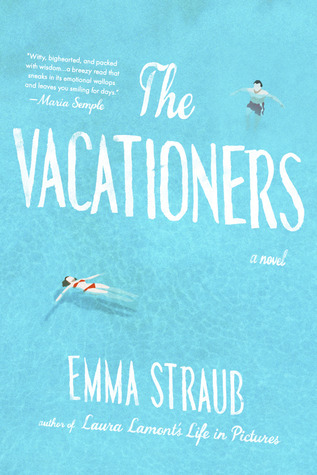
The real wish is, of course, that you had never read it in the first place, but that ship has sailed, to indulge in a cliché for the sake of staying on point with this book’s entire raison d’être. The Vacationers, by Emily Straub, should come printed with a disclaimer at the front that says, Please check the Goodreads reviews before assaying this!
No, I’m not usually this vindictive when reviewing a book I didn’t like, because, I reason, perhaps someone else will like it better. But despite a couple of pre-publication glowing reviews (how much were you paid?), no one does, and people need to know that!
The characters were a group of the most repellently dislikable people I have encountered since trying to read The Casual Vacancy, by J. K. Rowling, which can serve as the perfect example of that book I mentioned in my first sentence—bad enough to make me stop reading by Chapter 4. Unfortunately, these people had enough of an initial tinge of normalcy that I was bamboozled into believing that this story could go somewhere and be something, so I kept reading, wondering when that might happen, only to arrive at the end and say, “What? What?” As a reviewer on Goodreads who is rendered even more bitter than I observed,
“I kept reading in the hopes that
someone would drown.”
—Meghan
So, you’re wondering, what is so terrible? It’s kind of hard to explain. The Vacationers is basically a book about a family who go on vacation together in Mallorca. There are the parents, New Yorkers Franny and Jim, who are having a crisis in their relationship that happened after the reservations were made, so they decide to go through with the vacation anyway; there are the children, 28-year-old Bobby (lives in Florida, sells real estate with a sideline in health supplements) and 18-year-old Sylvia (about to leave for college, desperate to lose her virginity); there is Bobby’s cougar girlfriend, Carmen (who everyone resolutely dislikes); and there is the best friend of Franny, gay Charles, and his husband, Lawrence (hoping to adopt a baby), all brought together in a beautiful house in the hills for a two-week sojourn. The potential family dynamics could, and should have, proved interesting, but…they didn’t. All the things under scrutiny mostly happened or have at least been substantially foreshadowed before the trip began, which causes tension and a lot of talking. Let me amend that: whining, over-dramatizing, obsessive dwelling on he-said she-said I should’ve you could’ve why didn’t you, if only? “White people problems!” should be printed on the cover as one of those shorthand blurbs offered up by other authors to help out their friend’s book sales. There is a load of privilege, entitlement, and snobbery accompanied by a faint whiff of racism, a bit of misogyny and, as some reviewers noted, the reader keeps wondering if this is a send-up but concludes that unfortunately,
it is not.
I’m not going to dwell on everything that was wrong with this “slice of life” disaster (Definition: “A storytelling technique that presents a seemingly arbitrary sample of a character’s life, which often lacks a coherent plot, conflict, or ending”) except to give a small spoiler by way of illustration: When girlfriend Carmen walks out on the vacation (and on Bobby) and makes her own way back home rather than stay and be subjected to any more of this, I should have followed her out the door. But that unfortunately happens too late in the story to have made a significant difference.
I gave it one star on Goodreads. I wavered around two, simply for the descriptions of the locale and the food, but no. Those were merely unfairly employed lures to keep me reading.
Discover more from The Book Adept
Subscribe to get the latest posts sent to your email.

 The Book Adept