Prescience
I have always been confused by how this word is pronounced; the syllables divide up as pre•science, but according to the dictionary, you pronounce it PRESH•ens. Before I looked it up the first time, I was pronouncing it “pre-science,” because the definition is “the fact of knowing something before it takes place,” so it made sense to me that it would be pre-, or before, science, because that would mean it was something known “before the fact.” In other words, a prediction, which is another weird word (previous to speaking it?). The English language is wild and wonderful.
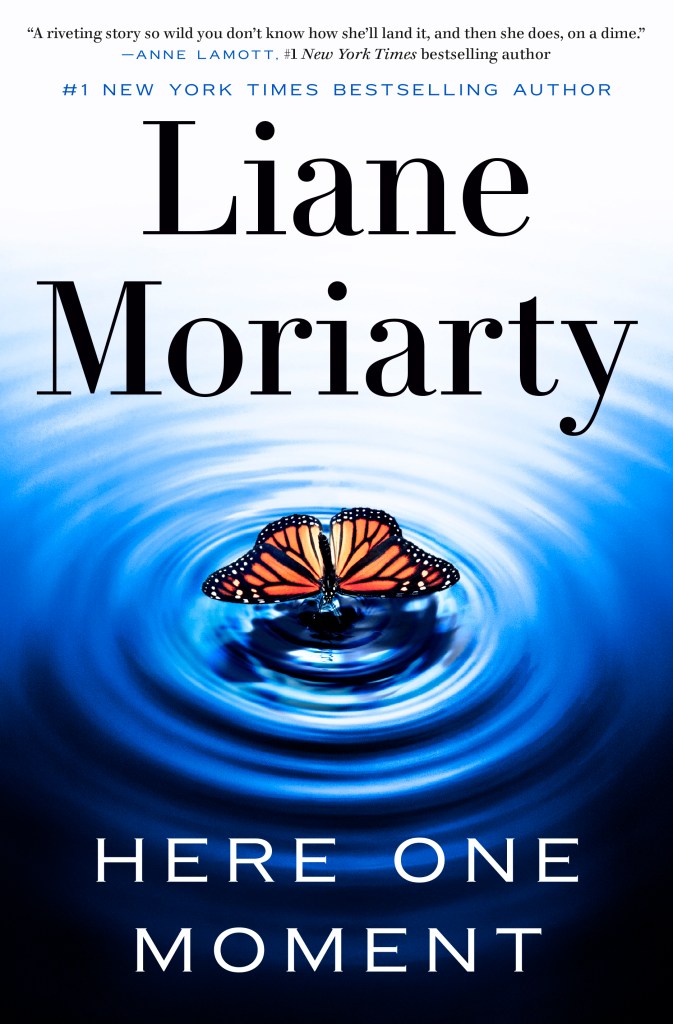
Anyway, I thought it was an appropriate title for a review of Liane Moriarty’s most recent book, Here One Moment. A bunch of people get on a plane—parents, children, young people, middle-aged, elderly, all caught up in their own plans—and among them is an unremarkable older lady who rises to her feet during the long delay before takeoff and, pointing her finger at each passenger, methodically predicts their deaths (age and cause). Some laugh as if it’s a good joke (mostly those whose prediction is for 96 or 103, of old age), while others panic as she details disease, accident, or violence at a young age or in the immediate future. When the short flight is over and they all disembark, the incident is put out of the minds of most, whether it’s skeptically, uneasily, or forcefully, but when the first passenger dies exactly as the “Death Lady” predicted, the rest are no longer so dismissive.
After the events of the flight, the story jumps between multiple story-lines detailing the lives and reactions of half a dozen passengers, interspersed with chapters from the lady’s life, and we wait to see whether she is a delusional fraud or a true clairvoyant, worrying right along with those passengers with imminent and uncertain ends as they pretend normalcy, choose avoidance, or change their lives to avoid their fate.
The question for the reader is, of course, if you knew your death date, would you do anything differently? Would you try to defy fate, manipulate the statistical likelihoods, shift your timeline? The germane quote Moriarty used in the book was from Elisabeth Kubler-Ross:
“It is only when we truly know and understand that we have a limited time on Earth and that we have no way of knowing when our time is up that we begin to live each day to the fullest, as if it were the only one we had.”
I enjoyed the exploration of the Butterfly Effect idea and, of course, drew parallels with that movie and also with Final Destination. It’s also been compared with The Measure, by Nikki Erlick, which I have not read (except for the Goodreads summary). This book dragged a bit during the detailing of Cherry Lockwood’s life (the lady with the pointing finger), but suspense was maintained in the sections about each person who was dealing with the prospect of an imminent demise, of causes mostly not under their control. So although the book seemed to take me an inordinate amount of time to get through, I would recommend it for those who find this question philosophically intriguing. Not my favorite book of Moriarty’s, but also not my least favorite!
Discover more from The Book Adept
Subscribe to get the latest posts sent to your email.

 The Book Adept