Meant to be
I don’t in general believe that anything is “meant to be.” But if anything could convince a cynic that there is such a thing as destiny, it would be one of Jenny Colgan’s novels. Close Knit was particularly illustrative of that theme, in that it was perhaps a little more transparent than its author might have intended in telescoping the story. I pretty much knew who the protagonist would end up with from about the third chapter (despite various rather transparent red herrings), and spent the rest of the book waiting for her to figure it out for herself and/or for the author to put her and her intended in the right kind of meet-cute circumstances to make it happen.
I didn’t know that there is a book—The Summer Skies—that precedes this one and stars another main character (the pilot) as its protagonist. But this read perfectly well as a stand-alone, and now I can go back and enjoy that one too.
As is usual with Colgan’s books, the beautiful, bare, wind-swept islands of northern Scotland are as much a character as anybody else in the book, and reading her lyrical descriptions almost persuades me that I would love to live in a locale that is fairly constantly beset by frigid winds, in almost total darkness during the winter and perpetual light in summer due to its place far above the equator. Likewise, the people with whom she populates the small towns and villages of the islands are in equal parts ordinary and distinctive, most of them sounding like the perfect neighbors and friends, with a curmudgeon or a crank thrown in here and there for ballast.
Authors should have to vet the copy written to describe their books on Goodreads (or does it come from the publisher? if so, shame on them!), because there were many inaccuracies in the details of this one. First of all, it’s described as a summer novel, which I suppose you could marginally support, since some of the action takes place in May; but in a clime where May can bring rain, hail, or even snow, it’s not exactly a typical summer vacay beach read! Second, the main character is described as having many friends, but the truth is, everyone in her knitting club is her mother’s age (or older), and Gertie is more their pet project than their contemporary. She is actually rather isolated, being a shy, dreamy “girl” of 30 who has no girlfriends or dates her own age. Third, when Gertie decides to take on a new job, it’s described as air stewardess on a small plane, but in fact her actual primary task is to run the desk at the tiny terminal, checking in the passengers and their belongings and making sure everything goes smoothly in the run-up to each flight. She is required to go up in the plane in order to understand aspects of her job and to occasionally serve as crew, but that’s a much less important function.
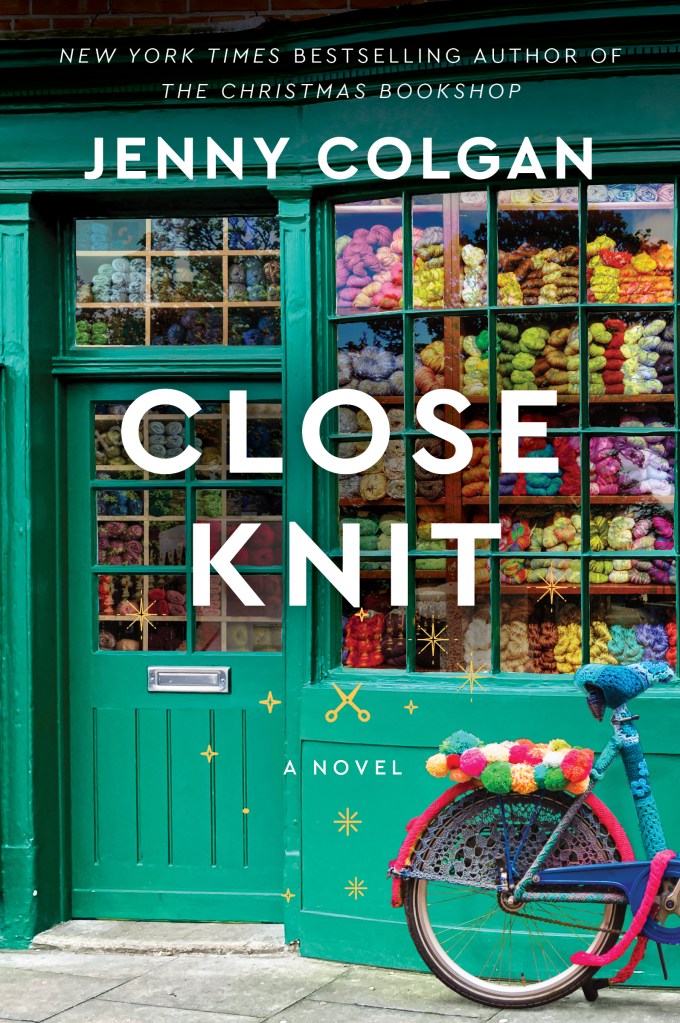
A final pet peeve is the cover design: While there is a knit shop in the village similar to the one depicted on the cover, the women of the knitting club have a persistent feud with its owner and, in fact, hardly frequent it, so to give it pride of place as the cover design is as bad as the stationary bookstore on a street corner that appears on one of Colgan’s other books about a mobile bookmobile that travels around an island supplying reading wherever it goes.
The story line that propels the action of Close Knit is that Gertie has somehow let her life slip through her fingers. She lives at home with her mother and grandmother, and her friends are their knitting club ladies, so she has no significant men in her life. She got a job 10 years ago at the local market and somehow the time has passed her by while she unloaded groceries, dusted shelves, and worked the till. Her only real entertainment is knitting beautiful scarves, socks, and hats, and the only place she experiences excitement is in her romance novel-driven dreams. Then she’s given the opportunity to switch jobs, which she does partly because there is a handsome and charismatic airline owner whose planes and helicopters use the terminal and she thinks this might be an opportunity to get to know him. But fate has something different in mind for Gertie…
Even knowing what would probably happen, I thoroughly enjoyed going through the process, as one enjoys a cup of cocoa and some warm slippers at the end of a long, cold afternoon. That’s probably more than half the appeal of a Colgan novel—the tactile and culinary descriptions set in the perfect atmosphere in which to enjoy them. The designation “cozy” was meant for her books.
Discover more from The Book Adept
Subscribe to get the latest posts sent to your email.

 The Book Adept