The Empyrean “trilogy”
This series by Rebecca Yarros has been hyped a lot. I usually shy away from that, because I have discovered it’s more often than not the kiss of death to my enjoyment. But…dragons. I love dragons. I read all of Anne McCaffrey’s Pern books at least three times. I adore the dragons of Patricia Wrede, Bruce Coville, Diana Wynne Jones, and Angie Sage, and also those in Tolkien’s The Hobbit and Farmer Giles of Ham. I put up with Jane Yolen for the sake of dragons. Dragons gave added value in Ursula LeGuin’s Earthsea books and in the various trilogies by Robin Hobb. One of my favorite series is The Last Dragonslayer and sequels, by Jasper Fforde. I was intrigued by Rachel Hartman’s dragon/human shapeshifters in Seraphina and Shadow Scale. Robin McKinley’s Damar books use dragons as more of an excuse for a story than as a major plot element, but I still loved them. So. I was perhaps predestined to read these.


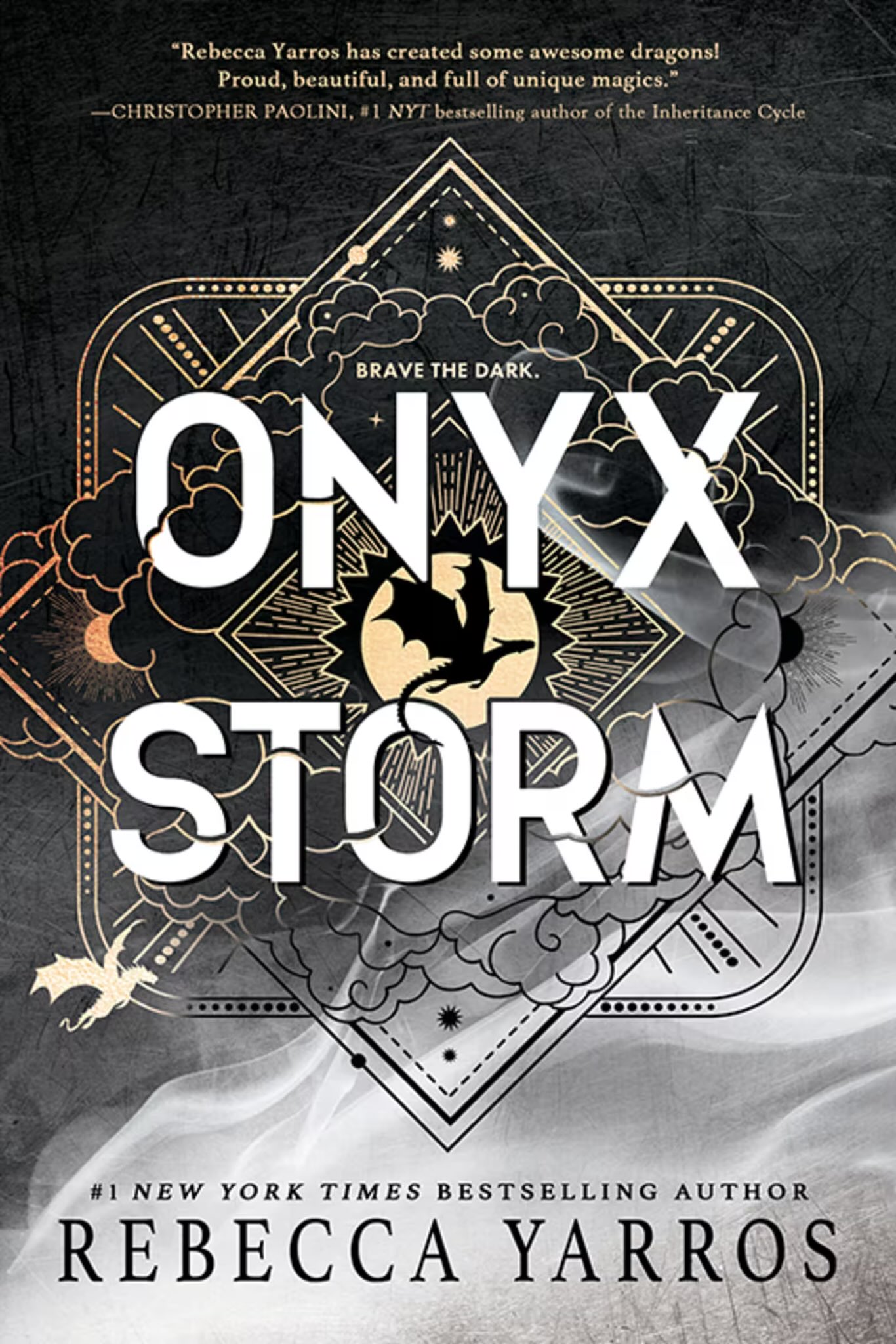
I will say that I was not initially disappointed by the dragons themselves. They are pretty cool, and the two we get to know more intimately through their association with main character Violet Sorrengail (Tairn and Andarna) have real personality. But there was much less thought put into all the rest of the dragons who appear in the books and, aside from their names being linked as a bonded pair with various characters, they were sadly both interchangeable and underutilized.
As for everything else, well, let’s break it down:
The writing was somewhat pedestrian—way too much exposition, language that was overly ornate but never coming to the point, and modern anachronisms (“for the win” and “shit’s about to get real” are the biggies that come to mind) that took me right out of the fantasy illusion. Sentence structure was awkward. (One reviewer actually counted and said “Yarros used 493 ellipses and 1,089 em-dashes in the 634 pages of Iron Flame.”) Both the meandering plots and the effusive, exclamatory style made me wonder how much power the editor was given over the content of these books (and why it likewise went underutilized).
The character building was good in the first half of the first book, and then disintegrated with each subsequent encounter. The protagonists, Violet and Xaden, had great potential, but knowledge of them stays on a shallow level because the author keeps describing them over and over without adding anything new, and the encounters between them are equally as repetitive. Both the heroism and the villainy become boring, because there’s little depth or explanation. And we might as well go on here to talk about the “romance” between the main characters, because this was an element that made them work even less for me. The first (explicit) physical encounter between them felt hot and daring, but by the time I got through the third book I was cringing and skipping the sex scenes because they were unoriginal replays both physically and verbally.
The secondary characters (Violet’s squad and siblings, the rebels closest to Xaden) had individual quirks that made them lovable or frustrating or inspiring or whatever, but I was disappointed that there was so little growth beyond the naming of that one element that characterized each of them. Much like the dragons, their characters and camaraderie could have been so much more of a feature, had the author cared more, but they were essentially one-dimensional.
The world-building was sloppy. It seemed like the only time it happened was when it was bolstering some plot point, so it became wearisome, for instance, to find out brand-new information well into the second or even third book simply because it was necessary to further the story. The fact that magic dwells only on the main continent, protected by wards, but there are whole archipelagos of islands without it, or that dragons are companions to the people in the warded lands but hated, feared, and targeted by the others would have been enlightening to know halfway through book one, not two-thirds of the way through book two (or later). And as for what magical abilities everybody has, it definitely felt like Yarros was making that up as she went along and needed a Hail Mary to get her out of the situation into which she had written herself. Everything we learned seemed less like a planned surprise and more like a decision in the moment as the author thought of some way to turn the story—oh, did I forget to mention this? Well, let me explain it here for you and then we can move on.
I will also say that since I am not a big fan of romance, maybe “romantasy” wasn’t as appealing to me as it might be to some; but I don’t think that’s really the problem. The problem is the endless, repetitive nature of the supposedly romantic encounters, which is a euphemism for the fact that every time the two protagonists saw each other, it was immediately sexual. Some non-fraught conversation would have been nice. Some peeks into childhood, some sharing of philosophy, a picnic, a book recommendation? Something.
Fourth Wing was good, despite some of these deficits, because we were discovering brand-new information—the challenges of getting into and surviving battle school, the intricacies of bonding with dragons, learning how to navigate the politics of both school and kingdom. It was interesting to learn that Violet had planned and thought she was destined to be a Scholar but was forced, despite her physical frailties (readers said the description of these sounded like she had Ehlers-Danlos Syndrome) and small stature, to choose to be a dragon-riding warrior because her mother was a big-deal commander and wanted all her children to choose that path. The details about Xaden and the other tattoo-marked riders being the children of rebels, basically conscripted into the dragon army to atone for the sins of their (deceased, executed) parents were intriguing. And the physical and mental obstacles Yarros sets up to test the potential riders to prove they could do the job were exciting.
But after the first shocks of a new environment, a new protocol, a forbidden love, the rest seems disappointingly like nothing but reiteration, filler, and false obstacles created to provide constant peaks and valleys in the relationships and the plot without ever taking us much of anywhere new. So (for instance) every time Xaden appears on the page, Violet has to lustfully re-react to his physique, his tattoos, his smoldering expression, his shadow-wielding. Every action or battle scene exists so that brave, impulsive but fragile Violet can be in peril or injured and Xaden can magically turn up to save her, scold her, and have his way with her (after the healers put her back together). And both the action and the storyline depend way too heavily on the life stories of just these two characters. It makes a dull read out of what could have had more significance and nuance.

My biggest beef, however, is that I was ignorant of what was apparently some fairly recent news. This was billed as a trilogy and I was, frankly, delighted to hear that. I wanted to read a series that had a beginning, a middle, and an end within a limited framework. So many fantasies just keep going until they exhaust either their author or their readers, but I thought I had discovered a tale that would be neatly told in three admittedly long but finite books. Nope. I kept reading book #3, at first thinking I should surely be farther along than 37 percent because what was left to say? and then thinking oh, there has to be at least 20 percent more to go because this doesn’t feel anywhere close to wrapping up, and then turning a page to discover, uh-oh, it’s over; WHAT?! I reread the ending of Onyx Storm three times and could make no sense out of it, only to discover (in a footnote on Goodreads on Yarros’s author page) that the rather cryptic close of that book was intentional because…dum dum DUM…there are two more books slated to be published. And after struggling through all the sturm und drang of book three without getting resolution of the central issue in a whopping 527 pages, I was, frankly, pissed off. I think I am done with Rebecca Yarros, despite the dragons. And that’s a big, big deal. Phooey.
Discover more from The Book Adept
Subscribe to get the latest posts sent to your email.

 The Book Adept