Beyond Cerulean
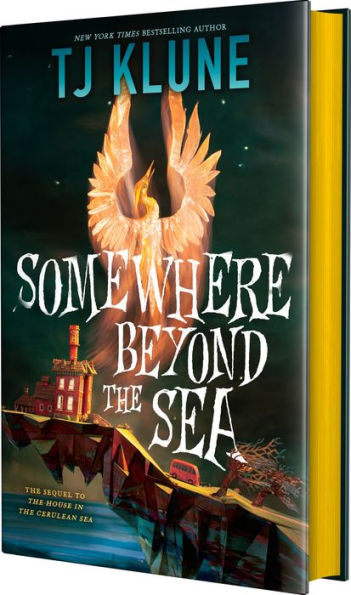
Just as I began my review of the first book (The House in the Cerulean Sea) with the words
“I had high hopes that I would love this book,” I hoped to wrap up my review of this one, its sequel, with the same conclusion I drew then—”This book was an unalloyed delight from start to finish.” Alas, I can’t quite say that.
Many of the same delights were present, the chief of them being the wonderful characters. A big pleasure of this book was to see how the children of the Marsyas Island “orphanage” have grown and come into their own under the positive attention of Arthur Parnassus and his partner, Linus Baker. My favorite parts of the narrative were the insights and revelations from Sal, Phee, Chauncey, Talia, Lucy, and Theodore, and the fresh perspective from David, the yeti child new to the family. The interactions, in particular, between David and the other children were such lovely models of how to bring someone into your orbit and make them feel wanted.
I also initially liked the political nature of the tale—the defiance of those in power when they try to use fear to silence and censor outliers. The opening—in which Arthur Parnassus testifies in public to the committee overseeing DICOMY and DICOMA about the abuse he suffered as a child at the hands of the department supposedly detailed to protect him—was a dramatic kickoff to the book-long campaign setting Arthur and Linus and their little band of hopefuls against the gaslighting of a self-serving, unaccountable government. The book is obviously meant to encourage people who have been “othered”—LGBTQ, as well as those who are racially and ethnically diverse—to stand up in solidarity and resist oppression and marginalization. The continuing revelations about the treatment of the magical community hark back to indigenous colonization and even genocide, and the story is also plainly intended to enlist “the rest of us” to stand with the othered, as Klune illustrates with his conversion of the townspeople of Marsyas into allies and supporters.
There are some dramatic moments that live up to this goal. I found it quite arresting when there was suddenly a realization by Arthur that rather than constantly fighting, he can just refuse outright to play the game. Instead of either resisting or buying into the government constraints, he has the ability simply to refuse to acknowledge their authority. It was a textbook lesson in how to leave someone flatfooted—stop collaborating with them in their appropriated self-importance.
But there are also a number of events that are so preachily on the nose (and in some cases either patently ridiculous or hail-mary impossible) that they actively take away from the message. I feel like those were a direct result of the “elephant in the room,” who appears by name in the acknowledgments but is caricatured and parodied in the book in the person of Jeanine Rowder, villainous government official. The choice Klune made to take on the anti-trans author J. K. Rowling by writing her into his book as the villain is the moment at which he lost the plot for me. The book morphed into a vehicle to scapegoat and belittle, on a too-personal level. Am I saying she doesn’t deserve pushback for her targeting of people who do her no harm? No. But there are many more egregiously hateful people in this world on whom a book villain might have been modeled, and perhaps the story wouldn’t have become so pointedly petty in the process. It felt like the set-up of a straw man to symbolically knock down. I wanted more nuance.
I still enjoyed most of the book. But the turn things took did make me sit back and wonder: Was there sufficient purpose to this sequel? Or did the personal agenda derail it from being what Klune intended? I’m honestly not sure.
I am also not fond of a deus ex machina-type resolution, so…there’s that.
My final conclusion is that I don’t regret reading the book, and would encourage others to do so—with the caveat that they take from it the intended message, the parts that are true heirs to the sentiments of the first one. Is that good advice? I don’t know. You’ll have to take your chances and come back to me on that.
Discover more from The Book Adept
Subscribe to get the latest posts sent to your email.

 The Book Adept