Perfect stone fruit
Halfway through my reading of The Mare, my checkout period at the library ran out, and I couldn’t get the e-book back on my Kindle for about a week, so I took a break and read something else. I think reading The Mare may have provoked a subconscious connection to this book, which is also a coming-of-age story with a narrator on the cusp between child and teenager, but at a time when a “teenager” wasn’t what it is today. It is a book I have read before, but not for about 30 years, so the story has its place in my memory but has softened and faded to the point where I could experience it fresh.

The Greengage Summer, written by Rumer Godden in 1958, is the story of a mother with five children who, at the end of her rope one summer, impulsively decides to pack them all up and take them to France—not as a reward, but to show them the battlefields and mass graveyards there in the hope that they will all become less obnoxious and selfish! There is a father, but he is a botanist who travels extensively for his work, leaving his family behind in Southstone, a provincial English village in which they live a thoroughly mundane existence under the watchful if stodgy eye of their Uncle William. They are not a well-to-do family; they wear uniforms to school and the rest of the time mostly hand-me-downs from their next eldest sibling, and their weekly pocket money is counted out in pence, not pounds. The children range widely in age: Joss is 16, Cecil 13, Hester 10, Willmouse (the only boy) is eight, and Vicky is five.
The family takes a long and exhausting train trip down to the Vallée de la Marne, in the Champagne district of France, their destination the Hôtel les Oeillets, a small pension in the countryside. But during the journey, the mother is bitten on the leg by a horsefly, and by the time they arrive she is so ill that she must be hospitalized with blood poisoning. The patronesse, Mademoiselle Zizi, is inclined to cut the children loose (despite their being unsupervised with nowhere to go), but Elliot, an English guest at the hotel, is prevailed upon by the mother to keep an eye on her family until she returns from hospital, so the five move in and start their holiday in France under his casual supervision.
None of them save Cecil speaks any French (Cecil had to learn endless French poems by heart as punishment for poor schoolwork, and it stuck with her), and all of them approach the holiday on their own terms. The book is narrated by Cecil, with insights provided both from her own observations and from the experiences of her siblings. Cecil is sitting squarely at that transition point between child and adult during this summer, while her sister Joss has suddenly crossed over to that place held by beautiful young girls in the first flush of their power as women. The others, known to the family as “the littles,” also go through some changes, as they all encounter their first introduction to an adult world in a different culture, untrammeled by the careful routines of their normal lives.
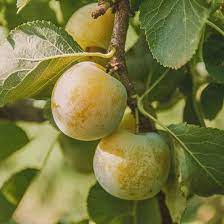
The name, The Greengage Summer, comes from the fruit orchard that is part of the grounds of the hotel, where greengage plums are ripening on the trees and plopping to the ground, begging to be consumed by the children who laze under their shade in the long afternoons by the river Marne. And like the fruit, the summer is filled for the children with flavor and sweetness that surrounds some hard stones or truths at the core.
There is more to the story—undercurrents, background information, and a mystery in which both the residents and the guests become caught up—but I don’t want to give away too much, because the book is a delight to read and I am happy to have rediscovered it, for myself and for those who read my reviews and might pick it up based on this introduction. In addition to story, there is a specific rhythm and artfulness in the way Godden tells a tale that makes me happily revisit most of her books, and this is one of my top five (out of the 60 she wrote). It’s also a great read to choose for the hot, languid month of August.
The characterizations of everyone involved—the children, the hotel employees, the guests—are wonderful, diverse and memorable, and the mood she creates of this leisurely sun-filled holiday fraught with dark undercurrents is engaging in the best way. It may be that switching over to this book halfway through my reading of The Mare is what gave me a certain dislike for and disappointment in that story, because The Greengage Summer has everything I love in a perfectly realized arc, right down to the last line of the novel.
Discover more from The Book Adept
Subscribe to get the latest posts sent to your email.

 The Book Adept