Diana Wynne Jones
I have spent a lot of quality reading time with the novels of Diana Wynne Jones. Although she writes mostly for middle-schoolers, there are also a handful of books that, while ostensibly for the younger set, have content possibly more suited to the adult fantasy reader. My favorite of hers is Howl’s Moving Castle, which is definitely one of those that appeals to a wide range of ages; I also enjoyed its two sequels, which are not up to the first one but are nonetheless good. And I will argue with devotees of Miyazaki that if you have only seen the animated movie made about Howl, you have not experienced Wynne Jones’s version; while the film is a truly delightful visual expression, it doesn’t begin to offer the nuance of the book itself. The other series of hers I have read and enjoyed is the Chrestomanci Chronicles, which are near-perfect fantasies for middle-schoolers. I have not read Dark Lord of Derkholm, but will no doubt get to it one of these days, as I will the Dalemark Quartet.
Her stories often combine magic with science fiction, bringing in fairy tales, heroic legends, parallel universes, and a sharp sense of humor that sometimes verges on satire or parody. There are levels to her books that are the key to making them enjoyable to a wide age range; young children can read them for surface enjoyment while older teens and adults get the jokes.
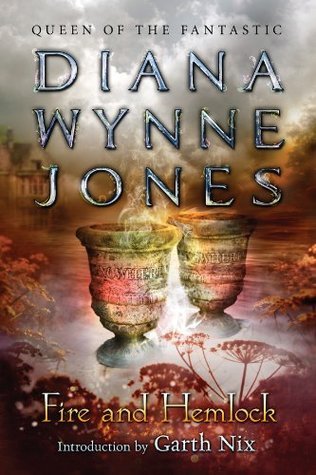
This past week I discovered that she also has some free-standing novels, and picked up Fire and Hemlock, which had an intriguing story line for which, in hindsight, I should have been better prepared.
The book owes its structure and character line-up to the ballad of Tam Lin, which dates from 1500s Scotland, and also to the story of Thomas the Rhymer, an actual Scots laird who lived from 1220 to 1298 whose story is confusingly similar to that of Tam Lin (both of them were kidnapped by the Queen of Elfland, although their destinies diverge after that initial act). I was embarrassingly unfamiliar with either of those legends going into reading this novel, and should have stopped the minute things got complicated and consulted Wikipedia for the synopses I finally ended up reading after I was done! Take heed of my experience and do that before you read this book if you want it to make sense. There are also echoes of both Hero and Leander and Cupid and Psyche, with echoes of T. S. Eliot. Diana Wynne Jones has written an explanation of her thoughts about the heroic that was included with my Kindle copy of the book, though it doesn’t appear except in later printed editions.
In the book, Polly Whittaker, 19, suddenly realizes that she has a set of double memories that began at the age of 10, which some entity is trying to make her forget. In the mundane set, she has been living an ordinary life: school, books, athletics, friends, irresponsible and uncaring parents, a loving but acerbic grandmother, and a boyfriend she’s not sure she wants. In the fantastical one, many of her actions are dictated by her sporadic but compelling friendship with a man she meets at a funeral, with whom she has an odd affinity. They experience some strange, inexplicable adventures together—are they truly magical?—but their friendship is threatened by menacing characters and events from which Tom Lynn attempts to shield Polly. She finally figures out what’s happening when it’s almost too late, and takes drastic action to secure both the memories and the relationship.
The book is such an odd mix of juvenile and adult that it was hard to read at some points, because it fluctuates between the mind of a young, naive girl and the definitely adult legend of a man in thrall to a wicked force that wishes to control his life. The narrative is carried by Polly, so we see everything through her clever and imaginative but innocent eyes, and if you are reading the book without knowledge of the backstory, it can be both frustrating and confusing, as well as long. I ended up liking it pretty well, and it’s probably Wynn Jones’s most ambitious plot in terms of the multiplicity of strands she introduces, but I was definitely happier with the straightforward, more mature, and somewhat humorous world of Howl’s Moving Castle.
Discover more from The Book Adept
Subscribe to get the latest posts sent to your email.

 The Book Adept