Culture war
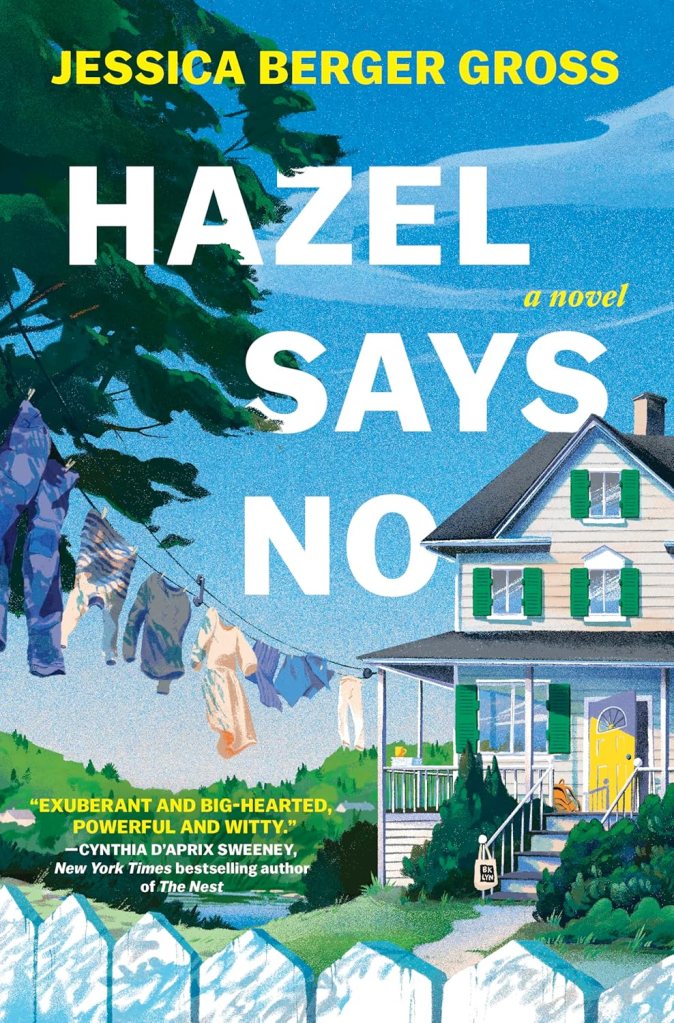
In Hazel Says No, by debut novelist Jessica Berber Gross, we explore the intricacies of the MeToo movement and the consequences of cancel culture in a small town in Maine. This author is being hailed by many as a new voice in feminist contemporary fiction, but for me it was an interesting exercise that didn’t quite make the transition to a leap-off-the-page story. There were fascinating nuances that explored areas I think no one considers, and for that I appreciated it, but the story dragged out far beyond the original dilemma and became less impactful as it did so.
The basic premise also had me wondering, Would this really happen at this moment in time?
The Greenberg-Blums, a Jewish family from Brooklyn, move to a small town in Maine after the father, Gus, receives an attractive job offer from a college there. His daughter, Hazel, is 18 and will start her senior year in high school in the fall, and his son, Wolf, is going into middle school. They move at the beginning of summer, and the kids spend most of it at the public pool, where Hazel encounters the high school principal, Richard White, there to supervise his daughter, Gracie, a future classmate of Wolf’s. He strikes up a conversation with her after noticing that she is reading a variety of fairly high-level literary novels while basking on her lounge chair, and suggests that perhaps Hazel should consider initiating a reading or writing club when she starts school in the fall. Their encounters are friendly but strictly surface, confined to a casual greeting or comments about reading and classes.
On the first day of school, a voice over the P.A. system calls Hazel Blum to the principal’s office. When she arrives, the principal chats with her for a few minutes, then sits down beside her, puts his hand on her knee, and informs her that each year he chooses one student with whom he will have sex during the year, and this year he has chosen Hazel. Her mind whirling with all the responses to this unbelievable statement, Hazel finally blurts out “NO!” and runs out of his office.
The rest of the story involves what happens when Hazel tells her parents, they confide in the college dean (a feminist studies scholar), and from there the news becomes public.
The first thing that hit me about this set-up was, Who in their right mind, in the aftermath of the immense blow-up of MeToo in the media, would actually do this? Smith not only propositions Hazel, but also explains that he has done this repeatedly in the past; although he has apparently gotten away with it up until now, does he really think that, after the profound cultural shift that came about as a result of the “outing” of sexual predators in powerful positions, his behavior could continue to go unremarked? Or that, once acknowledged, there would be no repercussions? Part of the MeToo phenomenon was the public scrutiny and accountability it promoted, paired with support for the survivors of sexual harassment and violence. For that reason, I was unable to overcome my disbelief that anyone would so blithely and transparently risk exposure by trying this on.
The parts of the book that I did like were how everything played out to conclusions that were not always expected. For instance, it explored the insular nature of a small town unable and unwilling to believe this accusation of a beloved public figure and how, for some, it provided an outlet for bigotry as they not only slut-shamed Hazel but also targeted her family because they were outsiders. It took into account the effects on Hazel and her family, but it also explored the consequences of being the wife and young daughter of the sexual predator. And, as Hazel’s story goes wide, we were also privy to how a story like this is taken up by the media in ways that go far beyond the initial scandal to perhaps exploit the situation to enhance their own agendas.
On a separate note, there is a scene in the book that was reminiscent of something that happened to me when I was a professor of library science teaching Young Adult Literature. The father, Gus, is an American Studies professor who teaches a class that considers the historical evolution of the family on television, as a microcosm of the larger culture. In his first class lecture he begins with Leave It to Beaver, the picture of 1950s traditionalism, then transitions through a few other sitcoms to All in the Family, with Archie Bunker’s misogyny and racism battling against his daughter and son-in-law’s wider sensibilities. After this, he moves to The Cosby Show as an example of the shift in the way black people are portrayed on television, featuring a family in which the father is a doctor, the mother a lawyer, and the children are benefiting from a lifestyle not previously seen on TV as part of the black experience. But although the show was a legitimate historical landmark, the minute he mentions the show in his class, certain of his students are outraged that he would dare to represent Bill Cosby in any way except as the outed serial predator we all later discovered him to be. Dr. Blum attempts to explain that the show, which aired from 1984 to 1992, could be looked at separately from the later discoveries about its star, but his students are unwilling to consider Cosby in any context, and several of them promptly start a petition to “Fire Gus Blum” that goes college-wide and then begins to attract attention that threatens his position.
In my YA Lit class, several students took issue with the fact that the first few weeks’ reading list consisted of books by and about white people. They demanded that I feature books by and about people of color, people of different socioeconomic status, and so on. I explained that since the first few weeks were dedicated to the history of young adult literature, which began to be considered a separate segment of fiction early in the 20th century, the assignments were consistent with the books that were being published at the time, which were written for white teens and did not begin to include people of color or LGBTQ+ as characters or talk about real-life issues until the 1960s.
I did however (like the father/professor in Hazel Says No) take a good, hard look at my syllabus and came to the conclusion that while i stood by my decision to represent those historically significant books, I could have done a better job with diversity when it came to updating my selections for the rest of the quarter, so I revised the choices by adding or substituting more inclusive works, both as regards authors and characters/stories. I also allowed the students themselves to suggest and select alternative books to read, if they found one that spoke to them. But, as happened in this novel, a certain small number absolutely refused to give up their first conclusions about me as an old white woman who was, at best, tone-deaf, and at worst, discriminatory and offensive. They felt free to gossip about me with each other, complain about me to my supervisor, and malign me in written comments that affected my livelihood.
The incident in this book that was reminiscent of my own experience of feeling canceled made me consider so many issues that are confronting our culture, and wonder how they will ultimately be resolved. On the political front right now, the current regime is intent on hurting people: They are whitewashing the past by removing historical websites about slavery, refusing to provide healthcare to women and others who don’t strictly conform to their restrictive view of humanity, and considering everyone not exactly made in their image to be “other” and open to attack. But there is also the faction who refuse, for example, to read the book The Adventures of Huckleberry Finn because of its lack of “political correctness,” despite historical context, or the fact that the main character rises above his culture with an epiphany that causes him to choose empathy over “doing the right thing.” (See my review, here.) These are the people who refused to vote for a candidate who represented 90 percent of their views because they disagreed with the other 10 percent, despite the fact that their refusal would plunge us into fascism. My hope for us is that we can manage to keep dialogue open, and calm the extreme pendulum swings so that both reason and empathy may prevail.
At any rate, Hazel Says No is definitely a conversation-starter (with others or in the privacy of your own mind!).
Discover more from The Book Adept
Subscribe to get the latest posts sent to your email.

 The Book Adept