Serendipity
I am wary of books that are described as “heartwarming.” I likewise shy away from anything that has been labeled “meet cute.” But there are occasionally stories about fortuitous occurrences that actually are genuinely charming, and The Lost Ticket, by Freya Sampson, is one of those.

Libby arrives in London from Surrey and gets on the 88 bus on the way to her sister’s house feeling as if she no longer recognizes herself or her life. Her eight-year relationship, her job, and her home have just been jerked out from under her by her “bored” boyfriend, and it’s a sign of how bad things have gotten that she is choosing to go stay with the officious Rebecca in London. But the elderly man next to her on the bus won’t let her sit in miserable silence; Frank instead tells her the story of how he met a girl on this same bus, the 88, back in 1962, with hair just the same beautiful shade of red as Libby’s. They made a date to meet up at the National Gallery, but Frank lost the bus ticket on which the girl had written her telephone number, and never found her again. She made such an impression that for almost 60 years he has continued to ride the 88 line hoping to run into her; in addition to feeling like there was a spark between them, he wants to thank her for saying something to him that changed the entire trajectory of his life.
Libby, sad and at loose ends, is inspired to help Frank find the woman he has sought in vain. She teams up with others in Frank’s life to try everything from online searches to running advertisements and posting flyers, looking for #girlonthe88bus. But Frank has growing dementia, and his daughter wants to put him into a care facility, so time is running out.
The events that spread out from this simple encounter of strangers on a bus illustrate how serendipity can be a blessing in lives that had previously felt fixed and inevitable.
I immediately identified with the characters. I enjoyed the setting. I admired how the book discussed relevant social topics rather than just being “aw, how sweet.” I particularly liked the element of found family, that what we don’t get from our biological relatives can be had by embracing empathetic strangers and turning them into our people. There’s really not much more to note about this lovely book, except to say that it was a real pick-me-up when I needed one, and was not nearly as predictable as I thought it would be when I began reading.
Christmas past
I find myself, on the 18th of December, woefully unprepared to offer up Christmas reads here on the blog. I haven’t exactly been busy, but I also haven’t been much in the holiday mood, so I have read nothing relateable to share. But I did do a search on my own blog, which I encourage you to do as well if you are in need of a festive book to read, and found a bunch of suggestions I featured from Christmases past. Just put “Christmas” in the search box and you will find at least five separate lists.
In case you are too lethargic to do that, here’s one that I mentioned before and will share again—a novella with minimal effort and maximum payoff from one of my favorite authors, sci fi writer Connie Willis. I knew that Willis herself collected Christmas stories, having come across a comprehensive list she made some years ago of all her can’t-miss favorites, but I didn’t know she had written one until a few years ago.
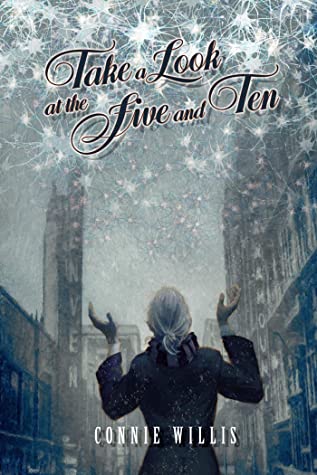
Take a Look at the Five and Ten is pure nostalgia in its subject matter while being scientific in its methodology. It adopts the premise of her book Passage, wherein a neuroscientist is conducting research on a particular aspect of memory. In that book it’s all about dreams, while in this one the topic is the TFBM: Traumatic Flashbulb Moment. A Ph.D. student, Lassiter, is doing a study of people who have experienced one of these; imagine his delight when he meets a new and potentially perfect subject at Christmas dinner with his new girlfriend’s family.
Ori begins dreading each year’s holiday season (Thanksgiving to New Year’s Day) in July. Her one-time stepfather, Dave, never lets go of the people from his past, so even though he’s working on his sixth marriage (his union with Ori’s mom ended when she was eight years old)), he never forgets to include in his celebratory invitations the in-laws he collected along the way, including Ori, Aunt Mildred (the great-aunt of his second wife), and Grandma Elving (the grandmother of his fourth). Dave’s latest bride, Jillian, cooks elaborately awful trendy food, and invites her snotty daughter Sloane, along with Sloane’s current boyfriend and her own stuck-up friends, and they all, with the exception of Grandma Elving, treat Ori as if she is a combination of charity case and the hired help.
Grandma Elving presents her own trying behavior, as she insists on telling the same story each year of how she worked at F. W. Woolworth’s “five and dime” store in downtown Denver one Christmas in the 1950s. Everyone else in the family is fed up to the gills with hearing it, but Sloane’s new boyfriend is fascinated by Grandma’s extraordinary ability to remember each and every vivid detail about her experiences at Woolworth’s, since clarity and consistency of a particular memory are hallmarks of a TFBM. Lassiter invites Grandma to be one of his test subjects, and the two of them elicit assistance from Ori to get Grandma to and from her appointments at the clinic where Lassiter is conducting the experiment. Ori quickly begins to have what she knows are ill-fated feelings for Lassiter as their proximity grows….
This is a cute and humorous Christmas tale reminiscent of the French farce-like quality of Willis’s time-travel book, To Say Nothing of the Dog. It’s short (140 pages), qualifying more as a novella than a full-length book, and you can get it for Kindle too, so if you’re trying to hit your 2025 Goodreads Challenge quota, it’s a quick read that counts. But best of all, it’s an unconventional Christmas story that will give you even more appreciation for Willis’s whimsy and heart.
Starts with “D”
I haven’t been on here for a while because I started reading a trilogy and decided that, since all three books were already published and I could read straight through it, I would wait until I was finished and review the whole thing.
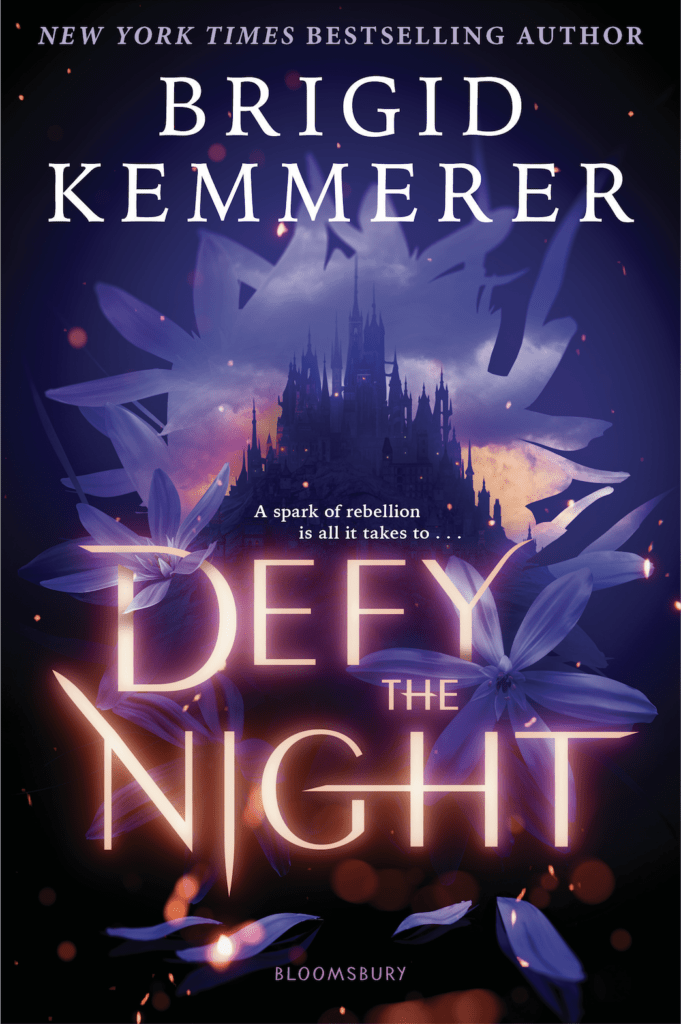
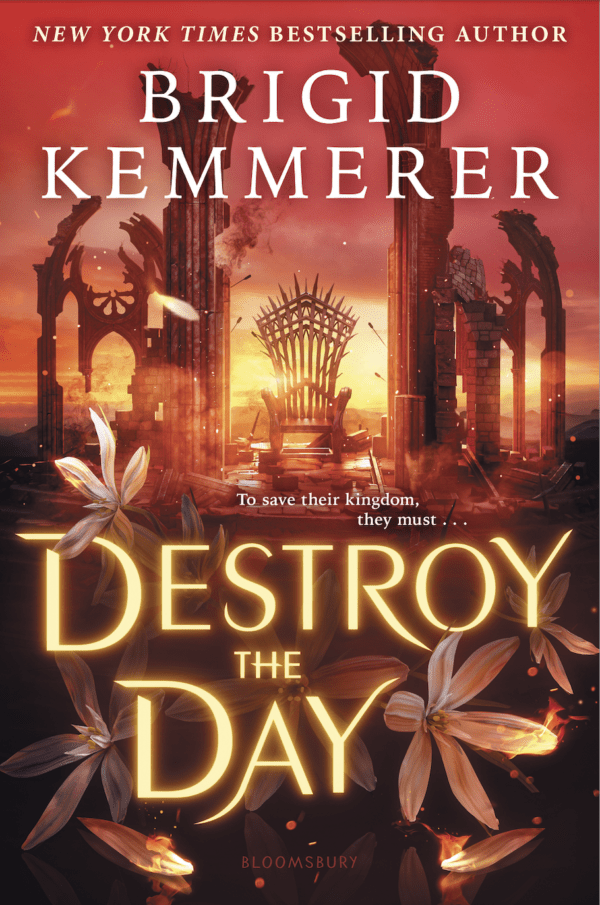
The trilogy is by author Brigid Kemmerer. The books are Defy the Night, Defend the Dawn, and Destroy the Day. I can’t say that I totally get the significance of each book title in context of the overall story, but you have to call them something, right? And alliteration always sticks in the brain…
I first discovered Kemmerer when I noticed her “Elementals” series in the YA stacks at the library, about four brothers with paranormal powers. I wasn’t drawn to those at all, and never read them, but when I read her stand-alone non-fantasy young adult novel Call it What You Want, I was bowled over and immediately followed up with the duology Letters to the Lost and More Than We Can Tell, and then found her other stand-alones.
When she started writing fantasy again, I felt confident to buy these books for my teen readers, but I had a little misgiving, because her first outing in the Cursebreaker series was a retelling of the Beauty and the Beast story. Since I would always prefer an original story to a retold tale, and since B&B is also one of my least favorite fairy tales, I almost regretted it; but I liked her writing enough to give it a chance, and ended up appreciating what she did to make it less sexist and cringeworthy! I never got around to reading any of the sequels, because I concluded that her real strength lies in writing about real teenagers in the throes of their confusing, sometimes difficult lives. But when I noticed this new trilogy and realized she had just finished it, I decided to check it out.

I did enjoy it; but I don’t think it changed my mind about where her true gifts lie, and I’m kind of sorry about that, because it seems she has fully committed to fantasy at this point in her career. Don’t get me wrong: The books are good, with flowing prose, great characters, decent world-building, and an original fantasy story (not a retelling this time). I just like her contemporary teen novels much better.
These are likewise meant for older teens; but that was one of the things I had a little difficulty accepting. The main characters, including the king and his brother the king’s justice (think enforcer) are all supposedly under 20 years old and, given that they have been ruling the kingdom of Kandala with an iron hand since they were 18 and 15, believability was strained. When in the third book the younger brother (Corrick) turns 19, I immediately thought yeah, no way. The story would have been much more realistic had the characters started out in their early 20s, but I guess that would disqualify the books for YA publication?
This trilogy is filled with political intrigue and drama. The basic plot is this: Harristan and Corrick’s parents are assassinated by one of the kingdom’s consuls, and Harristan becomes king of Kandala at the tender age of 17. Shortly after the brothers find themselves thrust into power, a devastating illness begins to spread throughout the kingdom. There is a remedy, a flower that grows in just two of the districts of Karala, each ruled by a consul, but the availability of the elixir made from Moonflowers is limited and the consuls who control its source are holding the kingdom hostage by doling it out selectively and at a high price. There isn’t enough to keep the common people from sickening and dying, and rebellion seems imminent.
Prince Corrick, frustrated by his role as King Harristan’s enforcer of the strict laws against smugglers and illegal traders of the blossoms, sneaks out at night to meet up with commoner Tessa, a young apothecary whose parents died trying to help their neighbors. He masquerades as Weston Lark, a young revolutionary, and the two bring doses of the elixir Tessa brews from the petals they are supposedly stealing from the palace to the folk living in the Wilds, but it’s never enough. Events take a turn that cause Tessa to try to sneak into the palace to confront the king, but her intentions in taking this step are changed when she discovers that nothing is as she expected when it comes to Harristan and his brother.
There are several big twists and surprises starting in the first book and continuing in the other two. In the second, some of the characters respond to an offer of help (and trade) from the neighboring kingdom of Ostriary and agree to go there to research the possibilities, leaving King Harristan to try to fix his dangerously divided kingdom, and the third book wraps all of it up and brings everyone back together. I don’t want to say more than that about any of it, because if you plan to read it you will need to experience it as you go, but it’s sometimes great, mostly good, and also has its occasional dull moments or weird segues like most fantasies do. There are a few things that frustrated me because they either suffered from inadequate explication or remained completely a mystery; but over all, a worthy effort. Kemmerer’s lively and interesting characters are, as always, her strong suit.
Public, secret lives

I finally got around to reading The Seven Husbands of Evelyn Hugo, by Taylor Jenkins Reid. Although she has written some other well-received books (Daisy Jones and The Six, Carrie Soto Is Back), this was the first of hers I have read. I’m always a bit skeptical about reading “popular” books, because I have been let down so many times by the promise created by all the hoopla, but I have to say that this one actually surpassed my expectations.
For those who have managed to avoid the book clubbers’ raves and have remained oblivious to this book, the basic outline is this: Evelyn Hugo is a Hollywood icon in her late 70s—retired, wealthy, and reclusive—who made it out of Hell’s Kitchen in the 1950s as a teenager and did whatever it took to become a Hollywood film star. Some of that meant entering into marriages for a variety of purposes that included true love, lust, ambition, politics, and money. Her relationships helped to shape both her career and her legend, but the men she married weren’t all of them the most important people to figure in her life—there is a story behind all the stories, and this is what Evelyn, now alone for many years, is ready to reveal while she still can.
She selects as her biographer a young journalist, Monique Grant, for reasons that are somewhat but not wholly connected to Monique’s writing abilities (and that’s another story) and gives her exclusive access. They spend days and nights together as Evelyn unpacks her entire glamorous and scandalous life—all the turning points, decisions, triumphs, and tragedies—until she finally reveals something that sets Monique back on her heels.
I’m not going to say much more about the story, because it’s one of those that you need to experience for yourself as you go along, rather than having it wrapped up in a couple of summarizing paragraphs. I will say that Jenkins’s writing style and the creation of the character and story of Evelyn are so evocative that you feel like you’re in the room with her as she tells it, as well as accompanying her to every movie set, red carpet, shop, motel, mansion, beach, or city street. It’s an enthralling look at Old Hollywood with its studio contracts and glitzy movie stars. The narrative creates a rich tapestry woven of ambition, betrayal, love, and a search for identity and authenticity. It’s full of historical detail and paints a colorful picture of the woman, her companions, and their backdrops.
My one caveat is that I would have liked to know just a little bit more about Monique Grant. Although we do get her basic story line, her character is so eclipsed by that of Evelyn that you tend to forget she’s in the room until Evelyn says “let’s stop there for today” and someone else’s hand reaches out to turn off the recording device.
Aside from that, I was captured and fascinated by this book and character from beginning to end, with no detail feeling extraneous. That’s a rarity, in my experience.
Busybodies
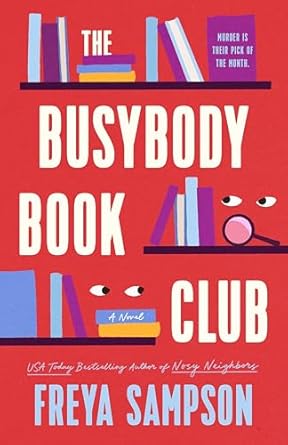
The Busybody Book Club is my first experience of the novels of Freya Sampson, and I think I will need to read at least one more just to verify what other reviewers on Goodreads had to say about them. Some loved this book, others said it was her least successful; if the latter is true, then I look forward to reading one/some of the others, because I found this a charming story with much to enjoy.
Nova Davies has recently moved to Cornwall to start a new life with her fiancé, Craig, and has found a job at the St. Tredock Community Center. She is attempting to revive a previously popular book club run by her predecessor, but so far it’s an uphill task. There are to date only five members including herself, and two of the five are distressingly silent, while the other two are all too outspoken. Arthur wants to read romances, because he is tasked at home with reading aloud to his wife, Esi, who has lost her sight and much of her mobility, and that’s what she likes. But Phyllis (accompanied by her smelly old bulldog, Craddock) insists that romances are rubbish and the club should focus on mystery, preferably the works of her favorite, Agatha Christie. She prefers Miss Marple (quietly brilliant) to Hercule Poirot (too pretentious), but is adamant about genre. Because they take turns suggesting each month’s read, however, opinions are also solicited from painfully shy teenager Ash, who is a science fiction fan, and from their new member, Michael, who is largely inarticulate and, of course, from Nina, who tries hard to keep selections eclectic and discussions moving despite Phyllis’s loud and frequent exclamations, interruptions, and wholesale scoffing.
On the night of their meeting, the only people left in the club are Nova and the four other members. At some point during the lively discussion of Where the Crawdads Sing, someone enters the center’s office and steals the petty cash box, which happens to contain ten thousand pounds allocated for a new roof. This isn’t discovered until the next morning, when the police are called by director Sandy to interview the book club members; everyone immediately focuses on the odd behavior of Michael, who received a text on his phone halfway through the meeting, looked distraught, and ran out of the room. He never returned to the meeting, and is instantly suspect; but Nova is also under scrutiny because it was her job to lock the office, thereby preventing the opportunity for the theft.
Losing that money is a disaster for the center and may actually precipitate its closing. The club members are immediately up in arms, Phyllis most of all, and are determined to figure out the puzzles of who could have stolen the money and for what purpose, and what has happened to the mysterious Michael. Theories abound, suspects are scrutinized, and meanwhile the relationships between the members change and grow based on their collaboration. Some things turn out exactly as you would expect while others are a total surprise, and the fun of the book is figuring out where you (and the characters) got it right.
This is a sort of hybrid; it’s a cozy mystery, but it’s also a story about people and their relationships with one another, their secrets, their memories, their hopes. And it’s a book about books, and who among us can resist that? I loved that the members ranged so widely in age, interests, and taste in books, and that there was “book chat” throughout. There are so many elements to this story—from coming of age to confidence issues to loneliness and grief—that kept the narrative lively and interesting. It’s not a “significant” book, but it is a well crafted and witty one that provided great entertainment and made me want to know what happens to the characters after. What more could you ask for, on a solitary rainy afternoon?
Memorable
I just finished Say You’ll Remember Me, by Abby Jimenez, and it seems that I am among the few who enjoyed it more than some of her other popular titles. I think I did because it was a simple story with mostly believable obstacles that came from real-world issues and not from elaborate mind games on the part of its protagonists.
The problem I frequently have with these contemporary relationship novels is that they require so much suspension of disbelief. Every trope comes with its moment where you think “Oh, c’mon, nobody would be that obtuse!” So often there are massive misunderstandings that keep couples apart, but the story relies on the reader accepting that, despite being in a relationship, these people never talk to one another, that they make blanket assumptions they don’t check out, then refuse to believe credible evidence, etc., and after a while I become impatient that I’m reading a book whose whole premise depends on two people not initiating one simple conversation.

This one was refreshingly different. It did have its flaws—but for the most part it felt believable to me.
Samantha has been living in Minnesota, having been drawn there for her work. She finds and decides to adopt a kitten, and takes it to a veterinarian who gives her advice she absolutely does not want to take. She is incensed by his attitude, which feels defeatist, and decides to prove him wrong, but when she actually pulls it off, she is surprised to discover that he readily admits he was mistaken and apologizes. Then Dr. Xavier Rush asks her out. Since his revised attitude comes along with Greek god-like good looks and a particular intensity that appeals to Sam, she decides to accept. They have one absolutely perfect date, and then everything blows up. Samantha had learned that her mother’s early-onset Alzheimers is advancing at a rapid rate and realized that she needs to be spending time with her and helping her family with her mom’s care, and she is scheduled to move back home to California the very next day.
That’s the real-world conflict that keeps them apart: geography and bad timing. They resolve to forget what might have been if they could have continued seeing one another…but neither Sam nor Xavier seems able to move past their undeniable connection.
The problem is, neither can change their circumstances to make a move. Xavier just opened his veterinary clinic a couple of years previous and is in debt for the start-up in an amount greater than he could get for selling it. And he can’t just hire someone to work there and run it in his absence, because he can’t afford to pay them—he’s been living on the leftovers after the loan payments are made, but no one else would do that. He’s stuck in Minnesota until circumstances change, but that could take a decade. And Samantha can’t and won’t shirk her responsibilities and cut her ties just to be with him.
But having a long-distance relationship with the burdens under which each of them is operating is nearly impossible, and although they give it a try, the thought that this situation might last for years is so daunting that neither of them is happy.
What happens when the person you have realized is “the one” for you can’t be in your life for more than a weekend every three months?
There were some features of the story that were less believable than others, and it does bog down in the middle when the angsty stuff becomes somewhat repetitive, but the attention to the details of Xavier’s back story, Samantha’s relationship with her family, and their undeniable chemistry when together keep it going. If you’re looking for a less formulaic relationship story, try this one.
The last?

I just finished what has been billed as the “last installment” of the Gunnie Rose story by Charlaine Harris—The Last Wizards’ Ball, number six in the series. And although I thought that it was appropriately told, with plenty of drama and intrigue and some fascinating new characters, I admit I am feeling a little puzzled. There was no cliffhanger as there was at the end of previous installments, but everything was left more than a little unsettled and open-ended, and I could see this series going on for several more books, based on the impression I received from this one. I can’t decide whether Harris likes an open-ended story, or is hedging her bets just in case.
Of course, one could posit a spin-off or two that, for instance, followed Felicia to New York City and then to Europe, or trailed Lizbeth to a possible new home in a place both greener and less fraught than Texoma, or followed the fortunes of Eli as he resumes his services to the Russian Tsar of California…
Just to inform those who are unaware of this series…
The setting is the former United States, but one event—the assassination of Franklin Delano Roosevelt—has significantly altered the history of the country. Without Roosevelt’s guiding hand during the Great Depression, the crippled country fractures, and various states were either absorbed into surrounding countries, taken over by former rulers, or banded together to form small nations. The original 13 Colonies pledged fealty to the British Empire; a few of the “top” border states became part of Canada; the south-eastern states are now “Dixie” while Texas and Oklahoma formed “Texoma”; the “flyover” states remained “New” American territory; the rest of the southwest was annexed by Mexico; and the biggest surprise was the Pacific Northwest, which was taken over—by a combination of invitation, treaty, advantageous marriages, and magic—by Tsar Nicholas and the remains of the Holy Russian Empire, which is now its new name.
The main protagonist, Lizbeth Rose, lives in Texoma and makes her living by hiring herself out as a “gunnie”—a combination of escort, guard, and gunslinger paid to protect people and/or cargos being transported by land or rail from one territory to another. It’s an unusual profession for a young woman, but Lizbeth is a crack shot used to relying on no one but herself, and takes all the risks to keep her clients alive and her cargos safe. Here is my full review of the first two installments, which also further explains the magic part of the tale.
In this the sixth book, Lizbeth Rose’s half-sister Felicia, a powerful wizard, is 16 and attending her first Wizards’ Ball, described by Lizbeth as similar in nature to the “Season” in a Georgette Heyer novel, otherwise known as the Marriage Mart. The most prominent grigoris, wizards, and magic-makers from around the globe send or bring the eligible members of their families (unattached youth under 30) to a week-long series of garden parties, tea parties, balls, theatricals, and what-not so that they can all meet one another and make suitable marriage matches. The aims are power (both magical and political), wealth, and the acquisition of a bloodline that will match well with, freshen, or diversify a perhaps played-out heritage.
Felicia is much in demand but also at great risk, since some would do anything to “acquire” her and her power for themselves, while others are bent on keeping that power away from those people, regardless of Felicia’s personal wishes. But Felicia is no pushover when it comes to defending her own rights, and she has her gunslinger sister and her grigori brother-in-law, Eli, along for protection and observation.
The time period in this book is during the build-up to what was, in another timeline, World War II—the ascendence of Hitler—and all negotiations are colored by political loyalties and intentions as it becomes apparent that war is in everyone’s future. This is part of the reason why I find it confusing that this is the last book, because in a world where there was no strong, unified American government with its military that jumped in at the end to turn the tide of the war, the possibilities are endless, and Harris has set it up with the added detail of magical abilities being in play on both sides.
While the book was entertaining, full of plots, drama, and detail, I was left feeling that if this was the end of the story, we have been dumped just as things were about to get truly intense. I’m hoping that Harris has a segue up her sleeve, as she did when she wrote the Midnight, Texas stories based on a character from her Harper Connelly series. If not…I have quite enjoyed them anyway, some more than others.
Short but jam-packed
As I have mentioned here before, I am generally not a reader of short stories. The last time I blogged about a couple of them that I picked up for my Kindle, I commented that in the future I would resist temptation even if they were written by authors I admire (those two were by Alice Hoffman and Margaret Atwood, so the star power was bright) because I found the brief format unsatisfying, no matter who wrote them. But I didn’t keep that resolution, and this time I’m glad I didn’t, although, alongside the satisfaction they gave me, I still feel a little frustration for the attenuated content.
First I was offered one by John Scalzi, who is one of my latest favorite science fiction authors and, when I saw it was about time travel (a particular fascination of mine), I couldn’t say no. Then one popped up by Alix Harrow, who has written three books since 2019 all of which enthralled me when I read them. This one had a knight in the title, so I assumed it was fairy tale-ish and therefore likely to please me, but it turned out to be something I like even better—a dystopian story.
Why, then, did these impress me so much? In trying to dissect that, the first thing that occurred to me was their immediate impact. In less than a page I knew that I couldn’t stop reading. Part of this is due to something novelists and readers have discussed for years (or millennia or eons): the first line.
When I think of a famous first line, the one that most immediately comes to me is “Last night I dreamt I went to Manderley again.” That’s the opener for Rebecca, by Daphne du Maurier, and if you ask readers on a Facebook page dedicated to books, it’s one that is often quoted. Others that crop up frequently are “It is a truth universally acknowledged, that a single man in possession of a good fortune must be in want of a wife” (Pride and Prejudice, by Jane Austen), and “Call me Ishmael” (Herman Melville’s Moby-Dick), “Happy families are all alike; every unhappy family is unhappy in its own way” (Anna Karenina, by Leo Tolstoy), or “It was the best of times, it was the worst of times…” (A Tale of Two Cities, Charles Dickens). These are all from classics, but there are many others nearly as famous that source from books that are popular, perhaps well known, but not considered in that pantheon, such as “I write this sitting in the kitchen sink” (Dodie Smith, I Capture the Castle), or “When Mary Lennox was sent to Misselthwaite Manor to live with her uncle, everybody said she was the most disagreeable-looking child ever seen” (The Secret Garden, by Frances Hodgson Burnett) or “We were somewhere around Barstow on the edge of the desert when the drugs began to take hold” (Fear and Loathing in Las Vegas, by Hunter S. Thompson).
I cite all these because they have the unique ability to cue you to a lot of what’s coming in one simple phrase. You immediately want to know: What or where is Manderley? who is the dreamer? Why did they leave Manderley in the first place? You want to argue that perhaps the last thing a single man with a good fortune might either want or need is a wife to spend it! If you have any Bible knowledge, you get all the deep connections to the name “Ishmael.” You instantly begin debating whether that statement about families and happiness or lack of same is true—you think about your own, and then you want to know why the author has embraced this premise. If you know that A Tale of Two Cities is about the French Revolution, then it must have been a bad time, but then wonder how being in the middle of a war could also possibly be the best. You ponder why someone would write while sitting in a sink; you immediately perceive that this person might be out of the ordinary and therefore worth cultivating. You want to know why Mary had to go live with her uncle, and what it was that made her disagreeable—was it that, or something else? You think about someone driving across Interstate 40 in a drugged state and are presuming you probably know what will happen next, but you don’t…so you keep reading.
Alix Harrow’s story, “The Knight and the Butcherbird,” begins:
Once upon a time,
a knight came riding into the holler.”
It is immediately arresting, because it’s like that game where you see a group of pictures and are asked the question, “what one thing is not like the others?” The “Once upon a time” and the “knight” immediately set you up for the expectation of fairy tale; but there are few areas in the world where someone would call a small, v-shaped, riverine type of valley a “hollow,” and when that gets transmuted to “holler” you know you are in southern Appalachia, most likely in West Virginia. So, what is a knight (presumably wearing armor to distinguish him as such) doing riding into Appalachia? The disconnect drags you in and glues your eyes to the page.
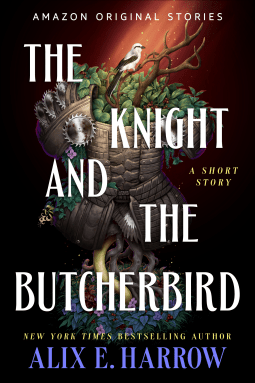
In the next paragraph you find out it’s been 300+ years since “the apocalypse,” that the knight is expected (people are standing around waiting for him), and that the protagonist is a misfit in her community (“I stood among them like a tumor at a birthday party: silent, uninvited. Likely fatal.”)
In the third, you get a picture drawn of the knight—specifically his armor, sewn of fine black steel-corded tire treads, the rusty state of his pauldrons, and the fact that he was “crazy old, maybe even fifty.” He is a Knight of the Enclaves, “tall, raised on multivitamins and clean meat.”
This is all on the first page, and tells us that: something terrible has happened to the world; there are survivors in a backward corner of it who are in need of assistance; and from “somewhere else” there is a person characterized as a knight who has come to help them with their problem. I could immediately, viscerally picture the poor, raggedy, sickly people (the ones raised without the vitamins or untainted protein) standing around at the mouth of their small valley home, waiting patiently for a hero to arrive; and I could also perceive the colossal impact of the knight’s presence.
Wouldn’t you want to keep reading?
John Scalzi’s story “3 Days, 9 Months, 27 Years” doesn’t start with quite such an arresting contradiction, but for a science fiction fan and time travel junkie, it still dragged me in:
The time machine is, in itself, not much to look at.

The remainder of the paragraph goes on to describe its physical appearance, concluding with “At the far end is a portal. One takes the client away. The other brings them back.” With this it is established that time travel has become a business (thus the clients), and that the narrator is probably the operator of the machine (confirmed in the next paragraph). The next page and a half describes in extremely simple terms what happens in the chamber when someone takes a trip and comments that, once the client has returned, “Where they go after that, like where they go when they walk through the first portal, is not specifically my concern. I am here to run the time machine.” The client, however, “has aged three days, or nine months, or twenty-seven years. They have been through a time machine, after all. This is how the time machine works.” Then, however, the operator, who sounds like he is describing the daily duties of a fairground carousel operator, comments that this is the theoretical process, but that is almost never what actually happens. “Theory is almost never practice.”
Could you put it down after that leading sentence? I couldn’t.
I’m not going to go into any more detail here on either story; I will just say that there is an exception to every rule, and I’m glad I made these exceptions to my “no short stories” one. They are special cases because they do absolutely everything that a good novel does: They each have a clearly worked-out premise; they are both amazing at both world- and character-building in the space of a few short sentences or paragraphs; there is a set-up, a conflict, and a resolution; and, best of all, they made me think about issues I had never considered, despite being a long-time reader of fairy tales, dystopian/post-apocalyptic fiction, and time travel theories. I finished both of them two days ago, and they keep on wandering through my mind, inspiring more questions. And yes, one of these is to ask the authors “Why not write the BOOK?”—but many more of them are diverting inquiries into the nature of time, anomalies, and serendipity, or thoughts about the eventual evolution or dissolution of humankind, depending on the paths taken (or not).
Thank you, John Scalzi and Alix Harrow. Keep writing.
Age and time
After 900+ pages of frustrating and confusing murder mystery, I needed a break from the serious, so I picked up two books in a row by Sophie Cousens, whose books are billed as romantic comedies. I don’t know that I would go that far, although there are comedic elements and/or moments. But I did find them enjoyable, one more than the other, although the one I liked second-best is apparently her most popular.
First I read Is She Really Going Out With Him?, mainly because I am a big fan of Joe Jackson. If you don’t get that reference, you are probably too young—Joe made his mark in the 1970s. But do go to Spotify and dial up his song by the same name—you might find a new favorite musician, who knows? If you like the song, then follow up by playing his album Night & Day.
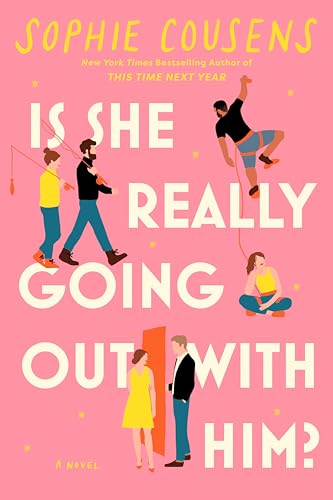
Anyway…the premise of this one is engaging, although you sort of know what will happen at the end by pretty early on. Still, it’s amusing the way the story takes you there. It’s the tale of a divorcée with two children and not much interest in (or success with) renewing the dating game. Anna is a columnist for a popular but struggling arts magazine that has just been bought by a larger company, and she’s nervous that her job is on the line; the new publisher wants material that is more social media-attuned than her traditional approach—more personal, more anecdotal, more relateable. She is doubly alarmed when she gets the idea that her office rival, Will, may be trying to poach her column.
She ultimately has a contest of sorts with him, when he proposes to the publisher that they do a dual column. Anna decides that Will will write about going out with seven women he discovers on dating apps, while Anna will give up the details of the same number of dates with men chosen by her children. Since they are young and enthusiastic (seven and 12) and not particularly discriminating in their choices, her dating pool is a weird one, but Anna gamely holds up her end of the competition. But working together with Will presents more problems than just fending off his job takeover…
Yes, it’s pretty trope-y, and yes it’s been done before, but Cousens does have a gift for character development and for comedic moments that keep this one pretty fresh. And yeah, an author who references Joe Jackson…

The second book, The Good Part, reminded me of a few other books (in a good way), foremost being What Alice Forgot, by Liane Moriarty. In that book, Alice gets conked on the head and forgets about the past decade of her life, in which significant things happened (she had kids, she got divorced), which makes it awkward and sometimes comical when she keeps trying to relate to people the way she did in the moment to which she has been returned by amnesia. The Good Part is sort of the opposite of that, because Lucy Young doesn’t forget her past, precisely, she just anticipates her future so hard that she suddenly wakes up there one morning.
Lucy is 26, a downtrodden TV production assistant who is tired of fighting for the promotion that never comes, tired of living in a dump with three inconsiderate roommates and a ceiling that leaks on her bed every time the upstairs neighbor takes a bath, and one night when she takes shelter in a news agent’s during a downpour and discovers a curious wishing machine, she puts a coin in the slot and wishes hard to be past all this and into the “good part” of her life.
Next morning she awakens with a ring on her finger that the handsome man downstairs apparently put there, and a closet full of really expensive designer shoes. But she also has two children about whom she has no memory, a high-powered job she doesn’t know how to do, and a shockingly old (40-something) face confronting her in the bathroom mirror! She has apparently been transported ahead 16 years but retains only the memories of her life up to age 26, which in her mind was last night.
Not wanting to be diagnosed as mentally ill, she tries for a while to “fake it until she makes it,” but with variable success (especially with her older child, who thinks an alien has possessed his mummy). At first she firmly believes that the mysterious machine has transported her here, and that she will wake up the next day back in her grotty apartment, but when this doesn’t happen, she also has to confront the idea that she may simply have amnesia and has conjured a crazy reason for it.
The most interesting part of the book is Lucy’s inner debate about what she really wants. She has it all—but at the cost of missing the entire experience of getting there. Her husband remembers them falling in love, the birth of their children, her climb up the professional ladder, but inside Lucy is still that single girl who has never been able to afford nice things, doesn’t know if she wants to have kids, wonders if she should ditch her career for something different…and now that she is seemingly in the middle part of her life, she has to decide whether she will settle into the wonderful achievements and relationships she doesn’t remember establishing, or try to get back to her past so she can experience them all first-hand—or possibly make different decisions? This quandary is complicated by the fact that what she ends up doing (if she is able to figure out how) may impact not just the lives but the very existence of the husband and children staring at her with so many questions in their eyes…
These books were a great way to while away a few days. I might even read more Cousens the next time I get burned out on long, serious, and complicated.
Hallmarked for letdown
I recently completed The Hallmarked Man, number eight in the Cormoran Strike detective series by “Robert Galbraith.” (I wish J.K. Rowling would just let go of the alias and publish these under her own name; it’s messing with my alphabetical filing.) More than once I harked back to the previous book, The Running Grave, while reading this one, because with that book I had a “Frenaissance” (as Phoebe Buffay calls it) with this series, and was so hopeful that things could only get better from there on out. Alas…no.
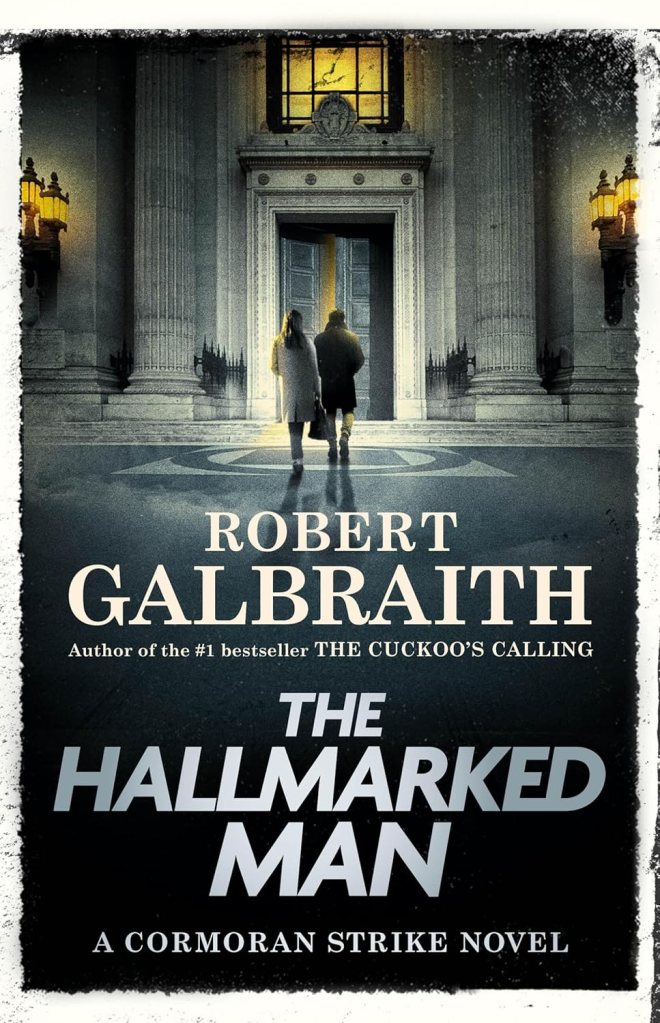
You have to maintain a real and dogged commitment to this series if you are going to read it, because each book is more than 900 pages long. I don’t mind a long book; in this series, it has made it possible not only to thoroughly explore the main mystery but also to feature other, minor ones that take up the daily functioning of the Strike and Ellacott Detective Agency, while leaving ample room for personal relationships not only between the two protagonists but also among all sorts of hangers-on, both staff and client alike, and I usually enjoy the variety contained within the larger story.
The series has, for the most part, kept a nice balance between the professional and the personal and, even if I didn’t enjoy a particular story line, I was always drawn in by the continuing evolution of the relationship between Cormoran and Robin. But this book felt like a giant misstep on almost all fronts and, while I enjoyed parts of it moment to moment, I was left feeling frustrated and dissatisfied with where we arrived by the end of it.
The mystery was so convoluted and the cast of characters so confusing that it felt like Rowling should have created the equivalent of one of those family trees that historical fiction writers often include in their books so that you can keep all the generations and their spouses and children straight. Someone is murdered and gruesomely mutilated and, because of the method, it’s hard to figure out who it is. The police have settled on one theory, but a woman comes to the agency convinced that the victim is her missing boyfriend and wants them to prove that it’s him, not the person the police have identified. In the course of the book, potential victims multiply until there are four or five possibilities, and to each of the victims is attached a cast of characters that must be interviewed to try to determine if he is the one; but the witnesses are almost as elusive as the putative dead men, and the story becomes an exercise in frustration. Add to that some red herrings about secret societies, the porn industry, human trafficking, and MI5 involvement, and it’s all just too much.
As if to take a cue from that, the personal lives are likewise chaotic, and the most disappointing part of the relationship between Cormoran and Robin is its repetitiveness. In the last book both of them seemed to have grown and, with the cliffhanger last time, I expected their relationship to be resolved or at least moved along. Instead, Robin’s boyfriend Ryan Murphy becomes her husband Matthew 2.0, if a bit nicer and less whiny, and Robin has reverted to all the self-deception and self-doubt she exhibited several books back, but with a new partner. She knows, deep down (or maybe not even that deep!) that she doesn’t want to be with him or have his children, yet she keeps deceiving herself that she loves him (as well as stringing him along). She also spends far too much time doubting Strike and putting moods and motivations on him without either his knowledge or participation.
On Cormoran’s side, the dithering becomes maddening. He has come to realize what he wants (Robin) and plans to reveal this to her, but he lets every minor misstep come between him and that revelation, and makes things exponentially worse with every hesitation. It’s all miscommunication, misunderstanding and angst. The upshot is that we end up in almost the same place we left off and, with the acknowledgment that they have now worked together for almost seven years, I for one wonder if continuing to ship them is even worth it.
The problem with a review like this is that it may turn people off to reading the series if they haven’t begun it, or to stop before assaying this chapter. I wouldn’t go that far; it’s not an irretrievably bad book, and it is, of course, necessary in order to understand the progression of both the agency and the relationship…but I’m not enthusiastic about it. When I first finished it I felt the need to turn around and reread it to pick up on all the stuff I had missed, but I didn’t love it enough to do so. That pretty much says it all. Disappointed after such a long wait, and hoping for a better outing next time…

 The Book Adept