Fictional memoir
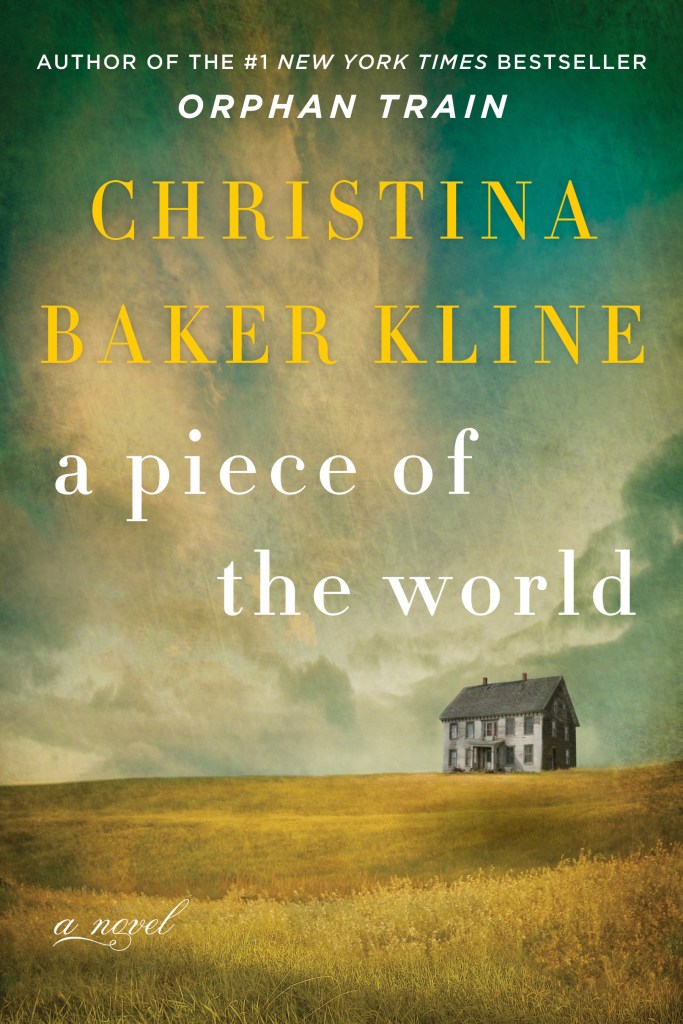
A Piece of the World, by Christina Baker Kline, is in a special category: Although the overall story is fiction, it is based on facts about real people, and reads like memoir.
The book is based on Andrew Wyeth’s painting called Christina’s World, pictured here. People have always noticed something slightly odd about the figure in this one—she’s not just reclining in that field, she looks like she’s wanting to get to that house, or perhaps even pushing or dragging her body along in the attempt. This is the germ of the idea for the entire book, which, although it does showcase some of Wyeth’s career, is primarily about the subject of the painting, Christina Olson of Cushing, Maine.

The book documents Christina’s entire life, which turns out to be a small one except insofar as she serves as muse to the famous painter. Christina suffers some kind of illness at age three (they never state what, but my thought was polio) that twists her legs up and makes her awkward and clumsy in all her movements. This and her own pride and self-reliance make her an outsider, both in her family and in her community, with the result that the chances others have for happiness seem to pass her by, no matter how hard she tries to grasp them. She grows up in the house previously occupied by generations of her ancestors; she cares for her brothers and her aging, ailing parents as her disability gradually worsens; and she is finally left with one brother to live out her days in an ever-diminishing daily routine circumscribed by her physical condition…until one day Andrew Wyeth’s young wife, Betsy, a family friend, brings him to visit, and he becomes fascinated with Christina, her brother Alvaro, and their house and farm in all its aspects. No detail is too large or too small for him to tackle in his art—he paints the rusty padlocks and spiderwebs, the sheer curtains blowing in the breeze from an upstairs window, Alvaro smoking his cigar—and this begins an almost 20-year relationship between himself and the two remaining Olsons, resulting in possibly his most famous picture/portrait.
“Later he told me that he’d been afraid to show me the painting. He thought I wouldn’t like the way he portrayed me: dragging myself across the field, fingers clutching dirt, my legs twisted behind. The arid moonscape of wheatgrass and timothy. That dilapidated house in the distance, looming up like a secret that won’t stay hidden.”
CHRISTINA OLSON
In some ways this is a dark, dour portrayal, but it is rescued from being too depressing by Christina’s will and strength of spirit, and by wanting to know what happens next. The book deals with complex issues; resentment, shame, lost dreams, family challenges, and social classes are explored, and the writer makes us realize that there is depth and intensity to even such a simple existence devoid of major events. There are some fine lyrical moments of expression, and Kline paints pictures with the words she chooses. I didn’t expect to like this book as much as I did—it kept me reading through one sleepless night, and I was a little sorry when it ended. It’s a great example of what an author can do with the kernel of a story, some thorough research, and a vivid imagination to bring them both to life.
Discover more from The Book Adept
Subscribe to get the latest posts sent to your email.

 The Book Adept