Unhappy fans
I miraculously got a checkout from my library for Emily Henry‘s latest, Happy Place, in about a third of the time I expected to wait. Then I read the reviews on Goodreads, which may furnish some explanation. Don’t get me wrong, every second or third review awarded five stars, but there were also those critical reviews between them for three, or even two or one star, a phenomenon I believe has not previously been experienced by this popular author.
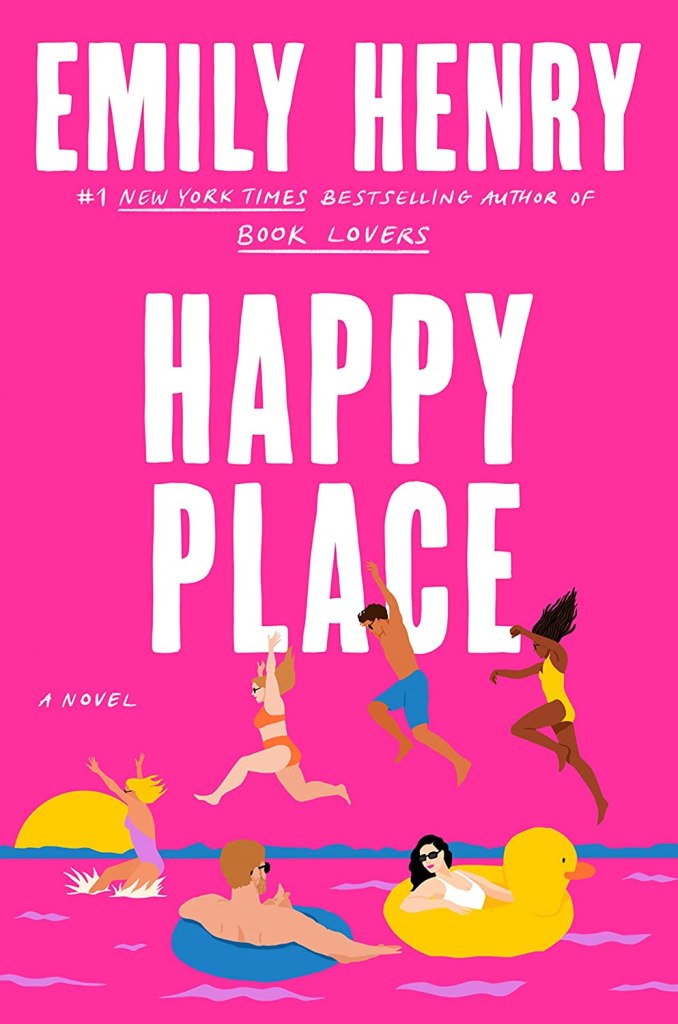
The story involves six friends, five of whom bonded in college and have remained uncommonly close, and one extra who was pulled into the group when she became part of a couple with one member. In fact, four of the original five have coupled up with one of the others, and this is the source of the current problem.
Their “leader,” Sabrina (I call her that because she’s the impetus behind keeping them all together), comes from wealth, and a tradition the group has had for their entire friendship has been to spend a summer week together at her father’s Maine “cottage.” But her dad’s most recent spouse doesn’t want to maintain the association of the cottage to his first wife and insists that he sell it, so this is the friend-group’s last gasp at a holiday together there, fraught with all of the traditions they have created over the years.
Sabrina and Parth have made the week into even more of an event by surprising their friends with their engagement, with a wedding planned for the end of the week on Saturday before they all pack up to leave the cottage forever on Sunday. Given this special occasion, none of the friends feels like they can refuse the invitation, let alone spoil it with bad news, so this makes it difficult for Harriet and Wyndham, who broke up four months ago but haven’t told anyone. Their plan was for Wyn to bow out of the week with some excuse while Harriet broke the news to the rest of them, but instead they are both on premises with nothing revealed, and have been awarded the best room together, a double en suite featuring a bathroom with no door. Awkward. And painful, and sensitive, and embarrassing and almost impossible to endure. But Harriet and Wyn don’t want to spoil the week for the others, and they do want to be at the wedding, so they are gritting their teeth and playing a part in public while taking turns sleeping on the floor in private. The third couple, Cleo and Kimmy, have secrets of their own, and there is building resentment between Cleo and Sabrina to cap off the basic tension in the air.
Harriet is a surgical resident in a prestigious program in San Francisco, and Wyn was living with her before going home to Montana to deal with family issues and never coming back. The two had been together for eight years, and happy for the first six, but once they relocated to San Francisco everything seemed to go wrong for them, as individuals and as a couple. But Harriet never dreamed the result would be a few devastating sentences on the phone that severed their connection permanently.
I personally enjoyed the book, both because I am apparently a hopeless romantic at heart and because I relished the vicarious experience of having a solid group of friends on whom I felt like I could depend forever. Who doesn’t want people in their lives who know you, are there for you, and will reliably show up for your highs and your lows? It threw me back to seeing the movie The Big Chill in 1983 and wondering, 10 years after high school graduation and five years after college, who of my friends I would still know 10, 15, or 20 years later (answer: one). So I liked being immersed in the group dynamic.
I also found Harriet’s and Wyn’s descriptions and chemistry with one another compelling, and cringed at what they had to go through as they maintained a façade for their friends. And I coveted everything about that vacay in Maine, from the weather to the food to the Lobster Festival to the opulent yet cozy cottage. Basically, I plopped myself down in the middle of the plot and went with it.
Others, however, were not pleased. One pointed out that “miscommunication” was the worst trope ever, and when I reflected on it, I had to agree; I realized that I myself didn’t identify that as a problem because I, like Harriet, tend to hang back, keep my mouth shut, and wait for someone else to make the important moves, so it seemed familiar and therefore not bad. But it was! They were both thinking one thing in their heads and allowing different information to come out of their mouths; they were both pretending to be happy while being oh so sad; they were lying a lot; and if, after eight years together, neither of them could bring themselves, through embarrassment or shame or fear, to fight for the other person or for the relationship, they probably deserved to be unhappy. Another reader actually said “The pacing of this book, the alternating timelines, the character development, the relationships were all beautifully and expertly written,” and then gave it three stars because of that trope. Finally, one of the one-star awarders said “Fake, awkward, contrived, and so, so dull. I simply cannot read another novel held together by the characters’ absolute refusal to communicate.” So there’s that…
Someone else said they felt the side characters had no personality, that they had been crafted as one-note cardboard characters whose most prominent feature was anxiety, and then left to function on their own. Another called them “unlikeable and underdeveloped…I just didn’t feel like I could root for them as I have others of Emily Henry’s characters.” I certainly didn’t feel this way about the characters during the flashback portions of the book, but in the present-day renderings I could kind of see it.
Finally, a surprising number of people found fault with the sex scenes, which I personally thought were both convincing and, well, sultry!
My conclusion is that with this story you will either identify with some/one of the characters and go with the flow, or you will get caught up in the frustration presented by the miscommunication trope and dislike it. I imagine that my review and thoughts will have absolutely no affect on those who are die-hard fans, while others may broach the book out of curiosity, taking a 50-50 chance on their reaction. Feel free to comment below on which person you ended up being!
Discover more from The Book Adept
Subscribe to get the latest posts sent to your email.

 The Book Adept
I see you read my review, lol
LikeLiked by 1 person