Silly sequel
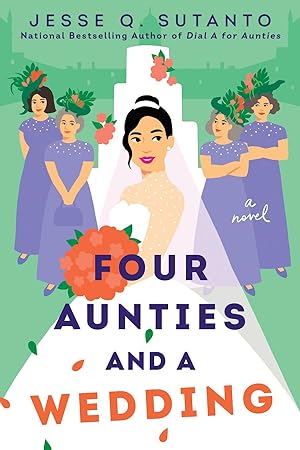
I just finished the sequel—Four Aunties and a Wedding—to yesterday’s book by Jesse Sutanto. It was, like the first, full of the antics of Medellin “Meddy” Chan and her idiosyncratic Indo-Chinese aunties, this time on her wedding day, and although it still had the trademark 2nd-language bloopers and irrational beliefs and superstitions of the first, it was even more frenetic.
Perhaps too frenetic. On the one hand, the descriptions of the aunties’ signature wedding-day outfits and their acquisition of vernacular Brit-speak so as to fit in when they go to London and meet Nathan’s family (their most favored expression being “the dog’s bollocks”) was highly entertaining, and the few interactions between Meddy and bridegroom Nathan were sweet and soulful. But these things were overwhelmed by a plot that took the hard-to-believe events of the first book to a whole less plausible level. (What I’m trying to say here is, it was way over the top.)
Meddy and Nathan are getting married at Christ Church, Oxford, which solves several problems: It’s the hometown of Meddy’s uptight new in-laws, which makes them happy (plus being a beautiful venue), but it lets her off the hook regarding inviting everyone in her entire insanely extended Chinese-Indonesian family, cutting the guest list from the thousands to a mere 200+. She and Nathan want the aunties to enjoy being guests at the wedding, so they have decided to find other vendors to supply the wedding with cake, flowers, makeup, photography, etc. But, as is typical in Meddy’s life, the aunts have worked out a “surprise” for her that she can’t be appropriately filial and still turn down: They have found another Chinese-Indonesian family of five who also do weddings, and hired them on the couple’s behalf.
The first meeting and all the planning goes unexpectedly smoothly, but then Meddy overhears her contemporary, the photographer Staphanie (yes, it’s spelled that way), talking about “taking someone out” on her big day and learns, to her horror, that the family of wedding vendors is Mafia and will reveal her family’s secret (from the first book) if she tells anyone. After this the entire book kicks up the adrenaline to a ridiculous degree as the aunties and Meddy scramble to keep anyone from killing anyone else while keeping it all from Nathan and his parents.
The parts with which I had the most trouble were the actual mechanics of the wedding day. First of all, if any bride spent this much time behind the scenes, ignoring her bridegroom and her guests in favor of running around with her aunts, neither the groom nor the guests would remain so sanguine. Second, about those guests: A few of Nathan’s business investors are highlighted as Meddy and the aunts try to figure out the intended target of the Mafia “hit,” but the rest remain a faceless mass, which is a bit antithetical to the whole idea of only close family and friends attending the wedding. Where were they, and what was their response when Meddy kept disappearing and the aunts became increasingly more embarrassing? And after the description of Meddy’s dress as being tightly corseted on the top half and unbelievably tulle-heavy (and too wide to fit in elevators) on the bottom half, it was hard to believe the things she was accomplishing while wearing it, especially without ripping it or getting it dirty. The thing that bothered me the most, though, was the thought of the total ruin of what was supposed to be a joyful and important occasion. It leant an air of melancholy to this slapstick comedy that lessened its potential impact.
But…I can’t say I didn’t enjoy it, because I did. One thing I liked about both of these books was the highlighting of Indonesian and Chinese cultures, with the contrasts between the lower and upper socioeconomic families and how different they can be despite common descent. The author states that she hoped to create sympathy and understanding without verging on stereotype, and for the most part she pulled it off, although better in the first book than in the second. I’m a little concerned that venturing on volume three may top off my tolerance for quirky mayhem and send me over the edge into annoyance, but I will probably still read it and then complain about it because hey, that’s what I do!
If you enjoyed such reads as the Finlay Donovan series by Elle Cosimano, as I mentioned in my last review, then the Aunties books may be something you would also want to read.
Discover more from The Book Adept
Subscribe to get the latest posts sent to your email.

 The Book Adept