It’s International Cat Day!

Let’s talk about some titles with cats as their theme!

MILLIONS OF CATS,
by Wanda Gág
This is considered the first American modern picture book. Before 1928, most picture books in the United States were imported from Europe or relied on standard separated text and static art. Millions of Cats was one of the first books to use double-page spreads where the art flows across both pages to tell the story. It won a Newbery Honor in 1929. It’s the story of an old man and an old woman who were very lonely and decided to get a cat. But when the old man went out searching, he found not one cat, but millions and billions and trillions of cats! Unable to decide which one would be the best pet, he brought them all home.

SIMON’S CAT,
by Simon Tofield
This artist started out publishing his animations about he and his demanding cat online, mostly on YouTube, and the book came afterwards. The cat’s daily escapades accentuate the hilarious and typical behavior of cats everywhere.

THE CAT WHO COULD READ BACKWARDS, by Lillian Jackson Braun
This is the first in Braun’s series of “The Cat Who…” cozy mysteries. She wrote the first in 1966, penned a couple more, and then wrote hardcore crime fiction for 18 years before returning to fill out this series; she ended up writing 29 of them. One reviewer on Goodreads says, “I have never seen a cat-themed novel depict a human / feline relationship better than Lillian’s do.” The characters and writing are quirky, the mysteries are offbeat, and it’s a good cup-of-tea rainy-day read.
POETRY FOR CATS: The Definitive Anthology of Distinguished Feline Verse, by Henry Beard
What if famous poets’ cats also wrote poetry? Pretty funny if you are not familiar with the original works but even better if you are.
I situate myself, and seat myself,
And where you recline I shall recline,
For every armchair belonging to you as good as belongs to me…
—Walt Whitman’s cat
If you can disappear when all about you / Are madly searching for you everywhere, / And then just when they start to leave without you, / Turn up as if you always were right there; / If you can shed your hair in any season, / And cough up half of all that you devour, / And rush from room to room without a reason, / Then sit and stare at nothing for an hour…
—Rudyard Kipling’s cat
Do not go peaceable to that damn vet, / A cat can always tell a trip is due, / Hide, hide, when your appointment time is set.
—Dylan Thomas’s cat

Just a few to get you started—you can find thousands more in the “lists” category on Goodreads!
https://www.goodreads.com/list/show/5848.Cat_Lovers_List
Continued enjoyment
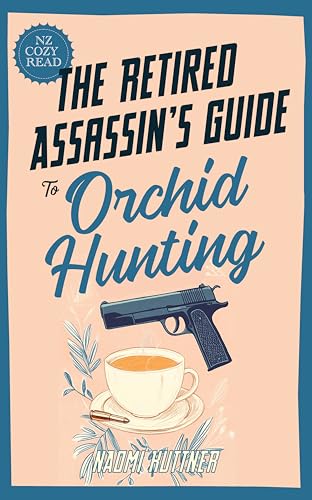
I read two books this week. One was the sequel to the cozy mystery I reviewed in my last post. The Retired Assassin’s Guide to Orchid Hunting, by Naomi Kuttner, would seem to follow one theme from the previous book—gardens. But orchids are less about gardening and more about collecting, especially because people mostly grow them either in pots (if they have a few) or in a greenhouse (if they have a bunch), and the word “hunting” in the title is no coincidence; orchid aficionados are all about seeking the rare, the storied, the unattainable bloom. A symposium on the subject is sure to draw a large group of rabid fans, and that is the set-up for this second story about Dante the retired assassin and his friends—Eleanor the (former?) con artist, and Charlie, the gardener who sees and talks to ghosts. Just your ordinary paranormal cozy mystery!
Dante has been working hard to acclimatize to “civilian” life with the assistance of regular AA (Assassins Anonymous) meetings on Zoom. He is learning to love the cat who insisted on moving in with him, and is easing up on his isolationist habits by actually contemplating a first date with the local veterinarian. But when the orchid symposium comes to town and Te Kohe’s resident expert on orchids dies under suspicious circumstances, Dante and his new friends team up to try to figure out which of the three other prominent figures at the gathering might be responsible, and why—and they only have the length of the convention to solve the mystery, so they’re on a tight timetable.
There are a couple of subplots; one involves Inspector Avery, who is actually back in town on vacation, choosing to spend his days off at the orchid symposium, and the other features a beautiful but weirdly attentive woman Dante is convinced has appeared at a suspicious moment and may be a threat to his retirement (and continued existence).
I enjoyed the inclusion of the paranormal elements, weaving together Charlie’s talent for perceiving the dearly departed with New Zealand’s flora and fauna and cultural/spiritual beliefs. The Pūriri or Ghost Moth was the perfect guide to help solve the mystery of the elusive Ghost Orchid all the collectors were pursuing, as well as an additional vehicle to expose the murderer. Another entertaining read from this series.
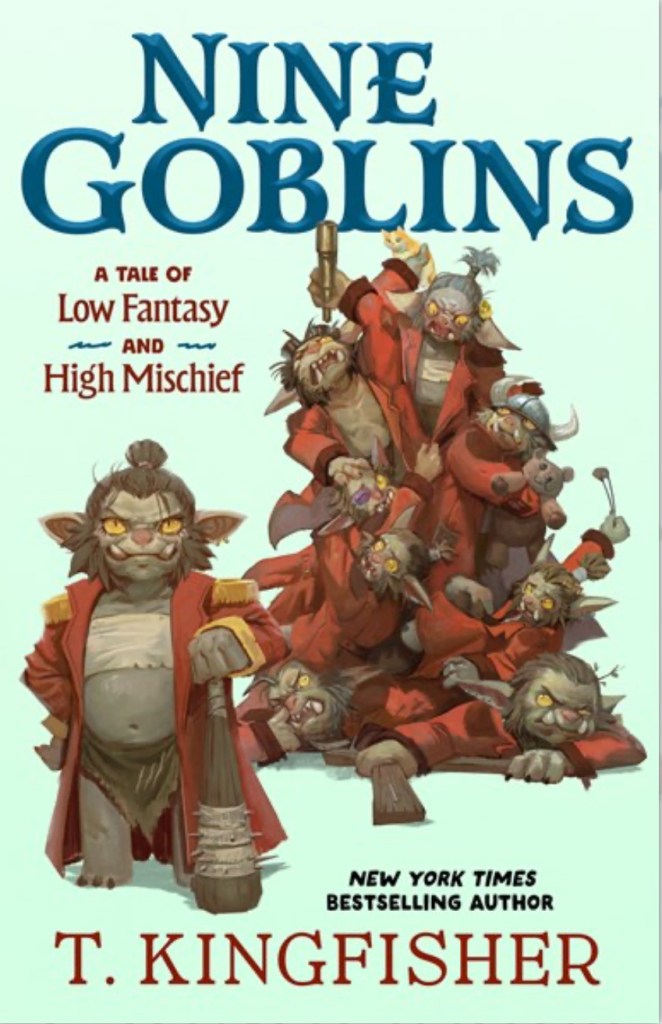
The other book harks back a few months to my discovery of the fantasy author T. Kingfisher and her weirdly wonderful stories. Kingfisher started out as a children’s book author called Ursula Vernon, but she began to feel confined by the inability to include certain elements in her storytelling (murder and mayhem) and decided to branch out into adult fantasy and horror fiction, as well as what she describes as her “occasional oddities.” The latter are the books with which I enthusiastically connected, including Nettle and Bone, A Sorceress Comes to Call, Hemlock & Silver, and a few others. I’m not much of a horror reader (too suggestible), so I will probably give some of her books a miss, but I am completely on board for her fantasy, so I put Nine Goblins on my waiting list at the library and finally snared it this past week.
The story had a bit of a slow start, because there was a lot of scene-setting background to get through before the action began, and it also turned out to be on the short side, a novella of only 160 pages. But once I got past the descriptive information-dump about goblins, orcs, elves, and other competitors for real estate with the ever-expanding human race, it turned into a typical whimsical Kingfisher tale with underlying Terry Pratchett vibes about more serious themes, and I thoroughly enjoyed it.
I discovered in the acknowledgments that Nine Goblins was actually the first of her “occasional oddities,” self-published in 2013, and that its success (though modest) led to all the vastly better-known others. So I’m glad to have come across it as Kingfisher’s “origin story,” so to speak.
Next up: The Calamity Club, by Kathryn Stockett, and The Orchard, by Peter Heller. Stay tuned.
A cozy assassin
I am a long-time mystery reader, but not in general a particular fan of the “cozy”—I tend to like my mysteries on the darker side. But I just read a charming and unexpectedly funny one that made me laugh out loud while keeping me guessing.
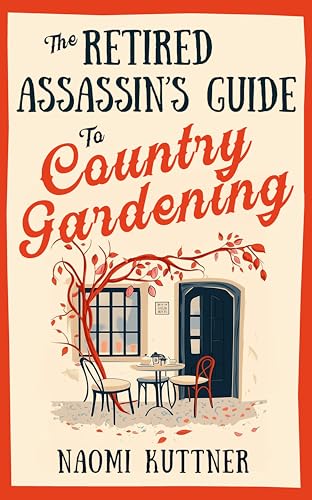
The book is The Retired Assassin’s Guide to Gardening, by Naomi Kuttner. There is a sequel I already have queued up on my Kindle, and a third book comes out later this year, which I will most certainly pursue when
it lands.
Although I did enjoy the novelty (for me) of a story set in New Zealand, with its unique flora and fauna and different sensibilities to the more common British cozy, the real attraction of the book was its characters and their difficulty fitting in with the small-town vibe.
The title character is Dante, a former MI6 assassin who has lived a life so focused on one thing that he has no idea, in retirement, what appeals to him. He has chosen to settle in the town of Te Kohe but, despite its friendly and outgoing atmosphere, Dante is maintaining the lifestyle he learned when he was trying to fade into the background and make no impression. He is socially inept, wishes to avoid the inevitable outreach from what he perceives as intrusively nosy neighbors, and hides in his sparsely furnished house subsisting on protein shakes.
The first person to breach his privacy is Charlie Wilson, a 20-year-old gardener who is determined to continue the botanical services he provided to the former occupant (now deceased) of Dante’s house. Dante considers that he might enjoy learning something about gardening while allowing Charlie to do the heavy lifting, so he acquiesces to Charlie’s employment.
Next is an invasion by local landowner Ted Andrews, who has done his research and has decided that Dante can assist him by providing bodyguard services at an upcoming big event. Dante is less than thrilled to be called upon for this, but Ted makes a forceful case that convinces Dante the easiest route to his peaceful existence is to go along with it.
The most significant and also the most mysterious character is Eleanor Graham, who presents as a typical social manager of her small town, with a finger in every pie and extensive knowledge of all the town’s inhabitants and their foibles, but who drops hints about a past life that was vastly more exciting and certainly in some cases illegal. She fills the role of prime sleuth, although the others contribute and there is also a police presence.
The crime and ensuing mystery here are clever and not obvious; there are some unexpected twists as regards the character and abilities of the three incipient friends (and those of the villain), and the best part of the book is what I call “deadpan” humor. I was also charmed by Dante’s inadvertent acquisition of a cat whose attentions advance him towards a more human and humane outlook.
My sole complaint is that the gardening promised in the title turned out not to play much of a role in the story and, since that is what attracted me to the book in the first place, I felt this as a lack. But otherwise, a greatly entertaining lighthearted read!
My Year in Books 2025
I managed to read quite a few more books this year than last (95 to 2024’s 66), but I don’t know that I realized much advantage from doing so, beyond just clocking the reading time. My stats, according to Goodreads, were:
95 books
28,425 pages read
Average book length: 346 pages (longest book 908 pages!)

Although I discovered some enjoyable reads, there wasn’t one single book that truly bowled me over or made me immediately check out another book by that author or settle in to read a lengthy series. And most of the books I did like were the lightweight ones that I ended up reading as a sort of relief between the tougher titles. Here’s a list:
The Lost Ticket, by Freya Sampson
The Busybody Book Club, also by Freya Sampson
Vera Wong’s Guide to Snooping (On a Dead Man),
by Jesse Q. Sutanto
Finlay Donovan Digs Her Own Grave, by Elle Cosimano
My favorite science fiction book was The Road to Roswell, by Connie Willis.
My new discovery in YA fantasy, with an intriguing Egyptian-like setting, was His Face is the Sun, by Michelle Jabes Corpora. I look forward to the sequel(s).
I read a few books that were award-winners, or by well-known literary authors, or touted by other readers as amazing reads, but found most of them problematic in some way, and therefore didn’t feel wholeheartedly pleased to have read them. They were:
James, by Percival Everett
The Seven Husbands of Evelyn Hugo, by Taylor Jenkins Reid
Horse, by Geraldine Brooks
The Mare, by Mary Gaitskill
Horse Heaven, by Jane Smiley
Three Days in June, by Anne Tyler
Gentlemen and Players, by Joanne Harris
These have all been reviewed on this blog, so do a search for the title or the author if you want the specifics. None of them received a thumbs-down, but none of them lit up my imagination either.
The most disappointing part of the reading year was the letdown I felt each time I finished the next book in a bestselling series I had previously enjoyed. I read two books by Michael Connelly—The Waiting, and Nightshade—and had a “meh” reaction to both. The Grey Wolf, by Louise Penny, didn’t deliver the characteristic Gamache love, and was filled with tangents and extraneous story lines. Perhaps the least successful (for me, at least) was The Hallmarked Man, by “Robert Gabraith,” aka J. K. Rowling, which was so endlessly convoluted that I felt the need to reread it—but so long, wordy, and unsatisfying that I didn’t! I’m really hoping these authors rally in the new year, but it’s more of a “fingers crossed” than an actual expectation.
Honestly, my best and most sustained reading took place when I got fed up enough to revisit beloved books from decades past by such authors as Rumer Godden, Georgette Heyer, and Charlaine Harris.
Today I am starting on 2026, two days ahead of schedule! Onward, readers!
Busybodies
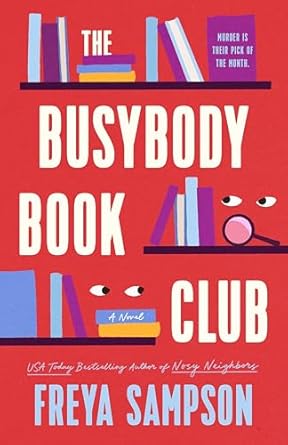
The Busybody Book Club is my first experience of the novels of Freya Sampson, and I think I will need to read at least one more just to verify what other reviewers on Goodreads had to say about them. Some loved this book, others said it was her least successful; if the latter is true, then I look forward to reading one/some of the others, because I found this a charming story with much to enjoy.
Nova Davies has recently moved to Cornwall to start a new life with her fiancé, Craig, and has found a job at the St. Tredock Community Center. She is attempting to revive a previously popular book club run by her predecessor, but so far it’s an uphill task. There are to date only five members including herself, and two of the five are distressingly silent, while the other two are all too outspoken. Arthur wants to read romances, because he is tasked at home with reading aloud to his wife, Esi, who has lost her sight and much of her mobility, and that’s what she likes. But Phyllis (accompanied by her smelly old bulldog, Craddock) insists that romances are rubbish and the club should focus on mystery, preferably the works of her favorite, Agatha Christie. She prefers Miss Marple (quietly brilliant) to Hercule Poirot (too pretentious), but is adamant about genre. Because they take turns suggesting each month’s read, however, opinions are also solicited from painfully shy teenager Ash, who is a science fiction fan, and from their new member, Michael, who is largely inarticulate and, of course, from Nina, who tries hard to keep selections eclectic and discussions moving despite Phyllis’s loud and frequent exclamations, interruptions, and wholesale scoffing.
On the night of their meeting, the only people left in the club are Nova and the four other members. At some point during the lively discussion of Where the Crawdads Sing, someone enters the center’s office and steals the petty cash box, which happens to contain ten thousand pounds allocated for a new roof. This isn’t discovered until the next morning, when the police are called by director Sandy to interview the book club members; everyone immediately focuses on the odd behavior of Michael, who received a text on his phone halfway through the meeting, looked distraught, and ran out of the room. He never returned to the meeting, and is instantly suspect; but Nova is also under scrutiny because it was her job to lock the office, thereby preventing the opportunity for the theft.
Losing that money is a disaster for the center and may actually precipitate its closing. The club members are immediately up in arms, Phyllis most of all, and are determined to figure out the puzzles of who could have stolen the money and for what purpose, and what has happened to the mysterious Michael. Theories abound, suspects are scrutinized, and meanwhile the relationships between the members change and grow based on their collaboration. Some things turn out exactly as you would expect while others are a total surprise, and the fun of the book is figuring out where you (and the characters) got it right.
This is a sort of hybrid; it’s a cozy mystery, but it’s also a story about people and their relationships with one another, their secrets, their memories, their hopes. And it’s a book about books, and who among us can resist that? I loved that the members ranged so widely in age, interests, and taste in books, and that there was “book chat” throughout. There are so many elements to this story—from coming of age to confidence issues to loneliness and grief—that kept the narrative lively and interesting. It’s not a “significant” book, but it is a well crafted and witty one that provided great entertainment and made me want to know what happens to the characters after. What more could you ask for, on a solitary rainy afternoon?
What makes a mystery?
This is a question I have been pondering this week as I started reading Anthony Horowitz’s Magpie Murders, a book that has been recommended over and over again by readers on the various Facebook reading groups to which I belong. I am a big mystery fan—in fact, it’s probably my third most-read genre, maybe second, behind fantasy and possibly science fiction. I love a good mystery; but I specifically love one that has some quality of individuality and that arrests my attention and reawakens a somewhat jaded appetite. As I began reading, I discovered that Magpie Murders was not it.
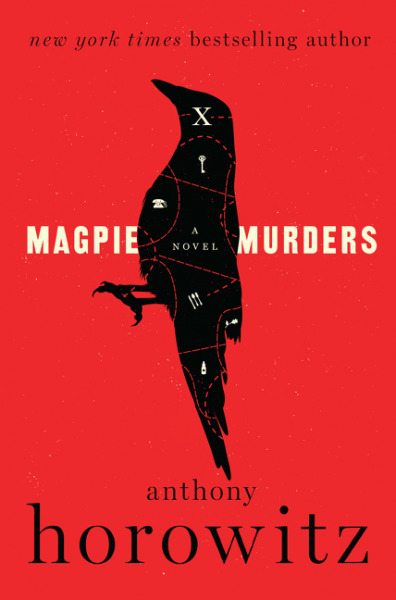
This book has been touted as the heir to Agatha Christie and Dorothy Sayers (and probably to Conan Doyle), and I can see the attempt, but to me it was a bland, by-the-numbers imitation (possibly attempting to be a parody?) rather than a “brilliant recreation of vintage English crime fiction.” When I was almost 50 percent into the book, I seriously considered posting it as a DNF. I honestly didn’t understand why there was any hoopla at all when it comes to this book.
It’s a typical cozy setting in a small town in the English countryside, with the requisite landowner, vicar, shop keepers, eccentric spinsters, surly handymen, and so forth. The detective’s only point of uniqueness in this setting is that he is German by origin; but given all his mannerisms, quirks, and habits, he might as well be Sherlock or Poirot or Jessica Fletcher. He has the slightly dense assistant, he asks seemingly unrelated questions and makes leading remarks that he won’t explain, and then he claims to know who the murderer is before anyone could possibly expect him to have solved the crime, given the vast number of suspects and the meager number of clues. The publisher described this book as “masterful, clever, and ruthlessly suspenseful,” and my response was, sadly, “none of the above.”
When I hit 50 percent, though, we stepped out of the book and into the office of the publisher of Alan Conway’s series about the detective Atticus Pünd, and I realized that the page I quickly skimmed past at the beginning of the book actually had something to do with the story and wasn’t just an introduction or something. So I went back and read it with attention this time, and realized that this was a book within a book and we were now getting to the real story.
I’m going to say here that although it was my fault that I wasn’t paying sufficient attention at the beginning, I’m also going to hold both the format and the author accountable for a little of my confusion. First, I’m reading it on my Kindle, and the way it was structured didn’t lead the reader to recognize that the start of the book was before the start of the book! As for the author, do you really tell the entire story within the story without its reader ever breaking away from it? I mean, Susan Ryeland sits down on a rainy afternoon with a bottle of wine and some chips and salsa to read a long manuscript; it’s more than plausible that she gets up at some point to replenish one of those (it says later that she had gone through more than the one bottle of wine), get something more substantial to eat (she would have needed it, to cushion the effects of all that alcohol), use the loo (I repeat, lots of wine!). A break halfway through that 48 percent of the book to remind the reader that this is a false construct, so to speak, of what the book is really about would have been helpful—and also both realistic and logical.
Anyway…
Once I hit the end of the manuscript and returned to the “real world” of Cloverleaf Books, a small publishing company whose owner and top editor were both reading the manuscript of Alan Conway’s ninth Atticus Pünd novel over a long weekend, I thought things would pick up and we would get the explosive and fascinating book we were promised by reviews and cover blurbs alike—but alas, that faith was misplaced. Others have commented how much more exciting they found the actual mystery that unpacks itself from the pages of Magpie Murders (the book within the book called Magpie Murders), but if so, I certainly wasn’t reading the same book.
Susan Ryeland was a dull and ambivalent character who constantly expressed her frustration that she couldn’t “do” the mystery thing the way all the great characters of literature were able to master it. When she wasn’t being tentative and indecisive about her attempts to solve the mystery, she was whining about her boyfriend, Andreas, who wants to whisk her away to Greece to run a small hotel with him. What an inconsiderate guy!
The other characters are likewise less than charismatic, and Alan Conway himself is written as a cold, devious, and thoroughly unlikeable person about whom it was hard to care. And there were too many instances of clues that were discovered to be clues, but then weren’t explained. Maybe Horowitz is saving something for the next novel? If so, it yielded an unfortunate sense of frustration while reading this one.

I hung in there and finished the book, but it was a near thing, and I regretted spending the time on it once I was done. I won’t be visiting the next in the series, which is 604 pages of the same, according to another Goodreads reviewer who characterized it as “ponderous, overly complicated, and too long.” I spent a decade recommending Horowitz’s Alex Rider series to many teen readers, but I can’t do the same for this one. There are so many better mysteries out there, and I’m going to go find one to expunge the irritation from my brain!
The Wong way

Vera Wong rises to another occasion in Vera Wong’s Guide to Snooping (On A Dead Man), by Jesse Q. Sutanto, the second (but hopefully not the last) in the saga of this intensely curious proprietor of a Chinatown tea shop in San Francisco. (The first was Vera Wong’s Unsolicited Advice for Murderers, reviewed here.)
Although the dead body didn’t land on the floor of her shop this time, he did, in some sense, seek her out. When Vera pays a visit to the police station to see Officer Selena Gray (the woman she hopes will marry her son, Tilly) about a problem of her own, she notices a troubled girl lurking outside the station, pacing back and forth and wringing her hands but unable to bring herself to enter. Vera knows, as a Chinese grandmother, that it is her duty to interrogate, er, offer a sympathetic ear until the young Millie gives up whatever is bothering her, so Vera takes her back to the shop for a sustaining cup of tea. Millie tells Vera that her best friend, Thomas, is missing…but Vera knows there’s a lot Millie is holding back.
That weekend, while cat-sitting at their apartment for Tilly and Selena, Vera discovers a treasure trove of information (she looks at the files in Selena’s briefcase) about a young man who has been fished dead out of Mission Bay, presumably a suicide, and although the man is listed as John Doe, it soon becomes clear that this is Millie’s missing friend. But as events progress, we learn that he had a public face as well, under a different name, as a prominent “influencer” on social media; four other people besides Millie who have possibly suspicious connections to the dead man convince Vera that this was murder, not suicide. Vera, bored since her last adventure as an amateur sleuth, jumps in with both feet to meet, interrogate, and adopt her new list of suspects into the chosen family she acquired the first time around. Despite Selena’s warnings to stay out of her investigation, Vera is determined to be one step ahead of everyone in figuring out this mystery, thus proving she is as intrepid at solving it as she was last time.
I think I liked this book even better than the first, which I thoroughly enjoyed. Vera has no filter, and her misunderstanding of American slang and her slyly manipulative cozening of people to get what she wants—which also usually corresponds to what they need from her—provides a lot of humor. It also lets us get acquainted with the cast of characters much more quickly as Vera grills them mercilessly in her quest to solve the murder. But although she can be a bit much, Vera makes up for it with her caring, which she exhibits in her preparation of vast quantities of food and tea for all and sundry. (Don’t read this when you’re hungry. You will immediately spend a fortune on DoorDash, and then be disappointed that it doesn’t measure up to the cuisine of Vera Wong.)
I was initially a little put off by yet another book with a prominent character who is an Instagram influencer, especially having recently read Sutanto’s previous book You Will Never Be Me, which was a much darker tale about two women obsessed with their online presence as “momfluencers.” But before I decided to put it down, I was drawn further into the story as each subsequent character revealed what they knew and a complicated back story emerged about the actual life of “Thomas” that led to his death.
I loved the moments in the story when each member of the motley crew that Vera assembles has the realization that…
“[L]ife gets much easier when you hand over the reins to Vera.”
Some on Goodreads said they didn’t like it that Sutanto took the story in that more serious direction, but I felt it was the perfect balance—a cozy with substance when it comes to societal issues such as family relationships, loneliness, generational differences and expectations, and also the fatal effects of greed and exploitation. It had a little bit of everything, but for me the Wong way was the right way, ha ha!
And, judging from the closing chapter, we may not have seen the last of Vera…and the next adventure could take in a much wider world than San Francisco’s Chinatown!
Cozy with nuance
I don’t remember who recommended this book to me; maybe I just read a review of it somewhere, or it popped up in my Kindle best buys or something. But probably someone told me about it because the main character is a librarian. (When you yourself are a librarian, people do that.)

Fried Chicken Castañeda, by Suzanne Stauffer, is a first book for this author, who was also a librarian for 20 years in New York City and Los Angeles, and then got her Ph.D. at UCLA in 2004 (I missed her by a year!) and went on to teach at the School of Information Studies at Louisiana State University. She is also a historian of libraries (you can see a list of her published papers on Wikipedia.
But the protagonist of her book, Prudence Bates, is bored with her career at Cleveland Public Library, and decides to go on hiatus to try something new. It’s early 1929, and Prudence has thus far led an extraordinarily limited life. Her father died a few years back, and her life choices have been truncated by the desire to spare her mother solitude. She wanted to go away to college, but instead attended one close to home so as not to leave her mother alone. She wanted to be an anthropologist who travels for research, but instead chose library science because she could get a local job to be there for her mom. But now her mother and Prudence’s nice enough but, yes, rather boring boyfriend are both pressuring her to settle down, and she’s so tired of fending them off that she almost succumbs.
Her boss at the library senses her ennui in the nick of time, and proposes that she attend a library program about young women couriers for the Fred Harvey Southwestern Indian Detours, who lead tours from the Santa Fe Railroad depots in the West to explore Native American art and culture. The stated goal by the library director was for her to emulate the presentation by developing similar programming for the library, but Prudence is so entranced by the life these nomadic tour guides describe that she packs her bags and heads out to New Mexico to train for a courier job. She has the college degree they require but not the familiarity with the terrain, so she stops off for a week on her way to the interview in the small town of Las Vegas, New Mexico, to begin to get acquainted with life in this corner of the world that is so different from her native Cleveland.
This book reminded me, for some reason, of the Molly Murphy mysteries by Rhys Bowen. They are not superficially too similar; but both protagonists are young, optimistic, and somewhat cheeky, and they both travel far outside their childhood norms to experience a different kind of life. The story also made me think of Dead to Me, by Mary McCoy, yet another librarian author (this one works at Los Angeles Public Library), because it’s set in a particular part of the past that yields extra interest; that book takes place during Hollywood’s Golden Age, while this one navigates the perils of Prohibition.
Stauffer has done her historical research, with the result that the background is filled with details about Pullman train travel, the fashions of the day, and the specific environment in the small New Mexico town Prudence chooses to explore. But what I liked best is that she didn’t shy away from permeating her narrative with the huge cultural divide of that era between the well-off white folk traveling on the trains and the Indian cultures these people are “touring” from a position that could be described as both superficial and patronizing. She is not at all heavy-handed, but does manage to insert reactions and observations designed to highlight such themes as racism, wealth inequality, and cultural diversity as her heroine gets to know the people who actually live and work in the towns through which she will be leading her tours, employed by the railroad and by the Harvey company.
The mysteries in this book are not quite as compelling (probably because there is so much character development and scene-setting to accomplish), but they are mixed up with a bit of romantic tension between Prudence and Jerry Begay, a Navajo man she meets on the train, that lend an extra spark.

the Castañeda Hotel in Las Vegas in 1926.
It’s not a book I would rave about and recommend to everyone I know; but it was certainly one of the better cozy/historical mysteries I have read, good for a couple of afternoons of entertainment. I would willingly pick up a sequel to find out more about the career of the gutsy Prudence as she pursues her dream. I hope she writes one!
Odd mystery series
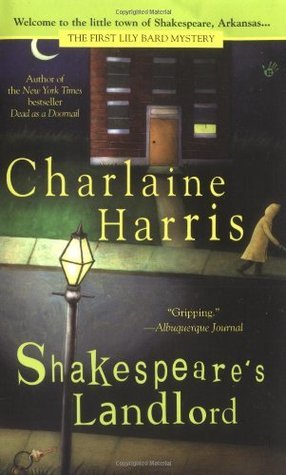
I was in between loans from the library a few days back, so I browsed the books on my Kindle to see what on there was still unread, or what I might want to reread, and I happened across Charlaine Harris’s Lily Bard mysteries. They are oddly named, and they are oddball murder mysteries—strangely engaging, given their dark tone. They would probably fall under the category of “cozy” mysteries, because they take place in a small town and the lead character isn’t a police officer or a detective, but they are, in fact, the antithesis of cozy in their theme! All five books have the name “Shakespeare” in the title, beginning with Shakespeare’s Landlord, and it’s confusing until you figure out that the protagonist, Lily Bard, was picking a town at random to call home and chose Shakespeare, Arkansas, simply because her last name is Bard. I guess there could be worse reasons for choosing to live somewhere…
Anyway, Lily, the center of all the action, is the survivor of an extremely violent and traumatizing episode in her past and, after trying and failing to get back to normal in her home town, where everyone knows what happened to her and is either pitying or prurient, depending, she moved a few times and finally landed in Shakespeare. She keeps strictly to herself: She makes her living by cleaning houses (preferably while her clients are away at work); she works out at the local gym—lifting weights and taking karate classes so that she is strong and self-sufficient; she avoids friendships and entanglements; and she walks the town at night when she can’t sleep.
When the first book opens, Lily has lived in Shakespeare for about three years, and has managed to remain a mystery to most of the town’s inhabitants, even though gossip in a small southern town is pretty pervasive. All that is about to change, however, because one dark night she witnesses a dead body being dumped in the town’s arboretum close to her house, and the murderer is using her trash bin cart to move the body. Even though she tries her best to stay out of it, an anonymous call to the local police chief, who happens to live in the neighboring apartment building, eventually drags her into the limelight. She soon realizes that the only way she’s going to get back to her peaceful existence is to figure out who killed the police chief’s landlord.
Each of the books features a murder, four of the five in the small town that apparently harbors a bunch of violent people below its deceptively peaceful surface presentation. (The fifth takes place back in Lily’s home town when she returns to serve as maid of honor in her sister’s wedding.) And Lily is somehow connected, if only tangentially by her job, her gym, or her therapy group, to all of the victims. This woman has had and continues to have some stunningly bad luck in life. To counterweight some of that, Harris has her meet a guy in book #2, the first person she doesn’t want to kick to the curb after a single encounter in all the years since her tragedy separated her old life from her new. And although the involvement is slow and cautious with many setbacks, the relationship is a true match.
It’s an weird little series, not only because it’s so relentlessly downbeat but because when I read it, I liked it enough to reread it twice! I can’t say what is so engaging about it—most of the inhabitants of the town are none too nice, and Lily herself, although admirable for her stoicism and self-reliance, is about as loveable as a cactus. Still, there’s something vulnerable about the way Harris writes these people that makes you want to know what happens to them, despite yourself.
Have a gander, as they might say in Arkansas, and see if the Lily Bard series is for you.
Heists and capers
I am a big fan of heist plots, particularly if they are art-related. When I was a teen librarian I enjoyed the Ally Carter Heist Society books, and really liked the crew and their capers portrayed by Leigh Bardugo in the Six of Crows duology. One of my favorite fantasies is the Queen’s Thief series by Megan Whalen Turner, and I also thoroughly enjoy more mainstream heist books like The Great Train Robbery, by Michael Crichton, or The Lock Artist, by Steve Hamilton, which includes the ideal combination of safe-cracking and the creation of graphic novels. I also enjoy all the movies in this sub-genre, such as The Italian Job, The Thomas Crown Affair, Tower Heist, Baby Driver, and the Ocean franchise. And I just finished binge-watching the TV series White Collar, which follows a thief and forger who works with the FBI in order to achieve a limited amount of freedom (he’s not in jail, but wears an anklet that limits his radius to two square miles of New York City). So when I saw that one of last week’s Amazon Kindle First Reads was an art forgery mystery, I enthusiastically grabbed Veridian Sterling Fakes It, by Jennifer Gooch Hummer.
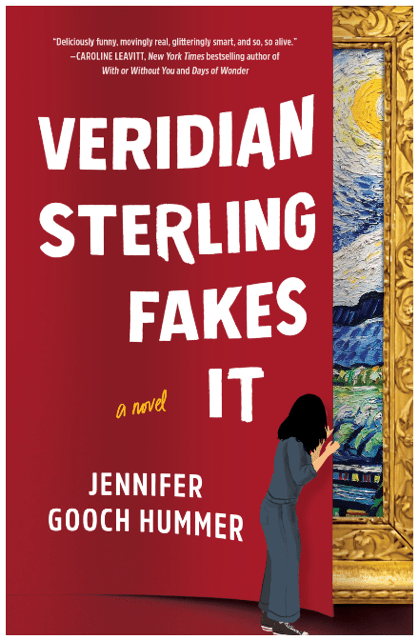
I won’t say that I was disappointed; it was sufficiently populated with interesting characters and situations and art-related historical facts that I read it with a certain amount of pleasure. But ultimately the book never really figured out what it wanted to be, and this lack of definitive direction made it a somewhat meandering and diffuse story with a lot of implausible elements and some clichés I could have done without. There are multiple different directions in which the author takes a few steps and then draws back instead of fully committing, which proves to be a frustrating narrative to read.
Veridian Sterling is a recent grad from the Rhode Island School of Design, with the typical hopes of everyone who excels in their art school classes and hopes that will translate into finding a gallery to display their work, interest (and sales) from the world of art aficionados, making a name for themselves…. And, like most art school grads, she quickly discovers that none of that is going to be forthcoming and that if she wants a place to live and food on her plate, she’d better find a “day job” to sustain her while she works on the rest of the dream. Veri has a job in the beginning at a laundromat/dry cleaners, but when she loses that she takes a position as an assistant at an art gallery that has rejected her paintings. The owner happens to be a former friend and roommate of Veri’s mother’s, when her mother was herself at RISD, and she is all too obviously modeled on Miranda Priestly from The Devil Wears Prada but without the icy demeanor and impeccable taste or, in fact, any redeeming qualities whatsoever. I found this character to be unnecessarily shrill and unlikeable and wished the author had chosen a different option.
We get a lot of stuff about working in the gallery and living her life, meeting an intriguing guy (the driver for a wealthy art dealer who visits the gallery regularly), discovering things she didn’t know about her mother, and various interactions with her best friend, all of which are overlaid with a level of stress that should be building up to something but takes an awfully long time to do so. By the time we finally get to the crux of the story (the mystery, the art crimes, the revelations), we’re just a teensy bit exhausted by the angst and the minutiae. Said plot point doesn’t even arrive until well past halfway through the book, and turns out not to be much of a mystery. While there was a build-up to what should have been the high drama, it felt like the stress level remained almost constant throughout, which did a big disservice to the revelatory bits.
In fact, while reading this book I was constantly reminded of one with a somewhat similar plot that I read and thoroughly enjoyed a few years back (in fact, I liked it enough to read it three times in six years!), so I’ll put in a plug for that one here. It’s The Art Forger, by Barbara A. Shapiro (see my review by clicking the title link), and that author achieved what I think this one was hoping to accomplish, by smoothly combining the multiple levels of mystery, art, and moral dilemma. One of the mistakes I think Hummer made was in attempting to include the slightly goofy humor and irony of such books as Finlay Donovan Is Killing It, by Elle Cosimano, but in trying to be all things to all readers, she couldn’t successfully pull together all the elements to make it work. So if you want a fairly lightweight version of the art forgery world, read this book; if you’d prefer an in-depth exploration of the same theme, go for Shapiro’s instead.
Finally, Christopher Booker famously made the case in 2004 for there being only seven basic narrative plots in all of storytelling and, having just finished watching White Collar, I do wonder whether part of this plot was a result of that coincidental symmetry or else this author did some binge-watching of her own….
 The Book Adept