The long way
I just finished reading The Long Way to a Small, Angry Planet, by Becky Chambers, author of the Wayfarers and the Monk & Robot books. This one is the first of four in the Wayfarers series, but it’s not obvious at all while reading it that it’s the start to a longer story. The only reason I might have surmised that is the overwhelmingly character-driven nature of this book, in which many things happen and lots of people/races are introduced but there is not a truly cohesive story line. That’s not to say that there isn’t a kind of evolution from the beginning to the end, but…is it a story? It feels more like a bunch of separate people’s narratives coming together simply because they are co-located in the enclosed space of a ship and a voyage, but while they do have an impact on one another, there isn’t the same kind of resolution that there is to a typical beginning-middle-end kind of tale with a sole protagonist.
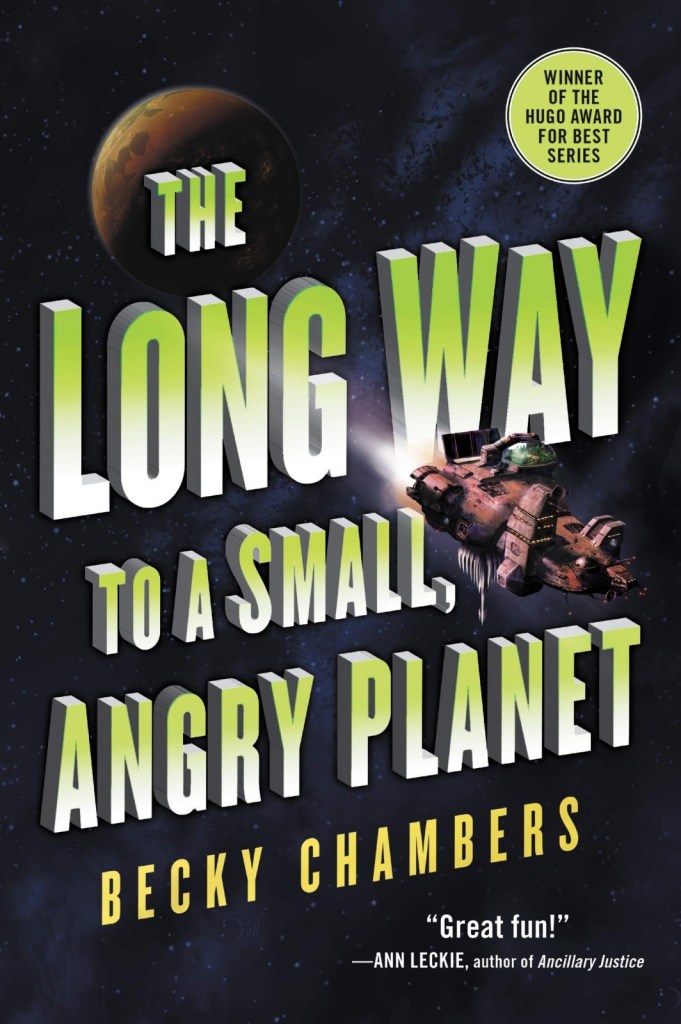
The event for which the book is named takes up not very much space in the overall timeline, which is kind of odd. Can you tell that I’m finding it a bit hard to review this book? I think it’s because, while I liked many of its diverse elements (including its diversity!), they didn’t gel for me in a way that would have made me love it. And although I liked and had empathy for its characters, I’m not sure any of them made the kind of impression that will make me want to read more about them in subsequent volumes. I finished the book with a certain degree of satisfaction, but it was more the feeling of “I’m good” than a compelling desire to keep going.
That is both the strength and the weakness of this book; because the story is about half a dozen (okay, maybe eight or nine) individuals who alternate in carrying the narrative, you learn a surprisingly extensive amount about the various kinds of “people” populating the universe without thoroughly investing in any of them. There are a few characters that have more page time and are therefore more engaging and involving than the others, but it’s a bit didactic in the way it goes about portraying everyone, and some of them end up being more cliché than person.

On the other hand, the number of issues and the depth and breadth with which they are explored is impressive, and not too heavy-handed. The involvement between species readily lends itself to discussions about topical and complicated subjects, from identity, sexuality, and violence to safety and defense, the implications of sentient artificial intelligence, and what constitutes “community.” I enjoyed the many variations of people (both their inner natures and outer appearances) that Chambers created, and the fact that none of them was stereotypical or relied excessively on science fiction that has gone before.
I guess I should give a brief synopsis, to be thorough, in case someone finds this blah blah intrigues them! It begins with Rosemary Harper, a human who is fleeing some personal issues and answers an ad for a position as clerk on the Wayfarer. It’s a tunneling ship, a kind of spaceship that creates wormholes to connect distant points in the universe so travel and trade can more easily take place between species. The story is set in a galaxy of aliens, with the humans being a sort of on-tolerance, minor group. There are a couple of older races with a history of expansion, cooperation, and development who have created the Galactic Confederation and brought in other member species at various points in their own maturity. There is a fair representation of these different species amongst the crew of the Wayfarer, and the philosophical bits of this “space opera” vehicle are about how they learn to cooperate and to appreciate one another. The ship is offered a contract to create a tunnel near the galaxy core that connects to a previously interdicted warlike species, and the build-up to and resolution of this contract is what drives the action, although this takes place late in the story (maybe at the 75 percent mark?).
The book isn’t for everyone; if you enjoy character-driven stories and envisioning complex alien cultures, you will like it, and the adventures of the Wayfarer gang do somewhat satisfy that yen for more stuff like Firefly. Despite its slow pacing, it was a fairly quick read, interesting and thoughtful but not taxing. Even though I’m not feeling it in this moment, I wouldn’t rule out continuing to follow the adventures of the Wayfarer crew in subsequent volumes, sometime later in my reading life.
Discover more from The Book Adept
Subscribe to get the latest posts sent to your email.

 The Book Adept
I LOVED these books! I loved the Monk and Robot books even more. Now I have to re-read them!
LikeLike