Slog in the woods
I just finished The God of the Woods, by Liz Moore, and perhaps my headline has telegraphed my reaction?
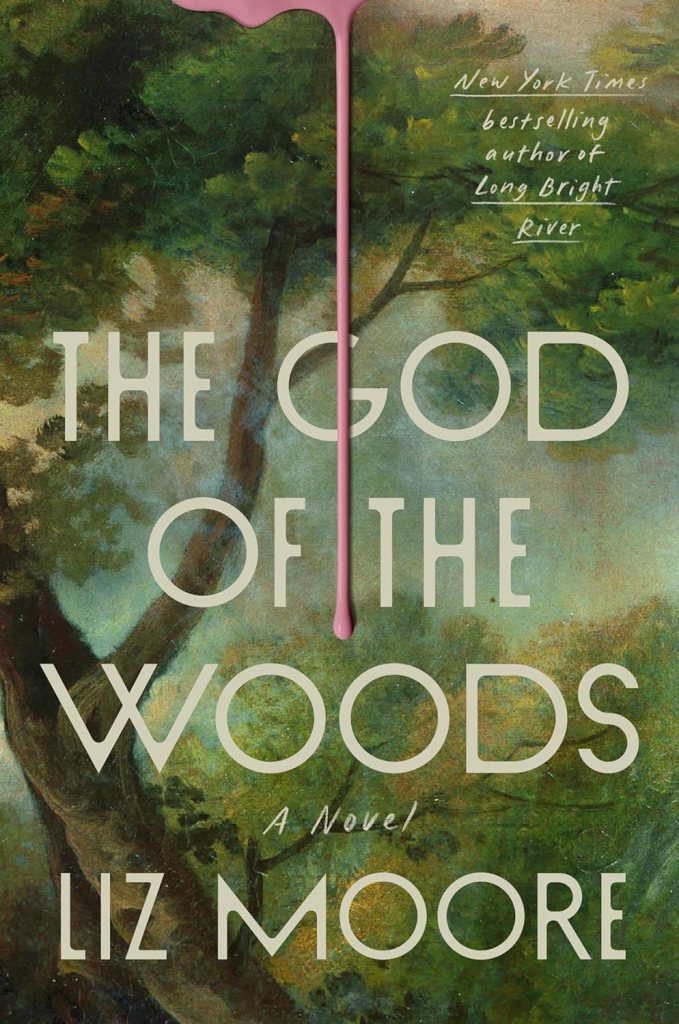
It’s not a bad book. It’s actually an intriguing story, at least initially. It takes place at a summer camp in the Adirondacks owned by the wealthy Van Laar family. This summer is the first time in three generations that any Van Laar child has ever expressed a desire to attend the camp, and ordinarily the family wouldn’t encourage their offspring to mix with the mundanes; but Barbara Van Laar has been such a problem for the past year or so that her parents are happy to put her in this controlled environment at a certain distance from home. She’s still close by—the camp is on one-half of the vast acreage owned by the family—but she’s not underfoot, sulking about in her all-black punk get-up, provoking her father and slamming doors, so all parties are happy with this solution. Until, that is, she goes missing.
Then we get the previous history of the family, which includes a son, Bear, who himself went missing (though not from camp) before Barbara was born, and was never found. A local man was blamed for his disappearance and assumed death, only to himself die before anything could be proved. The family believed he was the culprit, and let the whole thing go until Barbara’s disappearance sparks new interest in that similar set of circumstances, leading to speculation that someone else might have been at fault and is still out there preying on Van Laar children.
The problem is not with the storyline, it’s with how we glean each small morsel of information a teaspoonful at a time. There are seven points of view in this novel, and also a timeline that jumps from the ’50s to the ’60s to the ’70s (present day is 1975) to “day one” etc. of the search for Barbara, and both the narrator and the timeline switch in almost every one of the rather short chapters.
We get the story from the POV of Barbara’s camp counselor, Louise; from her bunkmate Tracy; from Bear and Barbara’s mother, Alice; from Judyta, a junior inspector on the case; from the widow of the presumed kidnapper of Bear; from the manager of the local motel at which the inspector is staying…. And it’s not just the current story regarding Barbara, or even the past story of Bear, it’s also the events leading up to the marriage of Alice into the Van Laar family, the relationship between that family and the managers (current and past) of the camps and with the police officers (current and past) of each investigation. The suspects include a boyfriend of Louise’s who is also the son of the Van Laars’ closest friends, who may have been double-dipping (or taking smorgasbord) in the pool of available females (including Barbara); we get the perspective of Jacob Sluiter, a serial killer (and an initial suspect in Bear’s disappearance) who has escaped from jail and is headed for the Van Laar preserve…kitchen sink doesn’t begin to describe the cast of characters here. The jumping around from person to person and era to era is disconcerting and ultimately offputting—or at least it was to me.
The resolution has a tender, ah-hah moment attached to it that made me momentarily soften toward the story, but there is also an implausibility about it that stuck with me longer than did that small detail, and I finished the book feeling frustrated—unsatisfied by the consequences meted out (or not) to various characters and dismayed by the cynicism surrounding the treatment of the rich vs. the “regular” people, even though I know that differentiation to be all too true in real life.
I do think that this is one of those books to which reactions will be diverse; certainly there are many people who adored it and gave it top marks. I will say that the writing is good, and the characters she develops beyond a certain point are believable and sympathetic; but much of the supporting cast struck me as cardboard clichés who took away from the total effect and made me wish they had either been developed more fully or left out altogether. I think a final pass by an editor determined to trim about 100 pages would have greatly benefited this book. It felt like the author couldn’t quite decide whether to write literary fiction, a mystery, or a full-on thriller, and cutting out some of the extraneous material might have propelled it towards a more defined identity. I was sufficiently engaged that I pushed to finish the book today before it went to the next person on the library check-out list tomorrow when my turn is up, but not so much that I will necessarily seek out this author again.
Discover more from The Book Adept
Subscribe to get the latest posts sent to your email.

 The Book Adept