One last book
I managed to fit in one more before the artificial barrier that is New Year’s Eve divides us from our past and pushes us into the future. Don’t we as humans have weird customs? I mean, I understand turning-point events like the solstices and equinoxes, where something actually happens (the day becomes longer, the night becomes shorter, or vice versa, the seasons change, etc.), but artificial constructs like New Year’s Eve/New Year’s Day are a bit baffling. It would seem more logical that the winter solstice would be the year’s turning point, but no, it’s 10 days later. Why?
Anyway, enough with the futile speculation; I read another book! And although I technically finished it on New Year’s Day, since I read 93 percent of it before the turn of the year, I’m counting it as last of last, instead of first of next.
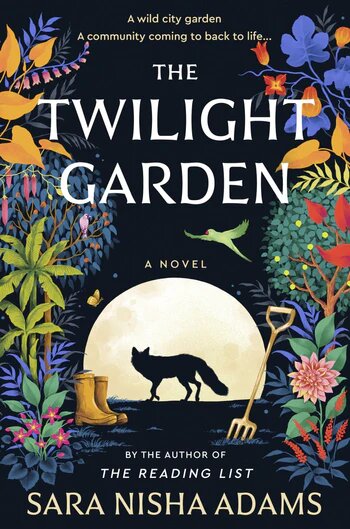
This one is called The Twilight Garden, by Sara Nisha Adams, author of The Reading List, which I previously reviewed here. That book caused a rather lengthy rant about all the things authors don’t know about librarians when they write their supposedly library-centered books; but while her research left a lot to be desired, she was a good storyteller and I like books about gardening, so I decided to give this one a try.
It takes place in a small neighborhood called Stoke Newington in the city of London, where two brownstone-like side-by-side residences (one owned, one rented) share a common garden space that was obviously at one point well cared for, but has been neglected by a string of tenants until it has become choked with nettles and bindweed, showing only faint outlines of its former glory. Living in one side of the property (renters) are Lewis and Winston, a couple who began as bankers at the same institution but who diverged sharply in their goals and aspirations when Winston decided the financial scene wasn’t for him and instead found a job as a clerk in a local grocery, while Lewis continued up the competitive ladder. On the other side (owners) are divorcée Bernice and her 11-year-old son, Sebastian (Seb), the mom prickly and privileged (Winston has nicknamed her Queen of Sheba) and the son friendly and disarming. None of them (except Seb) has any desire to spend a minute with the others and, in fact, Winston and Bernice have an initially adversarial relationship that annoys them both to no end. But when Winston, in the midst of life changes that make him desperate for something to occupy his time and his mind, begins laboring in the garden, prompted by some unexpected input, Bernice is first irritated but then intrigued. Soon the garden begins working its magic to bring these two and others together…
The book takes place with dual casts in two separate timelines, with the property as the unifying element; one timeline is in the 1970s-80s, while the other is (almost) present-day (2018-2019). With the exception of three people, all the major players are Indian immigrants or the children or grandchildren of immigrants, so there are some nice scenes featuring Gujurati cuisine and traditions accompanied by some less pleasant events tied to racism and prejudice. But the heart-warming scenes are far more prevalent than are the hints of discord, and the book is a lovely picture of what happens when people come together to celebrate their triumphs and share their losses while creating a beautiful garden that will have longevity. It’s populated by interesting and memorable characters and has enough specific gardening details to satisfy those who were drawn to it for that reason. A lovely read—not too heavy, but with plenty of depth. I also liked the perfectly narrative art of the cover.
Discover more from The Book Adept
Subscribe to get the latest posts sent to your email.

 The Book Adept