Water, water everywhere
I love dystopian and post-apocalyptic novels. I have a fairly long list on Goodreads of those I have already read, and I continue to look out for others amidst all the book recommendations I see online. Included in my favorites are A Boy and HIs Dog at the End of the World, by C. A. Fletcher; Starhawk’s Maya Greenwood trilogy set in San Francisco about the division of California into the good, bad, and ugly that includes The Fifth Sacred Thing (the best of the three); the seemingly neverending post-nuclear-war saga detailed in Obernewtyn and sequels by Australian writer Isobelle Carmody (that has taken her decades to complete); the weird and horrifying Unwind series by Neal Shusterman; and a few oddball stand-alones such as The Gate to Women’s Country and The Family Tree, by Sheri S. Tepper; Lucifer’s Hammer, by Larry Niven and Jerry Pournelle; and War Day, by James Kunetka and Whitley Streiber. I have about two dozen more on my list, and probably that many again that I still want to read. But Kassandra Montag’s After the Flood crossed paths with me purely by accident.
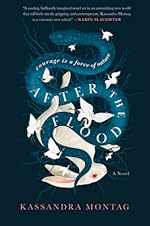
In December, I found a vendor on Etsy who put together cute “blind date with a book” packages including bookmarks, teabags, and a book, and thought this would be the perfect Christmas gift for a friend who seemed to be in an emotional slump; so I purchased the package and told the seller what book I would like her to include. Her response was to say that she didn’t take specific requests, but would try to accommodate if I gave her a list of preferred genres and some example titles. I felt that her advertising had been misleading, but ultimately went along with the program by giving her my friend’s favorite genres (romance and science fiction), with my sole request being that she send an upbeat story, since the whole idea was to cheer up my friend. Her choice was this dystopian novel by Montag, whose description alone should have warned her off.
After apologizing to my friend for this weird choice, I decided that I would read it myself to see just what she was in for; and after having finished it, I can say that it’s wholeheartedly depressing and that I’m really wishing I could get my money back. Not so much for me, but it definitely won’t be lifting my friend’s mood!
It’s set about 100 years in the future, when global warming has (presumably) done its worst…
We still called oceans by their former names, but it was really one giant ocean now, littered with pieces of land like crumbs fallen from the sky.
The ice caps melted and the water rose, first engulfing the coastlines and then, with the Six-Year Flood, the flatlands were likewise covered by water, and the remaining land consisted of mountaintops sticking up above the watery horizon. People fought to cling to the small settlements carved out of those elevated spaces, or they took to the water, living their lives on the sea and only docking to trade fish for vegetables, flour, fabric, and materials to repair their boats.
Myra and her daughter Pearl are eking out a precarious existence on their boat Bird, built by Myra’s grandfather when the water began to overwhelm their Nebraska farm. Myra’s husband Jason was so terrified of the encroaching floods that he decamped in a friend’s boat, kidnapping their five-year-old daughter, Row, while Myra was in her last month of pregnancy. Her grandfather and her mother didn’t survive the floods, and Myra was forced to set sail when Pearl was an infant still carried swaddled on her mother’s chest.
Now it’s seven years later, and Myra and her daughter are living day-to-day, keeping their heads down, avoiding other people for fear of their intentions. But one day Myra encounters a raider who inadvertently gives her news she never expected to hear; her older daughter, Row, is still alive, in a settlement up in Greenland. This hopeful news is offset by his comment that she’s nearly old enough (13) to be sent to a “breeder” ship, which is exactly what it sounds like; and Myra becomes determined to go and get Row, whatever it takes, to protect her from this fate.
Unfortunately, luck and nature are against her, and she has to team up with others to pursue her goals. But how many people is she willing (or right) to endanger to get what she wants?
The world-building in this book is excellent: visceral, realistic, and detailed. The disintegration of the moral integrity of desperate people also rings true, and many of her characters are compelling. But…there were a few things that work against elevating this to among my favorite dystopian novels. I found myself disliking the main character quite a bit for her ever-shifting moral compass and especially for all her justifications; so living inside her head in order to follow the story proved both exhausting and occasionally distasteful. And while the synopsis given by the publisher promises to serve up hope along with the angst, it seems like there is pitifully little room for that amidst all the catastrophe, and I didn’t feel like the end of the story justified the means.
Still, it was fairly engrossing, especially in the action-packed parts, and it also painted a poignant picture of the joys, the pains, the requirements of motherhood. So I would recommend it as a solid dystopian tale, but I wouldn’t rank it in my top ten.
Discover more from The Book Adept
Subscribe to get the latest posts sent to your email.

 The Book Adept