Still waiting
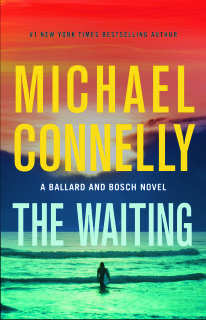
I finally picked up Michael Connelly’s latest, The Waiting, which features Detective Renée Ballard, backed up in one of the three plotlines by the retired Harry Bosch and in another by his daughter, Maddy, a fledgling police officer. And my title refers to the feeling that I am regrettably still waiting for this new protagonist to take off and give me the same fondness for Connelly that I have had throughout Harry Bosch’s long and checkered career and also that of Mickey Haller, the Lincoln Lawyer, in that side series.
Alas, after this fourth (fifth?) book featuring Ballard, I’m thinking that once Harry is well and truly no more, I will be letting this series slide off my TBR list. At this point, Ballard feels irretrievable to me; I believe Connelly’s best bet would be to dump her and start fresh with a brand-new protagonist who has absolutely no associations to previous characters (and therefore doesn’t suffer by comparison).
It’s hard to say exactly why I verge on disliking Renée; but it’s more than just that she’s not Harry. As I mentioned in a previous review, I was open to the switch to her quirky, nomadic character in the first book, when she was living on the beach in a tent with her dog and gave almost equal importance to surfing that she did to police work; but once she was integrated into the system, she became almost immediately boring. She has no life, she has no friends (even her relationships with her co-workers being either adversarial or more transactional than comradely), she is constantly reckless on the job but then inexplicably irritated that management doesn’t view her favorably or even benignly, and she’s a terrible dog parent! Honestly, she’s kinda toxic. Harry was also a rule-breaker, but his motivation was almost always clean: It was all for the sake of solving the case, helping the victim, catching the criminal. Ballard, next to him, seems calculated and kind of manipulative; she complains about the politics, but then fully enters into them to get what she wants.
I didn’t love any of the three plot lines in this one either. In the first, Renée’s car is broken into while she’s out on the water before work, and rather than simply report the theft of her wallet, badge, and gun, she decides that it’s a potential career ender (although it wouldn’t have been had she not given her superiors and colleagues reason to be exasperated with her consistently erratic behavior) and involves multiple people in surreptitious plotting and planning to get them back without anyone in power finding out. Even though it leads to a major take-down of dangerous people, it was so shortsighted in its motivation that it irritated me. She brings Harry in on her convoluted plotting to mask her own involvement, then wallows in guilt in case he gets hurt. I think this is one of those reasons for dislike of the character: She can’t herself decide who to be, so as a reader it’s hard to fasten onto some character trait to love.
The second plotline is initially gripping; a cold case that the Open/Unsolved Unit has been exploring via volunteer Colleen’s genealogy and DNA studies yields a familial connection to a serial rapist who terrorized the city for almost five years and then abruptly went inactive 20 years ago, and if the connection is correct, the rapist is a political hot potato. It could be a sensational “win” for the beleaguered unit, but then things take an unexpected (and less interesting) turn and the case is dragged out for the rest of the book only to be resolved quite abruptly in the last 20 pages.

Likewise, the involvement of Officer Madeline Bosch feels contrived, and her personality and participation are so muted that I could have wished this were simply omitted. Perhaps Connelly’s plan is to substitute Maddy for Harry now that Renée isn’t doing so well in the ratings, but if he’s going to do that, he has to get her off “the beat” and into a detective job in a hurry, which means doing some career short-cutting. What better way to achieve that than to have her volunteer for the Open/Unsolved Unit with the specific motive of solving the most notorious cold case in Los Angeles history? Like I said, it felt contrived.
All the other characters in the book, from the captain and the chief to Ballard’s volunteer co-workers to the FBI guys remained essentially cardboard characters, serving only as foils for the main characters, and not great ones.
I’m feeling like a huge curmudgeon—here she goes with another “damning with faint praise” review—but honestly, it’s been so long since an author and a book really knocked my socks off that I’m starting to believe that either they don’t exist or that I have become so hard to please that it will never happen again. I hope neither of those is true. I started this blog to encourage people to read, not to turn them away from books they might potentially enjoy!
Anyway, I’m also hoping Connelly will back himself out of this trajectory and pick a new one, because he’s been a good story-teller with a lot to offer throughout the Bosch and Haller years and I want that to continue. But I don’t think it’s going to happen if he sticks with Ballard.
Discover more from The Book Adept
Subscribe to get the latest posts sent to your email.

 The Book Adept
I don’t read analytically, and am easy to please if my favorite characters appear, but I also felt this book was disappointing. I appreciate your observations.
LikeLike