Hallmarked for letdown
I recently completed The Hallmarked Man, number eight in the Cormoran Strike detective series by “Robert Galbraith.” (I wish J.K. Rowling would just let go of the alias and publish these under her own name; it’s messing with my alphabetical filing.) More than once I harked back to the previous book, The Running Grave, while reading this one, because with that book I had a “Frenaissance” (as Phoebe Buffay calls it) with this series, and was so hopeful that things could only get better from there on out. Alas…no.
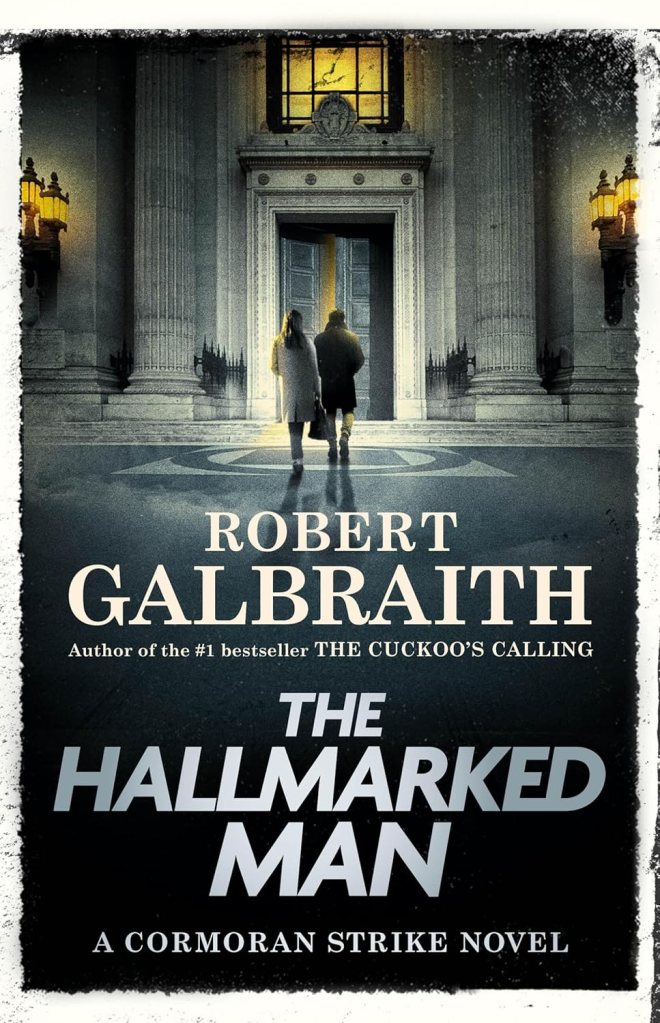
You have to maintain a real and dogged commitment to this series if you are going to read it, because each book is more than 900 pages long. I don’t mind a long book; in this series, it has made it possible not only to thoroughly explore the main mystery but also to feature other, minor ones that take up the daily functioning of the Strike and Ellacott Detective Agency, while leaving ample room for personal relationships not only between the two protagonists but also among all sorts of hangers-on, both staff and client alike, and I usually enjoy the variety contained within the larger story.
The series has, for the most part, kept a nice balance between the professional and the personal and, even if I didn’t enjoy a particular story line, I was always drawn in by the continuing evolution of the relationship between Cormoran and Robin. But this book felt like a giant misstep on almost all fronts and, while I enjoyed parts of it moment to moment, I was left feeling frustrated and dissatisfied with where we arrived by the end of it.
The mystery was so convoluted and the cast of characters so confusing that it felt like Rowling should have created the equivalent of one of those family trees that historical fiction writers often include in their books so that you can keep all the generations and their spouses and children straight. Someone is murdered and gruesomely mutilated and, because of the method, it’s hard to figure out who it is. The police have settled on one theory, but a woman comes to the agency convinced that the victim is her missing boyfriend and wants them to prove that it’s him, not the person the police have identified. In the course of the book, potential victims multiply until there are four or five possibilities, and to each of the victims is attached a cast of characters that must be interviewed to try to determine if he is the one; but the witnesses are almost as elusive as the putative dead men, and the story becomes an exercise in frustration. Add to that some red herrings about secret societies, the porn industry, human trafficking, and MI5 involvement, and it’s all just too much.
As if to take a cue from that, the personal lives are likewise chaotic, and the most disappointing part of the relationship between Cormoran and Robin is its repetitiveness. In the last book both of them seemed to have grown and, with the cliffhanger last time, I expected their relationship to be resolved or at least moved along. Instead, Robin’s boyfriend Ryan Murphy becomes her husband Matthew 2.0, if a bit nicer and less whiny, and Robin has reverted to all the self-deception and self-doubt she exhibited several books back, but with a new partner. She knows, deep down (or maybe not even that deep!) that she doesn’t want to be with him or have his children, yet she keeps deceiving herself that she loves him (as well as stringing him along). She also spends far too much time doubting Strike and putting moods and motivations on him without either his knowledge or participation.
On Cormoran’s side, the dithering becomes maddening. He has come to realize what he wants (Robin) and plans to reveal this to her, but he lets every minor misstep come between him and that revelation, and makes things exponentially worse with every hesitation. It’s all miscommunication, misunderstanding and angst. The upshot is that we end up in almost the same place we left off and, with the acknowledgment that they have now worked together for almost seven years, I for one wonder if continuing to ship them is even worth it.
The problem with a review like this is that it may turn people off to reading the series if they haven’t begun it, or to stop before assaying this chapter. I wouldn’t go that far; it’s not an irretrievably bad book, and it is, of course, necessary in order to understand the progression of both the agency and the relationship…but I’m not enthusiastic about it. When I first finished it I felt the need to turn around and reread it to pick up on all the stuff I had missed, but I didn’t love it enough to do so. That pretty much says it all. Disappointed after such a long wait, and hoping for a better outing next time…
Discover more from The Book Adept
Subscribe to get the latest posts sent to your email.

 The Book Adept