Short but jam-packed
As I have mentioned here before, I am generally not a reader of short stories. The last time I blogged about a couple of them that I picked up for my Kindle, I commented that in the future I would resist temptation even if they were written by authors I admire (those two were by Alice Hoffman and Margaret Atwood, so the star power was bright) because I found the brief format unsatisfying, no matter who wrote them. But I didn’t keep that resolution, and this time I’m glad I didn’t, although, alongside the satisfaction they gave me, I still feel a little frustration for the attenuated content.
First I was offered one by John Scalzi, who is one of my latest favorite science fiction authors and, when I saw it was about time travel (a particular fascination of mine), I couldn’t say no. Then one popped up by Alix Harrow, who has written three books since 2019 all of which enthralled me when I read them. This one had a knight in the title, so I assumed it was fairy tale-ish and therefore likely to please me, but it turned out to be something I like even better—a dystopian story.
Why, then, did these impress me so much? In trying to dissect that, the first thing that occurred to me was their immediate impact. In less than a page I knew that I couldn’t stop reading. Part of this is due to something novelists and readers have discussed for years (or millennia or eons): the first line.
When I think of a famous first line, the one that most immediately comes to me is “Last night I dreamt I went to Manderley again.” That’s the opener for Rebecca, by Daphne du Maurier, and if you ask readers on a Facebook page dedicated to books, it’s one that is often quoted. Others that crop up frequently are “It is a truth universally acknowledged, that a single man in possession of a good fortune must be in want of a wife” (Pride and Prejudice, by Jane Austen), and “Call me Ishmael” (Herman Melville’s Moby-Dick), “Happy families are all alike; every unhappy family is unhappy in its own way” (Anna Karenina, by Leo Tolstoy), or “It was the best of times, it was the worst of times…” (A Tale of Two Cities, Charles Dickens). These are all from classics, but there are many others nearly as famous that source from books that are popular, perhaps well known, but not considered in that pantheon, such as “I write this sitting in the kitchen sink” (Dodie Smith, I Capture the Castle), or “When Mary Lennox was sent to Misselthwaite Manor to live with her uncle, everybody said she was the most disagreeable-looking child ever seen” (The Secret Garden, by Frances Hodgson Burnett) or “We were somewhere around Barstow on the edge of the desert when the drugs began to take hold” (Fear and Loathing in Las Vegas, by Hunter S. Thompson).
I cite all these because they have the unique ability to cue you to a lot of what’s coming in one simple phrase. You immediately want to know: What or where is Manderley? who is the dreamer? Why did they leave Manderley in the first place? You want to argue that perhaps the last thing a single man with a good fortune might either want or need is a wife to spend it! If you have any Bible knowledge, you get all the deep connections to the name “Ishmael.” You instantly begin debating whether that statement about families and happiness or lack of same is true—you think about your own, and then you want to know why the author has embraced this premise. If you know that A Tale of Two Cities is about the French Revolution, then it must have been a bad time, but then wonder how being in the middle of a war could also possibly be the best. You ponder why someone would write while sitting in a sink; you immediately perceive that this person might be out of the ordinary and therefore worth cultivating. You want to know why Mary had to go live with her uncle, and what it was that made her disagreeable—was it that, or something else? You think about someone driving across Interstate 40 in a drugged state and are presuming you probably know what will happen next, but you don’t…so you keep reading.
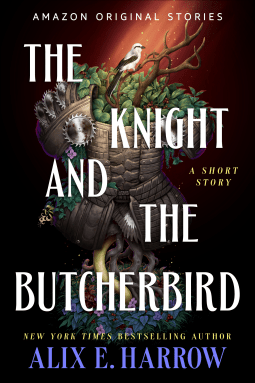
Alix Harrow’s story, “The Knight and the Butcherbird,” begins:
Once upon a time,
a knight came riding into the holler.”
It is immediately arresting, because it’s like that game where you see a group of pictures and are asked the question, “what one thing is not like the others?” The “Once upon a time” and the “knight” immediately set you up for the expectation of fairy tale; but there are few areas in the world where someone would call a small, v-shaped, riverine type of valley a “hollow,” and when that gets transmuted to “holler” you know you are in southern Appalachia, most likely in West Virginia. So, what is a knight (presumably wearing armor to distinguish him as such) doing riding into Appalachia? The disconnect drags you in and glues your eyes to the page.
In the next paragraph you find out it’s been 300+ years since “the apocalypse,” that the knight is expected (people are standing around waiting for him), and that the protagonist is a misfit in her community (“I stood among them like a tumor at a birthday party: silent, uninvited. Likely fatal.”)
In the third, you get a picture drawn of the knight—specifically his armor, sewn of fine black steel-corded tire treads, the rusty state of his pauldrons, and the fact that he was “crazy old, maybe even fifty.” He is a Knight of the Enclaves, “tall, raised on multivitamins and clean meat.”
This is all on the first page, and tells us that: something terrible has happened to the world; there are survivors in a backward corner of it who are in need of assistance; and from “somewhere else” there is a person characterized as a knight who has come to help them with their problem. I could immediately, viscerally picture the poor, raggedy, sickly people (the ones raised without the vitamins or untainted protein) standing around at the mouth of their small valley home, waiting patiently for a hero to arrive; and I could also perceive the colossal impact of the knight’s presence.
Wouldn’t you want to keep reading?
John Scalzi’s story “3 Days, 9 Months, 27 Years” doesn’t start with quite such an arresting contradiction, but for a science fiction fan and time travel junkie, it still dragged me in:
The time machine is, in itself, not much to look at.

The remainder of the paragraph goes on to describe its physical appearance, concluding with “At the far end is a portal. One takes the client away. The other brings them back.” With this it is established that time travel has become a business (thus the clients), and that the narrator is probably the operator of the machine (confirmed in the next paragraph). The next page and a half describes in extremely simple terms what happens in the chamber when someone takes a trip and comments that, once the client has returned, “Where they go after that, like where they go when they walk through the first portal, is not specifically my concern. I am here to run the time machine.” The client, however, “has aged three days, or nine months, or twenty-seven years. They have been through a time machine, after all. This is how the time machine works.” Then, however, the operator, who sounds like he is describing the daily duties of a fairground carousel operator, comments that this is the theoretical process, but that is almost never what actually happens. “Theory is almost never practice.”
Could you put it down after that leading sentence? I couldn’t.
I’m not going to go into any more detail here on either story; I will just say that there is an exception to every rule, and I’m glad I made these exceptions to my “no short stories” one. They are special cases because they do absolutely everything that a good novel does: They each have a clearly worked-out premise; they are both amazing at both world- and character-building in the space of a few short sentences or paragraphs; there is a set-up, a conflict, and a resolution; and, best of all, they made me think about issues I had never considered, despite being a long-time reader of fairy tales, dystopian/post-apocalyptic fiction, and time travel theories. I finished both of them two days ago, and they keep on wandering through my mind, inspiring more questions. And yes, one of these is to ask the authors “Why not write the BOOK?”—but many more of them are diverting inquiries into the nature of time, anomalies, and serendipity, or thoughts about the eventual evolution or dissolution of humankind, depending on the paths taken (or not).
Thank you, John Scalzi and Alix Harrow. Keep writing.
Discover more from The Book Adept
Subscribe to get the latest posts sent to your email.

 The Book Adept