The comforts of formula
Many writers of series (especially the ones with recurring themes, such as mysteries) fall into a pattern with their books—what one would call a formula. Depending on how well they perform within the confines of that formula, it can be either immensely satisfying to discover a story with all new characters and situations that is nonetheless comfortingly familiar, or it can quickly become tediously repetitive and cause you to seek out fresher fare. The books of Dick Francis, in my opinion, mostly fall into the former, positive category, and I have been re-reading some of my favorites lately when there seemed to be a dearth of new books to enjoy. (I’m sure they were out there, I just wasn’t finding them, and the frustration at my lack of success sent me back to some old familiars.)
The genius, if you want to call it that, of Francis’s books is that they all revolve around horse-racing, but within that broad context he explores many different aspects and occupations contained within or sometimes just adjacent to that world. So while many of his protagonists are jockeys or former jockeys, there are also books in which the main character is a horse trainer, an owner, a groom who escorts horses when they must fly overseas to far-flung racing meets, a sports photographer, a wine merchant, a banker, a jeweler…and he manages nonetheless to set all the stories in the world of horse-racing.
You do need to know that, based on the time period in which most were written (he began in 1962) and adding that to the upbringing, work ethic, and societal circumstances of the author, there are some features that may grate on a contemporary reader—chauvinistic or stereotypical assumptions about men’s and women’s roles being the most prominent. But if you can put those into the timeframe and mindset in which they were written, you can still gain much enjoyment from his tales about the world of horses. Also, because his female characters do have definite personalities and quirks, the macho nature of his stories is much less problematical than those contained within, for instance, the Mitch Rapp books of Vince Flynn (wherein all women wear pencil skirts and “high” ponytails!).
Whatever his profession, the protagonist is usually a competent (and more than usually clever) man connected somehow to the world of British horse-racing who becomes involved in some kind of quandary: a crime, a conspiracy, an act of violence. He is often reluctant to become involved, but is propelled by his ethics and innate sense of fairness to put things right. The villains are typically people who are outwardly respectable or even admired, but in truth are ruthlessly involved in some type of corruption—fraud, kidnapping, sabotage, murder. Despite not being a professional detective, the protagonist rather methodically uncovers the truth about these people and their misdeeds using a combination of intelligence, expertise, and resilience. He never makes it through entirely unscathed, usually coming up against the villains and their flunkies at least once or twice, when he is either physically or psychologically punished for his “nosiness,” surviving beatings, torture, financial ruin, or some form of betrayal. He ultimately manages to expose the criminals while surviving whatever retribution they have to offer.
Francis almost always manages to add in at least one romance for his amateur sleuths, and there is a fair amount of humor of the dryer Brit variety involved as well. He is also good with his descriptions of specialized professions or hobbies, bypassing the temptation to information-dump by placing the reader right in the moment in which the action occurs.
I have written about Francis and his books before, but felt the need to mention them once more because periodically re-exploring them gives me pleasure and perhaps, should you choose to read a few, might give some to you as well. The majority of the books are stand-alone one-offs as regards the personnel, but he does have a series of four about a former jockey named Sid Halley, and a duo involving trainer/rider Kit Fielding. So look out for those and read them in order if you come across those first.
Feel free to add a comment about series or authors whose books you find lend themselves to reading more than once or twice!
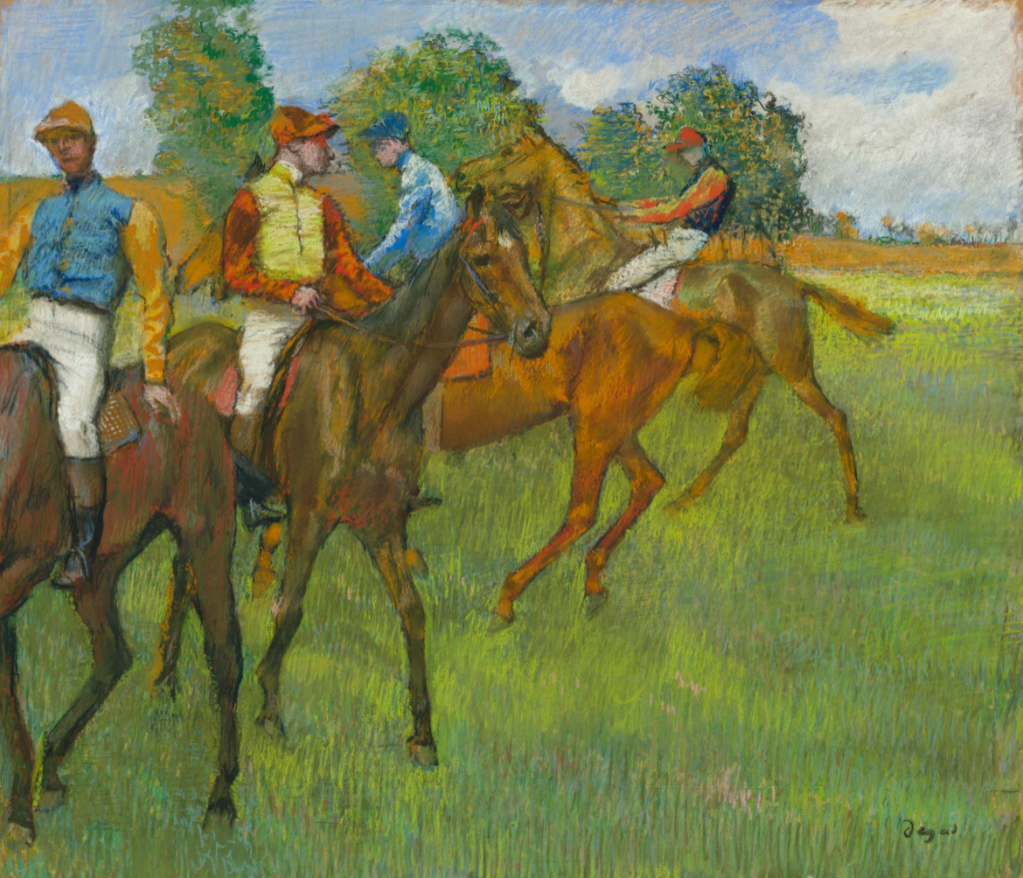
The art is “Before the Race,” by Edgar Degas, charcoal and pastels on paper.
Discover more from The Book Adept
Subscribe to get the latest posts sent to your email.


I read and re-read all my Francis books to absolute pieces. A few years ago, I decided to revisit them and was pleasantly surprised at how well they held up. The Sid Halley books are my favorites, but I think Proof deserves special mention as well.
love love love that Degas piece!
Two of my most-re-read series are the Murderbot Diaries by Martha Wells and, believe it or not, the Sookie Stackhouse books by Charlaine Harris. Both are even better as audiobooks, with outstanding performances by the narrators.
LikeLike
I liked the Sookie Stackhouse books a lot and read all of them, but my favorites from Charlaine Harris are the Harper Connelly series of four. If you haven’t read them, check them out and tell me what you think. I also like her new series about Gunnie Rose.
LikeLike
You like mysteries more than I do. I found the Harper Connelly books just kind of dull, and while I liked Gunnie Rose at first (maybe the first three?) I felt like it went off the rails after a while.
I loved her Midnight, Texas series.
LikeLike