Silence is golden

I picked up The Silent Patient, by Alex Michaelides, on the basis of a bunch of enthusiastic reviews by people on two Facebook reading group pages, and after finishing it, I have to ask…WHY?
I’m not going to use up a lot of space on this one. You may decide to read it anyway, and be as enamored of it as the many who gave it five stars on Goodreads. But here are my thoughts:
The main character is a psychotherapist, but his actions in this book lack any credibility, and in fact may well do a disservice to those who are considering therapy. It’s not the character himself (although I found him to be an unsympathetic one practically from the first page), it’s the lack of knowledge exhibited by the author concerning mental health diagnoses, treatments, and medications. Yes, it’s fiction, and in some instances I would say, Read it for the plot, the suspense, the twists, and don’t pay too much attention to minor inaccuracies; but this book goes too far. The drugs he mentions don’t act as he says they do. The treatment methods are slipshod and would never be tolerated by any facility for whom a licensed psychotherapist would work. The procedures in the supposedly locked and secure facility are laughable. The personal interactions between doctors and patients, doctors and doctors, spouses, and strangers on the street are not believable.
Aside from that, the characters are wooden, the plot is all over the place—including half a dozen unnecessary sub-plots that are nothing but blatant red herrings to distract you from what the other hand is doing—and there’s a fair bit of misogyny exhibited by most of the male characters, and uniformly negative portrayals of the female ones.
My headline for this review may be misleading: You could have taken it to imply that this book with “silent” in the title is golden, i.e., I’m recommending it. You would be wrong. While it may have turned out to be golden in terms of profits, my sole piece of advice would be to take it off your TBR list and breathe a sigh of relief that I saved you from wasting valuable leisure reading time.
Third time continues the charm
I just finished Alix Harrow’s third full-length novel, Starling House, and was nearly as taken with it as I was by her other two (The Once and Future Witches, and The Ten Thousand Doors of January). That’s saying something—if you read my reviews, you will know how blown away I was by every aspect of those two amazing stories.

This one is perhaps not as original an idea as either of the other two; instead, it takes some trope stuff and makes it fresh and interesting. It’s a combination of a Southern Gothic fantasy/horror hybrid and a coming-of-age story, and has a lot of levels.
In some ways it is a commentary on the bigotry and trauma one encounters as an outsider in a small town, particularly a small “company” town in the deep South. This one is Eden, Kentucky, and the town’s reason for existence is the working of the coal mines owned by the Gravely family. The town and its residents are either singularly unlucky or the story of a curse is true, because a sadder and less hospitable place could scarcely be conceived. The supposed origin of the curse is tied up with the history of E. Starling, a 19th-century children’s book author who was married to one of the three original Gravely brothers, wrote a story about a creepy place called Underland, built a mansion for herself after her husband’s death, and ultimately disappeared. Starling House has since been host to a number of owners, all of whom show up just when the previous owner dies or leaves, but such is its unsavory reputation that the people of the town cross the road rather than walk on the sidewalk near its gates.
The book revolves around Opal, a young woman who has never caught a single break. Her mother died in a car crash when she was a child, and she and her younger brother Jasper have continued to live in the motel room where they landed shortly before her death. Opal works a minimum wage job at the local hardware store, trying to save enough money to get her brother, a smart young man with debilitating asthma made worse by the miasma that hangs over the industrial town, into a private high school far from the environs of Eden; but there’s scant hope of that until she gets a job as a cleaner for Arthur Starling. She’s heard all the rumors about both the house and its owner, but she’d do almost anything to get Jasper the chance he deserves in life, so she begins the task of bringing this house full of dust and cobwebs (and other, more sinister things) back to life. But the feeling of sentience she gets from the house and the weird vibes coming off of Arthur, who seems alternatively tortured, coldly aloof, and strangely sympathetic, are getting under her skin, and she’s wondering where it’s all going to end…
You could scarcely find a less likable protagonist than Opal, but she somehow endeared herself to me. Maybe it’s because every small victory she has is so hard-earned that it’s almost not worth it, and you can feel the palpable intensity of her longing for things to change and her simultaneous hopeless conviction that they never will.
The best thing about this book for me was the language. Admittedly, it’s sometimes over the top or overly descriptive, but there are moments that struck me so forcefully that I marked them in my notes on my Kindle. Alix Harrow knows how, with one phrase, to invoke a memory or even an entire phase of life, as with this one, where she is describing some symbols incised into the wood of a door:
The carved symbols are still very slightly luminescent, like glowsticks the day after a sleepover.
I read that one sentence and jumped back to a moment in childhood: We were in someone’s yard at dusk, at the end of a birthday barbecue. We all cracked glowsticks that had been passed out by the birthday girl’s mother, manically waving the neon tubes and dancing around, lighting up the dark. By the next day, most of the chemical inside the sticks had finished its reaction and was subsiding, but there was still a dim glow to them if you turned out the lights in a windowless room.
The biggest flaw in the story for me is the revelation that Opal is 27 years old. Her character, while honestly and intricately drawn, seems more typical of a teenager—16, 17, maybe 18 tops—than of a young woman approaching her late 20s. Honestly, this book works better as a young adult novel, both in its characterizations and in the way the story is couched in a particular kind of gritty magical realism. But since I am a big fan of good young adult literature (note the emphasis on good), that’s fine with me. I simply decided to forget Opal’s age and read it as it reads. There are other problems—unresolved plot points, underutilized characters, unexplained mysteries—but ultimately it all worked for me, with its beautiful prose, interesting characters, and slow-burn sense of menace.
Reliable, still fresh

I just read Michael Connelly’s latest, the seventh in his books featuring Mickey Haller, the Lincoln Lawyer, and I was pleased and satisfied by Resurrection Walk. Those who follow/read this blog will know that I have expressed some degree of dismay about where the Bosch books are heading, with possible successors trying to take over but without either the pizzazz or the character depth that are inherent in Hieronymus “Harry” B. But Connelly has managed to map a new route for Haller, using as a starting point the exoneration of Jorge Ochoa from a previous book. Mickey got such a buzz from reopening that innocent client’s case and freeing him from prison that he has decided this will be a regular feature of his practice, his pro bono contribution to being a defense attorney. He calls the results the “Resurrection Walk,” because the person without hope gets to emerge from prison to walk free again. And he has enlisted veteran police detective and half-brother Harry Bosch to be one of his investigators.
Since Harry has such an aversion to helping the “other side” (defense) after a long and storied career as prosecution’s darling, he and Haller have agreed that he will only serve as a clearing house, and not take an active part in the actual defense process. Even though Harry is retired, he has a care for his reputation as a dogged seeker of justice for the criminals he has apprehended, and he also realizes that his participation for the defense could have repercussions for daughter Maddie, who’s just coming up through the ranks at LAPD. But after sorting through the pile of letters received by Haller from dozens of the incarcerated who maintain their innocence and are looking for his help, Harry finds one that rings true, and is drawn into a more active role.
He looks through the case of Lucinda Sanz, a wife and mother who was convicted of the shooting death of her ex-husband, sheriff’s deputy Roberto Sanz, and realizes that there is a lot of unexplained and unexplored territory in her case. The laser focus on her from the sheriffs’ department as the perfect and only suspect triggers the hairs on the back of Harry’s neck, and he tells Mickey he thinks they have a winner. The fact that they will now be pitted against a bureaucratic entity determined to protect one of its own makes the case a tricky one, ultimately fraught with danger for all involved.
Although the essence of Harry was, once again, a little bit lacking—he was portrayed somewhat woodenly, as has happened before when he is the secondary, rather than the main, character—it was less a problem this time, and the interactions between he and his half-brother and current employer were more characteristic. For instance, Harry agrees that he will be Mickey’s driver while they are investigating a case, but only if Mickey sits up front in the passenger seat, because Harry’s dignity won’t allow him to be cast as chauffeur. As far as the central mystery goes, it is often Harry’s intuition that brings out the facts necessary to make the case, although it is Mickey’s talents as the concocter of labyrinthine defense moves that ultimately wins through. The book has great suspense, with a lot of setbacks and some perilous moments, and ends with the promise of a twist in the future for Mickey. This is a solid and entertaining entry in Connelly’s franchise.
Parenthetically, if you are an Amazon Prime member and a Connelly fan, I can’t stress enough how wonderful is the “Bosch” series starring Titus Welliver in the title role, with fantastic portrayals of all the supporting characters by an array of both well known and relatively unknown actors. The TV series is pretty closely based on Connelly’s books in sequential order, and is every bit as involving. There are seven seasons of Bosch and, just when you sorrowfully get to the end of that binge, you discover that there is a new show, called “Bosch Legacy,” which has a somewhat narrower focus on Harry, his daughter Maddie, and defense attorney Honey Chandler. There are two seasons so far, with one more to come. I understand that there will also be a spinoff series featuring Detective Renée Ballard, hopefully with Welliver etc. still serving as secondary characters.

The test of a good book

When I first read The Gravity of Birds, by Tracy Guzeman, in 2013, I said, “This is one of those books that I wanted to turn around and read again as soon as I finished it.” After having read it for the second time 10 years later, I experienced the exact same impulse as soon as I turned the last page.
There can be a few reasons for doing that:
1. You liked it so much that you don’t want to be done;
2. It was so complex that when you got to the end you said, Hey, wait a minute…and went back to see if you completely understood how to get to where you “got”;
3. You wanted to wallow more in the writing or the characters or the imagery or the story.
Parts of all three of those play into my desire to start over. Paradoxically, this is a fairly simple story, and simply written, yet the complexity of human emotions and betrayals involved made it intricate and nuanced, as does the language.
A reclusive artist who quit painting 20 years ago summons an art authenticator and an art historian who has documented the artist’s career to reveal to them that there is a painting of his that no one has ever seen. It is a triptych that includes a self portrait of the artist, Thomas Bayber, with two young girls. Bayber has the main central panel, but the two side panels are missing; he wishes to sell the work, but will only do so if it is complete, and he tasks the two men with locating the other panels. The pair set out on this quest, but the historian, intimately familiar with Bayber’s foibles, soon realizes it’s not just about the paintings but about the subjects contained within them; Bayber wishes to track down the “girls,” now in their 60s.
Natalie and Alice Kessler (19 and 14, respectively) are sisters, spending a month with their parents at a cottage by a lake, next door to the precociously talented painter, Thomas Bayber (28). The family befriends the young man, but there is a special bond between him and the young Alice, who is just beginning a lifelong challenge from rheumatoid arthritis. Their friendship is resurrected eight years later when Alice is on the cusp of some life decisions and goes back to the cottage for a contemplative weekend, unexpectedly encountering Thomas, who is on the outs with his family and staying next door again. Their relationship shifts to something more intimate until Alice figures out something from the past that causes a permanent rift, and there is no contact between them for 30-odd years. Meanwhile, Natalie keeps her thoughts to herself…
The characters are complex and three-dimensional, especially the sisters. But there is a lot of set-up and it took a long time to appreciate their subtleties, so once I did, I wanted to spend more time understanding them than the author had given me.
The imagery is powerful and descriptive—I so wanted the artists in this book to be real, so that I could look them up on the internet and see their paintings and sculptures. I could almost picture them, but I wanted to see them “IRL,” as they say.
The story took place on a triple timeline in multiple locales, so I felt the need to go back and check exactly when certain things happened and who knew what at the time they did.
It was a compelling first novel, but although Guzeman mentions in her afterword that she is working on another, none has been forthcoming. It would be a shame if this author never wrote anything else; but this book is a solid accomplishment that can stand as a testament to her talent. An evocative book that will stick with you.
Quiet transformation
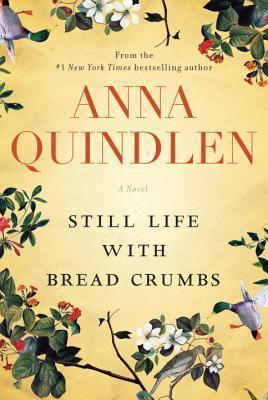
Still Life with Bread Crumbs, by Anna Quindlen, is a book that doesn’t have an initially heavy impact, but it sticks with you. It’s about a woman in a situation to which many of us in our 60s can relate: We were “somebody” once (or if we weren’t exactly prominent, we were at least identified as a certain kind of person who does a specific kind of thing, whose identity is wrapped up with that activity), and now we’re beginning a downsizing of that role; and this narrowing could be an end, or it could be an avenue for change, depending on how we react to it, how we see it through, what we are willing to allow.
Rebecca Winter was a famous photographer who produced iconic images relating to womanhood and motherhood—views of common items that grew in importance to express a certain kind of lifestyle or mindset in those who viewed them. Once, she was revered, sought out, exhibited, solicited for new works, invited to lecture, sometimes even recognized on the street. But now her sales are dropping off while her responsibilities (and bills) are growing, so she has chosen to solve the problem of her scant bank balance by renting out her costly Manhattan apartment and moving to a cheap rental in a small town in the middle of nowhere in particular. This will allow her to pay for her parents’ old age care until she can figure out what her next step should be.
It’s initially difficult for her to adapt to the dramatic change in circumstances, and she finds herself unprepared for the solitude, the immersion in nature, the lack of stimulation formerly provided her by big-city living, the inability to solve her problems by throwing money at them. But gradually she sinks into her place in this small community, finds regular routines, changes her expectations about what constitutes a success, and begins to tentatively create something different for herself. And these shifts in perspective also allow her to look at herself, her work, and her relationships in a way that finally breaks down the wall she has built between the idealized world of a woman behind a camera and the everyday experience of someone with nothing between herself and reality. It is a kind of coming-of-age story, but at the end, rather than at the beginning, of the spectrum.
Some reviewers really pick this book apart, belittling the transformative experience of the main character and calling it overly sentimental or even trite. Some also focus heavily on the May-December (well, perhaps July-December) romance, which to me was only one small element in the bigger picture being presented, not nearly as important as all the rest of it. Perhaps I am just a naive reader, or easily satisfied, but I would call this book a sort of “comfort food” read on the surface, but with strong underlying themes that give it a universal affect. I enjoyed both the superficial story and the deeper ruminations. I liked the storytelling, and tapped into the emotion, and I liked Rebecca’s authenticity and transparency, as well as the humorous side stories and anecdotes that keep the narrative lively and unexpected. It may not be to everyone’s taste, but for me, where I find myself in life, it was just the thing.
What I wished for
The Unmaking of June Farrow, by Adrienne Young, is the book I have been wishing to read. It’s both an elegantly written and a beautifully told story that incorporates a curse, a murder, something sort of like time travel but not exactly, and an emotionally complex web of relationships that are a pleasure to try to untangle. If I had to label it, I guess I would call it magical realism.

June Farrow was born into a family in which the women are believed to be cursed, and June intends to be the last member of this family in order to break that curse, resolving never to marry nor have children.
At some point in each of their lives, the Farrow women are overcome by madness—seeing, hearing, and experiencing things that aren’t there as their minds slowly unravel. June’s own mother, Susanna, became increasingly troubled, finally abandoning the infant June to be raised by her grandmother, then disappearing, never to be seen again. In the past year, June, 34, has begun to experience the warning signs that she, too, is beginning to lose touch with reality. She’s hearing phantom wind chimes, seeing a man’s silhouette looming and smelling cigarette smoke on the breeze from the open window, but there’s no one there. And then there is the red door that appears, standing in the middle of a field of tobacco or at the side of the road outside of Jasper, North Carolina, as if waiting for her to walk up, turn the knob, and step across the threshold. This is the story of what happens when she yields to that impulse.
I don’t want to tell much more than this, because you should be allowed, as I was, to unwrap this tale for yourself. I think it will be enough to say that it is immersive, atmospheric, romantic, and mysterious, and I thoroughly enjoyed it from beginning to unexpected end.

Scalzi saves the day
So…I have a couple of rules that I rarely break here. One is that I don’t utterly pan a book, but rather try to say something nice even if it wasn’t a book I enjoyed, and if I can’t do that, I simply ignore it. The other is not to review books that I haven’t finished, because I spent so many years as a librarian having to argue with self-righteous people who wanted to get books pulled and banned from the library shelves simply on hearsay when they hadn’t personally read the book for themselves. But…sometimes I succumb to temptation. And I’m not trying to persuade anyone not to read a book, I’m just saying why I quit after five chapters.

After a lot of positive hype in two Facebook book groups, I decided to read Go As A River, by Shelley Read, as my first book of the year. The description was intriguing—a combination of historical small-town fiction and coming-of-age novel—and people had praised it for its literary language. Within a few chapters of beginning it, not only was my interest flagging, but I was becoming actively irritated; when I finally decided to quit reading, I skimmed some reviews on Goodreads (fives down to twos) and decided that this time I would leave one, even though I had categorized this book as “Changed my mind.” Here is that review:
I’m wondering why no one is focused at all on the thing that has stopped me reading Go As A River after five chapters?
The people who disliked the book mainly say it’s because of the too minimal dialogue and too florid description, or the theme of unrelenting heartbreak, or their lack of interest in nature or motherhood. And many who disliked the book still cite the writing as beautiful and lyrical. Not one seems to have been bothered by the thing I dislike the most in storytelling, which is foreshadowing. I don’t know if it continues throughout the book, but the first few chapters are rife with text dedicated to phrases (or sentences or paragraphs) of “if only she had known,” or “she was to learn this lesson from him one day, but not just yet” or “she came to wish that he had left town that day instead” or some such. It completely steals both the momentum and the element of delightful surprise that comes from reading a story from start to finish without all the ominous “da da da DUM” of foreknowledge.
Also, the so-called beautiful writing is so over the top! Just to use one example: The main character, Victoria, mentions that her uncle-in-law went away to fight in World War II just a few short months after he married her aunt. Then she seemingly cuts away to describe an event that took place in her town, in which a man stalls out his roadster on the railroad tracks and the car is hit and destroyed by the train. She mentions that it grew into an elaborate tale about the supposedly gruesome details of the death of the driver (decapitated, splatted on the windshield of the train engine, etc), despite the fact that he had actually jumped clear of the car before the train hit. But this detail has absolutely nothing to do with how the author is using this simile, because after going on for three full paragraphs about it, she then says that what that train did to that car (i.e., mangled it beyond recognition) was what World War II did to Victoria’s Uncle Og, changing him from a young, enthusiastic, engaging, funny guy into a bitter, mean, spiteful slob in a wheelchair who delights in provoking discord. And she keeps doing this kind of thing, but as far as I can tell it’s just an exercise in “look at me,” because few of these passages materially advance the narrative, or give any significant perspective to either the main thread or any side story. She could have just said “the war didn’t treat my uncle kindly” and his nastiness and lack of mobility would have revealed what she meant. My ultimate reaction to the part of this book that I did read is total exasperation. No thank you.

After this inauspicious beginning to my reading year, I was about to begin searching my TBRs for something else when Los Angeles Public Library let me know that a book on my holds list had become available—Starter Villain, by John Scalzi, a completely different genre of book, without either baggage or literary pretensions—so I checked it out to my Kindle and began to read. I’m so glad that this book popped up when it did, because it completely saved my mood and provided a delightfully fresh interlude.
Scalzi seems to write two kinds of books, the first being the fairly straightforward story of something-or-other happening in space and/or on other planets—colonization, exploitation, war, murder mysteries with a technological twist—the kind of thing that Heinlein wrote about, but considerably updated. These would be his Old Man’s War series, his Interdependency trilogy, the Locked In books. The second category is when he takes some premise based in more outlandish science fiction—environmentally challenged dinosaurs on an alternate-dimension Earth, aliens on a religious quest, sentient fuzzy monkey-like beings threatened by a planetary takeover—and goes to town with all the wry and unexpected humor he’s been storing up while writing the serious stuff. While I have enjoyed all his books, I think these are my favorites; The Android’s Dream is one of the funniest books I have ever read, in any genre. Starter Villain joins the ranks of this second group of books and, despite its fairly short length, gives full value to those looking for a clever, twisty, funny read.
Charlie had a career as a journalist, but when everything went digital he lost that gig, along with the majority of other newspaper writers on the planet. Around that same time, his dad got sick, so rather than find a new job, Charlie elected to do some substitute teaching to fill in the financial holes while living with his dad and caring for him. But after his dad died, he felt both stalled and trapped, and hasn’t really made a move since. He’s still living in his dad’s house, but he shares the inheritance with three half-siblings, all of whom want him to move out and sell up, and the subbing doesn’t really pay the bills.
His new dream is to buy the town’s most popular pub—both the business and the building it’s in are recently up for sale, and he’s trying to think of a way to finagle it, but the bank looks askance at a divorced part-time substitute teacher whose meager liquidity is dependent on three uncooperative siblings. Then his Uncle Jake dies, and he is distracted from his life plans when his uncle’s right-hand assistant shows up at his house with a request from his uncle to conduct the funeral. Despite the fact that Charlie’s father and uncle were estranged from the time Charlie was five years old, he feels some obligation, as Jake’s only remaining next of kin…not to mention that Jake was an extremely wealthy man and there may be something in it for Charlie.
Becoming involved with his uncle’s estate, however, also means he has come to the extremely unwelcome attention of the other wealthiest men in the world—rich, soulless, and very curious about what will happen if and when Charlie inherits. But Jake has left Charlie some unexpected advantages to help him with his new profession as a “starter” villain, and he finds himself carried along in his uncle’s wake, trying to make sense of what is happening and what will happen next if he fulfills his destiny as heir apparent.
This is one of Scalzi’s most entertaining ventures. Charlie is a wonderful character—innocent, sincere, and somewhat bumbling, but not unintelligent; and although part of him is reluctant to become ensnared in Jake’s labyrinthine business dealings, he is nonetheless fascinated by some of their more outlandish results. The supporting characters are intriguing, the villains are, well, villainous, and it doesn’t hurt that genetic engineering has provided some unlikely spies who are on Charlie’s side—at least for now. It has a decidedly contemporary vibe, what with its themes of income inequality, workers’ rights, animal liberation, unions, nepotism, and corruption in capitalism. It’s also whimsical, silly, irreverent, and occasionally laugh-out-loud funny. Grab this one with gusto. [Warning to those who care: Lots of strong language, and a fair bit of over-the-top violence.]

Witchy women

I just finished the book Weyward, by Emilia Hart. It’s one of those books that seduced me both with its cover (a crow and a bunch of beautiful botanical illustrations) and the first third of its description, which sounds like a gothic novel written by Victoria Holt or Mary Stuart. You know the plot—a young woman inherits a cottage in the country from an aunt she hasn’t seen since she was six years old, and retreats there to escape from danger, only to encounter more mysteries from her past, and ultimately comes into her own by recognizing how she fits into her family’s history.
I would have been happier, I think, had the plot just stuck to that, with some flashback through the lens of the character Kate. Instead, what this book does is present parallel stories of three young women from the same family/bloodline who lived in the cottage at widely disparate times, from 1619 to 2019, and it didn’t quite work for me. I felt constantly dissatisfied by the amount of information we would get about one of the three before jumping to one of the others; although I liked the characters, I felt like each of them was given short shrift because there wasn’t enough space to tell their stories as completely as might have been done. I also wasn’t sure I needed to read three such desperate accounts of physical, sexual, and emotional abuse!
The book is touted as empowering, but although each of the women—Altha, Violet, and Kate—triumphs over tragedy in the end, the fact that it is with the help of some witchy magical realism makes it harder to focus on their progress. And honestly, the story is quite polarizing, in that all the men are uniformly horrid (except for Kate’s father, who’s dead), and all the women are victims hyper-focused on childbirth and legacy, who manage to rise above with assistance from their connection with nature. I can’t decide if the book was too long or not long enough, because I felt periodically bored while reading it, but also wanted more details on some aspects!
Bottom line, I didn’t hate it but wish I’d spent my time reading something less depressing, for which I had more affinity. If you want a good witchy/magical book, read The Once and Future Witches, by Alix Harrow, instead, or try any one of half a dozen of Alice Hoffman‘s.
Kudos to the cover artist, though.
Cozy does a morph

I just finished reading Murder at an Irish Wedding, the second in the Village Mystery series by Carlene O’Connor. I enjoyed it almost as much as I did the first book. The occurrence of a celebrity wedding taking place in the village at Castle Kilbane gives the opportunity for a whole new cast of suspects in the death of the best man, with exciting red herrings. But…I’m wondering if O’Connor knows the “rules” for cozy mysteries.

See, although there are other common characteristics (small town setting, quirky cast, violence taking place off the page), the one thing central to them is that the person who is solving the murders is doing so by accident, or because she is nosy and gains access to information she shouldn’t have, or she thinks of it as a hobby. So with a cozy you get, not a detective, private or otherwise, as your protagonist, but an amateur—a gardener, a yoga instructor, a baker, a priest; you get Jessica Fletcher!
But in the synopsis for the third book in this series, O’Connor has revealed (not really a spoiler, it’s in the Goodreads summary) that Siobhán O’Sullivan, eldest of six siblings, manager of Naomi’s Bistro in Kilbane, County Cork, Ireland, and the solver of two murders, is about to become part of Garda Síochána, the Irish police force.
So…does this series remain categorized as cozy?
A good time for cozy
After I finished the “regular” mysteries by Carlene O’Connor (my previous post) I had another book lined up to read, but I tackled the first couple of chapters and found I had no desire to continue. I checked for other O’Connor books on my Kindle Unlimited account, and discovered that the first in her Irish Village Mystery Series was on special for a reasonable price, so I grabbed it and started reading, and was immediately taken with it.

The book, Murder in an Irish Village, stars the six O’Sullivan children—Siobhán, James, Grainne, Ciaran, Eoin, and Ann, with Siobhán (Shuh-VAWN) being the eldest at 22 and in descending steps from there. The clan runs Naomi’s Bistro in the village of Kilbane in County Cork, Ireland, a restaurant named after their mother, who died along with their dad in a drunk driving accident earlier in the year. The drunk in question is in prison, but his brother has just revealed to Siobhán that someone besides Billy (he won’t say who) was actually responsible for the crash that killed them.
Then a dead man turns up, seated at a table in their bistro before opening, dressed in a suit and tie—and with the handles of a pair of pink scissors protruding from his chest. Siobhán’s brother James is first suspected and then arrested for the murder, but though the rest of the village believes it’s likely, Siobhán knows her brother couldn’t have done it, so she sets out to solve the crime and save the family and their livelihood (murder on the premises presumably putting a damper on the appetite).
This was a somewhat suspenseful and utterly charming example of a cozy mystery. The insular small-town attitudes were right on, the characters and scene-setting were both compelling and convincing, and the somewhat bumbling attempts of Siobhán to “help” her crush, the garda (policeman) Macdara, solve the crime were mostly pretty funny, though ingenious as well. I will happily keep reading this series while waiting for some of O’Connor’s more serious mysteries to drop.
On to Murder at an Irish Wedding!

 The Book Adept