A book about books?
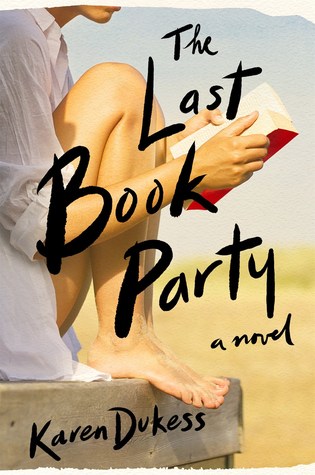
I really wanted to like The Last Book Party, by Karen Dukess, but honestly? I just didn’t, much.
There were elements of it that I anticipated liking. First of all, I think I gravitated to it because it was set during a summer at (in? on? never know the terminology here) Cape Cod, and after recently reading several enjoyable books set at such memorable places as Martha’s Vineyard and the Outer Banks of North Carolina, I wasn’t quite ready to let go of the summer/island settings.
Second, the protagonist works in book publishing in New York City, which I always thought of as the pinnacle of jobs, and she’s trying to write on the side, with which occupation I have sympathy, having tried to do that myself off and on for years in the middle of my life.
Third, there is a lot of talk of books and authors, which always delights me, either because they are familiar and I concur with the writer’s opinion of them, or because they are unfamiliar and give me new titles for my TBR list.
And lastly, I loved the cover!
But ultimately a book is only as good as its characters and story arc, and this one was, what word do I want to use? Slight.
Eve Rosen is an aspiring writer working as an assistant at a prestigious book publishing firm in New York City. She comes from a conventional suburban Jewish background, and thought New York would be the answer to her longings to be an artist, but so far it’s only been by proxy. One of her duties as an assistant is to correspond with some of the firm’s writers, and one of her favorites is the witty and urbane New Yorker writer, Henry Grey.
She is invited to a gathering at his Cape Cod home (her parents have a summer house there and she lets him know she will be around for the weekend) to meet a dazzling array of avant garde artists, including his wife, Tillie, a poet. Grey casually mentions that he could use a research assistant; when Eve returns to New York to discover that a new employee has been promoted over her head, she decides to leave the firm and reaches out to the writer to see if he was serious. Soon she is ensconced in Henry’s study, working on research materials for various of his projects and continuing in awe of him and his artistic circle. But some of the things she learns about this seemingly enviable literary world are not what she expected nor what she wants.
I can’t tell much more of the plot without revealing the whole thing, because there’s not a lot more TO it. The book is set up like a coming-of-age story in which Eve is figuring out who she wants to be; but the way she goes about it is shallow, self-deceptive, and clichéd. I spent most of the story wanting to hand her both a mirror and a backbone. There is a significant moment in the book where you expect major fireworks to happen; instead you get one outraged rant by Eve and then the matter is dropped as if it isn’t important. Considering what it was, I found this highly disturbing. And finally, the ending is one of those frustrating “two years later, here’s what I learned from my experience” epilogues that I loathe.
So although I will add this to my list of “books about books,” I won’t be touting it to anyone as a good read. It’s not horrible, either; I give it a resounding “meh.”
Farthing
I am a big fan of science/speculative fiction writer Jo Walton, although I have found her offerings to be somewhat uneven between things I love and things I recognize as worthy while not personally caring for them. I was excited to discover that she had written an alternate history in which Great Britain negotiated its way out of World War II in return for a treaty with Hitler, who proceeded to conquer the European continent while sparing England across the Channel.
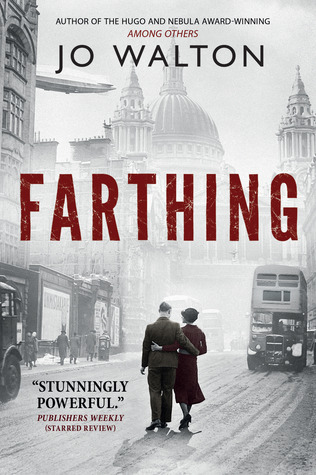
I thought Farthing was a new work, possibly designed to address the fascism and bigotry that have been revealing themselves these past few years in America; but after I got into it I discovered it had been published in 2006 and was, in fact, the first of a trilogy, the others being Ha’penny and Half a Crown.
I also found the book disappointing in some respects, but only because I had a particular expectation that it didn’t fulfill. I thought it was a full-on alternate history and would deal more specifically with the details of that world; instead, Walton used post-war Britain allied with Germany as a backdrop for a “locked-door” murder mystery novel reminiscent of Agatha Christie, which is not really what I wanted to read.
The details of the alternate history do matter to the story: Eight years after they overthrew Churchill and led Britain into a separate peace with Hitler, the aristocrats of the “Farthing set” are gathered for a weekend retreat at the Eversley’s estate. Lucy, daughter of the house, is one of the invited guests, although her new husband, David Kahn, a Jewish banker, is less welcome. Lucy has “thrown herself away” by marrying him, and is tolerated, rather than welcomed, into her old social circle as a consequence. Neither of them really wished to come to the country that weekend, but Lucy’s mother imperiously summoned them, and David felt perhaps she was holding out an olive branch, although Lucy, being more familiar with her mother’s prejudices, knows that can’t be the case.
Soon the two can only wish they had resisted the invitation and stayed in town; Sir James Thirkie, a friend of her parents who is also the person who engineered the historic agreement with Hitler for peace, has been murdered sometime between Friday night and Saturday morning, and some details of the murder look like they have been specifically engineered so it can be blamed on David Kahn.
Fortunately, the Scotland Yard inspector sent down to solve the case is less gullible than are the local police and sees the nature of the set-up; he doesn’t view Kahn as remotely likely in the role of murderer, but if he can’t see his way clear to accusing someone else, Kahn is likely to go down for it, as Jewish scapegoat on the scene. Inspector Carmichael does his level best to come up with a solution, but new details keep getting thrown at him that twist the mystery further this way and that until no one knows how it will end.
Although I recognized and appreciated both the set-up and the writing in Farthing, I felt somewhat dissatisfied after reading it. The mystery itself was not particularly intriguing, and the alternate history aspect left me wanting more world-building. I also wasn’t a big fan of the alternating point of view between first person (Lucy’s journal of the events) and third person (Inspector Carmichael’s investigation), although I did like both characters quite a bit. Character development is one of Walton’s strong suits, and she didn’t fail here, particularly as regards the inspector, whose ulterior motive for refusing to suspect David Kahn enriches the story.
It was strange to read the book from within the throes of the current political climate. I started the book two days before Election Day, and finished it a couple of days afterwards, and I did appreciate how the author asked the reader to consider the consequences of allowing fascist behavior to continue and grow. There is also a familiarity about the plight of the Jews in this book as compared with the history of black people in America; there are all these little bits of discrimination that each by themselves seem fairly innocuous (especially if you are not the party who is targeted by them) but taken collectively they are seen to intentionally omit, push out, reject, and deny full personhood.
I don’t think I am sufficiently enamored of this book to pursue reading the other two; but if you are a person who enjoys Agatha Christie or Dorothy Sayers mysteries and also appreciates good character development, witty dialogue, and an unexpected background for all of that, you might want to check out this trilogy.
My preference for Walton’s alternate history oeuvre is her three-book series that begins with The Just City. The Thessaly trilogy is based on the idea that the goddess Pallas Athene, curious as to its outcome, creates a society designed to follow the tenets of Plato’s Republic. She extracts 100 caregivers and 10,000 babies from various points in history (past, present, and future), puts them together on an island located in the distant past, and instructs the adults to raise the children strictly according to Plato to be their “best selves.” A few years into the experiment, she kidnaps and throws Sokrates into the mix, and then things get interesting.
The unexpected
Have you noticed that when it comes to famous and/or beloved writers, the unexpected is not welcome? I couldn’t believe how many people groused about Tana French’s last book (review here) when it turned out not to include the Dublin Murder Squad, even though it was a great story on its own.
I will confess, however, that I myself have done some “editing” when it comes to authors I like: For instance, I freely tell everyone that Jenny Colgan’s books previous to 2012 are not up to her standards, while all the books written during and subsequent to that year are wonderfully plotted, characterized, and entertaining.
I have come to the conclusion that while there may sometimes be validity in people’s rejection of particular titles because they were written early in a writer’s career, the truth is probably just that they didn’t follow the successful formula the author later evolved and made her own. In other words, they were unexpected.

One such novel of which I just turned the last page with great personal satisfaction is Liane Moriarty’s book The Last Anniversary. When I picked it up, I had already read many of Moriarty’s books, beginning with the later, more well known (and successful) ones and gradually working my way backwards. Her more recent books are not precisely formula, but they do seem to deal with women (and men) of a certain age, a certain financial and social status, and at a particular stage in their marriages, their careers, their parenthood, or what have you. So The Last Anniversary came as something of a surprise.
First of all, while the protagonist is about the right age (39), nothing else about her conforms to Moriarty’s other characters who, by this time, have entered into (and sometimes already exited out of) matrimony, have most of them had children, and almost uniformly live in the suburbs populated by others such as themselves. Sophie Honeywell is a successful business woman, popular and with many friends, but the last person in her circle to remain single. She sometimes wonders if she did right, breaking up with Thomas Gordon on the very day he had been planning to propose; she simply didn’t feel passionate enough about Thomas and was, in fact, a little stifled by his adoration, but perhaps she has missed her one chance in life to have the family she has always wanted? Sophie mostly doesn’t let it get her down, and she never thinks about Thomas (now married to someone else) until an odd occurrence brings him back into her life.
While they were dating, Thomas took her to the family “compound,” an island in the Hawkesbury River about an hour from Sydney where his entire family lives. Sophie had actually been there before she met Thomas; Scribbly Gum Island has become a tourist attraction because of an unsolved mystery regarding the Munro Baby. Thomas’s family are the caretakers of the mystery house from which Alice and Jake Munro went missing, leaving behind a whistling kettle, a freshly baked cake, and their baby crying in her cradle. Thomas’s great-aunts Connie and Rose discovered (and raised) the baby, and turned the mystery of her parents’ disappearance into a rather lucrative business—tours of the house, followed by cups of tea and scones, not to mention the sale of tourist tat.
Now, Thomas’s Aunt Connie has died, and she has somewhat inexplicably left her house not to any of her own relatives but to Sophie. There was something about Sophie’s innate cheerfulness that Aunt Connie had enjoyed, the few times they had met, and she decided Sophie was the type of person she wanted living in her house after her, even though she is no longer with Thomas.
Sophie makes some token objections but is secretly delighted; she adored Aunt Connie’s house from the moment she set foot in it, she loves the idea of living on an island, and she is more than ready for a change in her life. Although Sophie, an only child, is quite happy with her own family of three and has been quite spoiled with love and attention by her parents, she is also happy to be absorbed into this new, larger family.
The thing I liked so much about this book is that it relentlessly pursues the unexpected. With that build-up you would think that the next event would be for Sophie to find some young man associated with the island who was perfect for her, but with some obstacles in the way that would make it just absorbing enough to watch them work out how to come together. That doesn’t happen.
As you are introduced to other characters on the island, you develop new expectations, but the story keeps building them up and then taking yet another twist. Margie, one of the two daughters of the Munro Baby, is in an unhappy marriage with husband Ron, who no longer sees or values her. Margie eventually decides to take action to change her life, but keeps it a secret from everyone who knows her best. Granddaughter Grace, a young and beautiful artist married to Callum, has just given birth to Jake and is suffering cruelly from postpartum depression, but manages to present a blank face to the world and hide her secret. Aunt Rose, adrift after her big sister Connie dies, wonders if it’s time at almost 90 years old to start making her own decisions instead of abiding by Connie’s iron-willed decrees.
Moriarty hits a perfect balance between the whimsical and serious sides of this story. She addresses such issues as post-natal depression, the tick-tock of the baby clock for women approaching their 40s, stale marriages, and women’s insecurities in general, but she never lets the individual issues overwhelm the direction and mood of the book.
Threaded in amongst these narratives as a sort of semi-comedic relief is the central mystery of the Munro Baby, which certain younger members of the family are determined to solve. Connie and Rose know the truth, as does Enigma (the actual Munro Baby, now in her 70s), but Connie decreed that none of the others were to know until their 40th birthdays had arrived.
Although Sophie remains firmly the protagonist, the glimpses into the backgrounds, desires, and secrets of all the other characters make this a lively story that keeps the reader guessing almost to the end. None of the secrets are resolved in quite the way most readers would expect (and there is a perfect little “easter egg” at the end from an unexpected direction), which is what made this book a success for me, despite its lack of resemblance to Moriarty’s later oeuvre. Take a chance on it yourself and see if you agree.

Can I say that the various covers used on this book were irritating in their almost complete irrelevance to the story? Why not a picture of an island? or a deserted house on the shore? or even the damned marble cake left freshly baked on the table? Why a tree? Why a floating key on a ribbon? Why a hill with a baby buggy? (the closest, but still not accurate) C’mon, publishers, figure it out.
Bones will tell
I almost always feel sharply divided when reviewing one of Elly Griffiths’s Ruth Galloway books, because there is always much to like and also much to quibble about, and I sometimes feel nitpicky when I give in to the latter. And yet, that’s what a book reviewer does, if left feeling unsatisfied, irritated, or frustrated by a book. Her newest, The Lantern Men, is no exception to this split reaction.
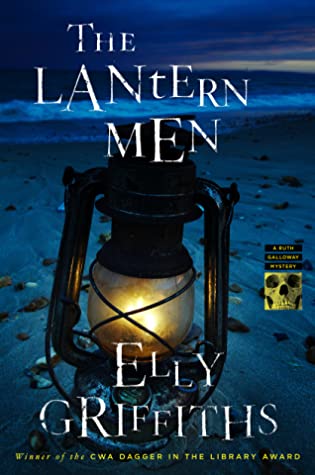
The story in brief: Ruth has moved mountains in her personal life in order to distance herself from the father of her child, with whom she remains in love: She has moved away from her beloved Saltmarsh to Cambridge to take up a new job, she has moved herself and her daughter, Kate, in with her American lover, Frank, and she is no longer officially on call as Norfolk police’s consulting forensic archaeologist. That job she has left to her colleague, Phil, who has always craved the limelight that Ruth mostly shunned, and is quite thrilled with that position despite the inconvenience of having to pick up some of Ruth’s classes at the North Norfolk university since she has left.
It has been two years of escaping into these various refuges from her mostly inarticulate longing for DCI Harry Nelson, who does reciprocate Ruth’s feelings but who feels constrained to stay in his marriage, partly because of his respect and remaining affection for his wife and his desire to keep a good relationship with his two grown daughters, but mostly because of the surprise of a late-in-life child—George, who is now two years old. The fact that Nelson and Ruth share parentage of Kate continues to make their lives awkward, but everyone seems to have settled—if somewhat uneasily—into their place in this unorthodox extended family, with Nelson’s older daughters now embracing Kate as their sister and Kate, in turn, delighting in Baby George.
These are the circumstances when a convicted killer brings Ruth back into Nelson’s orbit. Ivor March is in prison for killing two women, whose bodies were found buried in his girlfriend’s garden and covered in his DNA; but Nelson has always been convinced that March was also responsible for the deaths of two other women, gone missing in the same time period and with an eerie similarity in both looks and circumstances to those he killed. Now March has offered to tell Nelson where the bodies are buried, but only if Ruth (rather than her colleague, Phil) will be the archaeologist who excavates the grave. He won’t give a reason, except to say that Ruth is a much superior archaeologist to Phil and will see things he wouldn’t.
As usual, the research into the legends behind the murders in this series is meticulously done; in this case, the legend of the Lantern Men, whose wandering lights on the Fen lure people to their deaths in the marsh, has been appropriated by three men who conceive of it as their duty or privilege to find people—specifically, tall blonde young women—lost on the marshes and rescue them. These men live, along with a couple of women with whom they are involved, at a retreat center for writers and artists and are themselves the instructors. The women they “save” end up staying with them for a time and then leave—or disappear, depending on perspective.
I had little fault to find with the cast of new characters whose intertwined relationships were so confusing to the police in terms of whose loyalty to suspect when it came to the murders. All of that was valid stuff for red herring material, and worked quite well. I also enjoyed, as per usual, the regular cast of officers and friends that surround both Ruth Galloway and Harry Nelson—officers Judy, Tanya, and Cloughie, and the eternally weird Cathbad—and the valid details of the police procedural.
What I did find poorly done was Ruth’s relationship with Frank. These two people have supposedly been living together for two years, and yet there is no closeness depicted. Ruth does remark at one point that she finds it endearing when Frank calls her “honey,” but the evidence, which is scant, about their interaction is that she holds him constantly at arm’s length, doesn’t confide in him about anything but the most surface of daily events, feels uneasy about depending on him too heavily when it comes to Kate, and basically seems almost blatantly uncomfortable with their situation. And Frank is such a cardboard character. We get one or two details about his American accent, the way he dresses, and how he helps around the house, and a few negative reactions when he discovers Ruth is seeing Nelson regularly again for work; but by and large Frank is barely a presence, let alone a major player, in this book.
I was hoping so hard that if something were to happen again between Nelson and Ruth, it would for once be something definitive—they would finally decide that, regardless of whom it would hurt, they would be together. But it was the same old thing, from a greater distance but otherwise identical, that we got in all the previous books: Ruth longs for a sign that Nelson still cares but feels guilty when he gives that to her, and ruminates on whether, if they were together, they could even stand to cohabit; Harry is even less articulate inside or outside of his mind, simply reacting with anger and jealousy at every manifestation of Ruth’s changed lifestyle and relationship with Frank. This has gotten so old that I am almost out of steam when it comes to hoping for a resolution. If it doesn’t happen in the next book, I’m out.
Apart from that big caveat, there were some small things in this book that just plain irritated me. One rule of writing: Never bring something up if it doesn’t have some kind of significance or result later on. In murder mysteries, of course, this means don’t show a gun early on if no one is going to use it later. But in this book it was more in small details that kept being dwelt upon but never explained. One example: Ivor March’s girlfriend, Chantal, is characterized as someone who always dresses inappropriately for every situation. The police drop by to see her at her home and she is attired as if she is on her way to a party, wearing a tight pink dress and heels, at 10:00 in the morning. At chance meetings she is wearing such outfits as a pencil skirt, white blouse and pumps, as if she is going to work, but she doesn’t (work). After three or four of these comments on her appearance, I expected that at some point someone would say, She dresses like this because…but no one ever does.
I also found the ultimate solution of the mystery to be rather flat, especially after all of the intricate hoopla. I don’t want to spoil anything, but there didn’t seem to be any more than a random motivation for the killer to do what the killer did…as if “I liked it” was sufficient justification. Maybe it is, in the case of a serial killer…but one would like to understand something about why a particular type of victim was chosen, or whether it was a peculiar synchronicity that put them in the killer’s path…something!
The cliffhanger at the end will probably carry me over to the next book, because I remain a sucker for finding out “what happened”…but if it doesn’t result in something more concrete, that will be the end for me of the saga of Ruth
and Harry.
New mystery series
I’m always looking for new (good) mystery series, and someone on Goodreads mentioned this as similar to the series of other authors I enjoy, so I tried out Caz Frear’s first book, Sweet Little Lies, with her British protagonist, Detective Constable Cat Kinsella.

Cat was only eight years old when she met Maryanne Doyle, and it was a pure case of idolatry. Maryanne was the girl all the girls wanted to be, a teenage rebel with long dark curls and sparkling blue eyes. Cat and her family were on holiday, and although she’d seen Maryanne hanging around with her older sister, Jacqui, it was when Cat and her dad picked Maryanne up while she was hitchhiking in the rain that Cat formed a real impression of her. Cat knew she was being played when Maryanne expressed admiration for her Tinkerbell pendant, but she gave it up willingly to this gorgeous girl with the forceful personality.
A few days later Maryanne disappeared, but not before Cat observed her standing out in a field having a heated conversation with Cat’s own father, and overheard the word “blackmail.”
Before the family leaves for home, her dad is questioned by the police about Maryanne’s whereabouts, but he says he didn’t know her at all. Cat knows he’s lying, but she is Daddy’s girl and isn’t about to rat out her own father. But when Maryanne never turns up again, the memory of his lie festers and builds a wall between them, especially after Cat goes over to the “other side” from her dad with his tenuous ties to organized crime to become a police detective.
Then, a missing housewife is discovered in a park not far from the pub her father runs, and Cat wonders…
I enjoyed this book. It started out more like a psychological thriller, with Cat in therapy after a bad experience on the job, but quickly evolved into a fairly straightforward police procedural, albeit with a rather important connection to the protagonist’s personal life. Part of what I liked about it is that Cat, a dedicated officer who always wants to do the right thing, is now so conflicted because, despite her estrangement from him, she still feels the need to protect her father. And yeah, her silence isn’t completely altruistic: She knows that if any whiff of personal involvement with the case came out, her boss would sideline her in an instant, while she, naturally, wants to stay in the thick of things and be the first to know what happened.
A police procedural is only as compelling as the team the author puts together, and this is a good one. Cat’s immediate superior, DS Luigi Parnell, is the perfect old plod, wise and street smart as well as intuitive and kind. Cat idolizes her boss, DCI Kate Steele, for her brilliance and dash as well as for the way she looks after her officers. And the rest of the team is gradually developing into individuals before our eyes as they work the case. There is humor, camaraderie, and some snappy repartee.
There’s also plenty of suspense as the plot evolves. My only caveat would be the stunning coincidence that is at the heart of the murder mystery, but the author makes it work, and delivers an exciting and not wholly expected conclusion.

I liked it enough that I decided to go on to Frear’s second book, Stone Cold Heart. This book, too, had a satisfyingly convoluted murder mystery at its heart and lots more details about Cat’s personal life, both with her dysfunctional family and with her new boyfriend, Aiden, who is in the dark about the role Cat played in the mystery surrounding his sister, Maryanne Doyle. Cat is trying to keep things light because she knows that eventually the truth will out, but Aiden is pushing the relationship forward and Cat is having to juggle big time. Meanwhile the mystery of the Australian girl who came to London to have some fun and ended up dead keeps sprouting new suspects without satisfactorily absolving the old ones, and the team is baffled and frustrated. That’s a lot of intensity to deal with in one detective constable’s life…
There is a third book coming out on December 1st, and I’m already in line for the Kindle version at my library.
If you’re wondering what other series might be similar to this, the one that immediately comes to mind, for its protagonist, its team, and its satisfyingly baffling mysteries, is Sharon Bolton’s Lacey Flint series.
American Marriage
I just finished reading An American Marriage, by Tayari Jones. I can’t remember how I came across it—I ordered it from Book Outlet, but whether I browsed it and decided on it or it was recommended by one of the readers on Facebook’s “What Should I Read Next?” group, I don’t remember. The plot, which speaks to contemporary situations, intrigued me, and there is much to like about this book.

The basic story is this: Roy and Celestial meet, then meet again, and eventually fall in love or decide they have found the right partner, or whatever people do who decide to marry. Roy is in business but has greater aspirations, and Celestial is a fabric artist, specializing in making eerily lifelike baby dolls. They are married for about 18 months and are celebrating the anniversary of their first date when a crime is committed nearby and the victim identifies Roy as her rapist. Although Celestial knows it’s impossible (he was with her at the time, and neither was asleep), she is the only witness and is apparently less convincing to his jury than is the victim; Roy is sentenced to 12 years in prison.
For the first three years of Roy’s incarceration, Celestial stays true to Roy, although her sense of him, herself, and their marriage suffers as time goes on with little reinforcement as to its reality. She continues to pursue a dream first articulated by Roy to open a shop to sell her “poupées” (dolls), and allows her work to consume her as she feels increasingly alienated from her marriage.
André has been Celestial’s neighbor and best friend since they were small children. Although she has always regarded him as a friend, he has loved her since he met her. He was also friends with Roy, and is actually the one who introduced them and watched while they made a match of it; he has been Celestial’s constant companion since, never crossing the line, until Celestial’s doubt in the viability of hers and Roy’s relationship after several years apart gives him hope for something different. They eventually drift together almost as if it’s inevitable, and have begun to form a solid relationship when Roy’s lawyer’s efforts to appeal his case surprisingly pay off and Roy is released at the end of a five-year stint.
Roy knows that he and Celestial have been estranged; but he expects she has been faithful and hopes to rekindle or restart life with her now that his time in jail is over. Celestial, meanwhile, looks at the time they have been separated versus the time they were actually together, and sees it as something of an uncrossable gulf.
The book has several things to recommend it: The format is intriguing, with the narration of the first few chapters before Ray’s arrest alternating between Roy and Celestial. After the arrest, the alternating narration continues but becomes epistolary, contained in letters from the prison to Atlanta and back again. Shortly before Roy’s release, André steps in with first-person narrative, and the rest of the book is mostly from his and Roy’s alternating points of view. I found all of it absorbing.
The language in which the story is written is engaging, with an extended vocabulary and unusual, evocative phrasing by the protagonists in both their conversations and their descriptions that constantly catches the ear.
The premise itself is what drew me to the book: The knowledge of how easily and how often mistakenly a man of color is arrested in this country is an issue in the forefront of many people’s minds right now, so the opportunity to read a book about that actual event was appealing.
There are, however, also some things that are lacking about this book. The first, for me, is the pivotal incident—the misunderstanding that led to accusations that led to conviction and incarceration. I understand that the author’s purpose was more about focusing on the outcomes of the wrongful conviction and that the conviction was in some ways a foregone conclusion, given our society’s blind spots; but I would have liked a little more attention paid to the mechanics of how Roy ended up in prison than the five scant pages it is given. It was, ultimately, a he-said-she-said situation, and although it was unlikely to conclude differently, I would have appreciated seeing that drama enacted on the page instead of being nearly incidental to the story.
The second is the treatment of the characters. Interestingly, the secondary characters (Roy’s daddy, Big Roy and his biological father, Walter; his mother, Olive, and Celestial’s father, Franklin) were beautifully drawn and seemed like real people from the neighborhood. But there was a disconnection for me from Celestial, which I found particularly strange considering that the author is a woman. There was a lot of noise made by Roy in the attempt to keep Celestial; but she was such a reticent, inarticulate figure that I never got a sense of exactly what it was that made her tick. Even though I understood, by the end, what was happening and had a sense of why, the words are never actually said by Celestial, and I was, along with Roy, so frustrated by that. It came to the point, during the pivotal decisions about their marriage, where he was speaking for both of them, almost holding a conversation with himself by claiming to know what she was thinking and how she felt, and although he may have been intuitive enough to guess those things, I actually found it rather offensive that the author wouldn’t just put the words that needed saying into Celestial’s mouth. She ended up such a passive, helpless, weepy creature when she started out as the strong and independent one, and it left me unsatisfied, particularly because we get to find out the conclusion to everything through one of those “six months later” epilogues that I hold in such disregard.
Still, despite all this I see the value of this book in explaining the crippling disconnection of a whole segment of society from their roots, their relationships, and their continuing lives by the mechanism of wrongful imprisonment, and the struggle it must be to reconnect with any of those once the separation is over. The total disruption of lives is unforgivable. There is much here that is profound and moving, and Roy is not a character I will soon forget.
Magic and realism
I hadn’t planned to read South of the Buttonwood Tree, by Heather Webber, right now, but I’d had the Kindle version on hold from LAPL and they sent me an email to say it was ready to be checked out, so I went for it. Library schedules wait for no one!
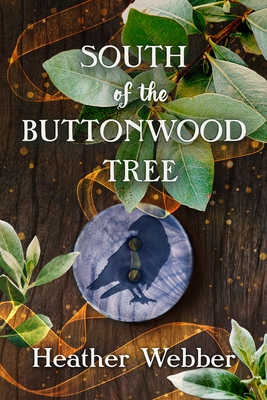
I had thought that it was a sequel to Midnight at the Blackbird Café (it even has a corvid pictured on the cover), but it wasn’t; instead, it was almost a duplicate of that book, with a few significant variables. Small Southern town, check. Ne’er-do-well family looked down upon by the more upwardly mobile family who has a secret connection to it, check. Two daughters, one from each family, who end up exposing all the secrets and discovering what that connection is, exactly, with some magical realism and some romance thrown in. Check! Although the author does a good job of fleshing out her characters and making them unique, the situations were so similar that sometimes it was hard to remember that it wasn’t a sequel (or that I had once again forgotten I’d read a book and re-read it only to find it strangely familiar!).
I’m back to my ponderings about what constitutes magical realism on this one because it, like Blackbird Café, is really just a cozy with some magic thrown in. In Blackbird, people ate pieces of pie from the café and then had significant dreams after, in which they might hear from dead loved ones. I conceded that this was marginally possible. But in Buttonwood, people went to the Buttonwood Tree and asked questions, and the tree gave them a button with their answer engraved on it. IN HANDWRITING. This pushed my “buttons,” pardon the pun, because I feel like this is far beyond the bounds of magical realism, straight into magic. I halfway expected that, by the end of the book, it would be revealed that there was someone behind the “fortunes,” acting as the town seer (or manipulator) by carving buttons and messages out of a branch of the tree and leaving them for people, but no: They actually just appear magically from a hole in the trunk of the tree, and nobody questions it. And they are specific in some cases: In the central plot, a baby is abandoned under the tree, and the button says “Give the baby to Blue.” Okaaaaay…
One of the two young women protagonists, Blue, has the ability to find things or people, and she finds them by letting the wind push her where she needs to go. This I found more plausible. The other protagonist, Sarah Grace (who is a house rehabber), talks to houses and they talk back to her—not necessarily in words, but in mood and occasional actions (like things falling or doors sticking at important moments). Again, that felt natural for magical realism. But the buttons bugged me.
The rest of the story, like Blackbird, is a “cozy” of small-town life, the resolving of secrets and regrets, and the providing of romances. It’s as satisfying as that kind of book can be; but again, the main magical realism element seemed a little jarring in the midst of it, instead of charming as it was meant to be. Maybe I’m just too much of a cynic. As Roald Dahl is quoted in the book, “Those who don’t believe in magic will never find it.”
Reading mavens
A reminder for those who not only enjoy reading but also like talking about it and seeing other people do it: Please visit The Book Adept’s shop, to purchase book- and reading-related images on various products, including prints, cards, and postcards, T-shirts, mugs, and more! While you are there, also check out all the non-reading-related art. The link is: https://www.redbubble.com/people/meligelliott/shop
Here are some of the images on offer:

Character
I haven’t made a post for a while now, for several reasons: I’m still finishing off Charlie Higson’s dystopian series for teens (I’m reading The End and hoping that all my many questions are answered); I started teaching my Readers’ Advisory class at UCLA this past Tuesday and have spent some of my time preparing for that (mostly cleaning up my combination office/art studio so it’s fit to be seen in the background of Zoom); and I’ve been rather caught up in the political events of the day (unhealthy obsession with Facebook posts). But I should be at the end of The End soon, and on to my next read.
In the meantime, the combination of contemplating “appeals” for readers’ advisory and doing a massive clear-out, clean-up, and re-shelving of my entire library of fiction in my four bedroom bookshelves caused me to think about the nature of “character” as a dominating force in fiction.
To explain a bit for those who are not up on librarian lingo, appeals are what we call the various reasons why people enjoy what they read. Some people are motivated by adrenalin and want something fast-paced and exciting; others love beautiful language and want to be wooed by unusual or lyrical phrasing; and one particularly powerful appeal is that of “character.” The ability to identify with or, alternatively, loathe a character or set of characters in a book is one aspect that draws people to read more. The success of the belabored Harry Potter franchise is largely due to the desire to find out what happens next to the maturing Harry and his friends, and all of us can probably think of a book or five whose characters were what kept us coming back to its pages. A few recent books in which character dominated include Eleanor Oliphant Is Completely Fine, A Man Called Ove, and The Seven Husbands of Evelyn Hugo. (A major clue as to whether the book is character-driven is if the main character’s name appears in the title. Witness Harry Potter and the….)
As I have mentioned here several times, belonging to the Facebook group “What Should I Read Next?” is sometimes an exercise in patience, because most of the readers there have become caught up in the bestseller craze and all end up reading the same 12 books. So in the effort to find them—and you—other compelling reads, I thought I would spend a blog post examining some of my past favorites that are wholly about the character.
A compelling writer of character-driven works is the author Mary Renault, and although her entire oeuvre contains much to appreciate, there is not another that rivals The Persian Boy, her tale of a bed slave named Bagoas who was abducted, gelded, and sold as a courtesan to King Darius of Persia. When Alexander and his Macedonian army conquer the Persians, Bagoas finds himself in a rather untenable position and decides he will achieve safety only by ingratiating himself with the conqueror himself. Although Alexander is quick to see the appeal of this highly motivated slave, he is slow to take advantage of his utter dependency, and the courtship between the two of them is both touching and fiery.

The Persian Boy is actually the second in a series of three books Renault wrote about Alexander. The early years, when he rises from a beleaguered son of warring parents to become the master of all lands he surveys, are covered in Fire from Heaven, in which he experiences love and trust for the first time with his best friend and fellow warrior, Hephaistion. But that book is far more event-driven, whereas The Persian Boy, being narrated from the point of view of someone with whom Alexander had a solely personal connection, is limited in scope in terms of world events but much more specific about the relationships. It is, in fact, a love story, and I would regard it as one of the great ones, containing as it does not just attraction or romance but also loss and pain, desire and jealousy, joy, courage, and cowardice. It is an exceedingly intimate view of Alexander the man beside that of Alexander the great warrior, and is filtered through the emotions and psychology of a patient bystander.
At the beginning of the third book, Funeral Games, Alexander the Great lies dying, surrounded by his former generals, satraps, and wives, all competing like wolves for the prizes of power and land. Only the two loves of his life, Hephaistion and Bagoas, realize and truly mourn what has been lost. Funeral Games documents the disintegration of the mighty empire built in 20 years and brings Alexander’s saga from age 12 to 33 to its close.
There is a variability of voice in these tales that lets them be read as a series but also allows the reader to experience them as stand-alone novels. The first is told in the first person by Alexander; the second is the purview of Bagoas; and the third is written from a third-person observer stance. I discovered and read The Persian Boy first, only picking up the others afterwards, and felt no sense that anything was missing in that first reading. When people ask for an LGBTQ love story that goes beyond the contemporary meet-cute or the simultaneous struggle with coming out that invades so many of these stories, my thoughts immediately return to the yearning and transcendent happiness contained with the pages of Renault’s classic work.
Another protagonist with whom I have been in love since the first time I read the book is Shevek, the humble man and brilliant physicist at the heart of Ursula K. LeGuin’s book The Dispossessed. The book is a recounting of an existential thought experiment: The author posits what would happen to individuals in a social system that rewards conformity, although that social system in this case is based on a sort of group anarchy. Urras is a world much like our own, driven by commerce. Within its teeming millions is a group of individuals who wish to live their lives quite differently and, because Anarres, the moon of their planet, is suitable (though not ideal) for human life, they are allowed to colonize it. The two societies make a pact that neither will invade the other and, for more than 100 years, not one individual from either society has crossed the line between them except for shipments of supplies that arrive and leave the small port on Anarres.
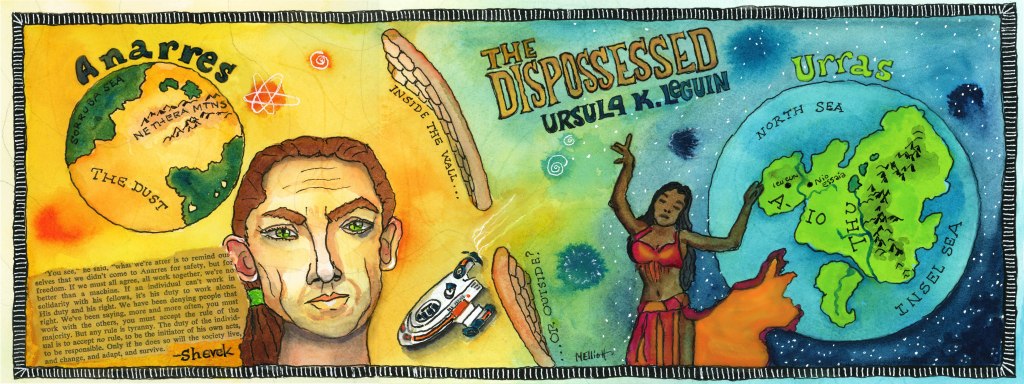
Shevek grows up in this ascetic society, a planned utopia where no one takes precedence over anyone else, where each is valued but all are expected to make their contribution to society in return for a place in it. He does his part, planting trees in the desert, drawing food service or waste management tasks for 10 days at a time, and through it all manages to find a great love, Takver, and have children; but while he goes through these tasks of daily life, his brain is operating on another plain—trying to understand temporal physics—that demands discussion, the exchange of ideas, and a close relationship with those on his mental level who are capable of understanding his brilliance. Ultimately, he makes the choice, despite the possibility of losing his home, his family, perhaps even his life, to go back to Urras to see what the scientists of that world have to offer him.
The fascinating part of the book is how the society on Anarres was originally founded as a profound act of nonconformity, and yet ends up suppressing originality and demanding obedience from a man chafing under its restrictions. LeGuin achieves her objective—the exploration of the concept of freedom—by letting the reader recognize the virtues of the system under which Shevek lives and
then realize how stifling it has become, without being either polemical or strident.
If it weren’t for the “stigma” of being categorized as science fiction, I believe this book would take its place amongst the most important of classic novels, and that Shevek would be a much more well-known protagonist in the reading world.
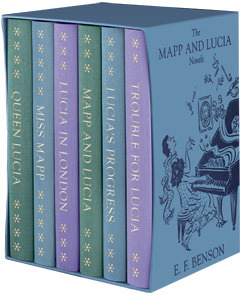
Some books you love for a protagonist, and some for an entire cast of characters. In the second category are the books by E. F. Benson that were latterly brought together in an Omnibus volume called Make Way for Lucia. There are six Mapp and Lucia novels in the series, and they must be read in order, for events take on importance in a specific sequence that must be appreciated.
At first glance, you might not think that a view into the social world of upper-middle class Edwardian village dwellers would be particularly compelling. But what you have to understand about the Mapp and Lucia books is the exaggerated degree of sheer triviality that guarantees a contrary fascination. Benson had a disdain for middle class people pretending to a rank to which they are not entitled, and his satires of these mushrooms trying to push their way into high society are brilliant and also funny as hell.
The books feature the feuding doyennes of Riseholme and Tilling, whose decidedly bourgeois residents get flustered in the presence of noble titles but king and queen it in the presence of everyone else. The main protagonists—or should we call them pugilists?—are Emmeline Lucas, designated “Lucia,” and Elizabeth Mapp. Though the stories begin with each of them ruling their respective roosts with total social supremacy in their separate villages, fate brings them together to hilarious effect. But the reader is not solely reliant on Lucia and Miss Mapp in these stories; Benson has created a whole cast of characters, including the dashing Georgie Pillson, aging bachelor, with his elbow-length cape and carefully trained piece of hair draped over his scalp; the drunken and slightly naughty Major Benjy; artist and naked sunbather Irene Coles; Mrs. Boucher with her daughters, Piggy and Goosie, in tow; and so many more. The tempests in the teapots that are the meat of these ’20s and ’30s comedies of manners are hilarious, witty, and slightly nasty. In other words, inspired. Auberon Waugh, eldest son of Evelyn, said,
“I might have gone to my grave
without ever knowing about
Lucia and Miss Mapp. It is not a risk
anyone should take lightly.”
It’s about time for me to read them for the third time.
I hope you have enjoyed this meander through some character-driven books, and that it will inspire you to look them up for yourself or to reflect on the characters that have come to life for you during your lifetime of reading. If any compelling ones occur to you, please share!

 The Book Adept