Young Numair
Tamora Pierce has begun a new miniseries within her larger panoply of books about the fantasy kingdom of Tortall. The three books will be based on the life of the great sorcerer Numair Salmalín, one of the most powerful mages in that world, and chronicle his beginnings as a young lad studying his craft at the University of Carthak.
Arram Draper, which was his given name, showed his gift early when he set a series of accidental fires in his family’s home in Tyra. Since his parents were cloth merchants, their wares were particularly vulnerable to conflagration, so they rapidly took counsel and sent him to the Imperial university, where he would study all aspects of magery, from animal husbandry to healing to water magic, as well as simply learning to control, channel, and use his formidable gift of power.
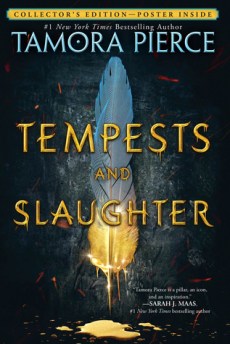 In the first of the expected trilogy, Tempests and Slaughter, Arram is the youngest student at the university, and comes in for a fair amount of hazing until he is taken up by his future two best friends, Ozorne (who is seventh in line to inherit the Emperor’s throne), and Varice, who struggles with her affinity for food magic and hedge witchery, since women who practice in these areas tend to be underestimated or even overlooked. The three are among the most advanced students at the university, and move up swiftly, independent of the regular students, which further bonds them together. Arram’s tendency to accidents while using his power, Ozorne’s proximity to the throne, and Varice’s magnetic personality draw attention both wanted and unwanted from professors, jealous fellow students, and more pernicious enemies. As they progress through their years of schooling, each of them draws fire, individually and as a group, adding to their chronicle of adventures.
I had looked forward to this trilogy, since I enjoyed the adult character of Numair as encountered in multiple volumes of the Tortall books, but I ended up giving this three stars out of five on Goodreads. I liked it, I enjoyed it, but it wasn’t a rave-type book.
While I appreciated the immediate and total immersion into the Pierce universe, this time in Carthak, and enjoyed the scene setting, the background, and the atmosphere, that was a large percentage of what this book had going for it. The characters were great—Arram, Varice, and Ozorne really stood out as individuals, as did most of the Masters (mage teachers); and even the incidental side characters like the gladiator Musenda, and the magical bird, Preet, were compelling and individual. I also enjoyed the depictions of the magic itself, the interaction with various gods, the animals, and the other students.
So…why did I give it three stars? Because it’s a background book. It’s true that it’s all about how Arram Draper became Numair, but there’s no real story arc. It’s an accounting of his days in school, of what he learned and how he learned it. (It’s actually quite Harry Potterish, now that I think about it.) It is occasionally enlivened by isolated incidents that show he is growing older and more skilled, that he is expanding his horizons and his knowledge of the world and the magic in it, but there is no beginning, middle or end. It’s a narrative, a record. And honestly, that was mostly fine with me. I enjoy pretty much everything about Pierce’s storytelling, because she is so surefooted in this world she has created and so able to convey its every nuance to the reader…but because there is no arc, there are no big feelings to go with this book. It’s back story. It allows the reader to develop a fondness for the characters, to wonder what will happen next, but there are only the hints of trajectories in their future. As I read through it, I kept wondering why this book merited such a dramatic title (tempests and slaughter?) and while there are storms and deaths aplenty, they come across as an almost ordinary part of the chronicling of Arram’s life.
I definitely plan to read the other two books when they come out, and I wouldn’t discourage anyone from reading this one, because it does set things up nicely for a book with some action in it…I would merely caution those who have embraced her other stories from this universe not to have big expectations beyond the familiarity of being at home again in Tortall.

Fresh look: old book
Continuing this occasional feature…
Barbara Kingsolver achieved her greatest fame with the book
I honestly like the least of her entire list—The Poisonwood Bible, nominated for a Pulitzer and multiple other awards. But before she wrote this serious tome, Kingsolver penned several shorter books that caught my imagination:
Taylor Greer grew up poor in Kentucky, with the dual goals of avoiding pregnancy and getting out. On her drive west to seek her fortune, she is unexpectedly “gifted” with a three-year-old American Indian girl, who is dumped in her car in obvious need of mothering and more. So Taylor’s plans change abruptly, and she puts down roots and begins to build a community to help her care for her new foster daughter, Turtle. This is the story of The Bean Trees; in the sequel, Pigs in Heaven, Turtle witnesses an event that has repercussions for her life with Taylor, exposing her to her heritage and her past. These two books are a wonderful combination of charming and heartfelt, with lots of humor but also with a serious message about the family you inherit and the family you choose.


The third book Kingsolver wrote right around the same time period is Animal Dreams, a love story, an environmental inquiry, and an exploration of Native American culture. I was captivated by all three of these books and have revisited them several times. If you are looking for short but intense fiction with an American southwest setting and eccentric characters, try any or all of these three by Kingsolver.
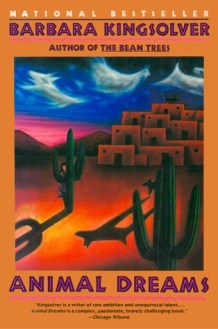
I featured the original covers here, because they are the ones with which I am familiar (and also, I really like them), but all three of these books have been re-released in trade paperback and are easily obtainable, if in a more bland, less culturally celebratory package.
Yearly Gamache
No, that wasn’t a misspell. Although…anything with ganache would go well with Gamache. I am referring to the latest book in the detective series by Louise Penny. As is usual every August, I anticipate the arrival of Gamache, and then spend two days reading it and I’m done for the year. I try to draw it out, but it’s simply not possible.
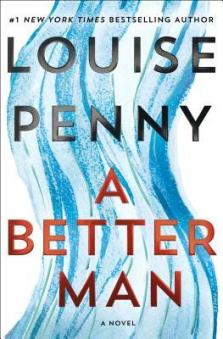 In A Better Man, the newest book featuring the Chief Inspector, catastrophic things arrive in the typical three: The spring floods in Québec are threatening to overwhelm the riverbanks and possibly the dams of the entire province; there is a vicious twitter campaign villifying Armand as he returns to the Sûreté du Québec as Chief Inspector; and in the middle of all this, Gamache’s protegé, Lysette Cloutier, implores the Sûreté’s help to locate a friend’s daughter, who’s gone missing.
This one is good…but not as good as some. The mystery—the missing woman, Vivienne—was a little overwrought, with some characters in hysterics for most of the book; while Penny throws in various red herrings to prolong the suspense, I had gotten an inkling early on of the possible solution, which was in fact true (though not for the reasons I had surmised), and I kept waiting for the characters to figure it out as well. I have great respect for both the intelligence and instincts of Gamache, his son-in-law and cohort, Jean-Guy Beauvoir, and his colleague, Isabelle Lacoste; but in this case they personalized their feelings by picturing Gamache’s daughter and Jean-Guy’s wife, Annie, as the woman in peril, and missed key clues while obsessing on bringing someone to justice.
One part that I love about the Gamache novels—the eccentric community of Three Pines, where the Gamaches now reside—seemed subdued in this book. Apart from the disastrous reviews of Clara’s new art form (landscape miniatures), the references to the other residents were incidental, brief, and not particularly memorable, and I felt like the book suffered a little accordingly. Not much…but a little.
Equally bothersome is my observation that Penny’s prose has devolved in the course of this series. I remember a couple of books, towards the middle of the pack, over which I waxed lyrical about the poetic language, but that’s no longer the case. I find the short, partial, strung-together sentences with which she now expresses herself to be jarring. I’m not sure what happened, but once I noticed this, I went back to examine those previous works and recognized the differences. It’s sad to me, because the overwhelming mood of these books is determined by the subtlety, humor, pathos, and grace of the character of Armand Gamache, and yet those things are no longer expressed in the kind of language which one would expect Gamache himself to use. I am surprised no editor has brought this up to the author; or, if the editor has done so, that Penny has not taken note. Perhaps she prefers this newer, choppy, abrupt style. I do not.
So, while I enjoyed my annual visit to Three Pines, the Sûreté, and the world of Gamache, it wasn’t an unalloyed pleasure.
This is a series I frequently recommend to those looking for a combination of police procedural and character-driven complexity—somewhat akin to the Dublin Murder Squad novels of Tana French. I usually tell people that if they don’t thoroughly enjoy the first book, they should try one or two more, because the series improves exponentially with every volume. Although I no longer feel I can say that, exactly, it’s still true that it’s a strong series with a lot to offer. Don’t let my remarks about this latest volume deter you from checking out the others. There are 15 books so far in the series, and all but four have received five-star ratings from me!
 And just for fun, here is a chocolate raspberry ganache cake worthy of being served up by the bistro in Three Pines. If you’re a “foodie,” be prepared to be constantly craving exotic hot drinks and French treats throughout the reading of this series.
Fresh look: old book
NEW FEATURE: I have so many years of eclectic reading in my past that several friends have suggested I go back and dredge up the memory of books that bowled me over when I read them first, and briefly share them here. I agreed that the chance to revisit some old favorites would be a pleasure. Also, in the context of giving good readers’ advisory services in the library, the truth is that the new books at the top of the bestseller list are checked out, with multiple (or hundreds of) holds, so it’s good to have backup in an old book that might fulfill the same desires as the new one. So here goes…
M. M. Kaye wrote a series of murder mystery/romances called Death in [fill in the blank], from Berlin to Zanzibar, as well as some straight-up romances set in exotic locales and involving typical male leads such as pirates and slave traders. But one of her books stands out far above the rest: The Far Pavilions. Even though she wrote some of them before and some of them after, I feel like all her other books were rehearsals so she could get everything right in this one.
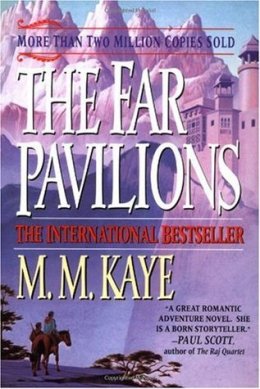 It’s a long and complicated epic with lots of historical context, and it paints such a vivid picture of India under the British Raj and Britain’s incursions into Afghanistan that you can almost smell the dust and hear the bullets whistling past your ears. The hero and heroine are the products of two separate cultures, and their status as misfits in both societies draws them together as children and reunites them as adults in a poignant love story that plays out against a volatile background of war and empire-building. The book is 958 pages long, and I have read it three times; I’m sure I’ll read it again someday! If you are a fan of historical fiction but are looking for something with a different setting to the ordinary, this book will fulfill those desires.
Awakening
Some of the symbolic meanings of peacock feathers are “awakening,” “vision,” and “protection.” When I finished The Peacock Emporium, by JoJo Moyes, I wondered if she had specifically chosen that as a surname for the main protagonist (even though a married name) to foreshadow the action.
 The story revolves around Suzanna Peacock, a woman of 34, who returns, with her husband, Neil, to live in a house provided by her landowner family, near the small town of Dere. They are there because of financial troubles—Neil lost his job, and Suzanna ran up credit card debt—and Suzanna greatly resents the need to be obligated to her parents for providing them with shelter, when what she wants is to be as far from her troubled background as possible, preferably in London. Restless and at loose ends in the country but not willing to consider Neil’s solution of having a baby, Suzanna decides to open a small gift shop and coffee house on the main street of town. She calls it The Peacock Emporium, and Suzanna soon loses herself in collecting all the unique and wonderful items she wishes to sell in her hybrid shop.
Suzanna has never come to terms with her background. Her mother, Athene Forster, first wife of her father, Douglas Fairly-Hulme, died in childbirth, and Douglas’s second wife, Vivi, is the only mother Suzanna has ever known; but the difficult relationship between Douglas and Athene, a self-absorbed, reckless glamor girl, has always overshadowed Suzanna’s complicated relationship with her parents, and has caused her to be withdrawn from the family dynamic. She can’t help but feel that everyone in her family views her through the lens of her mother’s doubtful character.
Putting together the Emporium is the first real accomplishment of Suzanna’s life, but although she takes great pride in the exacting way she has set up the shop, her introverted affect makes her less than ideal as a shopkeeper. What luck, then, when the irrepressibly upbeat Jessie shows up at her door, determined to befriend Suzanna despite herself, and equally committed to turning Suzanna’s showpiece into a neighborhood haunt. As the shop begins to take on the personality of both women, the community embraces it, and Suzanna’s perspectives slowly and subtly begin to change, until a disaster shows up all the cracks in her life that need mending—or rending.
I had a hard time getting into this book initially; the first 80 pages consist of three disparate timelines in different locations, and the story jumps from one to the next with no apparent connection. I hung in there because I have enjoyed this author’s other books, but if things hadn’t started making sense soon after that, I might have put the book down. Fortunately they did; we arrived at the present day with Suzanna and the shop, and subsequent events revealed the necessity for all the previously gleaned information.
This is a book with Moyes’s usual compelling cast of characters who engage you with their issues and quirks, although in this book there are a few that you positively dislike, or at least for whom you lack empathy. It’s also a book containing strong messages, including generational differences, changing cultures, and moral dilemmas. There is an underlying lack of trust amongst many of the characters, primarily due to a dearth of honest communication, but with all of that there are also moments of extraordinary generosity and love. It’s an odd, sometimes depressing, sometimes poignant, and ultimately joyful story that’s not for everyone, but I’m glad I read it.
 There are three covers for this book, and none of them gets it right. The hardcover features a woman in a dress from no known era that is associated with this story; the paperback at least has women dressed as Debs from the 1960s (the era of Athene Forster’s debut); but the more recently released paperback features a girl on a bicycle, even though no character in this book ever rides one. I say again, as I have lamented before: Doesn’t anyone in the art department ever read the book? Or at least look at a synopsis? Ask for advice? Care about being true to the story? C’mon.
Secrets
Although the title of Liane Moriarty’s book is The Husband’s Secret, many more secrets abound in this book about responsibility, guilt, culpability, and consequences.
 The initial secret is contained within a letter, addressed from Jean-Paul to his wife, Cecilia, to be opened only in the event of his death. She finds the letter in with some filed tax papers, and though she itches to open and read it, she reluctantly decides that this would be too great an invasion of her husband’s privacy. She admits to him that she found it, only to be somewhat stunned by the extremity of his reaction when he learns that the letter still exists—he thought it was lost or destroyed long ago. He tries to make light of it (he wrote it right after the birth of their first daughter, now a teenager, and claims it was in the emotional heat of the moment), and asks her not to read it and to give it back to him. But something happens that makes her no longer willing to respect that wish, and all the rest of the consequences of this tale about three families follow.
I had some initial trouble with how, exactly, these three stories would interlock; even though they lived in the same town, there were generational differences, outside influences, and a lot of time and space between some of the events, so the book was hard going for the first part. But after the secret is revealed and everything begins to tie in, I read with increasing fascination and momentum. Part of the fascination was that I did not expect that to be the secret. When you think about something that one spouse is keeping from another, your mind automatically goes to the usual stories: past infidelity, Johnny is not your son, I’m leaving you for the pool boy, etc. But this secret is BIG, and affects so many more people than just the wife to whom it is revealed that it makes the story extra compelling. And of course, the minor secrets people hold that either directly or indirectly impact their relationship with and reaction to the big secret further that suspense.
The particular ways in which all of the characters’ lives entwine one with another is the main appeal of this book, and bring you to various conclusions that are then offset by a catalogue of what-ifs in the epilogue: What if this had happened that way instead of this, what if this person hadn’t been in this place at that time, what if anyone had been able to show a little restraint at the proper moment, etc. That is the core of this book, those what-ifs, and they lead you to look at your own laundry list, past and future, and try to decide (about the events of the book and your own list) whether they are black, white, or gray.
Weirdly, although I thoroughly enjoyed the book, part of me would have preferred other stories to grow out of it. Because all three family dramas were sublimated to the central event, some felt incompletely told. The story of Will, Tess, and Felicity, for instance, had its own trajectory that I wish the author had either explored further here or turned into a separate novel. I really wanted to know what happened there! So far, no joy, but perhaps Moriarty will finish their story someday?
Parenthetically, I’ll say that I am not a fan of the “floofy” covers they put on Moriarty’s books. They definitely downplay the narrative.
Memory and time
About her book What Alice Forgot, Liane Moriarty says the following:
I had always wanted to write a story about time travel but I found the logistics made my head explode.
Then I read a story about a woman in the U.K. who lost her memory and behaved like a teenager – she didn’t recognize her husband or children. I realized that memory loss is a form of time travel.
So I came up with the idea of a woman, Alice, who loses 10 years of her memory. She thinks she is 29, pregnant with her first child and blissfully in love with her husband. She is horrified to discover
she is 39, with three children and in the middle of a terrible divorce. It’s like
the younger Alice has travelled forward
in time.
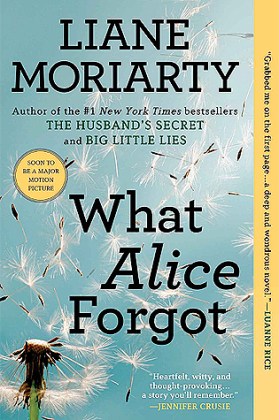 It’s 2008. Alice Love is 39 years old. She is at her spin class at the gym. She didn’t eat any breakfast or drink any water before she began the class, and as she begins to sweat, she becomes faint and falls off the bike, hitting her head quite hard on the way down.
These are all details that you find out later in the book. The opening scene is one of confusion—Alice opening her eyes to discover she is lying on a cold floor with a bunch of people staring at her, and not knowing where she is, why she is there, or what has happened. And when people start trying to explain it to her, she is more confused than ever. She remembers that she is pregnant with her first child, who she and her beloved husband Nick have nicknamed the Sultana (since that’s about the size of the fetus at this point). She doesn’t understand why she was at the gym, because she hates working out, and she is baffled by the thin and taut state of her body, since she remembers it as larger and softer. Once the hospital calls her contacts, she notices that her sister is acting weird around her, almost like a stranger, and when she calls Nick (who is for some reason on a business trip) to tell him she has had an accident, he yells at her and hangs up the phone. What in the world?
Alice has a temporary case of amnesia. She thinks it’s 1998. She doesn’t remember anything at all subsequent to that, including the fact that she now has three children and is in the midst of a nasty and bitter divorce. How is that possible? She and Nick are so happy! After a couple of days at the hospital trying to come to terms with all of this, she returns home to confront what was a ramshackle fixer-upper but is suddenly imbued with every single advantage Alice and Nick had daydreamed when they bought it. Her husband returns from his weekend with the three children, ready to drop them off as usual on Sunday night, and Alice is in a panic—she’s never cared for one child, let alone three, and hers are now actual little people, with personalities and phobias and quirks with which she is completely unfamiliar! She doesn’t know what to feed them, or the addresses of their schools, or that she’s supposed to drop Tom at swim class and take Olivia to her violin lesson—none of it rings the faintest bell. And Nick looks at her with anger and disgust, when all she longs to do is throw herself on his chest and cry.
Readers tell me that what they liked best
about this novel was how it made them
think about the choices they’d made and
wonder how their younger selves would
feel about the lives they are leading now.
—Liane Moriarty
This book is a journey of self revelation, but not just for Alice; because of her condition, she has suddenly gone back to being who she was 10 years ago, and all the people surrounding her must similarly take a look at who they have become in the decade she is missing. Alice discovers that she doesn’t much like many of the decisions she has made that have brought her to this point, and because she can’t remember her life, she busily goes about reversing some of them. This is my favorite part of the book, because her simple naiveté leads her to mend fences that she couldn’t and wouldn’t choose to attempt if she remembered why they were broken. The story is, indeed, a form of time travel, and at this point, I was actually rooting for Alice to remain contentedly in the past!
The book is by turns serious, looking at such subjects as infertility, infidelity, and bullying, and comical in its recounting of Alice’s mishaps as she flails around trying to figure out who she is and who she wants to be. It similarly challenges the reader to think about decisions made that have led to this point and to wonder—would I do things differently, if I could suddenly revise them?
Both an enjoyable and a rewarding read.
Elly Griffiths
The Stranger Diaries is an interesting mix. It is a contemporary version of a Victorian Gothic novel; there is also a story within the story, which brings the past into the present and makes it relevant again. It’s the only stand-alone novel (that I know of) by Elly Griffiths, who is best known for her Ruth Galloway archaeology mysteries set in the wilds of Norfolk (most of which I have enjoyed quite a bit), and a series called Stephens and Mephisto (which I haven’t read—yet).
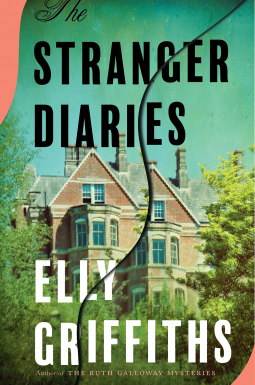 The diaries mentioned in the title belong to Clare Cassidy, a divorced English teacher with a 15-year-old daughter named Georgia. Clare teaches at a local comprehensive, Talgarth High, on the coast of Sussex, which includes an old building that was formerly the home of a reclusive Victorian writer. R. M. Holland was most famous for a short story entitled “The Stranger,” a murder mystery with which Clare became fascinated, and which led her to decide to write a biography of its author. She also occasionally teaches the story in her upper-level English class, which means there is a fair degree of familiarity with it amongst both staff and students.
The set-up for the book includes the typical Gothic trappings: Holland’s wife, Alice, was rumored to have fallen to her death from the staircase of the house that descends from Holland’s study on the top floor, and is said to haunt the school; the legend is that if Alice’s ghost is seen, the incident foreshadows a death. The atmosphere is amped up by the location of the book in moody Sussex, with dense sea mists, lonely downs, and abandoned factories.
Clare’s friend and colleague Ella Elphick is found murdered, accompanied by a note that is a quote from “The Stranger.” The police investigation is led by Detective Sergeant Harbinder Kaur (herself an alumnus of Talgarth High), who initially suspects Clare, until other events take place that seem rather to target than to implicate her.
The book is alternately narrated by Clare, DS Kaur, and Clare’s daughter, Georgia, and the story grows quite complex, due both to the variety of narrators with their markedly different points of view and insider knowledge, and to the proliferation of interesting and potentially sinister secondary characters. It also grows wilder and more strange as it incorporates echoes of the Victorian past. I never guessed the murderer, but greatly enjoyed trying to figure out who it could be, as my potential suspects kept meeting an untimely end!
DS Harbinder Kaur was a great character (she and Georgia both introduce some humorous notes that are a nice contrast to Clare’s slightly hysterical tone), and I’m hoping perhaps Griffiths will bring her back in subsequent books, now that she has established such a thorough back story for her.
I hesitated to review this book right now, because it would be so much more effective if you were to read it in October, just when Hallowe’en is approaching! Perhaps you should put it on your list and revisit it then for maximum creepiness.
Angst and romance
That headline may be a little misleading. The angst isn’t necessarily in the romance, it’s more about the romance.
TL;DR—click here to read a summary of this post.
People who claim to be expert (or at least, er, Adept) at readers’ advisory need to be well-rounded enough as readers to be able to recommend books in every genre, but I confess there are a few in which I am not well versed. One is romance; while I enjoy the occasional book dubbed a “cozy,” wherein the romance is not the entire point of the story, I am mostly a novice and a stranger when it comes to reading mainstream romance.
I did read a few Harlequins in my youth, because my mother adored them so they were always lying around the house. And in my 30s, when I was struggling to become a writer, it occurred to me that an easy way to make a buck might be to try my hand at writing one. I went so far as to send away to Harlequin for the specs to their various series, but I was put off by the incredibly stereotypical requirements. There was a set number of pages, a prescribed age range for the man and a similar profile for the woman (men were late 20s to early 40s, while the women had to be 18-24), and a specific story structure to follow. I decided, from the heights of youthful idealism, that this would be a betrayal of principle and never went farther with that aspiration.
No longer are romances planned out in that way—not even those from Harlequin. Not even the sacred HEA (happily ever after) is guaranteed any longer! There are still prevailing formulas, but with a lot more wiggle room. But romance as a genre is still a relative stranger to me, so I enrolled in an online readers’ advisory class for romance to see if I could garner some tips about referring romance readers to their ideal books.
We were assigned two books to read in the second week: A Rogue by Any Other Name, by Sarah MacLean, and What the Librarian Did, by Karina Bliss.
 Of the former, I’m not going to say much, except that if this is supposed to be a good example of a contemporary historical romance, then the bar has been set way too low.
Clichés abounded, human interactions were awkward, dialogue was overdramatic and talky, and historical context was distinctly lacking. A few torrid sex scenes (and the requisite ripped bodice) were just not enough to carry the rest.
On the other hand, What the Librarian Did surprised me. I had low expectations for a Harlequin based on what I used to read in my (long-ago) youth, but this book had good characters with assets and flaws, a believable story line, and a subplot that had nothing much to do with the romance, but was therefore a nice balancer. I liked it!
 The story follows Rachel Robinson (ha-ha, Ms. Robinson), a university librarian, who has a secret in her long-ago past that is about to come back to haunt her. Meanwhile, new student Devin Freedman is garnering an extravagant amount of attention from everyone except Rachel, who’s never heard of him. Devin, lead guitarist in a wildly successful American rock band, has quit the biz to return to his native New Zealand and pursue a business degree. Rachel encounters him on his first day at school when he arrives to tour the library, and her lack of knowledge about him piques his curiosity, while she takes one look at his bad-boy charms and is intrigued, despite herself. The cat-and-mouse that follows switches off from one to the other, and is made more complex by the intrusion of the secret from Rachel’s past, with which both of them must come to terms.
The first thing I liked is that these characters are both adults in their 30s. There was none of this experienced macho man mentoring the naive young girl nonsense—these are two people with an equal amount of years behind them, multiple relationships (and failed marriages, on Devin’s part), and a lot of complex baggage. But there is also “the spark,” which is the essential ingredient for a really satisfying romance, in my opinion, and Devin and Rachel definitely have it. Add to that wit and humor and the aforementioned plot twist complication, and you have a story. I’m all about the story, so this book made me happy!
Hopefully I can find more like this to give to my readers’ advisory clients.
(One caveat: The cover looks like something from the 1970s meant to appeal to swoony teenagers. Which is one reason why I don’t spontaneously pick up Harlequin novels! I think it highly probably that the best thing ever to happen to romance readers is the anonymity of the Kindle!)
TL;DR: A Rogue by Any Other Name was clichéd, overdramatic, and poorly reflected its historical context. What the Librarian Did had believable characters, an interesting story line and subplot, and a satisfying ending, and also contained wit and humor.

 The Book Adept