Reasons to re-read
On impulse, after finishing Once Upon A River,
I picked up and re-read Jenny Colgan’s The Bookshop on the Shore, which I reviewed here when I first discovered it. Since I thoroughly covered all aspects of the book in my first review,
I wasn’t going to bother to bring it up again; but re-reading it set me thinking on various tangents that I thought might be worth discussing from a readers’ advisory standpoint.
The first tangent was Colgan’s treatment of Zoe’s son, Hari, in the story. Hari is a four-year-old boy, perfectly delightful in every way according to his mother, except that he doesn’t speak. There’s nothing physically wrong with him, and all the doctors consulted by Zoe say it’s a psychological thing and will “probably” resolve itself eventually when something shifts and he simply starts to talk.
This is small comfort to Zoe, who has to live her life explaining something big about her child. Everywhere they go, people bend over and say “Hi, little guy, what’s your name?” and are at first offended at the lack of response and then pitying when they discover the reason why. At every daycare, at every school, with every new acquaintance or stranger in a shop, both Zoe and Hari are called to account for his not being able to do what many parents probably wish their children would do less of—speak, shout, cry. In all these aspects, happy or sad, Hari is silent.
Even Hari’s father, Jaz, judges him by this lack of ability. While he loves his son, Hari’s inability to speak is a constant nagging flaw that Jaz seems unable to get past. Colgan evokes a genuine sense of compassion for Hari and for Zoe for having to deal with all this heavy expectation every time Hari is given the opportunity to open his mouth.
 When the pair move to Scotland and Zoe becomes an au pair at a “big house” with three children, for the first time Hari is accepted for who he is, by the five-year-old Patrick. Patrick is, by his own estimation as well as everyone else’s, incredibly clever for his age, and with that quite outspoken.
In short, he’s a talker. Their first encounter:
Hari put down his tablet, got up and padded over to the newcomer.
“Who are you?” said Patrick.
“This is Hari,” said Zoe. “He’s living here too.”
Patrick regarded the boy with some suspicion. Hari glanced over at Zoe worriedly, but she smiled at him as if to say it would be all right.
“Hmmm,’ said Patrick eventually. “You don’t talk too much. I like that. I like to talk A LOT. Do you like dinosaurs?”
Hari nodded.
“Okay,” said Patrick carelessly.
And just like that, Hari’s situation was normalized. Later, when Jaz visits, Patrick steps up to him and says, “I am absolutely Hari’s best friend.”
“Oh. Well. Good,” said Jaz. “Can you teach him to speak?”
“I absolutely like Hari how he is,” said Patrick.
This was such a simple and beautifully done example of both the hardships encountered by the differently abled and the potential for them to be loved no matter what. I realized, upon re-reading this book, that one of the things I enjoy about Colgan’s writing is her evocation of a sense of empathy with all her characters. This is a key element in readers’ advisory—does your reader want to identify closely with the characters in their book? Some people enjoy being alienated by the protagonists of their stories, but there have been books (notably, The Casual Vacancy, by J. K. Rowling) that I have refused to finish because I found the characters so repellent and so totally lacking in any redeeming qualities that I simply didn’t want to spend another minute in their company.
By contrast, I love reading about people who are different from me, whether that means significantly older or younger, of a different race and country, gay, male, extraordinarily gifted or limited in some way—as long as I can somehow identify with them through the agency of empathy. When I ran my high school book club, I remember some of the parents being puzzled by why all the girls in the club seemed to consistently choose books with gay male protagonists. The reason was not specifically that they were gay or male, but that the author had done a good job both highlighting their differences and conveying their similarities.
The second tangent that came to mind upon re-reading this book was place. Colgan’s books are, at least six of them, set in the wilds of Scotland, up among the hills and the lochs and the sheep, with the wind whistling in off the ocean and the weather subject to change by the hour. If someone asked me objectively if this was my ideal locale to put down roots, I would most likely say no, since I hate wind, don’t like being cold, and greatly value the close proximity of my Trader Joe’s. But I live a comfortable, mostly middle-class life, with a (small) house to myself, a driveable car, and enough income (most months) to keep me going. If I had lived (like Zoe, the protagonist of this book) in a small, dark, stuffy bed-sit in a bad neighborhood of London with my little son, worked two jobs just to maintain that life, and had to drop off my kid at a questionable daycare while I did it, those same hills and lochs and freezing but beautiful views might seem like heaven. In fact, if I lived here in Los Angeles in a grotty little apartment, sharing walls with noisy neighbors who smoked and fought loudly, and had to take the lousy public transportation system to two jobs to get by, Scotland would be a dream come true for me, as well.
This is the talent of the author who can evoke a palpable sense of place for the reader, whether by contrast as in this example, or by the use of lyrical language and detailed description (also employed by Colgan). Since one of the reasons many people read is to be transported out of their everyday lives to another time and place, to a lifestyle they may have dreamed of but never dared to attempt, or even to a lifestyle they wouldn’t voluntarily choose but might wonder about, the sense of place is a powerful tool when advising people on what to read.
The talent of the writer is to make wherever the reader lands more palatable, or at least more fascinating and foreign or perfectly homey. For instance, while none of us might want to live in the bed-sit in Edinburgh or in London, where Colgan’s characters Nina and Zoe originated before embracing Scotland, that’s partially because of the way the accommodations, and their surroundings, are described: Dim light, dirty streets, noise, confusion, traffic, bad air, crowded buses and trains, the pervasive smell of takeout drifting up from the café downstairs—a thoroughly unappealing situation.
On the other hand, what if the bed-sit you were living in, just as tiny, were at the top of an old house in the Latin Quarter of Paris? What if, even though it was small, and you had to climb four flights of stairs because the elevator was always broken, once you arrived at the top and entered your little space you could see out the dormer windows to a perfect view of the dome of the Sorbonne? What if you painted your tiny flat a beautiful shade of seawater green, and put up diaphanous sheers at the windows, and hung a few favorite pictures, painted by talented friends, and had a cozy little stove to keep it warm? What if outside your tiny room and down four flights of stairs was Paris?

The quality most closely related to a sense of place as an appealing quality of a book is the desire (or need) for escape—to experience something different, somewhere else, and live there for a while. Try out your readers’ advisory skills by describing the setting of the book you are suggesting and see if your readers’ eyes don’t light up at the prospect of going there.
Another chance
If you have been a reader of the Book Adept blog for a while, you will perhaps recall my review of Diane Setterfield’s Bellman and Black, and the depth of disappointment I experienced on reading it.
It took me a while to be willing to assay another of her books, but I found the description of Once Upon A River, published in 2018, to be too enticing to resist, so I bought a copy and read it this past week. I am happy to say that it fulfilled my expectations, which included the lyrical language of her previous books but also contained a satisfying story arc, with a beginning, a middle, and an end, and resolution for the varied and mysterious characters involved.

As its title promises, the book is framed as a fairy tale, or at least is fairy tale-like. The river in question is the Thames, and the river is the central character of the book, as it affects everyone who comes in contact with it—those who live along its length, in pubs, villages, towns, and isolated huts, those who punt along in its shallows or ride its currents on barges or private yachts, and those who end up drowned in its depths.
“They sat on the bank. It was better to tell such stories close to the river than in a drawing room. Words accumulate indoors, trapped by walls and ceilings. The weight of what has been said
can lie heavily on what might yet be said and suffocate it. By the river the air carries the story on a journey: one sentence drifts away and makes room for the next.”
This is the story of three children, and the impact of their disappearances (and possible reappearance) on the people close to them, as well as on the inhabitants of one small town who are caught up by chance in the events that restore one of them to life.
Amelia is the daughter of the Vaughans, a wealthy couple, who gladly pay the ransom when she is boldly kidnapped right out of her bed, but don’t receive her back again after their payment. Alice is the child of a desperate mother who, abandoned by her ne’er-do-well lover and unable to care for herself or her little girl, ends it all in a jump from a bridge above the roiling waters of the Thames, after first dropping her daughter in to drown. And Ann is the sister of Lily, a poor unfortunate who makes her way by keeping house for the local parson, but who isolates herself in a hovel by the river because she is making amends for something dreadful she did as a child that lost Ann to her forever.
Along the borders of this world lie others. There are places you can cross. This is one such place.
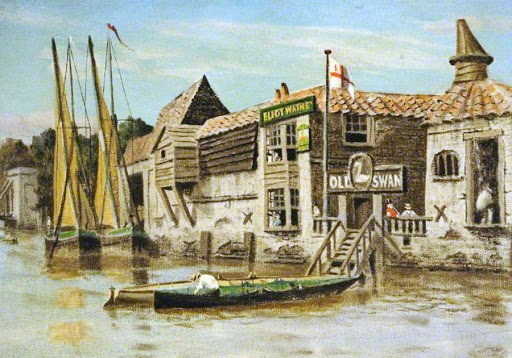
On the night of the winter solstice, the regulars at The Swan, an ancient inn at Radcot along the Thames, are occupied in their usual pursuit of telling stories. The door bursts open to admit a stranger, badly wounded and scarcely able to keep to his feet. He is carrying what everyone present at first identifies as a doll or a puppet, but after calling for the local nurse to examine and treat his injuries, someone realizes that it is actually a child, a little girl, already dead.
Hours later, however, the girl stirs, takes a breath, and comes back to life. No one can account for her previous deathlike state, but all are happy to have a child returned to life, against all odds.
But whose child is she? Helena Vaughan, who has been deranged with grief over her daughter’s kidnapping, is ready to embrace her as the missing Amelia, even though two years have passed. Someone else recognizes her as Alice, the granddaughter of another local family, who would be happy to welcome her although she is the love child of their wayward son. And Lily is convinced her sister Ann has returned to life. The girl herself is mute and unable to answer the questions of who she is, where she came from, and to whom she belongs. Both the principals and the villagers who were present at her dramatic denouement involve themselves in theories and possible solutions, and under all runs a dark current of deceit and, some would say, evil.
This is a compelling, thoughtful, and engaging read. The ins and outs, the possibilities, the theories and discussions encompass not only the fate of one small child but the bigger picture, the issues of life and death—how much they are worth, how they arrive, how they depart, what is the best way to pursue them. The discussion includes the new theories of a man called Darwin, who posits that man comes from water and from animals and is therefore related to and also responsible for all life, not just that of humankind. The historical details included in the occupations of some of the characters are engrossing (farmer, charlatan, photographer). And all of it is entertwined with the constant presence of the river, the giver of life and death to so many who move along its banks and in its depths. The fairy tale quality is palpable but the archetypal nature of fairy tales doesn’t dominate the story, which is individual and unique.
I think perhaps Diane Setterfield has, with this book, surpassed The Thirteenth Tale, as wonderful as that book was. But it’s hard to compare them, for although they both have literary language and a timeless feel, they are completely different stories, sharing only the theme of magical realism. Now that I have regained my confidence in her work, perhaps I will return to that book for another look—it’s been a decade since I read it.
Empathy
This book made me cry three separate times, and I don’t do that. Ever.
The book is Just Life, by Neil Abramson, and is one of half a dozen that I bought recently from bookoutlet.com, which sells remaindered books for between $2.49 and $7.00, paperbacks and hardcovers alike, music to the ears of someone who reads as much as I do. The only downside to these prices (which, let’s face it, is also an upside) is that shipping is high unless you order $35 worth of merchandise, in which case it’s free. So when I notice a book or two that I want and they have, I scroll through the rest of what is on offer and pick up enough to get that free shipping. Just Life came in one of those mixed bags. I’d never heard of either it or its author, but the story sounded good.
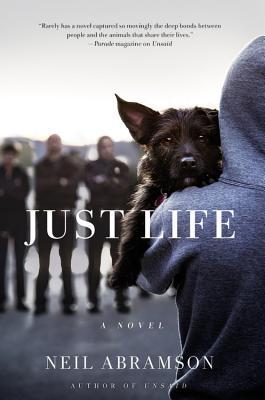 It starts out like a dystopian suspense novel: It’s told in third person, but from the points of view of four major characters, one of whom is a veterinarian and proprietor of a no-kill animal shelter, in the Riverside borough of New York City, that is being zoned out of existence. Adding to her desperate attempts to save her shelter or find somewhere for her dogs to go is an additional disaster: There is some sort of virus, appearing only in that neighborhood, that is making children sick. One has just died, more are severely ill, and the virus, which was initially blamed on pigeons, is now felt to be the responsibility of dogs with rabies in Central Park.
Samantha, the vet, and anyone as familiar as she is with infectious viruses (her estranged father is a researcher) is frankly skeptical that this could be the cause, but she knows from experience how fear can work on the human mind, and worries that panic and ignorance will mandate a “QCK,” an acronym for quarantine-cull-kill.
The other major characters in the book—a city policeman (formerly a K9 cop) assigned by choice to this neighborhood, a homeless, damaged teenager with a special affinity for dogs, and an elderly Catholic priest suffering the onset of Alzheimer’s—personify the double entendre indicated by the title of the book: They are all attempting to live a just life, and part of that mandate is a concern for all creatures, not just for humans.
The other meaning of the title becomes clear as the back story reveals that there are no viruses in animals to which humans are ultimately resistant, and vice versa—that we are all “just life,” and equally susceptible. But local politicians and bureaucrats, including the governor (who is running for president and wants to act the hero) and the Centers for Disease Control (CDC) refuse to admit that proposition could be true, and the protagonists must mount a defense in a war against dogs.
In his afterword, Abramson writes about how he hoped to show the eternal battle between fear and compassion, and how achieving compassion in the face of fear is a daily struggle. The story line in Just Life emphasizes this battle and highlights the difference between those who love all life and those who prioritize humans. In the process it is suspenseful, moving, and eye-opening.
At one point in the book, someone asks Sam what she would do if someone came for her dogs. She remembered that in veterinary school one of her professors had made her class memorize a quote from William Ralph Inge:
“We have enslaved the rest of the animal creation, and have treated our distant cousins in fur and feathers so badly that beyond doubt, if they were able to formulate a religion, they would depict the Devil in human form.”
Anyone who is a dog person knows that the most badly treated of them will nonetheless forgive a human who shows them a little kindness. This book, for me, posed the question, What if we could all be so empathetic?
It was also a fast-paced, gripping story with both people and causes worthy of embracing, and an exciting ending that has you afraid to turn the final pages.
Serendipity
It’s so fun when you have a friend who also likes to read and who gets excited about what she’s reading and wants to tell you all about it.
It’s even more fun when your friend thinks she has discovered a new author, only you know something about this author that she doesn’t and can share that.
 I went to a concert the other night with my friend Lisa, and while we were waiting for the performance to begin, she said to me, “Oh! I’m reading the BEST BOOK right now, I just discovered this author and I love everything about it, the story, the writing style, it’s so good! You have to read it!” Then she pulled out her phone, punched a few buttons, and held up a picture of the book cover, which was
Ninth House, by Leigh Bardugo.
“Oh!” I said, “Leigh Bardugo!”
Lisa looked surprised. “Do you already know about this book?” she asked.
“No. That is, I’ve heard of it, but no, I know her because she’s a young adult author.”
Lisa had no idea that before she penned her first adult novel, Bardugo had written the Shadow and Bone trilogy, the Six of Crows duology, and King of Scars, returning to the Grisha universe (as well as Wonder Woman: Warbringer). So I got to tell her all about those books, and recommend the ones I particularly like (Six of Crows and Crooked Kingdom), as well as tell her the story of when Leigh Bardugo was a brand-new, just-published author who visited Book Café at Burbank Public Library and did a stunning visual presentation for our teenagers of all the ways in which she had found her ideas for writing the Grisha books.
 My comments about Six of Crows, from Goodreads:
I liked the first series by Bardugo well enough, but was fatigued by all the magic and angsty pseudo-romance by the end of it. But this one stars a good old-fashioned gang of thieves with skills and exploits attributable for the most part to themselves, not to their paranormal powers. There are Grisha in the mix, but they are much more human, and humanized by association with the rest of the characters. There is attraction among the characters, but it’s much more subtle and doesn’t take over the story, just adds to it. I particularly liked the main protagonist, Kaz, and the Wraith, Inej. And Bardugo’s writing has jumped up to beautifully lyrical, not an awkward word anywhere. Likewise, the world-building and plotting are amazing. Can’t wait to read the next one.
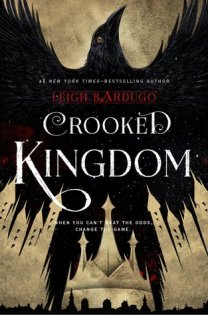 And about Crooked Kingdom:
I thought Six of Crows was good, but this one really raised the bar. I got about a third of the way through it and thought, how can it get better than this? and after everything that has happened, how can there still be two-thirds of the book to go? But there was, and things just kept getting more interesting, more desperate, more seemingly unsolvable and insurmountable, with a great big build-up that made me crazy to finish but made me want to savor it all at the same time. I ended up reading the last five chapters a couple of times; I’d read a chapter at breakfast and then at lunch, instead of moving on, I’d go back and read what I read at breakfast to make sure I had caught everything, seen all the possibilities, gathered all the nuance. You know a book is good when your first response at turning the last page is a more than half-hearted desire to start the book over again right that minute. Way to step up your game, Leigh Bardugo.
So now, I will have the pleasure of reading her first book for adults, and Lisa can go back and dip into her back list. Isn’t it wonderful to have friends who read?
A mixed bag
In my last book review (too long ago, I know—things have been hectic), I mentioned that I was going to read another book by Cathy Lamb, because I was so enamored of the first line of the book:
“I left my wedding dress hanging in a tree somewhere in North Dakota.”
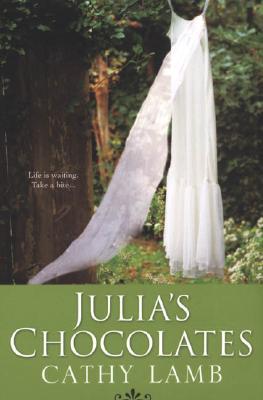 It turns out, unfortunately, that the first line was the best thing about that book. Although I did finish it, and although I did enjoy certain aspects, I concluded that this author is just too disjointed in the way she structures her novels. There is a challenge for the heroine that seems perfectly realistic and commonplace, and yet the way it is addressed in the novel is through the cultivation of that heroine by perfectly unrealistic, silly, contrived people and circumstances. As I indicated in my previous review, it’s like someone took a book chock full of magical realism, tore out all the pages, and dumped them in a cauldron with the ones from a straightforward realistic novel, and then drew pages out at random and put them together to make a new book that jumps wildly between fantasy and real life.
And yet…I ended up reading two more of them.
One of the (poor) reviews of Julia’s Chocolates on Goodreads commented that the book was “sappy chick porn.” Her justification of this was that whenever a woman in such a book left an unhappy marriage, a horrible relationship, or another life-threatening situation, there is always around the next bend a delightful little town, a wildly successful talent that she can immediately turn into a new career, and a perfect Prince Charming. None of this resonates of truthfulness for anyone, but those are probably the exact reasons why books such as this enjoy a wide readership. Julia’s Chocolates was not a particularly well done example of one of them, but in the next two books, I did find some saving graces.
 The next book I read is called Such A Pretty Face, and it is, as you would surmise, about a fat woman plagued by the constant cliché of supposedly well-meaning people telling her that if she’d only lose weight, everything would be divine. But I have to give Lamb credit: In this one she managed to avoid a lot of the clichés that plagued the previous book, and she actually drew a realistic picture of a woman so inundated by horror in her life that all she felt able to control was her eating, her eventual size protecting her in some aspects from dealing with the world around her.
The portrayal of Stevie Barrett’s terrifying childhood and the precipitating event that sent her from a loving though troubled home into a dysfunctional, belittling one was sensitively done, with details so perfectly personal and intimate that they evoked the scenes almost too powerfully for the reader. Similarly, her struggles as an adult to come to terms with herself are touching. After a heart attack at age 32, she undergoes bariatric surgery and loses more than half her weight, but inside she is still the fat, unattractive, deeply unhappy person she was never able to confront. Slowly, with assistance from friends and relatives, she begins to turn this around.
The criticisms of this book are two: One, Cathy Lamb doesn’t know how to write dialogue for the bad guys. She can depict them realistically, but when it comes time for them to speak, they sound like the villain in a melodrama, complete with handlebar mustaches and maniacal ha-ha-has! Two, of course, is the perfect love of her life who discovers, pursues, and wins her in the course of the book. As my friend on Goodreads said, “I mean literally, the next man she meets will always be handsome, sexy, available, and perfect for a long-term relationship.” This book deals with that topic more realistically than did Julia’s Chocolates, but it still seemed a bit too ideal.
Actually, let’s make those criticisms three, which goes as well for the next novel: the completely generic book covers. There were so many interesting images in this book that could have been featured on the cover to give it a little pizzazz as well as some intrigue, but no. Also, in the last book I will review, the sisters all three had black hair. Ahem.
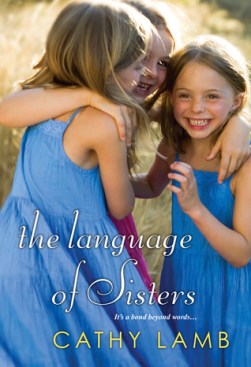 My favorite, The Language of Sisters, is about three women—Antonia, Elvira, and Valeria—Russian sisters who escaped Communist Russia with their parents when they were young children, and moved to Oregon to be with the rest of the noisy, loving, extended family of Kozlovskys. This book, as do most of Lamb’s, has a touch of magical realism to it: The sisters are able to hear one another in their heads at times of danger, sadness, or trial, and can call out to one another for help. The book is narrated by Toni (Antonia), and is essentially her story, although it encompasses both her sisters, her extended family, and the “extra” family she has created on the dock of the tugboat (floating in the Williamette river) that she calls home. It’s not a surprise that those characters, given Lamb’s propensity for exaggeration, include an interracial couple, a lesbian couple, a high-priced call girl, an elderly opera singer suffering from dementia, and a husky blond DEA agent jonesing to be Toni’s soulmate.
The things I enjoyed about the book were the secrets that are gradually revealed throughout the course of the book—some in the recent past, and some left over from the girls’ Moscow childhood. The flashbacks to Moscow were particularly powerful. And I will admit that I also enjoyed, even while scoffing at, Toni’s blossoming relationship with Nick (the DEA agent). Apparently even a cynical reader can’t, in the end, resist romance.
I’m still not sure I would count Cathy Lamb as among the authors I like or would return to for more; but this has been a pleasantly fluffy, cozy, romantic interlude in my reading habits for which I have been grateful while confronting so many challenging pursuits in the real world for the past few weeks. (Let me just say that “I hate Microsoft” encompasses almost all of those challenges.) Although I will now return to my regularly scheduled programming of fantasy, teen fiction, and anything else that strikes my fancy, I won’t rule out another Lamb interlude in my future.
All about books
I accidentally found another book about books! It was also about a lot of other stuff, some credible, some fantastic, and most of it a little over the top. It is All About Evie, by Cathy Lamb.
I said, after my months-long dedication to Kate Atkinson’s convoluted mysteries interspersed with the literary but somewhat bleak novels of Jane Harper, that I wanted something fluffy; but fluff overwhelmed everything else in my first choice of 2020, and my second was a promising but ultimately disappointing one. This book definitely brought the fluff, along with some magical realism, but in this case it was fluff with which I closely identify, so the reading was a much more pleasurable experience.
 Evie lives on one of the San Juan Islands in the Pacific Northwest, in a remodeled carriage house painted in my color schemes, stuffed with toppling towers of books and surrounded by a rose garden. She has many animal friends—the list includes dogs, cats, goats, sheep, horses, and alpacas—who live with her and keep her company. She has a bookstore in town, where she lectures people on expanding their minds by reading out of their chosen genre, and serves delectable pies and cakes and interesting kinds of tea while conducting book clubs for diverse demographics. She has a mother and several aunts who live nearby and who give her love and quirky advice and don’t smother her too much. In essence, it sounds like my idyllic lifestyle.
She also (here comes the magical realism) has premonitions. Some are good, some are horrifying. Some she can do something about, others she can’t fix no matter how hard she tries, and some she doesn’t want to alter because sometimes karma should be a bitch.
Cathy Lamb has definitely bought into the idea that the first line is everything in hooking her readers’ attention: Hers in this book is, “I knew she was going to be hit by a white truck.” (In the next book of hers that I decided to read, it is “I left my wedding dress hanging in a tree somewhere in North Dakota.”) In this way she introduces Evie’s premonitions. Evie sees a future for someone—you could rather refer to them as precipitating events—and feels compelled to act on her knowledge, and yet what do you do? Walk up to someone and say “Excuse me, please be late for work today so that scaffolding doesn’t fall on you and kill you”? Try that and see what happens. In Evie’s case, it taught her to be secretive, made her overly anxious most of the time (obsessively watching her surroundings for signs to determine when the premonition will manifest), and occasionally led to criminal acts such as locking her favorite librarian in her home so she wouldn’t get hit by a train, or risky behaviors like climbing up to the peak of a two-story house to fix some shingles so that her elderly neighbor wouldn’t try to do it himself and break both legs in the fall.
These premonitions are why Evie has buried herself in a small town, in a small bookstore, with mostly animals as friends—a lower incidence of premonitions than would hit her in the overcrowded press of the big city. These precautions have not eliminated her problems, but have certainly reduced them to be almost manageable.
Evie has only ever had one premonition about herself, and it’s about her death, in a car accident, when she meets another woman driver on a one-lane road on the edge of a cliff; but she never sees the ending. She feels like someone dies, but doesn’t know if it’s her or the other woman, and she has an odd feeling that she knows the other woman, although she’s never seen her before.
This leads us to an alternate narrator in the story, a pregnant teenager locked up for murder in Portland, Oregon in 1975, whose sole defense in her trial is that she “saw” her boyfriend’s father trying to kill her boyfriend, and the vision led her to a pre-emptive strike to prevent that act.
This alternate narrator also lets in a big dose of reality to this so-far quirky and not-so-serious story. The book turns out to have a darker vein of truth about misogyny and abuse of women and children, which is both powerfully handled and disconcerting as a contrast to the extremely lighthearted nature of most of the rest of the narrative. Setting these incidents against the backdrop of Evie’s aunts, who construct and wear fantastical hats on all occasions and do nude yoga on the beach, is sort of like when renowned magical realism author Alice Hoffman abruptly transitioned from 1995’s Practical Magic, with its witchy tequila-drinking women who could fly, to 1997’s Here on Earth, a tale of a twisted adolescent love that returns to poison the adults who participated in it. But Alice kept those in separate books. Lamb does not.
It didn’t make me dislike the book, exactly; but it did pull me up and make me wonder whether it was wise to try to pack it all into one volume.
There are some wonderful scenes, on both sides of the narrative. One that was a favorite was when a goth teenager came into the bookstore looking for yet another vampire novel, and Evie lost her patience and insisted that the girl read a memoir.
I pointed to the seats by the windows. “Sit. Open the book. Read it.”
“I have to meet my mother soon.”
“Text her. Tell her to come here when she’s done doing whatever. You have got to expand your closed mind and read about other people in this world who don’t bite necks and have long teeth.”
The other I particularly enjoyed was when the temporary police chief, who has decided that Evie should date him despite her patent dislike of him, attempts to intimidate her and gets owned by the townspeople, who all gather around him in the street to comment loudly and unflatteringly about his particular style of bullying and ask if he can’t get a date any other way. Both are wonderfully written; I just had trouble shoe-horning them into the same narrative.
I liked All About Evie well enough to try another, so I am on to Julia’s Chocolates (the one in which the wedding dress is abandoned in a tree in the first sentence). I’ll let you know my conclusions soon…
How about twice?
I’m reviewing the book Once in a Lifetime, by Cathy Kelly. I’m not sure why, because I’m about to pan it. But stick with me, you may find it of interest.
This book was a failure that had all the advantages to be a success.
I have the feeling Cathy Kelly aspires to tell stories like those of Maeve Binchy, and she certainly had all the Binchy elements here: An interesting locale, a bevy of memorable characters, and some life decisions that needed to be resolved. And it came so close in many respects, but in others was a huge disappointment.
 The book is the story of various people who are most of them somehow related to a wonderful department store in Ardagh, Ireland called Kenny’s, the epitome of all things elegant and unique contained within its stalwart Edwardian exterior. And yet, instead of beginning with the store, the book first starts the narrative with a rambling description of the character Star Bluestone, a witchy woman with special powers who lives a happy single life as a hermit in a cottage and weaves beautiful tapestries that oh, here’s the connection, she sells at Kenny’s.
The book should have begun by being firmly focused on the store and its owner, because he is pivotal, and the store turns out to be the connecting element for virtually all of the characters. And once she gets to it, Kelly tells just enough about it so that you are thoroughly enamored of it and wish you could shop there; but then neglects to give it that Binchy feel of daily involvement that would have made it a true vehicle. Kenny’s Department Store could have served as the foil to showcase all its characters in the same way that Binchy’s The Evening Class used the night school to examine the lives and secret goals of all the folks who were enrolled in its beginning Italian class; but Kenny’s ultimately took a back seat. It came and went in importance, and although the story wraps up with a Kenny’s narrative, it disappeared for far too much of the book to be the sustaining element.
Likewise, in some ways Kelly is a master at characterization, and yet I felt like, in the end, her characters failed to hold the line. The personality and presence she developed for TV reporter Ingrid Fitzgerald meant that Ingrid simply would not have reacted to things the way she did in the end, I don’t care how soothed she was by the book’s airy-fairy mystical witch woman who seemed to have the solutions to many of the characters’ problems. Similarly, if this person was to be the catalyst for so much action, then she, like Kenny’s, should have been far more prominent throughout the story, instead of in bits and bobs here and there. She has the “Star” role as the opening character and then disappears for most of the book. As for the rest of the ensemble, I sincerely liked Charlotte (Charlie) and Natalie, David Kenny, and even the subsidiary characters Dara, Molly and Ethan, and Ingrid’s best friend whose name I am blanking on; but their stories were so uneven in length and detail that the reader got confused as to where the book was going and what would end up being significant. Tangents abounded.
One additional disappointment was that Kelly gives a big promise of treating her women like people, and then succumbs, near the end of the book, to what I would consider rank misogyny. One goes completely out of character to forgive the unforgiveable; another (a successful and self-sufficient businesswoman) acts like a giddy schoolgirl and embraces a “last chance” romance with a younger man (all of which was fine), whereupon her friends observe that “he’s just the type of strong man she needs.” What?! That is not fine.
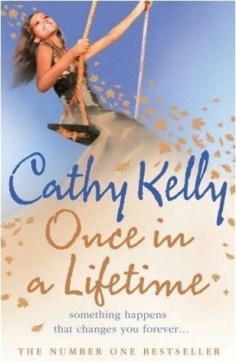
Finally, what did the book in for me was its cover and its title. “Once in a Lifetime” is so vague as to be insulting to a book as specific as this one was; I don’t even have a clue to what it refers in this story! And where in the world did that picture of a girl on a swing come from? No one in the book ever frequents a playground, or gets on a swing, or feels as happy and jubilant about it as this pictured stranger apparently does. What the hell, publishers? While I was ultimately able to read the book for its own merits (which, despite my negative review, were many), the cover was so misleading that it took me twice as long to get into the story, which wasn’t following the lead that the cover gave it. It’s a relationship book masquerading as chick lit.
 I don’t usually even review books that I didn’t enjoy, but I was so frustrated with this one that I had to vent. The ideas, the setting, the characters, the language were all there, but it just didn’t gel. I would love to see Kelly do a rewrite of this book, reign in some of her characters (enough about Charlie’s mother, already!) and expand the others, connect them all more closely with the store that brings them together, and change the title and cover to something reflective of all that (like this one!).
I doubt that would ever happen, but that is my wish, because this book DESERVED to be better.
Sequels (sigh)
There are those authors such as Louise Penny, Michael Connelly, Robert Crais (mystery writers), or Maggie Stiefvater, Leigh Bardugo, Sarah J. Maas (young adult fantasy) who reliably turn out books in their ongoing series year after year. You can almost set your clock by Penny at this point. I know that every August, I will be reading another book about Chief Inspector Armand Gamache, and I am happier for it.
At the opposite end of the spectrum are authors who start with good intentions but for various reasons fail to deliver, sometimes for years or even decades. If you love their writing, you have to be willing to wait. You can’t hurry them; their process is their process, and it’s not going to go faster because a lot of fans are being petulant and demanding. So you have to love their writing so much that you are willing to re-read what you have, sometimes multiple times, until the next book finally appears.
One that comes to mind is The Queen’s Thief series, by Megan Whelan Turner, in which she wrote the first book (1996), we waited four years for the second, six years for the third, four more years for the fourth, and seven years for the most recent, which came out in 2017. Turner is promising #6 (which may be the final volume) for 2020, but given her track record, I am not holding my breath. But when it arrives, it will be greeted with cries of joy, and I will re-read the series for what, the fourth time? to celebrate its completion, because it is just that good.
Another is the dystopian fantasy known as The Obernewtyn Chronicles, by Australian writer Isobelle Carmody. She started the series while she was in high school. She finished it in 2015. She was 57 years old.
I loved that series so much that when the final book was published in Australia a year before it was due to come out here, I did a trade with a young Aussie friend on Goodreads. She wanted Cornelia Funke‘s third book in the Mirrorworld series, which was not released in Australia (and speaking of which, wondering when there will be a book #4?), and I wanted The Red Queen, so we traded addresses and mailed them to one another.
Finally, there are writers who start a series, go like gangbusters for the first few volumes, and then…nothing. The subject of this blog post is one of these, and it’s not to make any particular point but simply because it’s an amusing anecdote.
In the internet age, it’s a lot easier to make a personal connection with an author, and because of the ease of contact, it’s also more likely they will get back to you. Imagine being able to type a few lines on your computer keyboard instead of hand- or type-writing your response on actual paper, putting it in an envelope, addressing it, scrounging up a stamp…no wonder fan letters didn’t get such frequent responses!
Recently I was moved to make one such contact, due to some extenuating circumstances, and here below are the results.
The email was to Jasper Fforde, author of the series The Last Dragonslayer. Book #1 came out in 2010, book #2 in 2011, book #3 in 2014, and then…nothing. A listing on Goodreads with a potential title and no book cover was the best one could find for the subsequent 5+ years.
TO: Jasper Fforde
FROM: A Fforde reader
Dude. Are you EVER going to write the last book in The Last Dragonslayer series??? Because in addition to needing to oblige this elderly librarian fan, you now have 14 English literature students in CHINA eagerly awaiting results.
One of my former book club kids at the library went on to study languages at Berkeley and then got a job teaching English literature to Chinese students in China. He wasn’t having a lot of luck raising their reading skills, so I told him to dump the classics and give them something to read that they would actually ENJOY, and recommended The Last Dragonslayer by you. I checked in with him today on Facebook and asked him if his students had liked the book. Here is his reply:
my literature students loved the book
they quote it often
and they are in the middle of writing an essay on it
i’m proud of them.
one student now refers to himself as the mighty shandar
As you can see, it is absolutely imperative that you get that one done. International relations depend upon it.
Best regards,
Melissa Elliott
Adjunct professor, UCLA MLIS
Teen librarian (retired)
Avid fan
Two weeks later, he replied:
Dude, yes I am (and thanks for calling me dude).
It’s the book I’m working on now, and will probably be called something like: “Trolls v. Humans, a titanic struggle of good against evil, with ample breaks for tea and cake.”
So panic not.
Best,
Jasper
I wrote him back:
I live in California, where it is required by law that you “dude” someone at least once in the course of an acquaintance. I like to get it out of the way up front.
I am supremely happy to receive this news. I will at once reassure the Chinese that they can expect it forthwith, and I promise a review on my blog of the new book plus the entire quarky series, once Trolls v. Humans lands among us.
Sincerely and with great joy,
Melissa Elliott
https://bookadept.com/blog
Have YOU ever exchanged correspondence with an author? Tell your story in the comments…
Kate #5
Sometimes reading Kate Atkinson’s books make you feel like you’re meeting your cousin for coffee.
She sits down and, before you can pick a topic of conversation, she launches into a long narrative about her friend Janey. Now, you have met Janey a few times, but you don’t know any of the other players, who include Janey’s ex-husband and his exploits with the new wife, her two sons, one of whom has made her proud and the other who has gone AWOL, and her formerly drug-addicted daughter for whom childbirth was transformative and who is now out looking for real estate with her shiny new hubby. As you listen, you think, I know that these intimate details of Janey’s life are interesting to someone, but why would you think they would be interesting to me? Could we address subjects that are applicable to us both, please?
If you have a relationship with your cousin such that you could actually say something like that (instead of just listening interminably and politely), your cousin might then say, Oh, I’m telling you all this with a purpose, I come into the story later, just wait for it. So you wait…and you wait…and you wait. And while you are waiting, you are thinking to yourself, Gee, I hope the eventual point of this story is worth it.
Most of the time, when reading Kate Atkinson, it IS worth it. But sometimes you do feel like Doubting Thomas and just want to poke someone!
Big Sky, which is Jackson Brodie book #5, is the epitome of Brodie’s favorite saying, which is,
“A coincidence is just an explanation waiting to happen.”
Although Jackson himself is involved with a fairly mundane set of clients—a woman whose spouse is cheating on her, an entrapment plan regarding a guy on the internet trying to lure young girls—the stuff going on around him, to which he is largely oblivious until it is thrust under his nose and he has to pay attention, is pretty major. There is a scandal from the past that has resurfaced with the imminent release from prison of one of the perpetrators; there is a current drama that only emerges as its links with the past bring the protagonists to the fore; and there’s a whole lot of interpersonal stuff going on. All of this is positively rife with coincidence.
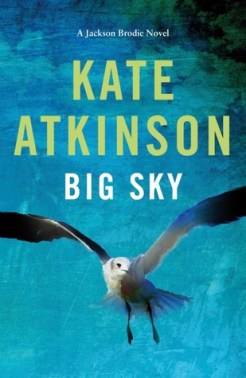 It’s been 10 years since Atkinson wrote her last Brodie book, and she chose to age everyone to the appropriate point, from Jackson’s son, Nathan, now a sulky teen, and his daughter, Marlee, about to embark on marriage, to various others from his past, including the wonderful Reggie Chase, last encountered at age 16 but now a Detective Constable in Yorkshire.
Reggie and her partner, Ronnie (equally diminutive but fierce), have been tasked with following up on some details from a supposedly closed case, a vast pedophile ring that encompassed businessmen, politicians, and power brokers in its “magic circle” of depravity. But as they poke at the case, with many of the original players long dead, it becomes clear that something else has emerged from that old association, equally as sinister in its own way, run by the hangers-on from back in the day, who are equally adamant about keeping their secrets. Brodie, typically clueless, somehow bumbles into and out of association with most of the people involved, with sometimes tragic and sometimes comedic effect. The best characters to emerge from this scrum, in terms of reader interest, are definitely Crystal Holroyd and her stepson, Harry.
As I read, I thought that the fact that Atkinson had waited 10 years to bring Brodie back, coupled with the reintroduction of so many characters from the previous novels, would surely signify a satisfying ending to this long adventure, but no. Things between Jackson and Louise are still dangling; we don’t know what happened to Tracy and Courtney; and while the details of this particular outing are mostly resolved, there are a few loose ends that could be tidied, should Atkinson choose to do so. I’m thinking there may be another book in Brodie’s future.
If I’m honest, I’m glad there isn’t another one right now, though; I think my next read is going to be something “fluffy,” with a limited number of characters and relationships and a story told all in one perfectly straight line….


