Branching out
Because I’m not much of a romance reader, confining myself to anything by Georgette Heyer and most things by Jenny Colgan, I have never previously read anything by Jude Devereaux. I am, however, a big fan of mystery and, noticing that she had written her first, decided to check it out of the library and see whether there was a reason Devereaux is a best-selling author.
I did enjoy this mystery! It’s not the best plotted or most literary or twistiest I’ve ever read by a long shot, but Devereaux’s gift for creating engaging characters immediately drew me in. I’d definitely classify this as a “cozy” mystery; it’s set in a quirky small town and features a cold case solved by a trio of smart amateurs, so it fulfills the criteria.
 A Willing Murder opens with a prologue that sets up the crime from back in the ’90s, and then turns to the present-day to acquaint us with Kate Medlar, a young woman burdened with a sensitive and overly dramatic mother. Kate has always wanted to know more about her father, but beyond idealizing him and never ceasing to mourn him, her mother isn’t generous with the details. Then, Kate’s mom lets slip that her father has an older sister still living, and this mobilizes Kate. It turns out that her Aunt Sara is a successful and wealthy novelist living in a small town in Florida. Kate researches the town, discovers that she can make good use of her real estate license there, finagles a job, and then writes to ask her aunt if she can stay with her until she gets her own place.
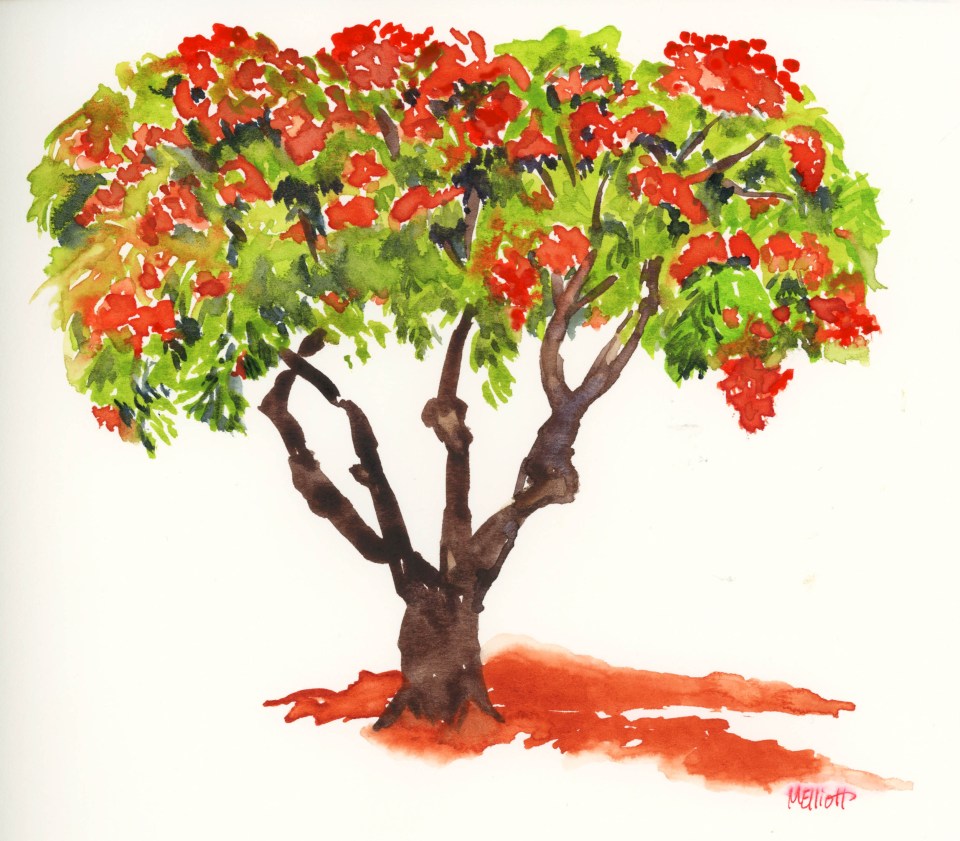
Sara is rattling around alone in her palatial house in Lachlan, and has just invited Jack Wyatt, the man who renovated the house for her and also the grandson of her childhood sweetheart, to move in while recuperating from an auto accident. But there’s plenty of room, so she says yes to Kate. Before the aunt and niece can get to know each other very well, they go with Jack to look at one of the properties he’s just bought to remodel and sell, and come upon a gruesome discovery. On the property was a beautiful royal poinciana tree riddled with termites, and it has been taken down in order to avoid its falling over more destructively in the next hurricane. While Sara and Kate are photographing the prone tree, Kate slips into the muddy hole and discovers that 20 years earlier, someone planted it over the freshly dug grave of two murder victims. And Jack thinks he knows, to his shock and dismay, who they are.
 The sheriff, a long-time townie, is afraid to open the cold case, because he thinks he knows who murdered the two: Jack’s father. Sara, Jack, and Kate don’t believe this to be true, and decide they will confirm this (and possibly find the murderer) for themselves. But someone is one step ahead of them, throwing out suspicion and committing mayhem to conceal the truth.
While there were a few things in this debut mystery that were a bit obvious, it has amusing and witty moments to go along with the tragedies that occur, and the veil of secrecy kept up by the long-time residents of a small town is perfectly portrayed. The way the reader arrives at the conclusion is sufficiently (though not overly) intricate, and the conversations amongst the trio of amateur sleuths make the story vibrant and personal. Over all, it was a sturdy and entertaining book, and I plan to read the next of the Medlar mysteries to reunite with Sara, Jack, and Kate.
On the shore
In yesterday’s mail, I received my advance-order copy of Jenny Colgan’s new novel, The Bookshop on the Shore. Although I had just started reading another book, I promptly put it aside, because I was so in the mood for this book. I’d had a difficult week, and Colgan’s signature combination of can-do attitude with gentle romance plus her evocative setting (northern Scotland) were the required remedy.
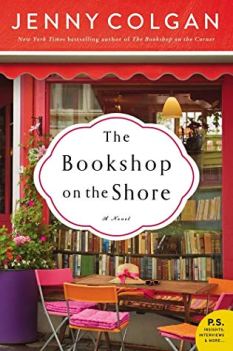 This novel is not exactly a sequel to my favorite of Colgan’s books—The Bookshop on the Corner—since the protagonist is new. But it is set in the same locale, most of the characters from that book are here in a peripheral role, and Goodreads characterizes it as “Scottish Bookshop #2.”
Zoe is a young mother of a four-year-old son, Hari, who is practically perfect in every way—sweet, loving, smart, well-behaved. The only issue with Hari is that he doesn’t speak. Zoe has taken him to multiple specialists, all of whom conclude that there’s nothing wrong with him, and that he will “probably” speak when he’s ready. This worry is at the top of Zoe’s list, but is by no means the only problem with which she is dealing. She’s living in London in a tiny bed-sit in a bad neighborhood, working at a daycare job inadequate to pay her bills, and her ex-boyfriend, Hari’s father, is a go-with-the-flow kind of guy who’s more interested in making it as a deejay than he is in contributing childcare funds to support his son. When her landlord leaves her a rent hike notice, Zoe knows that she will at that point be truly beyond her means, so she appeals to Jaz for help, not expecting much but ever hopeful. Jaz disappoints, as usual, but fortunately the interaction results in a helping hand from an unexpected source.
Jaz’s sister is Surinder, Nina’s best friend from The Bookshop on the Corner, and she has just received a call from Nina, who is desperate to find someone to take over her business (she travels around rural Scotland selling books from a van converted into a mobile bookshop) during the rest of her pregnancy. Surinder sends her Zoe, with Hari in tow. But working in Nina’s business isn’t enough to keep Zoe afloat and also doesn’t provide her with a home, so Nina finds Zoe an evening-and-weekends job as a live-in au pair to the local “big house” family.
Zoe approaches her jobs with a will to succeed, but rapidly discovers that both are going to be uphill work. She hasn’t Nina’s gift for matching every customer with the right book, and the bottom line is making that obvious during her first weeks with the book van. And the au pair gig seems like a bigger nightmare than her horrible life in London, with three rude, uncooperative children who ominously refer to her as “Nanny Seven,” and a father who is obviously checked out and not coping. But with little other choice, Zoe has to seize her opportunities and make the best life she can for herself and her silent little son on the admittedly beautiful shores of Loch Ness.
This is a trademark delightful tale from Jenny Colgan that fulfills all the requirements her readers have come to expect. The characters are wonderfully delineated (particularly those of the three miscreant children, the curmudgeonly housekeeper Zoe and Nina refer to as “MacDanvers” after Rebecca, and Zoe’s son Hari), and the setting in rural Scotland is, as always, a major factor enriching the scenario with descriptions of nature that make the city dweller long to catch the next flight to Inverness. Colgan has the skill to engage the reader with the protagonist’s plight such that every challenge and triumph are taken personally. I thoroughly enjoyed this book, and it set me thinking again about whether a retirement in a rural setting would suit me better than my current situation as one of the million citizens of Los Angeles!
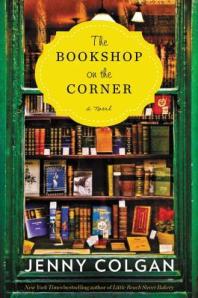 The only caveat I have, and I had it with the book’s predecessor, is calling the mobile book van a “bookshop” and depicting it on both covers as a stationary location! Don’t the publishers read their books? There has to be a better title for both books, and better artwork as well. But, I suppose that if you had called this one, for instance, “On the Shore,” where much of the action takes place (both the selling of books and the live-in nannying), it wouldn’t hook in all those readers who want a book about books and readers; and we are a big and focused readership. Oh, well….
YA authors, adult fare
This week, I picked up two books to which I had been looking forward: Jane, Unlimited, by Kristin Cashore, and Tell the Truth, Shame the Devil, by Melina Marchetta. I didn’t look forward to them because I’d heard anything at all about their contents, but simply because of my sheer adoration of both authors’ previous work. Both have been exclusively young adult authors up to this point, Cashore with her fantasy series set in the Five Kingdoms that begins with Graceling, and Marchetta for a combination of realistic stories (Saving Francesca and sequels) and her fantasy series (Finnikin of the Rock, Froi of the Exiles, and Quintana of Charyn).
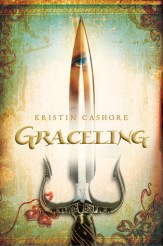 These two YA authors share something else that I have puzzled over since I have been reading YA: Their work doesn’t necessarily appeal to teens as much as it does to adults. Although Marchetta’s contemporary realistic books seem to have teen fans, the teens I coaxed into reading Finnikin liked it well enough but not sufficiently to go on and read the two sequels (which is a shame because I think they are her two best books). Similarly, the minute I read Graceling, I was raving about and recommending it to every teen fantasy fan I knew, and although a certain percentage connected with it, that percentage wasn’t nearly as high as I estimated it should be, given that it’s a brilliant story with a feisty, personable heroine. I keep talking it up, but I have sometimes wondered, in both authors’ cases, if they shouldn’t have released their fantasy series as adult books rather than sequestering them in the teen section. Certainly many adults I know have loved them.
It’s always interesting when a teen author branches out into adult, or when an adult author writes for teens. I have previously blogged about the sometimes disappointing results when adult authors tried to write teen books and only succeeded in diluting the spirit of their adult books in the mistaken belief that teens need things to be dumbed down. Similarly, there are YA authors I adore whose books for adults have left me cold. Of the two books I read this week, one incited that reaction, while the other was exactly the opposite.
 My friend CeCe on Goodreads says about Jane, Unlimited, “It’s a bizarrely delightful puzzle box of a book, and I enjoyed every second of it.” Other friends similarly adored and raved about this book. I’m glad they had that experience, and extremely sorry that I can’t echo their enthusiasm.
After I somewhat guiltily decided to put the book down at 132 pages and not finish it, I went back and read Kristin Cashore’s afterword about it, and discovered that it had started life as a “Choose Your Ending” type book and then evolved into its current incarnation. This might offer a possible explanation for my poor reaction, because I have read two of those books in the course of my tenure as a book club leader for teens, and greatly disliked the experience both times.
Before anyone accuses me of such, I want to say that it’s not that Cashore didn’t follow in previous footsteps by providing another gripping fantasy story set in the Five Kingdoms; I am eclectic in my tastes, and perfectly willing to read from all genres. But to me, this book didn’t know to what genre it belonged (which is, according to some reviewers, one of its delightful strengths), and the beginning of it was so disjointed and confusing that it just never took hold in my imagination.
It reminds me of The Westing Game, by Ellen Raskin, beloved of middle-schoolers everywhere, apparently. We read it for my teen book club, the kids gave it an 8.5 out of 10 rating, and I hated every minute of it. It was confusing, went off on tangents, provided no character development for its quirky tribe, and left me floundering.
That’s exactly how I feel about Jane, Unlimited, which begins with a similar setting—a strange mansion, set on an island, belonging to a reclusive millionaire, with a lot of puzzles to be solved. (It harks back to Agatha Christie as well.) I had an inkling of a feeling for Jane, the one person in the story with a tiny bit more character development, but as the rest of the array rushed past in dizzying numbers, I couldn’t muster up any enthusiasm for learning more about them; and if I did, I was doomed to disappointment. For instance, at one point Jane’s mentor and host, Kiran, offers a private conversation that seems to promise more enlightenment about what her thing is (for the first 100 pages she has been merely a sulky looming presence), and just as my interest was piqued, Jane thought to herself, No, there are more interesting mysteries than this one to solve in this house, and said “See you later!” to Kiran, who wandered, off, disappointed. She wasn’t the only one! There was instance after instance of this, when I thought a story was about to take off, but nothing ever did.
I guess that if I had stuck around for something to finally gel, there are interesting developments to be had (CeCe says so), but my patience was exhausted, and I decided to go read something else. So sorry, Kristin. I know you worked hard on it.
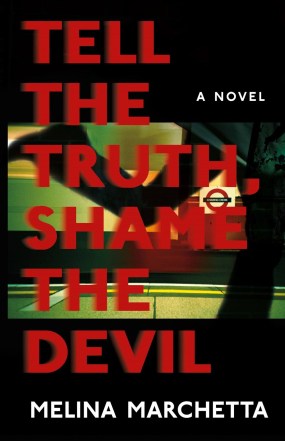 Providentially, the “something else”
I decided to read (not without trepidation, considering this experience) was Melina Marchetta’s adult suspense novel, Tell the Truth, Shame the Devil. In this instance, not only was I not disappointed, but I finished the 400-page book in two days. Although this book contains a bunch of teenagers as significant characters, it is from the adult point of view that the story unwinds, and the adults in the story have the typical hard time fathoming the teen mindset.
Bashir “Bish” Ortley is a cop who is “on leave” from his department after having lost his temper and threatened a superior officer. His daughter, Bee, is on a school field trip in France when word arrives that her bus has been bombed in Calais, and that children are dead and injured. Bish rushes to the scene, and discovers that his daughter is shaken but unharmed, but the same can’t be said for other people’s children. Partly on his own initiative and partly because the French inspector on the scene seems to need the help, Bish finds himself getting involved in the conundrum of who did it and why. Then it’s discovered that one of the girls on the trip (who has been rooming with his daughter the whole time) is the grandchild of one of the most notorious bombers in recent British history, and the daughter of the woman who confessed to making that bomb. The question is whether Violette is a suspect, a simple victim, or the intended target of the bus bomber? Things get more complicated when Violette and a boy she befriended on the trip disappear, somehow making their way across the Channel to England, and fears for their safety combined with the need to find out how they were involved cause the Home Office to unofficially but peremptorily commandeer Bish to do their research and liaise with the girl’s family.
I loved that the principal protagonist, Bish, plays dual roles in this book—frantic father and analytical cop—and that he is such a flawed human being and yet somehow capable of connecting with everyone in his effort to arrive at the truth and also to protect the two wayward children. The differing viewpoints, the lack of trust of everyone for everyone else, the convoluted nature of the crimes, past and present, all add to the suspense and provide for a truly satisfying reading experience. I felt like the book portrayed sensitivity in its dealings with a difficult topic, and yet was honest and true to people’s natures. The story arc held my attention throughout, and I loved the ending and even the epilogue (not usually a fan of epilogues, but this one didn’t end the story, it added to it).
Bravo from me!
I’d like to say that it’s possible Jane, Unlimited truly is something new and innovative that some readers may love, and that it may be my lack of imagination that causes me to prefer a more traditional story arc discernible as such. You’ll have to try them both and see for yourself.
Another flower book
 In the course of writing my post “Flower power” a couple of weeks ago, I looked at a few lists of novels with flowers as their theme, and decided to expand my repertoire regarding the language of flowers by buying and reading The Flower Arrangement, by Ella Griffin.
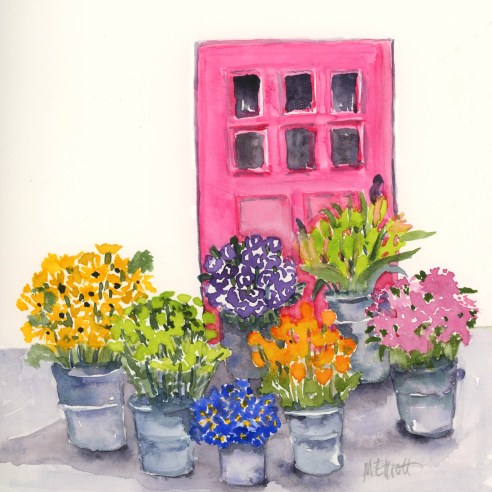
In the midst of severe distress over the loss of a much-wanted child, Lara decides to leave her career as a graphic designer and open a shop she calls Blossom and Grow, in the heart of Dublin. Although, as her doubtful husband warns her, the work is backbreaking, the sourcing of the flowers challenging, and the hours long, the venture turns out well, and Lara loves her little jewel of a flower shop with its beautiful pink façade decorated with hand-painted trompe l’oeil ivy.
Like the protagonist in The Language of Flowers, by Vanessa Diffenbaugh, Lara has a special gift for putting together the right flowers with the right person (even when it’s by accident!), and this theme of people buying flowers for an apology, a declaration of love, a sick friend, a marker for a special day, or simply a spontaneous gesture carries the plot forward. Each chapter is titled with a different flower and its meaning, and there are delicately detailed descriptions of all kinds of blooms throughout the story.
This book probably falls into the category of “cozy romance,” or perhaps you could call it relationship fiction? It’s cleverly done, and is definitely the sum of its parts. Yes, I know that’s not the saying, it’s supposed to aspire to be more than the sum of its parts; but in this case it is appropriate and I’m not denigrating it—the parts do come together to make a whole.
I confess, however, that I was a little disappointed by the way the story evolves. In the beginning, I invested quite heavily in Lara’s tale, which is told first, and assumed that the entire book would be about her; instead, it consists of vignettes that, while tangentially connected to her, don’t necessarily reveal or forward her plotline. There is a central cast of characters played by her brother, her father, and other significant relationships, but then we branch out in turn to those characters’ relationships, and also check in on random people who are connected to the flower shop, it’s true, but sometimes by the thinnest of threads. The author does do a good job of weaving them into a cohesive story, but I simply wanted more Lara.
The one thing that tells against this being considered a romance is that you don’t get your traditional (requisite?) HEA (happily ever after) in the end. Although there are some happy tidings for various people, many loose ends are left, and not because there will be a sequel, I don’t think, but because the author simply wanted them that way. I always think I’m okay with open-ended books until I read one, and then, when I get to the last paragraph and realize my ultimate curiosity won’t be satisfied, I sulk. So this book’s ending made me just a little sulky! I don’t mean to say not to read it, however; it’s a charming, engaging story with a lot of heart, decent writing, great characterization, and an interesting story line.
I had two issues with the physical presentation of the novel: The first was the cover, which, while cute, doesn’t match the description of the shop (thus my little painting, above, to recall the theme of pink!). The second was the title of the book! I don’t understand why the author didn’t call it Blossom and Grow, after the shop; not only would it have been a more memorable title than The Flower Arrangement (which is so generic as to be forgettable, and I did several times when people asked me what I was reading!) but it actually better expresses what happens in the course of the story.
Perhaps Ella Griffin will see this and let us in on her reasoning.
Two steps forward
I was looking for something a little lighter to read after my foray into post-apocalyptic zombie-land, and I realized that I had never gone back to pick up the sequel to the delightful The Rosie Project by Graeme Simsion. Alas, all copies of the sequel were checked out at both libraries where I hold membership, and my book budget for June (and truthfully for July) was long since spent, so I opted instead for something else by Simsion. I had heard nothing about it previous to borrowing the e-book, but Two Steps Forward proved to be a new favorite.
 I didn’t know much about El Camino de Santiago previous to about 2014, but in that year one of my Facebook artist acquaintances, Jennifer Lawson, decided to walk 500 miles along the Camino route and record her progress with sketches. Once she had achieved the feat, she came home, sorted out her sketchbook, and documented the experience in her book Walking with Watercolor.
I promptly bought it, mostly for her delightfully lively and effervescent watercolors rather than because I was intrigued by the topic, but as I read it, my interest grew. The idea of making such a walk, whether on the Appalachian Trail, through the Pacific Northwest, or meandering England’s Lake District, had always been appealing to me. It’s not something to which I could aspire at the moment, given the state of my knees, but who knows? Could happen someday before I die!
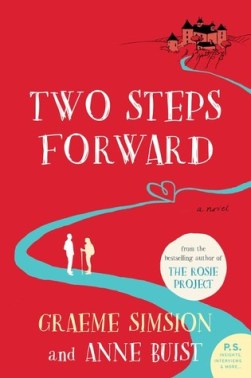 Simsion co-wrote Two Steps Forward with his wife, Anne Buist, and it is loosely based on their own experience of walking the Camino, although it is fiction. El Camino de Santiago is a centuries-old pilgrimage route that ends in Santiago de Compostela in northwest Spain. People walk the Camino for all sorts of reasons, though—not just as pilgrimage but as an athletic challenge, as a meditative exercise, as a vacation choice. They start the route from separate points, depending on where in Europe they are coming from, and all converge at the end to receive a certificate of completion and (if they want it) a blessing.
There are two main protagonists, and each author wrote from the viewpoint of one, then traded their writing, edited, added to and refined it, and put together a seamless story narrated by two.
Californian Zoe has recently taken some devastating hits in her life. First, her husband Keith has died in a car crash, a sufficient reason for grief; but a few weeks later, Zoe learns from her accountant that Keith’s business had been in trouble, and if she sells her house she may just barely be able to pay off the business debt—if she’s lucky. Devastated not only by this new catastrophe but by the thought that Keith didn’t sufficiently trust in their relationship to be honest with her about their financial situation, Zoe is at loose ends (and in a daze) when a friend from childhood invites her to France. Not knowing what else to do while waiting for the house to sell, Zoe decides a visit is in order. While out window-shopping in France, she sees a shell charm that inexplicably calls to her. When she discovers the scallop shell is a symbol for El Camino de Santiago, and that the town where she is visiting is a beginning point for part of the route, Zoe impulsively decides that a time-out from her life to grieve, ponder, and find a new direction is just what she needs and, spending most of the last of her money, kits herself out and departs on the route.
Martin, meanwhile, is walking the route primarily for commercial reasons. He is a British engineer, and has designed a cart that he believes will be a wonderful solution to pilgrims who have trouble carrying their belongings on their back. Since every prototype must be tested and proven before manufacturing takes place, Martin decides that the perfect antidote to hanging around dealing with the aftermath of a nasty divorce is to take his cart on “the Way.” With the promise of some interest by investors once they see the results of his walk, the “Buggy man” embarks only a day or two after Zoe on the same part of the path.
Zoe and Martin, along with a host of other colorful and memorable walkers, show the differences in the kind of walk or pilgrimage that is to be had along El Camino. Zoe, flat broke from the get-go, is hoarding her funds by staying in the cheapest of hostels, occasionally even sleeping in a church or barn, and cooking for herself or snacking on what she can carry. Martin, much more flush, is trying out B&Bs and hotels and savoring the local cuisine in the better restaurants in each town. Some travelers don’t think twice about taking a bus or a cab over a rough patch, while others believe that to gain one inch of progress on the Camino under anyone’s power but their own is cheating and nullifies the whole experience.

This illustration shows one of the stone markers with its distinctive scallop shell that indicates the Way for the travelers to follow, with three pilgrims walking in the background.
The delight of this book is its slow build as the walkers continually cross paths with one another. One will have a short day and the other a long one, and will pass each other, unknowing, but land in the same town in the same restaurant on the same night. Some are up and out the door at the crack of dawn, and walk until dusk, while others nurse a hangover, stop for a leisurely déjeuner, dawdle along for 10 kilometers, and call it a day. This all leads to both expected and unexpected encounters and near-misses.
The accompanying theme to the walk is, of course, what each walker gets out of it, and as both Zoe and Martin make progress in their individual quests for meaning, understanding, forgiveness, or whatever else they have come to see that they need or crave, their interactions with one another also change and grow. The book comes to a dramatic and satisfying conclusion, and then further gratifies the reader with an epilogue to reveal what happens to the characters after their “time out of time” interlude is over. Two Steps Forward is nearly as much a journey of discovery for its readers as it is for the walkers.
If you like this sort of book, you might also consider The Distance from Me to You, by Marina Gessner, a novel about a young woman who walks the length of the Appalachian Trail alone between high school and college, or Skywalker: Highs and Lows on the Pacific Crest Trail, a humorous nonfiction memoir by Bill Walker.
And if you liked what you saw of Jennifer Lawson’s drawings in her book about the Camino, be sure to check out her current series on Instagram. She’s drawing, painting, and collaging 100 dogs in 100 days, and they’re all delightful.
Ew, zombies
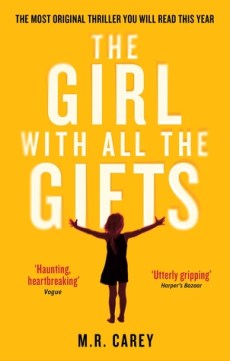 As I have mentioned before, I am neither a horror fan nor (specifically) particularly tolerant of gore, so that I would choose to read a zombie book (without prompting from my teen book club) seems unlikely. I actually picked up the book thinking it was a different young adult novel (and now I don’t know which one that was—it was about a girl whose parents locked her in the garage every night because she had scary abilities), and when I realized what The Girl with All the Gifts was, I almost put it down. But the protagonist immediately caught at my imagination, and I had to keep going. I’m glad I did.
I came late to this one (the book came out in 2014 and the movie apparently premiered in January of 2017 only to sink like a stone—I never heard of it, despite the inclusion of Glenn Close as Dr. Caldwell!), but I agree with author Maggie Stiefvater‘s analysis:
The most sure-footed novel I’ve read all year. A dystopian thriller with a real, beating heart. Recommend. Recommend. Recommend.
So many zombie books are basically action/adventure/gross-out, with people constantly trying to figure out ways to escape being eaten and/or turned. This one, on the other hand, is more of a philosophical analysis of what constitutes a human being, who is worth saving, and what acts are justified in the cause of scientific inquiry and the hope for a “cure.” That makes it sound pedantic and slow; be advised that it is also filled with action, chase scenes, creeping horror, and unbearable poignancy.
The book opens with a bunch of kids who are locked into wheelchairs to attend school. The viewpoint is Melanie’s, arguably the brightest girl in her class, who comments on the variety of teachers and subjects, her interactions with other personnel (including doctors, soldiers, and the other children), and the weekly routine, an undeniably bleak and peculiar one to be imposed on children. The reader gradually comes to realize what’s going on in this cell block locked away from the wider world (the setting is England), just in time for this routine to shift utterly and eject certain of the characters out into that world, following them to see how they fare.
The science—the kind of fungal infection that could plausibly mutate into a zombie-type disease—felt new and interesting. The characters who persist throughout the story are thoroughly developed, with an understanding of their motivations and aspirations. The dystopian world is horrifyingly bleak, and definitely conveys the feelings of the last few people in a dying apocalypse. But for all that, the book is fresh, the story is moving, and the conclusion both beautiful and terrifying.
 There is a second book, The Boy on the Bridge. I initially thought I wouldn’t read it, because the ending of this one is so satisfying I didn’t feel the need; but that book turns out to be a prequel to this, answering some questions about things taken for granted in The Girl with All the Gifts, and I may have to go for it, distaste for zombies notwithstanding!
Although I believe the author wrote these books for adults, because of the age of the protagonists one could also consider them high on teen appeal. From my slightly squeamish position regardingly the sometimes excessively graphic detail, however, I don’t think I would recommend them to teens under the age of 16!
Seeking a thrill
After reading in one genre for a while, I often seek a “palate cleanser” by consciously choosing from another. Since I just finished about 2200 pages of epic anthropological science fiction, I decided to turn to something fast-paced and psychologically thrilling, and checked out two books by
B. A. Paris.
 The first was The Breakdown, and the title is definitely a double entendre. Cass is driving home from a last-day-of-the-semester party with her colleagues. It’s “a dark and stormy night,” and she’s in a hurry to get home, so even though her husband, Matthew, has repeatedly pled with her not to use the shortcut through the woods, Cass decides to risk it. She sees another car, pulled into a turnout at the side of the road, with a woman sitting in it. She passes the car, then stops and looks back to see if the woman needs assistance, but the woman neither moves from the car nor signals Cass by honking or flashing her lights. It’s raining so hard (and is in such an isolated, creepy location) that Cass doesn’t want to get out of her own car, but she figures that if the woman’s car had broken down, she would have signaled in some way, so she continues her drive home, planning to call someone for her when she gets there. But something happens to put it out of her mind, and she doesn’t make the call.
Next morning on the news, she learns that the woman was murdered. Cass can’t seem to overcome her guilt, and it’s compounded by the fact that she doesn’t want to tell anyone (including the police), for fear of incurring scorn and blame, or even suspicion. If only she had stopped, if only she had called, the woman might still be alive.
In the following days, Cass grows increasingly distraught, and begins to exhibit signs of her stress by forgetting things—some small, some important. Compounding her distress is the thought that perhaps she is exhibiting the signs of early onset dementia, which is the disease to which she recently lost her mother. Then the house phone starts ringing every morning after her husband has left for work, but there’s nothing but silence on the other end. Cass starts to believe that someone knows she passed the victim’s car the night of the storm. Perhaps they think she saw something she didn’t. Are they watching her? Stalking her? As her memory grows worse and evidence mounts up that there’s definitely a problem, Cass doesn’t know what to do or whom to trust.
The suspense in this book builds nicely. The author knows just when to deal out bits of information about the other people in Cass’s life—her colleague, John, her best friend, Rachel, her husband, Matthew, as well as more peripheral contacts—to send the reader down some right and some wrong tracks in their suspicions about what’s going on. Like any good thriller, there is a twist you don’t quite see coming that puts the entire story on a different footing and begins to solve the mystery while leaving the most shocking bits for last.
 I enjoyed this book so much that I decided to go back for more, and picked up Paris’s book Bring Me Back. This one has a before-and-after component to it, beginning with the traumatic night that Finn lost Layla. The two young lovers were driving home late at night from a ski holiday; Finn stopped at a lay-by to use the bathroom, and when he returned to the car, Layla had disappeared. Or at least, that’s how he told the story to the police; there may have been a few details he left out.
The book picks up 12 years later with Finn living with Layla’s sister, Ellen. After a few stagnant years unable to adjust to the loss of Layla, Finn meets Ellen at a memorial service suggested by Tony, the detective who, during the lengthy investigation, has become a friend. Finn and Ellen take mutual comfort from shared grief and a certain sense of familiarity, and begin to spend time getting to know one another. Now they have been living together for nearly a year, and have imminent plans to wed.
Then Tony calls Finn to tell him that an old neighbor of theirs swears he spotted Layla in the street near the cottage where they lived. Finn’s heart leaps, and he realizes that while he loves Ellen, if Layla were actually alive…the possibilities are troubling. While he assumes that the old man who claims he saw her could have made a mistake, he has no explanation for the Russian doll that appears at his and Ellen’s house, an exact replica of one Ellen lost as a child and always believed that Layla had stolen. And what about the leading emails he begins to receive from a stranger?
Finn keeps most of these events and clues from Ellen, hoping to sort things out on his own. If Layla is still alive, though, why hasn’t she just turned up? What could she want? What is the purpose of this game?
This one was more of a mixed bag for me than The Breakdown; a little more predictable in some moments, a little more clichéd. But I have to say that it was a compulsive read, and despite the ridiculous behavior of some of its characters, I continued to want to know what was going to happen until the very end, which is fittingly climactic. It’s definitely a page-turner that would make you a good beach read, if this is your kind of book! Paris knows how to draw a picture of life that is bright and shiny on the surface but dark and murky underneath, and to dole out glimpses of the latter in tantalizing servings.
From what everyone says on Goodreads, Paris’s most interesting book is still to come: Behind Closed Doors is her debut novel and received many votes in Goodreads’ best debut novel and best mystery/thriller categories. All copies are backed up with holds at the library right now (always a good, though frustrating, sign), so I have put it on my list. The author also has a new book expected to be released in January, 2020.
Cross-cultural sci fi
I’ve just gone on a reading odyssey not quite as lengthy or labyrinthine as Game of Thrones, but definitely of a complexity that would deter some readers! It’s a series containing four books, each of the first three coming in at around 500 pages, and culminating in a fourth book with a staggering 752! The series, by Kate Elliott, begins with Jaran. I had read Kate Elliott once before when I took a look at her young adult series that begins with The Court of Fives. I liked that one well enough to give it four stars on Goodreads, but not well enough to keep reading the rest of the series. But in my comments, one thing I mentioned that I did enjoy was the portrayal of the societal relations between the conquerors and the oppressed.
 That turned out to be something that Elliott does even better in her adult novels, and I was immediately hooked by the deeply complex interrelationship of all the players on the board of this science fiction saga. My response to the first book was that it reminded me of a couple of Ursula K. LeGuin’s Hainish books (and I can’t pay a higher compliment than that). Similar to Rocannon’s World and The Left Hand of Darkness, it’s an anthropological science fiction story, with overlapping alien races who may know about each other but don’t know each other. It’s old school, and yet it’s fresh, and I enjoyed and was engaged by the way it unfolded.
In the first book, we learn that Earth has been subsumed into a vast galactic empire ruled by the alien Chapalii. At one point a human, Charles Soerensen, led a failed rebellion against their dominance, but rather than punishing him, the Chapalii inexplicably made him a “duke” of their kingdom and gave him dominion over an interdicted planet, Rhui. (What it means that the planet is interdicted: The native peoples are prohibited from knowing about space travel, alien or human technology, or anything that is beyond the development of their existing culture.)
 On Rhui, there are two types of people, the jaran and the khaja. Khaja is actually a jaran word for “not jaran,” otherwise designated by the jaran peoples as “barbarians.” The jaran are akin to the Romany people of Earth, in that they are nomadic, dwelling in tents and moving from place to place according to whim and affected only by weather and pasture. They are matrilineal, with female etsanas of twelve tribes deciding what’s best for the people, but the women work in a fairly equal partnership with men, who are the warlike, saber-wearing, horseback-riding element of the tribes. They are proud, romantic, mostly illiterate but nonetheless intelligent people with an oral tradition and an elaborate history. And under the leadership of the charismatic and visionary Ilya Bakhtiian, they have recently grown larger aspirations and are in the process of conquering the khaja within their realm of influence.
The khaja are all the peoples on Rhui who do not follow in this nomadic tradition—those who have settled down into city-states or kingdoms and jealously guard their land for their own people, who speak various local dialects and are unwelcoming to strangers. Their lifestyle differs markedly from that of the jaran, not just because they are not nomadic, but because they follow a more traditional pattern of patrilineal societies in which women have few rights and are treated as chattel. This includes those groups spread out across the landscape of Rhui and also the inhabitants of the city of Jeds, which is the secret stronghold of Charles Soerensen, the aforementioned duke of the planet, known in Jeds as the Prince of Jeds. This city is the de facto capitol of the planet, where there are schools and universities, a library, and supposedly more “civilized” inhabitants, although under their thin veneer of culture, they also subscribe to the unequal treatment of men and women.
The people of Earth associated with Soerensen cautiously visit and explore the planet in various ways, while maintaining a cover as locals. The Chapalii are supposedly forbidden by the interdiction from traveling to Rhui at all, but as the first book opens, we discover they are not all sticking to this contract.
Charles Soerensen’s heir to the “throne” of Jeds (and actually to all his holdings on all planets) is his sister, Tess. She is young, just graduated from university, and is uncertain of the role she wishes to play in Charles’s complex agenda. She is also suffering from a broken heart, and feeling rebellious. So she sneaks aboard a shuttle bound for Rhui, intending to go to Jeds and buy herself a little time to think; but because the Chapalii on her ship are involved in an illegal operation, she ends up getting dumped somewhere out in the wilds, and is picked up after a week of wandering by the leader of the jaran warriors.
Tess decides that she will remain with the jaran people, immersing herself in their society, as the perfect cover for attempting to solve the Chapalii smuggling scheme that put her there on the planet. What she doesn’t reckon with is her seduction by the warmth and inclusiveness of their lifestyle, and her growing feelings for their leader, Ilya Bakhtiian (and his for her).
Whew! That’s a long and complex introduction to an equally elaborate and convoluted story, but if it sounds like something you’d like, definitely invest the time. With each book more conflicts arise, more truths (about each of the peoples depicted) become apparent, and more investment in the future fates of all takes place. And while we do eventually reach an ending that is satisfactory, the potential is there for more about the individuals and the cultures involved, should Elliott ever decide to revisit them. I can’t help hoping that someday she will!
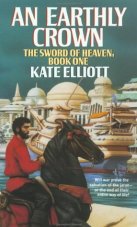

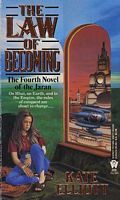
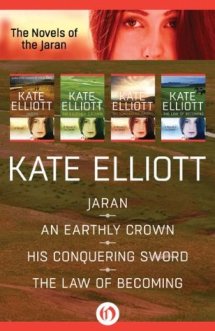
The four books are as pictured above: Jaran, An Earthly Crown, His Conquering Sword, and The Law of Becoming. Don’t be put off by the covers (dated looking and unfortunately not great to begin with); two of the four books are out of print at this time anyway. But this could be considered a good thing: Who has room on their bookshelves for four more 500+-page books? Do as I did and buy them as a four-book set on Kindle. If you’re not sure you want to read the whole series, you can get each book individually for the Kindle, but why spend the extra money? I checked out the first one from the library, and then got tired of being on the holds list for the other three and bought the set.
If you have ever had a romantic dream of wandering on horseback with the Travelers; if you have ever wondered how a matrilineal society might work; if you have ever wondered if there are, indeed, aliens among us; this is the series for you. (And do check out the Hainish novels of Ursula K. Le Guin as well!)

 The Book Adept