Discworld
As I mentioned in my Cat Day post, I continued on with Terry Pratchett’s witch tales by reading Wyrd Sisters, and then when I finished that I ducked out of the witch-specific books and instead assayed Mort, the first of the series with Death as its narrator.
For me, although I love the witches themselves, the most delightful part of Wyrd Sisters was the traveling actors with whom a certain very important player in the fate of the kingdom of Lancre shared a river boat, a wagon, and a stage. His talents there also serve him well when it comes to inhabiting his true destiny on Discworld, but the descriptions of the individual performances, some untrammeled but others under the influence of the witches’ meddling with time, are hilarious homages to Shakespeare.
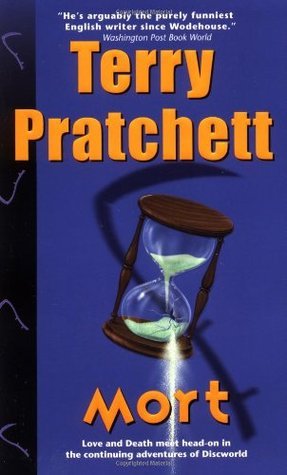
The brief cameo of Death in this book led me to read his shared autobiography with young Mort, whom Death solicits as an apprentice of sorts, so Death (or DEATH, as he is known colloquially) can take a vacation to experience what it’s like to be human. He assiduously takes part in all the pursuits that humans seem to enjoy most (fishing, drinking, and so on) and is somewhat underwhelmed. But while he’s off getting his human on, Mort is messing with the fabric of time, destiny, and fate by refusing to off some of the people whose hourglasses have run out. Mort is horrified by the prospect that he might have to inhabit this role forever if DEATH continues AWOL, and takes steps, assisted by DEATH’s adopted daughter Ysabell.
I think I can sum up Pratchett’s sense of humor when I tell you that DEATH’s pale stallion that he rides across the wind and stars to usher souls into the next world is named Binky.
While I generally prefer books with more gravitas, I can see that an occasional foray into the bounds of Discworld will be a welcome vacay read for some time to come.
One fierce moggy
I forgot about my usual post of cat stories for International Cat Day (today), so I’m going to do an abbreviated one honoring a single cat from the book I’m currently reading.
Wyrd Sisters, by Terry Pratchett, is one amongst 40-odd books of his Discworld series, but is also second of the six “Witches” books contained within that larger saga. It features Granny Weatherwax, Nanny Ogg, and young Magret, who get themselves into some good trouble when they decide to meddle with politics in the kingdom of Lancre, in which they reside.
Playing an important role in bringing together the witches with the ghost of Lancre’s former ruler is the cat Greebo. He is a one-eyed, foul-tempered gray tomcat who has aggressively fathered about 30 generations, but Nanny Ogg still characterizes him fondly as her sweet kitten (although privately she has been known to refer to him as a fiend from hell).
He features in other books of the series as well—Witches Abroad, Lords and Ladies, and Maskerade. At one point he is transformed into human form, but maintains his scars and his retractable claws, and exudes the raw animal magnetism that allowed him to claim paternity to all those descendents; but he is still handicapped by a cat’s inability to work door handles, and has an unfortunate and disconcerting tendency to groom himself with his tongue.
There are some illustrations of Greebo online, but they are copyrighted so I don’t like to poach. So here, instead, is a photo of my old feral cat, Papi, who was likewise tough, one-eyed, and prolific. He and Greebo were, as the Brits would say, fierce moggies.

Happy International Cat Day!
Pratchett

I don’t know how, in my decade-long exclusive pursuit of all things science fiction and fantasy, I managed to miss out on Terry Pratchett. I discovered some of the contemporaries to whom he is frequently compared (Douglas Adams, Piers Anthony), but it took another 30-some years and a degree in library information studies before I was introduced to him via the Tiffany Aching portion of the Discworld books. As a teen librarian, Pratchett came to my attention through the offices of The Wee Free Men; I was really taken aback when my high school book club didn’t love it as much as I did, but I didn’t let that deter me. I read every Tiffany Aching book (five total) that was out or came out thereafter, and loved them all, but for some reason I still didn’t go back (as I normally would) and explore all the other Discworld books.
Perhaps it was because of the sheer volume of the series—41 books is a lot to tackle, and I no longer read with the obsessive one-track mind that I did in my 20s, when I let nothing stop me from completing a series start to finish. But I was at extreme loose ends this week after finishing In This House of Brede; I initially moved on to another Rumer Godden but discovered that i was satiated for the moment and was craving something different. None of my holds are even close to arriving, so I went searching for something else by running my eye down my “Want to Read” list in Goodreads.
This is when I most miss being mobile; my finding process used to entail going to the library and looking at the new books and the just-returned shelves, and then wandering down aisles of my favorite genres—mystery, fantasy, science fiction—to see if old authors had new (or older) works I hadn’t yet discovered. It’s a lot easier to find an unknown treasure that way than it is to scroll through lists on the internet, as I do now that I am essentially housebound. There are the visual, physical, tactile elements of cover art, author quotes, flap summaries, the feel of the paper, the choice of font, the smell of the book, all of which yield up something that helps me make a decision. By comparison, it’s a sterile (and also endless) process to scroll through (sometimes erroneous) Goodreads descriptions, look at the ratings posted by other people, and speculate about whether I can choose something just based on these paltry factors.

This is partially what took me to Terry Pratchett—there was at least some experience, some familiarity with his story-telling and writing style, his characters, his world-building. I did pay heed to several people who said the first two books in the Discworld series, while introductory, were not his best writing, and that to start with #3 was a good beginning, particularly because it is also the debut of Granny Weatherwax, with whom I was already familiar from the Tiffany Aching books. So I acquired a copy of Equal Rites from Kindle Unlimited, and began my exploration of Discworld.
One thing you forget, if you go long periods between Pratchett tales, is his sense of humor and how he exploits old sayings, puns, wordplay. And even though Pratchett’s powers developed exponentially as he wrote each subsequent book, the humor is here from the beginning. The first one I wanted to write down the instant I read it was when Granny Weatherwax decides to find accommodations in a new town; she comments that she has specifically elected to live in an apartment next door to a talented and successful purveyor of stolen articles, because she has heard that good fences make good neighbors. Ba dum bum.
Equal Rites is the story of young Eskarina, who is mistakenly selected to be an heir to wizardry. A wizard comes to Granny Weatherwax’s village of Bad Ass seeking the child to whom he is to hand over his staff before his imminent demise; the smith of the town is an eighth son whose wife is about to give birth to his eighth son, which is highly propitious. So when the wizard realizes he has six minutes to live and Granny, having just delivered the baby, carries it into the room, the wizard places the child’s tiny fingers on his staff to claim it, and then expires before he can discover that the eighth son is actually a girl.
On Discworld, gender equality is a dream—at least for women. Only men are wizards, just as only women are witches. Men have, of course, tried being witches (because they don’t take no for an answer), but it has never worked out well; but those same men have banded together and insisted that “the lore” absolutely forbids women to be wizards, and no woman has ever been admitted to Unseen University as a candidate. Granny W, however, is determined that Esk should at least have the chance (as is Esk herself), so the two set out on a journey to the city of Ankh-Morpork, for Esk to try her luck. This is the basis for the chaotic hijinks that ensue for the remainder of the book.
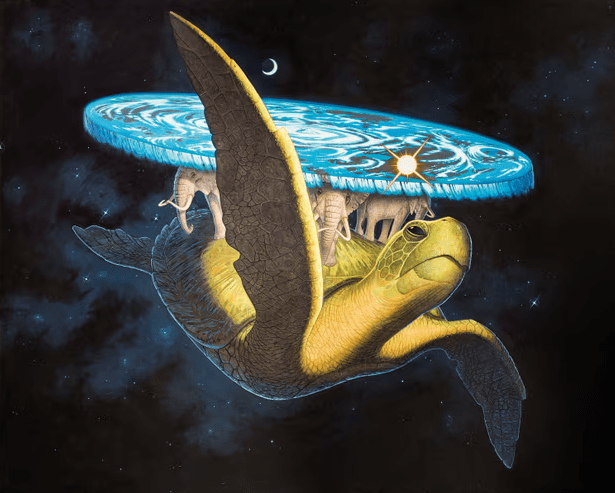
I really enjoyed both the introduction to Discworld and the reacquaintance with Granny W. (and with Pratchett). I think I will continue on for a while; they say you can just read the “witch” books (of which there are six) on their own, but I might also branch out into other characters’ tales set on this flat world carried on the back of a giant turtle and four elephants.
Digging Finlay
I just finished the newest offering from Elle Cosimano in the Finlay Donovan series, and it definitely lived up to its predecessors and gave me a good time during the three days I took to read it. I have reviewed all the other books in the series on this blog; if you read the review of the first one, it will tell you all you need to know to pull you into this tale of the single mom/romance author who gets mistaken for a contract killer.
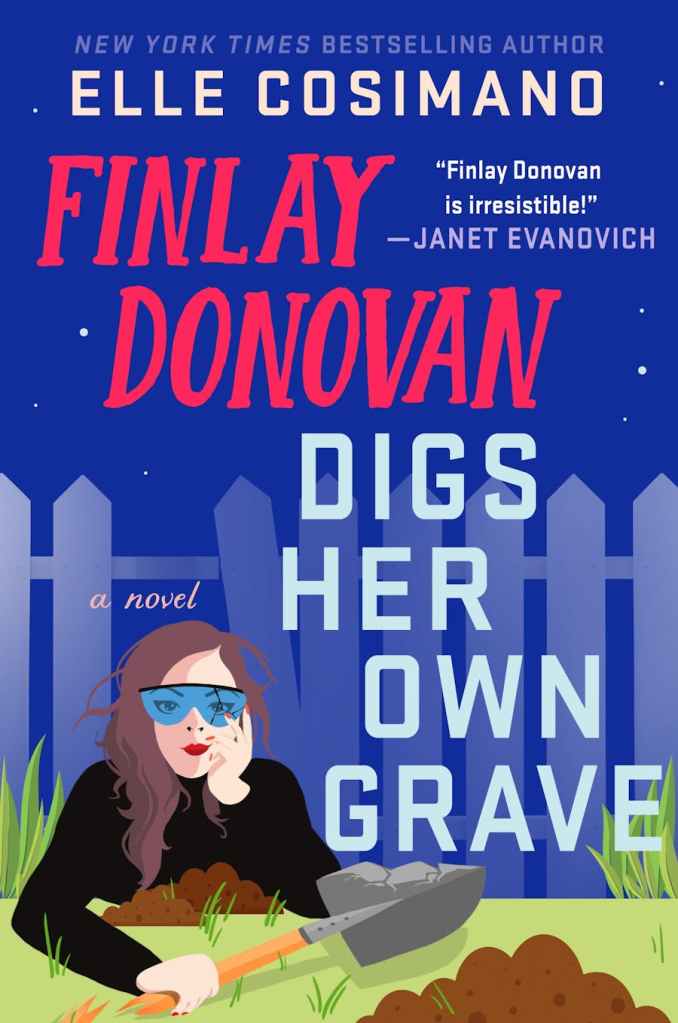
The books are, in order: Finlay Donovan is Killing It, Finlay Donovan Knocks ’em Dead, Finlay Donovan Jumps the Gun, Finlay Donovan Rolls the Dice, and this latest, Finlay Donovan Digs Her Own Grave. (There is also a book 3.5, a novella of 107 pages that reveals some of the back story of nanny Vero Ruiz, called Veronica Ruiz Breaks the Bank. That’s the only one I haven’t read…yet.)
As with the others in the series, not a lot of time has passed since the events of the previous book, but this time Finlay and her nanny/business manager Vero don’t actually create trouble for themselves, but are helped into the thick of it by Finlay’s elderly neighbor, Mrs. Haggerty. Margaret Haggerty has featured in all the other books, mostly as the busybody across the street who keeps a pair of binoculars next to her front window and writes down all the transgressions and suspicious behavior of the people in her neighborhood. (She’s the one who revealed to Finlay that her husband was stepping out on her with his real estate agent, Theresa.) But this time it is Mrs. Haggerty who is under suspicion—a dead body has been found buried under her backyard rose garden, and she’s the prime suspect. The police can find no connection between her and the victim, so she is cleared, but since her house is an active crime scene, she insists on moving in with Finlay, Vero, and the kids until the yellow tape comes down and the heating and electricity are restored.
Finlay, who has just finished a book and has a little breathing room before needing to get on with her next, had been looking forward to some calmer down time, hopefully including some fraternization with hot cop Nick, while Vero is negotiating her reinvigorated relationship with childhood pal and current love interest Javi. Neither of them is overjoyed to welcome Mrs. Haggerty into their home, but when her grandson drops her off and disappears, they haven’t much choice.
Then things take a turn that pulls them into the investigation, when Finlay’s cheating ex-husband, Steven, becomes a suspect! There is a small part of Finlay that wouldn’t mind Steven getting his comeuppance…but he is the father of her children, and ultimately she doesn’t believe he’s a murderer. But how to prove his innocence?
After re-reading the other four books before jumping into the new one, I have to say that I appreciated the slightly less fraught tone of this story. There were still twists and turns and surprises, but it was neither as convoluted nor as frantic, with a little more time to develop characters, and that was a needed development. The cast list was pared down (the last book had several criminals, a half dozen extra cops, multiple murder victims, and enough incidental characters that I kept thinking as I read, “Who is this guy again?”) We didn’t just get to know more about Mrs. Haggerty, but we also deepened our acquaintance with Cam, the teenage computer hacker; we saw Finlay and Nick get to know one another better; and I also loved the vignettes of the children, Delia and Zach, as they navigated being bullied at school and conquering potty training, respectively. There were quite a few laugh-out-loud moments, some genuine suspense, and some big surprises, but it felt like we settled down into a better understanding of the principals, which makes me anticipate the next book with greater pleasure.
If you’re looking for a cross between mystery and French farce, with a dose of middle class angst and some fancy crooks, you will want to try this series for yourself.
Indy lassoes some humans
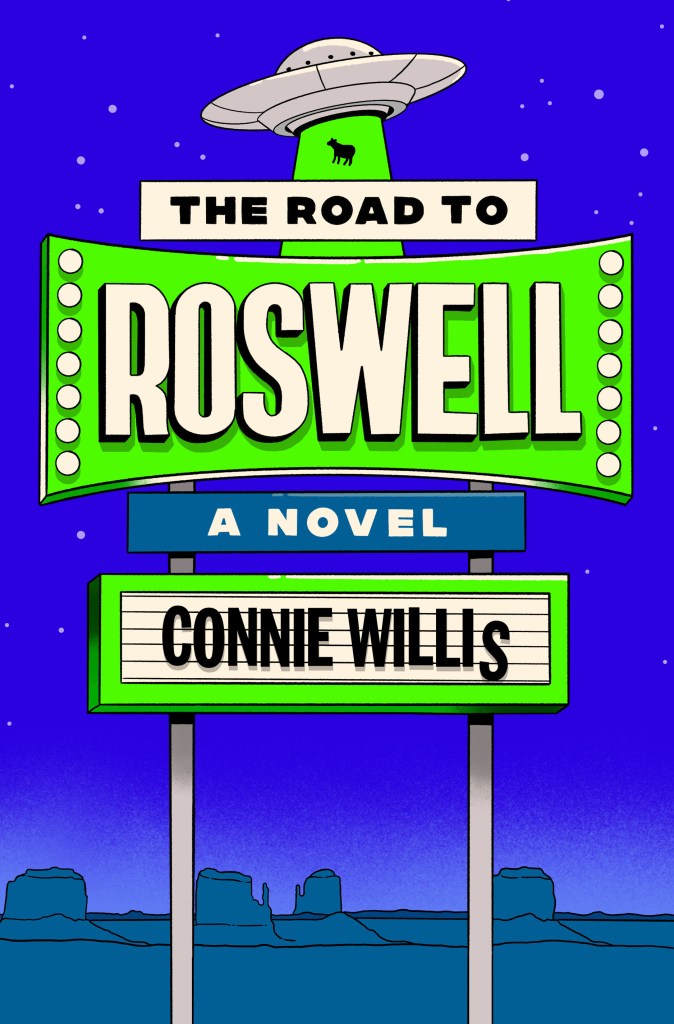
I just read a book recommended to me by my friend Kim, who is as much (or more?) a fan of science fiction writer Connie Willis as I am. I hadn’t heard of this one (and apparently of a few more, once I reviewed the list at the back of the book!), and I’ve been wanting a good new sci fi comedy (my last one was by John Scalzi), so I settled in this past week with Willis’s The Road to Roswell. I was surprised to discover that it was published less than two years ago; when Kim recommended it, I just assumed for some reason that it was an older book, perhaps because Roswell was a lot more popular setting a couple of decades ago than it seems to be now.
There were, contained within this book, both some unexpected and some entirely expected elements. The unexpected one was the nature of the alien. Not a Gray, not a Reptilian, he instead looks sort of like a tumbleweed (good camouflage in the desert!), a round shrub with branch-like tentacles; but when he wants to accomplish something, those tentacles stretch and flex and flatten, and shoot out to grab and hold whatever he is aiming to control. One of the protagonists thus gives him the nickname “Indy” (after Indiana Jones and his bullwhip).
The expected element was the nature and structure of the narrative. Connie Willis creates this peculiar kind of interaction in many of her books—sometimes subtle, more often extreme—in which communication between characters is constantly stymied. People start to say things but get interrupted. People mean to tell other people important information but forget, or get sidetracked, or are ignored. People try to pass on messages through a third party, who misunderstands and misinterprets them or, again, forgets all about them. The result is an ongoing escalation of tension over the missed opportunities, especially as questionable situations are further exacerbated by the ongoing lack of understanding. It results in a story full of dialogue that fails to move the action forward as intended, and when I read one, I find myself needing to take a break now and then to allow the anxiety from the escalating tension to subside!
This book begins with Francie, who has flown into Albuquerque and rented a car to drive to Roswell, New Mexico, where she will (maybe) be serving as maid of honor to her college roommate and best friend, Serena. It’s only a maybe because Francie has been in this position with Serena several times before, but no wedding has yet taken place; Francie’s role seems to be showing up in the nick of time to talk Serena out of marrying whichever oddball nut job for whom she has supposedly fallen head over heels. In this instance, it’s a UFO-obsessed alien-chaser who thinks the best venue in which to celebrate their marriage is the International UFO Museum.

Imagine Francie’s surprise, therefore, when aliens turn out to be real. She finds this out when she and her rental car are commandeered by one, who wants to go somewhere (although he can’t communicate where) and needs Francie to serve as his chauffeur. Soon, while on their surprise road trip, they also acquire a hitchhiker (maybe a grifter), Wade; an hysterical guy obsessed with alien abduction conspiracy theories; a little old lady on a bus trip to the Las Vegas casinos; and a retiree whose enormous RV becomes their new vehicle when Francie’s rented Jeep will no longer accommodate everyone the alien decides to lasso and bring along on this adventure.
Despite the kidnapping aspect, Francie and the others (except for the conspiracy guy, who can’t stop talking about invasions, probing and Men in Black) become convinced that “Indy,” as they call him, is in trouble and needs their help to get out of it. They go from unwilling abductees to a team devoted to understanding and helping their new friend, as they drive all over the southwest looking for who-knows-what and encountering rattlesnakes, Elvis impersonators, and people and aliens who may mean them harm. The book is a frenetic mix of abduction, expedition, and romantic comedy, and it’s fun. Really fun. If you need a silly story that also encompasses the best and worst of human foibles as illustrated by their reaction to aliens in their midst, this is one to read.

Alien encounters
John Scalzi is a funny guy. It took me awhile to reach this conclusion, because when I began reading his books, I didn’t approach them in chronological order; my first experience was with his robot/murder-mystery book Lock-In, and after that I read the whole “Old Man’s War” series, which (apart from a few bad puns and tongue-in-cheek moments) is relatively serious in nature. But then I found Fuzzy Nation, Redshirts, and The Android’s Dream, and realized he has a well developed sense of humor. And this past week I perused his backlist and found his very first novel, called Agent to the Stars, which both solidified that opinion and also reminded me of a whole vein of science fiction (alien encounters) that I have consistently enjoyed. Some of them take the subject seriously, while others (like this one) treat it with a fun and refreshing lack of gravitas.
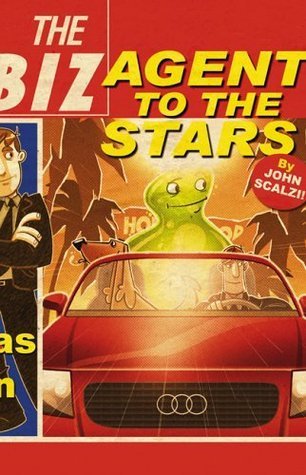
Agent to the Stars follows a premise that I first encountered in Sheri S. Tepper’s book The Fresco—
the question of what would happen should extraterrestrials make contact with one ordinary human, rather than going the more accepted route of approaching the government of some country or the Secretary-General of the United Nations, i.e., an official body or representative. In this case, said extraterrestrials arrive at the conclusion, after long-term absorption of radio and television and movie broadcasts, that Hollywood is the all-powerful entity in our world, and the best way, therefore, to spring themselves upon mankind is to get the entertainment industry to pay attention; they therefore hire themselves an agent to represent them (as one would).
They first contact the head of a powerful agency, but his visibility may attract too much attention while decisions are being made about how to make palatable a group of aliens who are essentially shaped like big piles of Jello with extrudable tendrils and smell really bad, so he passes the responsibility down to his most successful brash young agent, Tom Stein. One of the Yherajk thus becomes Tom’s constant companion in the quest to exchange knowledge between the two races, and this association becomes a comedy of errors that encompasses an aging golden retriever, a vapid young starlet, a persistent tabloid journalist, and a completely implausible but thoroughly entertaining series of events, as Tom and the alien representative try to figure out how to introduce the Yherajik to the world at large.
If this topic appeals to you, here is a small sampling of alien encounter fiction in several categories, both serious and humorous, that you might also like to explore:
TYPICAL EVIL ALIEN SCENARIOS:
The War of the Worlds, by H. G. Wells—In this classic, an army of invading Martians seeks to end human civilization. Extensively treated on radio and film as well.
Starship Troopers, by Robert A. Heinlein—A space opera drama pitting the Terran Mobile Infantry against “the Bugs.”

Ender’s Game, by Orson Scott Card—A much more nuanced version of Heinlein’s story, with young children playing computer-simulated war games that refer to the 100-year-long war with the “Buggers.” The difference here is, there are sequels in which Ender speaks and acts against xenophobia…
Binti, by Nnedi Okorafor—portrays an encounter with the Meduse, “an alien race that has become the stuff of nightmares.” (two sequels)
The Three-Body Problem, by Liu Cixin—A secret military project seeks to contact aliens, but the ones they find are on the brink of destruction and decide to invade Earth and take it over. (two sequels)
EQUIVOCAL ENCOUNTERS
(the aliens are “good,” or at least well-intentioned, but seek to alter the humans somehow):
Childhood’s End, by Arthur C. Clarke—the classic “aliens as interventionists” story that arguably begat all the others…
Dawn, by Octavia E. Butler—The Oankali save humanity from atomic destruction, but want to genetically merge with their “primitive civilization” to create a new species. (two sequels)
Human 0.4, by Mike A. Lancaster (YA)—a twist on an “invasion of the body-snatchers” scenario. Smart, fast-paced, thought-provoking. (one sequel)

The Host, by Stephenie Meyer—She’s not the greatest writer, but she is a good storyteller. The Earth has been invaded by a species that take over the minds of human hosts while leaving their bodies intact. A treatise on cooperation vs. autonomy.
The Sparrow, by Mary Doria Russell—One could argue about the category for this one, but it’s a mesmerizing tale, regardless. A scientific expedition of Jesuits make first contact with extraterrestrial life. (one sequel)
BENIGN/POSITIVE AND/OR HUMOROUS ENCOUNTERS:
The Left Hand of Darkness, by Ursula K. LeGuin—LeGuin wrote a group of books called “the Hainish Cycle,” which depict humans’ absorption into a growing intergalactic civilization (the Ekumen). One of the most famous—and arguably the best in terms of intellectual science fiction (it won both the Hugo and the Nebula)—is this book about a human envoy sent to conduct a first encounter with the inhabitants of the planet Gethen, a race of genderless, intersex beings. It’s fascinating, thought-provoking, but also deeply emotional.
The Hitchhiker’s Guide to the Galaxy, by Douglas Adams—extremely silly and inventive. (five-book series)

The Long Way to a Small, Angry Planet, by Becky Chambers—my review of the first book is here. (five-book series)
The Fresco, by Sheri S. Tepper—This is the one I immediately remembered when I started reading the Scalzi book I just reviewed. Latina single mom Benita Alvarez-Shipton is approached by a pair of aliens who ask her to be the sole liaison between their race and humans. First up, she has to contact the Powers That Be in Washington and convince them she’s not crazy.
I hope you find something here that will cause you to enjoy this aspect of the science fiction galaxy!
Dog Day Afternoon

No, this isn’t a post about a 1975 bank robbery movie. But the title seemed appropriate, given that it’s National Dog Day and also that I am getting such a late start that my post won’t be available until after noon, one of those hot, sleepy afternoons when dogs (and people) prefer to lie around and languish (i.e., read!) during the summer heat. I did some pre-planning for this post by making a list of some pertinent dog-oriented books, but then my distracted brain failed to follow up, so a list is pretty much all you’re going to get this time. But don’t discount it just because it’s not elaborated upon; these are some great reads, encompassing fantasy, mystery, dystopian fiction, science fiction, some true stories, and a short list for children.
NOVELS FOR ADULTS (AND TEENS)
The Beka Cooper trilogy (Terrier, Bloodhound, Mastiff),
by Tamora Pierce
A Boy and His Dog at the End of the World, by C. A. Fletcher
Iron Mike, by Patricia Rose
A Dog’s Purpose, by W. Bruce Cameron
First Dog on Earth, by Irv Weinberg
The Companions, by Sheri S. Tepper
The Andy Carpenter mysteries, by David Rosenfelt
The Dog Stars, by Peter Heller

DOGGIE NONFICTION
Marley and Me: Life and Love with the World’s Worst Dog,
by John Grogan
Best Friends: The True Story of the World’s Most Beloved
Animal Sanctuary, by Samantha Glen
James Herriot’s Dog Stories, by James Herriot
A Three Dog Life, by Abigail Thomas
Inside of a Dog: What Dogs See, Smell, and Know,
by Alexandra Horowitz

CHILDREN’S BOOKS WITH DOGS
Sounder, by William H. Armstrong
No More Dead Dogs, by Gordon Korman
Harry the Dirty Dog books, by Gene Zion
(illustrator Margaret Bloy Graham)
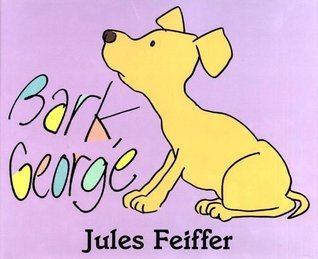
Bark, George, by Jules Feiffer (one of the best for reading aloud!)
And for those who wanted more, here is an annotated list of more dog days books from a previous year, along with some suggestions for dog lovers that go beyond reading about them.
Finlay’s road trip

I was excited to get the notice from the library that Finlay Donovan Rolls the Dice, the latest in the series by Elle Cosimano, had landed on my Kindle this week. The overwrought novelist-turned-criminal’s story continues right from where Book #3—Finlay Donovan Jumps the Gun—left off. The open questions at the end of that book: Will Finlay’s nanny, Vero, get out from under her debts to low-life underworld characters? Will her sister Georgia manage to make things last with new FBI girlfriend Sam? Will Finlay convince ex-hubby Steve that things are over between them, and will she finally manage to have a real relationship with police detective Nick—a problematic quandary since she has participated in so many criminal activities to which she can’t “cop,” pardon the pun. Will Finlay and Vero take back the Aston Martin that someone stole from them and also rescue Vero’s crush, kidnap victim Javi? There were so many dangling threads to remember that I almost immediately wished I had stopped to reread #3 before assaying #4!
Because I had read that book within days of its release more than a year ago, it took me a while to get into the rhythm of this new book. The series is really one long story, so you have to be up on all the events from page one of Book #1 in order to really get what’s going on. You also have to understand what this series is and what it is not; while there is a boatload of illegal activity taking place on its pages, it’s really more of a French farce than it is a mystery or thriller, although the fast pace and quick twists and turns certainly make it exciting. Someone on Goodreads compared Finlay and Vero to Lucy Ricardo and Ethel Mertz and, although they are smarter and more savvy, the relationship between them and among all the other disparate characters, from teen hackers to police officers to mob bosses, does bear a certain similarity—and that chemistry is Cosimano’s real advantage.
In Book #4, the cast all take a complicated road trip to Atlantic City in pursuit of their various objectives—and everybody, and I mean everybody, comes along, from Finlay’s mom, kids, and ex-husband to all the cops (crooked and straight) and criminals (major and minor). There are numerous misdirections of everyone involved, no one seems to have a real handle on what’s going on, and all are giving a good imitation of chickens minus their heads.
My ultimate conclusion after reading this chapter in Finlay Donovan’s story is that it was a little too busy. There were so many things happening to so many people all at once, and their connections were sometimes so confusing (wait—who is Ricky, again?) that it was hard to keep straight at times, which meant there was less focus on the strengths of the franchise—the snarky banter, the romantic entanglements, the misunder-standings that propel the heroine and her cohorts. I did enjoy it, but I’m glad that a few characters permanently exited the page (no, I’m not saying who, though some will be a surprise and others not) so that perhaps the next book will be less frenetic and more tightly focused. I did enjoy getting to know Finlay’s mom, Susan, but I also wanted a little more of the Nick/Finlay inter-action, I wanted to hear about Zach’s progress with potty training and Delia’s latest faux pas; and the characters’ days-long lack of sleep and irregular meals made me almost as tired as they were!
I hope that Elle takes a deep breath and keeps everyone closer to home for the next one. Yes, there will be a next one—there was a significant cliffhanger at the end of Dice about nosy neighbor Mrs. Haggerty that leaves us waiting eagerly for its resolution in (sigh) another year!
Delightful whodunnit
I guess that headline makes my blog post kind of unnecessary; but I could not wait to offer up a reaction to Vera Wong;s Unsolicited Advice for Murderers, by Jesse Q. Sutanto.
Let me start by saying something unrelated about the text of this post: I had a rain leak in my roof right above my computer yesterday, and my keyboard got drenched. It is dried out now and still mostly works, but there are a couple of significant issues: The backspace (delete) key instead turns off the sound, and the apostrophe either appears as a semicolon or not at all. So as much as it pains me to write a review in which there are no apostrophes, since the book title itself contains one then needs must if I want to write it before I have access to a new keyboard, which I do! I will attempt to write without contractions as much as possible, apart from the book title, seen above with semicolon.

I previously reviewed two other books by Sutanto, and I liked them well enough (the first better than the second), but this one feels like a whole different level of enjoyment. It is as quirky as those, for sure, but it is less frenetic, more logical, and abounds with interesting and likable characters. The book is solidly based on the main title protagonist, while all others revolve around both her and a circumstance in which she finds herself embroiled; but there is no lack of either detail or interest in every other actor in this little play Vera Wong is creating in her attempt to solve a murder.
Vera is a small but intense lady with a tea shop in the middle of Chinatown in San Francisco. For the past few years her clientele has dwindled down to a single visitor per day, but Vera has not let this discourage her: She still arises before dawn, dons her athletic costume and gets in a brisk walk before opening the tea shop in anticipation of composing the perfect brew for every need from her vast store of jars and bottles full of exotic ingredients. But one morning Vera descends from her apartment to her shop to discover a body on the floor! Mostly unperturbed but intensely curious about who he is and how and why this young man has ended up dead inside her shop, Vera decides she is the ideal person to help the police investigate, and takes a few things into her own hands that would better have gone to the detectives who later respond. But when those detectives are then unable (or, in her view, uninterested and/or unwilling) to solve what Vera has decided must be a murder, Vera waits to see who else arrives and begins to compile her suspect list based on the level of interest each person shows. In her view, nobody is better suited to this task than a Chinese mother of a certain age!
Each of the people who subsequently turns up has some sort of connection to the dead man, and Vera is in her element as she alternatively prods and snoops in her attempts to get at the truth. The fact that she makes a friend out of each of them in the process (and also tries her hand at matchmaking) is not, in her eyes, a deterrent to exposing one of them as the killer. The humor and inevitability of her progression is equal parts poignant and hilarious.
The sole bone I have to pick about this story (and with this author) is the way Vera is persistently described—as a little old lady. The descriptions of Vera—her hair, her clothes, her mannerisms—suit the picture, but then Sutanto reveals her age and everyone reading this book above that age is going to be outraged, because Vera is 60! I think you have to add on a minimum of a decade, and probably half again or even double that, in order to legitimately be referred to in that precise way. As a woman of 68, I feel elderly in some ways (mainly in my crackly knees and blips in short-term memory), but I do not think I will consider myself as a little old lady until about the age of 84! Yes, Vera is a granny, but a little old lady she is not! Read it and see if you agree…
Lighthearted…and also dark?
I love finding a book that successfully combines light and dark humor. The last book/series I read that did that was the Finlay Donovan series by Elle Cosimano, and I have now found another: the “aunties” books by Jesse Q. Sutanto. i just finished the first and liked it enough that I immediately went to my library website and checked out #2 in the series to start on tomorrow morning with breakfast.

In Dial A for Aunties, Meddelin Chan is the third-generation American 20-something from a mixed-race Indonesian/Chinese family of women who all live in close proximity in Glendale, California, and work together in the family wedding business. Big Aunt does the cakes and food, Second Aunt the makeup and hair, Third Aunt (Meddy’s Ma) the flowers, and Fourth Aunt is the entertainment, a singer at the after-wedding reception, while Meddy herself is the wedding photographer. While she loves photography and does enjoy certain aspects of her job, she didn’t really plan for her future to consist of living and working with the aunties (“Don’t leave your big day to chance, leave it to the Chans!“); but she is a dutiful (and guilt-ridden) daughter, and when her (mostly male) cousins all decamped to other cities or states after college, she swore she wouldn’t likewise desert the aunties.
This led to major heartbreak for Meddy, though, because Nathan, her college love and, she believes, the love of her life, was offered a prestigious job in New York City and, rather than disappoint the aunts or hold him back from choosing success on the other side of the country, Meddy breaks up with him so he is free to pursue his dream while she can keep her promises to the family.
The story begins a few years after the breakup. Meddy has dated a few guys in the meantime, but her heart isn’t in it, and her Ma and aunties have begun to despair of ever having grandbabies. So Ma signs up for online dating posing as Meddy, cultivates a relationship with the rich and handsome Jason, and then springs a date on Meddy that’s “blind” for her but not for Jason, as he feels they have really gotten to know one another online and through texts! Meddy reluctantly agrees to the date, which is to take place the night before the family does their thing at a huge society wedding on a resort island off the coast of California. The evening ends up going horribly wrong, leaving Meddy in a panic, needing the aunties to bail her out of trouble in the midst of preparing for their big job.
I don’t want to say much more than this, because the pleasure of this book is in discovering the mishaps as they occur and trying to figure out how the clueless yet ingenious aunties will fix them. The publishers did a disservice to the reader in outlining too much of the story on Goodreads, so don’t read it if you prefer to be surprised, as I do. It’s well worth the wait! Let’s just say it’s an exciting wedding weekend, and there’s a reason for the title being reminiscent of “Dial M for Murder.” I laughed out loud or shrieked in disbelief several times.
 The Book Adept