Re-reads
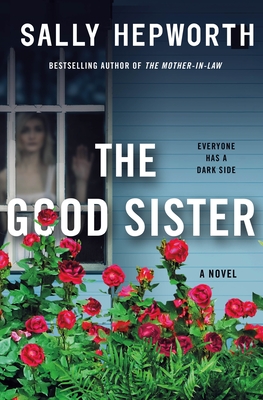
I got frustrated by the length of time I was having to wait for new library books and decided to do some rereading this week, since older books are easily obtainable. I chose the first book, The Good Sister by Sally Hepworth, because I had just reread Eleanor Oliphant and their protagonists share some things in common.
Although I remembered the story pretty well, there are always things that you don’t pick up on the first time through. One of the ones I enjoyed this time was protagonist Fern’s description of her mode of dress. She starts out by saying she is a librarian, and at 28 years old she is much younger than the average librarian (apparently the average is 45!). She comments that many librarians tend to be stodgy dressers, but Fern likes to express herself, so her typical outfit is a rainbow T-shirt topping a long, swirly skirt in some bright color (that day’s was sunshine yellow) with a pair of rainbow- and glitter-covered “trainers” (Brit for sneakers or tennis shoes) to match. She tops off all of this by putting her long strawberry blonde hair into two braids and then rolling them up above each ear for a Princess Leia look-alike effect, although she asserts that she is not copying that style; it is merely a handy way to keep her hair out of her face while working.

As a person who went to library school at 48, I was definitely up in that core demographic, but I did share some characteristics with Fern. I liked wearing colorful, full, knee-length skirts (flowered, striped) with matching solid-color leggings, black boots, and a T-shirt or sweater on top, depending on the season, and although I never did the Princess Leia ‘do, I did wholeheartedly embrace braiding during my 11-year career as a teen librarian.
I enjoyed this book as much this time around—it definitely held up. The characters are either delightfully quirky or deliciously sinister, and the action and narrative are nicely balanced to hold your interest. If you would like to read my initial full review, you can find it here.
The second book I picked up was one I hadn’t read since 2015 when it first came out, and I didn’t remember a lot about the story. It’s The Reversal, by Michael Connelly, and it was the book where he shook things up in several ways: Mickey Haller (the Lincoln Lawyer) crosses the aisle to become a prosecutor for one case; he partners up with his (first) ex-wife, Maggie McPherson, an assistant district attorney for Los Angeles; and instead of his usual investigator, he hires his half-brother, LAPD detective Harry Bosch, to help put a child-killer behind bars for the second time.
I looked forward to reading it again because I liked that all my favorite characters were in one place. But in the end, I didn’t find this to be one of his better stories. I did enjoy having Haller, Bosch, and McPherson all working together on a case that Mickey was prosecuting, but there was a bit too much courtroom (without enough drama). The man they are prosecuting has spent 24 years in jail for the crime and everyone is still convinced he is guilty. But some new DNA evidence proves compelling enough for the courts to grant him a retrial, and in the meantime he’s out in the world while the trio tries to find enough evidence to put him back in prison.
I felt like not enough happened “in the field” in this book, and I also didn’t enjoy the guy in the role of defense attorney; he was whiny and not sufficiently developed in comparison to his opponents. There is also a huge foreshadowing element with the murderer that never comes to fruition, which was both disappointing and annoying, and the ending is both rushed and anticlimactic, after a big build-up. I actually dropped my rating on this one from four stars to three after rereading it. I’m still a loyal Connelly fan, but in certain books he seems off his game, and this was one for me.
Two of my “new” (to me) books just came in and got transferred to my Kindle, so there will be fresher reviews coming soon.
The Proving Ground
I picked up the latest from Michael Connelly with a teensy bit of trepidation, because I haven’t really enjoyed the last three novels he has put out into the world, whether about Bosch, Ballard, or the new guy Stillwell. They felt forced, they felt a little stale, they felt like his heart wasn’t really in it when he wrote them. But I adore the Lincoln Lawyer, so I got this one from the library and embarked on it as my first read of 2026.
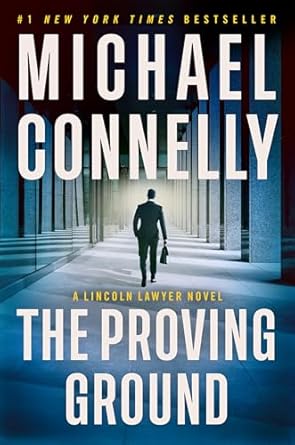
Although the title references the area in front of the jury’s box where the lawyer stands to make his opening and closing arguments, it was also prophetic for me, because with this novel I felt like Connelly proved he could still write a compelling book involving one of his regular characters. But if you are expecting the self-same iteration of Mickey Haller that we have seen in past novels, you might be disappointed.
Mickey had an epiphany that led him out of criminal defense and into civil court practice, this being his first case to actually go to trial. And it’s a big one: A mother is suing a billion-dollar Artificial Intelligence company because the boyfriend of her teenage daughter, under the influence of the company’s chatbot they claim was designed as a companion for teenagers, shot and killed the girl when she broke up with him, after the chatbot told him he should “get rid of her.” So although both gun control and murder are issues, they are not the center of this lawsuit, which is focused on the bigger picture of who should be held responsible. The premise is that the chatbot had faulty input and insufficient guardrails in place, especially when it was ostensibly designed to deal with impressionable young teens who haven’t, themselves, developed a moral compass; tragedy was the result.
I like that Connelly is addressing a current and urgent area of concern by showcasing this courtroom battle that isn’t just about guilt or innocence but about accountability. In so many aspects of our culture now, technology seems to be outpacing ethics in alarming ways, and Connelly has poured extra fuel on the battle over gun control in the United States by taking it to another level. A gun was, once again, too readily available to a teenager (his father kept the gun in the house), and his fantasies of revenge on a girl who “hurt him” (she was alarmed by his internet-driven attitudes and broke up with him) flowered into violence with support from a machine created to interact like a human
support system.
The court persona of Mickey Haller is still front and center: He manages to insert some of his trademark theatrics, although the civil court judge is quicker to reign him in than was normal in criminal court; but underlying the flamboyant drama is dogged research, a constantly evolving strategy, and then ultimately his willingness to gamble everything in the courtroom to get that lynchpin response from a witness that will make his case.
There is a fair amount of both legal-speak and technical discussions about artificial intelligence that might deter some readers. But despite some of those intricacies, this is still courtroom drama, with everything that can ensue—witness intimidation, manipulation of voir dire, attempted bribery, and plenty of dirty tricks from a corporation desperate to be held blameless and to retain control of one of its most lucrative products. Civil court is something of a misnomer here.
There is participation in preparation for the case from another character in the Connelly oeuvre not recently heard from, which was fun. There is also a personal, events-driven aspect to this book, when ex-wife Maggie’s house burns in the Eaton Fire and she moves in with him while waiting on insurance and trying to decide what to do next. Since Mickey made the move from criminal to civil court he has fewer direct clashes with Maggie “McFierce,” now the Los Angeles District Attorney, and obviously hopes that they can reconcile permanently—but that’s left for another day. Some Goodreads reviewers took issue with Connelly setting this at the time of a particular landmark event, since it dates the narrative, but as a Los Angeles resident I liked the local context he always provides.
Although I wasn’t completely in love with the way the book ended, for me this was a satisfying return to Michael Connelly showing what he can do when he’s on his game.
Presumption
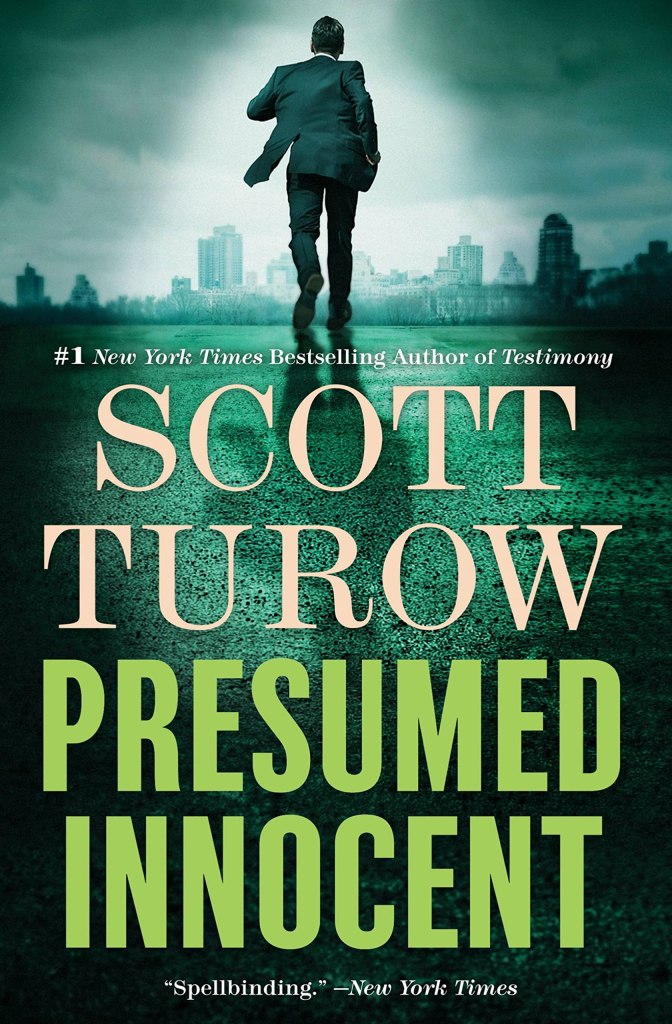
I recently watched the 2024 miniseries revamp of Presumed Innocent, based on the 1987 book by Scott Turow. I had seen the original movie, made in 1990, starring Harrison Ford, Raul Julia, and Greta Scacchi, so I was intrigued to see what Jake Gyllenhaal would make of the lead role as Rusty Sabich, and how an eight-episode miniseries would differ from a two-hour movie. My reactions were mixed: Gyllenhaal and Ruth Negga, who plays Barbara Sabich (the wife) were amazing in their roles; but I thought the woman cast as the notorious Carolyn Polhemus was so mundane and uninteresting compared to Greta Scacchi, for whom that role seemed to be custom-made, from her manner to her appearance.
Watching the miniseries brought up another whole series of questions, however; I believe I did read the book at some point, but the 1990 movie took precedence in my memory and the only way I really recalled the plot was from that. Since the miniseries has a couple of extra characters not in the movie, alters the gender of some of the original characters (which in one instance shifts the plot), and also ends differently, I was curious enough to find out whether I was remembering the book correctly by checking it out of the library for a re-read.
For those who don’t know the story: Rusty Sabich is the chief deputy prosecuting attorney, working directly under boss prosecutor Raymond Horgan, in 1980s Chicago. It’s an election year, and one of Sabich’s colleagues, Nico Della Guardia, is running against Horgan. Just a few months before the election, another colleague, Carolyn Polhemus, is murdered in her apartment, and Horgan, busy with the election, details Rusty to cover the case, hopeful that it will be a quick solve that will boost his campaign. It’s a complicated tale with a lot of stuff I don’t want to reveal because that is the main pleasure of the book—discovering the details as they unfold—but things get distinctly sticky for Sabich.
Turow has a pleasing way of combining suspenseful story-telling with the necessary legal details to create an engrossing courtroom drama. Although there were a few “wince” moments when it came to the language used around both racial and sexual identity (which surprised me a little, given when the book came out), I guess it’s easy to forget when certain language exited the approved lexicon of political correctness, and otherwise the book was not heavy-handed. Over all, it was enjoyable to experience the story one more time, and I confirmed that the first movie was more true to the book. That doesn’t take away from the impact of the miniseries, but it is a different kind of tale in some ways.
I have never read any of the follow-up books (I believe there are eight set in this universe, at least a few of them also starring Sabich), but I may do so now, because I enjoyed the characters Turow created and would like to see what happened to them after this part of their lives was over.
Readalike

Usually when someone asks for a “readalike,” they mean that they like a particular author and would like to find another author or two who write in the same way, whether because that author publishes infrequently, or has died and won’t be producing any more books, or whatever. But I’m afraid I mean this in a less flattering way, in that the entire time I was reading A Calamity of Souls by David Baldacci, I was thinking about all the ways in which it echoed a favorite Grisham book (and movie), A Time to Kill. The setting is a similar one (the South in the 1960s), the issue is a similar one (a black defendant with a white lawyer trying to get him a fair trial), and there is even the civil rights “savior” who arrives from the North to help the southern lawyer navigate this tricky case in front of a judge and jury who are blatantly racist. (One could also draw parallels with To Kill A Mockingbird, specifically in what ends up happening to one of the main characters.)
Although the cases are different (in ATTK, the defendant has killed his daughter’s rapist, while in this one the black man has been accused of murdering and then robbing his white employers), and although in one the legal genius from the North is a Jewish law student from New York while in the other she’s a black civil rights lawyer and hails from Chicago, the dynamic is very much the same. The difference is, I found Grisham’s story completely gripping, while Baldacci’s has some interesting moments as the two lawyers set about discovering who could have done the crime and then put their client in the hot seat to take the blame, but other than that element of mystery, a lot of the book reads like a Civics lesson.
The author takes pains to mention significant cases (Loving v. Virginia), racially charged props (the Green book, which the author has to find a roundabout way to include because it had ceased publication by 1968), sundown cities, and the like, and much of it seemed both heavy-handed and beside the point. This book presumes that the reader has no first-hand knowledge of the history of racism in the South and its manifestations in the 1960s when laws had been passed to end it but southern whites were dragging their feet to implement them. The characters are mostly one-dimensional, presenting as either a hero(ine), conflicted and confused, or irredeemably evil, with little nuance. One reviewer on Goodreads said they were uncomfortable with the portrayal of the black characters and actually felt that the author perpetuated some stereotypes while trying to do the opposite; I would have to agree.
It’s not an irredeemably bad book, but it’s not very good. It’s my first experience reading Baldacci, as far as I remember (I might have read one back in my 20s?), and to be fair I might try another of his without the obvious agenda and see if I enjoy it more, since so many people rave over his books. But…I’m certainly not on the library website looking for my next one right this minute!
Reliable, still fresh

I just read Michael Connelly’s latest, the seventh in his books featuring Mickey Haller, the Lincoln Lawyer, and I was pleased and satisfied by Resurrection Walk. Those who follow/read this blog will know that I have expressed some degree of dismay about where the Bosch books are heading, with possible successors trying to take over but without either the pizzazz or the character depth that are inherent in Hieronymus “Harry” B. But Connelly has managed to map a new route for Haller, using as a starting point the exoneration of Jorge Ochoa from a previous book. Mickey got such a buzz from reopening that innocent client’s case and freeing him from prison that he has decided this will be a regular feature of his practice, his pro bono contribution to being a defense attorney. He calls the results the “Resurrection Walk,” because the person without hope gets to emerge from prison to walk free again. And he has enlisted veteran police detective and half-brother Harry Bosch to be one of his investigators.
Since Harry has such an aversion to helping the “other side” (defense) after a long and storied career as prosecution’s darling, he and Haller have agreed that he will only serve as a clearing house, and not take an active part in the actual defense process. Even though Harry is retired, he has a care for his reputation as a dogged seeker of justice for the criminals he has apprehended, and he also realizes that his participation for the defense could have repercussions for daughter Maddie, who’s just coming up through the ranks at LAPD. But after sorting through the pile of letters received by Haller from dozens of the incarcerated who maintain their innocence and are looking for his help, Harry finds one that rings true, and is drawn into a more active role.
He looks through the case of Lucinda Sanz, a wife and mother who was convicted of the shooting death of her ex-husband, sheriff’s deputy Roberto Sanz, and realizes that there is a lot of unexplained and unexplored territory in her case. The laser focus on her from the sheriffs’ department as the perfect and only suspect triggers the hairs on the back of Harry’s neck, and he tells Mickey he thinks they have a winner. The fact that they will now be pitted against a bureaucratic entity determined to protect one of its own makes the case a tricky one, ultimately fraught with danger for all involved.
Although the essence of Harry was, once again, a little bit lacking—he was portrayed somewhat woodenly, as has happened before when he is the secondary, rather than the main, character—it was less a problem this time, and the interactions between he and his half-brother and current employer were more characteristic. For instance, Harry agrees that he will be Mickey’s driver while they are investigating a case, but only if Mickey sits up front in the passenger seat, because Harry’s dignity won’t allow him to be cast as chauffeur. As far as the central mystery goes, it is often Harry’s intuition that brings out the facts necessary to make the case, although it is Mickey’s talents as the concocter of labyrinthine defense moves that ultimately wins through. The book has great suspense, with a lot of setbacks and some perilous moments, and ends with the promise of a twist in the future for Mickey. This is a solid and entertaining entry in Connelly’s franchise.
Parenthetically, if you are an Amazon Prime member and a Connelly fan, I can’t stress enough how wonderful is the “Bosch” series starring Titus Welliver in the title role, with fantastic portrayals of all the supporting characters by an array of both well known and relatively unknown actors. The TV series is pretty closely based on Connelly’s books in sequential order, and is every bit as involving. There are seven seasons of Bosch and, just when you sorrowfully get to the end of that binge, you discover that there is a new show, called “Bosch Legacy,” which has a somewhat narrower focus on Harry, his daughter Maddie, and defense attorney Honey Chandler. There are two seasons so far, with one more to come. I understand that there will also be a spinoff series featuring Detective Renée Ballard, hopefully with Welliver etc. still serving as secondary characters.

Time out for lighter fare
After reading that somewhat grisly dystopian, I have been in the mood for less intensity; I picked up and started reading two separate fantasy books—one a continuation of a series I loved last year, the other a stand-alone quirky one that’s been on my TBR list for a while—and couldn’t get into either one. So I went instead for a combination of relationship reads and light mysteries.

First up was An Island Wedding, #5 in the series of books Jenny Colgan set on the island of Mure, in Scotland. It was lovely to be back with a cast of familiar characters in a magical (not literally, just in terms of pristine scenery) place where I have enjoyed previous stories so much. In this one, Flora and Joel are finally to be wed; but Joel, product of a violent childhood followed by a long line of foster homes, doesn’t seem to “get” what it means to Flora, only daughter of a large and affectionate family and member of an extended community to which she has belonged since birth, to have a traditional wedding. Unmeeting wishes become exacerbated when another “daughter” of the island, a glamorous trend-setter, decides to hold her wedding on Midsummer’s Eve (the same day as Flora’s) at the grand hotel Flora manages, and Flora has to put up with Olivia’s overboard plans while being distinctly underwhelmed by her own. Since it’s Jenny Colgan, you know that it will all work out, but it’s fun to experience it along with your favorites. There is also movement in a side story involving the island’s immigrant doctor and its favorite schoolmistress.
After listening to a student in my readers’ advisory seminar wax poetic about Beach Read, by Emily Henry, in last week’s book-talk for the class, I picked that up and read it one more time, and enjoyed it again by noticing different things this time through. I do have to agree with Taylor, though, that neither the title nor the book cover is appropriate, considering the beach in question is the shore of one of the Great Lakes in Michigan, and it’s mostly too cold to go there for more than 15 minutes! And if the title was meant to reference one of the books that the two author protagonists were writing, that was off base as well. Still a good read, though.
Then I jumped back to the mystery series I started at the recommendation of a librarian friend a few weeks back, and read the next two books in the Andy Carpenter legal thrillers by David Rosenfelt, First Degree and Bury the Lead. I am continuing to enjoy these, despite my initial reluctance to tackle a legal mystery series. As another person on Goodreads commented, Rosenfelt (i.e., his character, Andy) is “quick with a quip,” and I am enjoying the mix of humor, exasperation, frustration, bafflement, and creative thinking that seems to propel him towards the solution of these mysteries. I do wonder how many more books in this series Carpenter can sustain by presenting a defense of SODDIT (“some other dude did it,” acronym made famous by Dismas Hardy)—his clients can’t all be the victims of frame-ups…can they? But so far he has done it well…
Given my preoccupation with the last few weeks of my readers’ advisory class combined with some recent health challenges that make me tend to lose patience with long, intricate narratives, I may keep reading this kind of distracting, pleasurable fare for the rest of this year! We will see if the mood turns…but in the meantime Andy Carpenter #4 (Sudden Death—he’s fond of the sports metaphor) is next on my list.
Legal luck
I was talking, this past week, with my Readers’ Advisory students about the peculiarities of mystery fiction, one of them being the prevalence of the series. I’m sure some are saying to themselves, But, fantasy! and yes, other genres, notably fantasy and science fiction, are also heavy on series. The difference is, the series exists in those genres specifically to advance the story, while in mystery fiction that’s not true or, at least, true in a different way.
Mystery readers love their series because they get attached to the protagonist. If you think of some of the series out there that have not just been popular on the page but also on the television or the big screen, it is the character who is the prevalent element around which everything else circles. Harry Bosch, Kinsey Milhone, Walt Longmire, Stephanie Plum—in every case, readers keep reading (or watching) because they find the character compelling. It doesn’t seem to matter so much what the story is, as long as the dynamic and charismatic detective is at the center of it.
For this reason, mystery readers can be more forgiving than readers of some other genres. If the character is one they like and with whom they identify, and if more details are revealed about this character in each subsequent book in the series, mystery readers may go along a book or two or even three further even if the mysteries themselves—the plots—aren’t so great, just because they enjoy the familiarity of the character’s world and person.
This doesn’t mean that mystery readers can’t be hypercritical of a poorly plotted novel—a clumsy reveal, a red herring that doesn’t go anywhere, an epilogue for an ending instead of the direct action that they crave—but they will hang in, hoping for a renaissance of their writer’s story-telling skills, just to be with the character.
I have found myself being a perfect example of this with several mystery series over the years (Elly Griffiths, I’m looking at you), none more obvious than my abandonment of John Lescroart’s legal mysteries that all take place in the courtroom long after the (initial) crime was committed. The masters of this oeuvre are, of course, Grisham and Turow, but Lescroart’s Dismas Hardy definitely held his own until…he didn’t. The first two-thirds of the series was fresh and exciting, starting with #1, Dead Irish; I liked the protagonist, the side characters, and the setting (San Francisco). But after a while I could have written many of the scenes myself, because they were based on and exceedingly repetitive of similar scenes in every single volume. I think I finally gave up at about #17. To give him credit, Lescroart did try to shake things up by going with different characters from the same world (Abe Glitsky, Wyatt Hunt), but since they all worked in the same or adjacent venues that had already been exhaustively portrayed (and ate lunch in the same dismal hole that had been described at excessive length in each and every volume), it just didn’t work, and I gave up on Lescroart.

This soured me for quite a while on the subgenre of legal thrillers itself, but I’m happy to say I may have discovered a new one for which I can muster enthusiasm. I read the first book—Open and Shut—in David Rosenfelt’s Andy Carpenter series, and found it fresh, somewhat humorous, and possessed of a mystery both satisfying and entertaining, so now it’s only incumbent on me to keep reading and see how long it lasts—there appear to be at least 25 more books behind that one.
Open and Shut introduces Andy, a brash young defense attorney whose choice of profession pleases neither his father, a formidable former District Attorney for New Jersey, nor his financially and politically ambitious (and temporarily estranged) wife, Nicole. Then, after asking Andy to take on a seemingly unwinnable appeal for a man on death row who was convicted seven years previous, his father drops dead at a Yankees game, leaving Andy with two puzzles: Why would his dad, who was heavily involved in convicting the guy himself, put Andy in this position; and why did he hide the fact that when he died, his son would be inheriting 22 million dollars? It slowly becomes clear that these two seemingly unrelated facts are somehow tied together; but does Andy really want to know how his father acquired $2 mil almost 37 years ago, but never mentioned it or touched a dime of it for all this time?
Some things I liked about this book: The protagonist, a down-to-earth, pragmatic guy with his share of issues; his associates—sharp (though pessimistic) investigator and potential love interest Laurie; Kevin, who gave up the law to run a laundromat because he was too good to lose and felt guilty no matter who he prosecuted or defended; and of course Andy’s golden retriever, Tara, who is his best friend and tends to garner more attention than most of the humans in Andy’s vicinity.
I liked it well enough to keep reading the series; we’ll see how long it takes for Andy to wear out his welcome.
Innocent vs. not guilty
I just finished reading Michael Connelly’s latest, The Law of Innocence. This was a “Lincoln Lawyer” book featuring Mickey Haller, and the case he was attempting to defend was his own. A traffic stop turns into a fishing expedition when the cop sees something leaking from under Haller’s car, and when he pops the trunk it contains a dead body.
The body is that of a former client of Haller’s, and the evidence that he was killed in the trunk of the car while inside Mickey’s garage is pretty damning. Obviously (to the reader), Haller is being framed by someone, but by whom and for what purpose? Denied bail due to the machinations of a spiteful judge, Mickey has to muster his team and plan his defense while living in a cell inside Los Angeles’s Twin Towers Correctional Center, where he’s a potential target of inmates and jailers alike.
I enjoyed this mystery for a variety of reasons, including Connelly’s usual attention to detail as he presents the story from a Los Angeles resident’s viewpoint, including that of an inmate of Twin Towers. The distinction between a not-guilty verdict and proof of innocence was the quandary that drove the story, since Haller’s reputation and his future as a successful attorney is on the line if there is a shadow of a doubt about his culpability. He doesn’t just have to prove reasonable doubt—he needs everyone to know that someone else did this.
One reader commented that he liked the Haller novels better than the Bosch ones because the Haller ones were narrated in first person and therefore more compelling than the third-person Bosch. Weirdly, I usually have the opposite reaction to these. I don’t know whether it’s because I don’t identify with Haller as a person or if it’s just that I prefer police procedurals to legal drama, but I find the Bosch narratives much more involving. Also, whenever Bosch is featured as a character in the Haller books in his role as Mickey’s half-brother and an investigator on his behalf, it seems like Connelly suddenly doesn’t know how to write him—his presence is positively wooden. Maybe he’s attempting to show how Haller sees and reacts to him instead of putting him across with his usual personality? but it’s weird how unlike himself he is.
In general, this book is the usual entertaining crime thriller from Connelly. I have to say that I found it less than riveting until it gets to the trial, at which point the accelerating discoveries and the vituperative back-and-forth between prosecution and defense enliven things considerably. I wasn’t entirely happy with the ending, but I can see why Connelly went there. It will be interesting to read the next Lincoln Lawyer volume, whenever it comes along, to see how Mickey’s career is impacted, if at all, by the events of this one.
As for the “big controversy” over which people have declared they would never read Connelly again, I didn’t find it in the least unbelievable that someone who was trying to beat a murder rap would want to weed a Trump supporter from his jury. Since they seem unable to discern when he is lying to them, it seems logical that having someone on a jury who can’t distinguish lies from truth would be counter-productive. I didn’t view this as a huge political statement, but merely a way to point up the importance of honesty within our legal system. Of course, my politics apparently fall on the same side as Connelly’s….
 The Book Adept