Momfluencers
What kind of word is THAT? Ask Jesse Q. Sutanto, author of the thriller You Will Never Be Me. The book is set in the worst cliché-ridden version of Los Angeles (as a 52-year resident of this city, I beg to differ with the exaggerated depiction!), and its two main characters are social media “influencers” who are also moms touting their lifestyle—thus that ghastly splice.
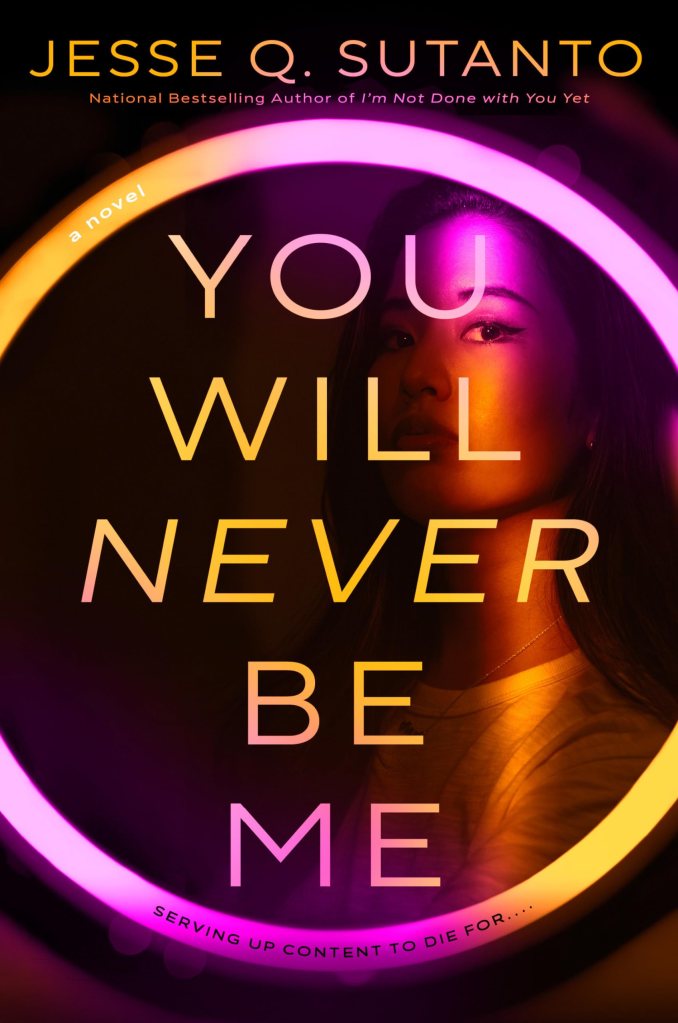
I had previously read Sutanto’s romcoms (the “Aunties” trilogy) and her delightfully silly mystery Vera Wong’s Unsolicited Advice for Murderers, so when I was looking for some lighter dark reading, I decided to try one of her thrillers. The library had this e-book on hand, and as a relative novice to Instagram with fewer followers than I would like (this is for my page featuring my portrait-painting), I thought it would be fun to read about some of the people who have made a true success out of their presence in such forums.
In some ways, it was fun; but I felt at a disadvantage with this book because, although the moms were supposedly besties in all things, the truth that they were jealous competitors who had trouble celebrating each other’s wins (particularly when one substantially overshadowed and outperformed the other) made both of them inherently unlikeable. And although I don’t mind villainous characters, I usually like it better when there is one sympathetic person in the story for whom I can cheer. You know, someone with at least one redeeming quality….
In the beginning, Meredith was the popular rising star and Aspen was the eager but slightly gauche fan. Before Meredith met Aspen, there was a friend-gap in her life; she was so busy trying to become popular to legions of online strangers that she didn’t have time to cultivate people in real life. But when she runs into Aspen at a Hollywood pretty-people party and realizes just how out of her depth she is, Meredith takes a shrewd look at Aspen’s potential and, flattered by her naive, awed admiration, decides to help her. She teaches her about hair and makeup, shows her how to make videos to entice both followers and sponsors, and gives her a leg up into Meredith’s world.
A few years later, Aspen’s star has risen exponentially, while Meredith’s influence has waned—her “brand” is a little tired, a little old. Aspen has crafted a new, polished look, married Ben, and given birth to darling twin girls Noemie and Elea; fueled by motherhood and the need to be the breadwinner in an unequal partnership (her husband is in real estate but not a player), Aspen has switched her brand to become a “momfluencer.” She films the daily routine, presenting herself and her family as living an idyllic existence—the twins always dressed in adorable matching outfits, every meal gourmet and served with panache, home decor curated to shine online. When you collect as many followers as Aspen, the deals for product placement follow, and the dollars flow in.
When Aspen gets pregnant with a third daughter, Meredith decides she has waited long enough for Mr. Perfect and chooses to become a single mother with the help of an anonymous sperm donor. While she wouldn’t go so far as to say she gave birth to baby Luca so that she, too, could go the momfluencer route, well…that’s what she has tried to do. But somehow she just can’t pull it off with the seamless brio of the successful and somewhat patronizing Aspen, who is too busy now to hang with her best friend Mer, drinking wine and gossiping as they used to do. The tables are turned; Aspen is on top, and Mer is, well, not either admiring or in awe. She resents Aspen’s success and especially her lack of willingness to share her ideas and methods the way Mer had shared with her when Aspen was the one at the bottom. Meredith discovers it’s not fun to be ditched, and finally, in frustration, she blows up at Aspen and says some unforgiveable things, and the friendship is over.
A few months later, Mer, who has been stalking Aspen (just a tiny bit, right? nothing serious) gets lucky. Little Elea leaves her iPad out on the patio where an enterprising person can appropriate it. Mer isn’t sure why she took it, but when she discovers that Aspen has created an online calendar that updates automatically onto all the family’s devices, she has access to Aspen’s social media schedule. At first she just tweaks things, causing Aspen to arrive late at a lunch date or forget to pick up the dry cleaning; but soon she is erasing meetings with sponsors and turning up in Aspen’s place to sign lucrative contracts. Meanwhile, Aspen can’t figure out what has gone awry—has the pressure of having to (appear to) be the perfect mom in front of millions caused her to lose her mind and her mojo?
Then something happens that turns the relationship on its head and sends Aspen’s and Mer’s story in a whole new direction…
It sounds like big fun, right? And some of it is. But until the twist 50 percent of the way through the book, there is a lot of snark. We don’t get to live through any of the harmonious early days of Meredith’s and Aspen’s friendship, we are instead dumped directly into the bitter rivalry felt by Meredith and the somewhat dismissive, too-busy inattention exhibited by Aspen. And neither of their lives is the shining example they present online because, let’s face it, motherhood is never that easy. Aspen and Ben have grown apart as he has become increasingly resentful of being on camera 24/7 (and having his nose rubbed in the fact that he’s not the breadwinner), while one of the twins is acting out like she’s 16 instead of seven. Mer is constantly exhausted by the unending round of nursing, changing, and being awakened by baby Luca, and upset by her inability to make more money and have the nice things Aspen has already achieved. None of the supporting characters—Ben, Mer’s sister Claire (or Clara? I could swear her name switched halfway through the book)—is a sympathetic one either. So the whole recitation becomes tiring if you are looking for some comic relief amidst all the anger and angst.
But…that twist. It makes things interesting. And there’s another one later on that takes things in an even more extreme direction. So although at 49 percent I was ready to give this book faint praise (not pan it, exactly, but not promote it either), it turned out to be a much better story than I had expected at the halfway mark. And it’s definitely eye-opening about the online popularity that people who want success must pursue. Although I wish I had the 17K followers my friend Phoebe has scored, and that I sold the bulk of my paintings the way she does, I’m certainly not going to be ruining a treasured friendship over it! (Even if I only have 879 people looking at my portraits today…) How DID she do that?
(If you’d like to follow me and save my friendship with the lovely
and talented Phoebe, you can find me at https://www.instagram.com/losangeles_melliott/.
I’m just sayin’…)
Beyond Cerulean
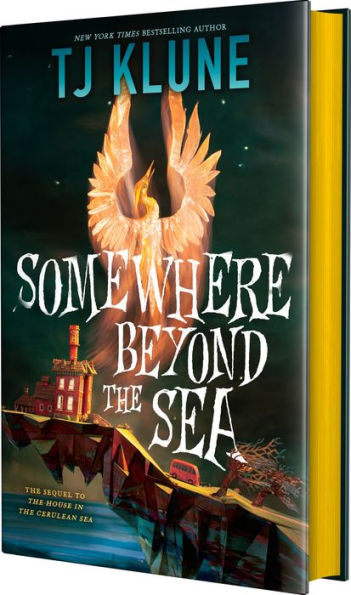
Just as I began my review of the first book (The House in the Cerulean Sea) with the words
“I had high hopes that I would love this book,” I hoped to wrap up my review of this one, its sequel, with the same conclusion I drew then—”This book was an unalloyed delight from start to finish.” Alas, I can’t quite say that.
Many of the same delights were present, the chief of them being the wonderful characters. A big pleasure of this book was to see how the children of the Marsyas Island “orphanage” have grown and come into their own under the positive attention of Arthur Parnassus and his partner, Linus Baker. My favorite parts of the narrative were the insights and revelations from Sal, Phee, Chauncey, Talia, Lucy, and Theodore, and the fresh perspective from David, the yeti child new to the family. The interactions, in particular, between David and the other children were such lovely models of how to bring someone into your orbit and make them feel wanted.
I also initially liked the political nature of the tale—the defiance of those in power when they try to use fear to silence and censor outliers. The opening—in which Arthur Parnassus testifies in public to the committee overseeing DICOMY and DICOMA about the abuse he suffered as a child at the hands of the department supposedly detailed to protect him—was a dramatic kickoff to the book-long campaign setting Arthur and Linus and their little band of hopefuls against the gaslighting of a self-serving, unaccountable government. The book is obviously meant to encourage people who have been “othered”—LGBTQ, as well as those who are racially and ethnically diverse—to stand up in solidarity and resist oppression and marginalization. The continuing revelations about the treatment of the magical community hark back to indigenous colonization and even genocide, and the story is also plainly intended to enlist “the rest of us” to stand with the othered, as Klune illustrates with his conversion of the townspeople of Marsyas into allies and supporters.
There are some dramatic moments that live up to this goal. I found it quite arresting when there was suddenly a realization by Arthur that rather than constantly fighting, he can just refuse outright to play the game. Instead of either resisting or buying into the government constraints, he has the ability simply to refuse to acknowledge their authority. It was a textbook lesson in how to leave someone flatfooted—stop collaborating with them in their appropriated self-importance.
But there are also a number of events that are so preachily on the nose (and in some cases either patently ridiculous or hail-mary impossible) that they actively take away from the message. I feel like those were a direct result of the “elephant in the room,” who appears by name in the acknowledgments but is caricatured and parodied in the book in the person of Jeanine Rowder, villainous government official. The choice Klune made to take on the anti-trans author J. K. Rowling by writing her into his book as the villain is the moment at which he lost the plot for me. The book morphed into a vehicle to scapegoat and belittle, on a too-personal level. Am I saying she doesn’t deserve pushback for her targeting of people who do her no harm? No. But there are many more egregiously hateful people in this world on whom a book villain might have been modeled, and perhaps the story wouldn’t have become so pointedly petty in the process. It felt like the set-up of a straw man to symbolically knock down. I wanted more nuance.
I still enjoyed most of the book. But the turn things took did make me sit back and wonder: Was there sufficient purpose to this sequel? Or did the personal agenda derail it from being what Klune intended? I’m honestly not sure.
I am also not fond of a deus ex machina-type resolution, so…there’s that.
My final conclusion is that I don’t regret reading the book, and would encourage others to do so—with the caveat that they take from it the intended message, the parts that are true heirs to the sentiments of the first one. Is that good advice? I don’t know. You’ll have to take your chances and come back to me on that.
Reverse the trope
We’ve all read the book or seen the (probably Hallmark) movie: The protagonist is a successful young executive of a major corporation; his assets include a tasteful wardrobe, a midtown rent-controlled loft, a sports car that screams big money with every rev of its engine, and the perfect girlfriend, from the top of her sleek chignon to the tips of her Louboutins. She shows up to work every day at the publishing house or the art gallery, dressed in a pencil skirt and crisp white blouse, manages her business with a firm hand while terrorizing her subordinates, and at the end of the day orders Thai take-out, because she never bothered to learn to cook. Everything in their mutual world seems well ordered and meant-to-be, if a bit regimented.
Then our man is sent by his employer to a picturesque small town, probably to either acquire or shut down some competing business, and while he’s there he meets her: The One. She is the antithesis of everything he thought he wanted—she has long, curly hair, wears sundresses and flip-flops, and is earnest about protecting her home and family from the rapacious big-city villain. Despite apparent incompatibilities, they fall in love, and the young executive suddenly decides that giving up the city for the country, the tense 60-hour work week for the laid-back life of a construction worker/baker/shepherd, is the way to go, if only he can be with his true love.
And of course he is also giving up the city girlfriend, the icily perfect career woman whose urges and drives he once wholeheartedly shared. He pretty much dumps her without compunction, and that’s the last we hear of her in this story, because it’s all about his renaissance as a man of the people living in a one-horse town and making babies with his soul mate.

In Book Lovers, by Emily Henry, Nora Stephens is that woman—a literary agent known as the Shark for her ruthless bargaining on behalf of her clients—and she has been summarily dumped for the country girl not one, not two, but three times. So when her beloved younger sister, Libby, comes up with the idea of a sisters’ vacation, a month’s retreat to Sunshine Falls, North Carolina, Nora acquiesces for the sake of spending time with her sister before Libby is subsumed, yet again, into motherhood with the birth of her third child, but has no illusions about the lure of the small town. She is a city girl, born, bred, and determined to remain.
Libby has other ideas: She has designed the trip as a transformation for Nora, and hopes to lure her away from her business-first attitude to become a more well-rounded person with an actual personal life. (It’s hard to love again after the multiple humiliations, so Nora puts it all into her job.) Libby has visions of Nora picnicking with a hunky country doctor, but instead, almost the first person Nora encounters is Charlie Lastra, a handsome but surly editor who rejected one of her clients’ books a couple of years back, thereby earning Nora’s abiding dislike. What he is doing there in Sunshine Falls is just one of the mysteries Nora finds herself confronting as she tries and fails to find any redeeming qualities about rural bliss. She misses the coziness of her apartment, the sound of car horns, and her Friday night Tom Yum Goong, and nothing is going to keep her from them, beyond this month-long time-out. But Libby (and maybe Charlie) have other ideas about Nora’s fate.
I have to say that I loved this book unreservedly. The clever ploy of turning the cliché upside down and telling the story of the city “girl” who was (repeatedly) left behind was brilliant, but only the first of the twists and turns this story takes as Nora explores the depths of her inner self and makes some surprising but not at all clichéd discoveries. And it certainly didn’t hurt that with protagonists who are a book editor and a literary agent, the story revolved around books. I loved the characters, the setting, and the emotional energy, and wanted to read it all over again the minute I rather hastily finished it (not being able to shut off my Kindle until 2:17 a.m. when I arrived at the last word).
I enjoyed two other books by Emily Henry, but when I reviewed them I used words like “meet-cute” and “feel-good,” and while I extolled the witty banter and the chemistry between the protagonists, I also saw the predictability inherent in those two wish-fulfillment stories. Book Lovers is different—I wouldn’t call it a parody, but it certainly has those moments, and the point isn’t the happily ever after but the acquisition of self knowledge. There is also both banter and romantic sizzle, but they aren’t exactly the point—or at least they are far from being the main or only one.
I don’t always have a lot of respect for either romance or relationship reads in terms of their originality or their ability to hold my attention, but this one was a five-star.
All the feels
His thoughts were all cerulean.
Linus Baker, The House in the Cerulean Sea
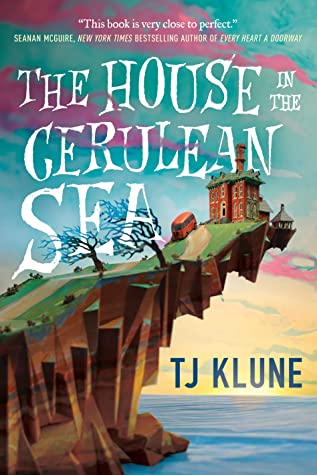
From my first glimpse of the whimsical cover illustration with its charming lettering,
I had high hopes that I would love this book. It reminded me in some ways of another unexpected pleasure, The Extraordinary Education of Nicholas Benedict, by Trenton Lee Stewart. They have some similar central themes—difference, acceptance, empathy, friendship—but I would say that whereas Nicholas Benedict is primarily written for children, this book—though certainly appropriate for youth above a certain age—is definitely targeted towards the adults in the audience, despite its population of characters who are as young as six years. Just like another favorite of mine—The Last Dragonslayer, by Jasper Fforde—this is fantasy that, while it may appeal to people of all ages, can only be fully appreciated by an understanding of the nuance, the inferences, the underlying message.
Linus Baker is the quintessential civil servant. He works hard at his mid-level job, refrains from involvement in the petty office politics that surround him, and spends his scant leisure time snug at home with his cat, Calliope, and his vintage record player. He is occasionally made unhappy by the arbitrary pronouncements of his immediate supervisor and her lackey, and is also sometimes discouraged by the unrelenting rain that afflicts the city in which he lives, but since these things have been essentially the same for the past 17 years, he doesn’t think about it much.
Linus works for DICOMY, the Department in Charge of Magical Youth, as a Case Worker. His job is to investigate the state-run orphanages specifically designated for the housing of children with special powers and gifts, and to make recommendations regarding the best care of the orphans. He is painstakingly thorough at this job, but has learned not to look past his final reports to wonder what happens once he has been and gone.
One particularly miserable morning, Linus is summoned to meet with Extremely Upper Management, and they tell him that because of the excellence of his reports related to previous endeavors, he has been selected to investigate Marsyas Island Orphanage, a level-four classified institution that houses some of the rarest and most dangerous children, to comment on the welfare of those housed there and also on the caretaker, one Arthur Parnassus.
Linus’s journey to the island is the beginning of an adventure that initially seems wasted on this stuffy 40-year-old bureaucrat, but which proves to be a transformation for all involved.

This story was an unalloyed delight from start to finish. The level of exaggeration in the set-up is borderline ridiculous, and yet renders the rest of it perfectly realized. It’s a character-driven tale, and oh what characters! In contrast to the stereotypical nature of those appearing in the first section, the children of the orphanage are as diverse as an author could imagine: The six children are either completely or virtually unique, either the last or only of their kind, or at least exceedingly rare, and this isn’t just a commentary on their magical natures but also on their personalities. Likewise, Arthur Parnassus is an enigma worth exploring, and Linus Baker soon discovers that he is very much interested in doing so, though it be against his conscious will, which is obsessed with strictly following the Rules and Regulations.
Linus has been allotted a month on the island to do his research, write four weekly reports, and deliver his conclusions to Extremely Upper Management, and though initially dismayed by the prospect, Arthur and the children soon draw him into their isolated little world and cause him to embrace feelings he has never before experienced. The level of unconditional love and kindness expressed is heartwarming, and yet this is not a cloying story but rather a plea by the different among us to be seen, recognized, and accepted with all their idiosyncrasies. It asks tough questions about prejudice and complacency, and challenges our need to categorize people into stereotypes in order to deal with—or forget—them more easily. But ultimately the book is all about hope and about love that doesn’t discriminate. As I said in my title, it has all the feels. I can’t give it higher praise than to say that while it made me laugh and entertained me thoroughly, it also made me want to be a better person. It’s the perfect book for that moment when your faith in people is slipping.

Just for fun, I decided to illustrate one of the opening scenes when Linus Baker arrives on the island and confronts some of the children. The green blob is Chauncey, whose sweet nature belies his monstrous form, and whose most dearly held wish is to become a bell-boy at a hotel in the city (thus the bellman’s cap). He has come to greet Linus and deal with his luggage. The Pomeranian peeking out from behind him (and faintly visible in his entirety through the amorphous blob of Chauncey’s body) is Sal, a large, shy, silent boy who shifts, in moments of panic, into the form of a small dog.
Lucky Charms

I was between books and having a hard time deciding what kind of reading experience I was craving, and I ended up doing a reread of Crosstalk, by Connie Willis, to provide some light comic relief in between the literary and the dystopian.
To really love Connie Willis, you have to be willing to go along with a writing style that is a sort of frenetic stream-of-consciousness experience led by one or more of her characters. No matter their major premise, many of Willis’s books are based on the idea that people hope for the best but continually expect the worst, and that they can’t keep their mind on the present moment because they are either obsessively dwelling on the past or compulsively anticipating the future. And because sometimes more than just the protagonist behaves in this way, you have a built-in tendency for poor communication, missed opportunities, and sometimes comical results. Not that all her books are intended as farce (as is this one); but this frustrating communication style is almost universal in her stories, meaning that the tension builds from low to high as you continue to read. It engenders excitement along with the frustration, and certainly guarantees that you want to finish the book to find out what happens—did the protagonist’s worst fears come true? or did they somehow manage to pull off whatever was necessary to meet their objective? The test is whether you (unlike the main character) can deal with the anxiety while enjoying (in this case) the romantic comedy.
Crosstalk takes place in the not-too-distant future. Its main protagonist, Briddey Flannigan, works at Commspan, a company that is in direct competition with Apple to produce the latest smart-phone technology. Briddey is dating one of her co-workers, the sharply dressed smooth-talking Porsche-driving Trent, and is thrilled when Trent suggests to her that they undergo a new outpatient procedure that is all the rage, the EED. Simply explained, if two people are sufficiently invested in their relationship, then this operation creates empathy between the romantic partners so that they can actually experience one another’s true feelings. Trent implies that undergoing this procedure would be the run-up to a marriage proposal once they have achieved this desirable emotional connection.
There is a lot of interest from Briddey and Trent’s co-workers (and inexplicably from his boss) in their daring step, and attention of a different kind from Briddey’s family, who are all opposed to her undergoing the procedure. But when the celebrated Dr. Verrick who performs the surgery has an unexpected opening, Briddey and Trent go for it, only to end up with some unexpected consequences: Briddey finds herself connected, not to Trent, but to someone else entirely, and empathy is just the beginning of what she experiences.
The tension ramps up as Trent wonders why—a couple of days past the estimate when the doctor said their “channel” would open—the two of them have not yet connected; and between keeping it a secret that she is in synch with someone else and keeping her increasingly suspicious family at bay, Briddey is at the end of her rope. But that’s only the beginning, as unforeseen complications take all her energy and attention.
Crosstalk explores a timely topic for the Information Age—the perils of over-communication, along with miscommunication, gossip, deception and the many other ways human interchanges can go wrong. Connie Willis says on her blog,
The novel was partly inspired by our wildly over-connected world, in which we’re constantly bombarded with communication, most of it unwelcome, and partly by the misconceptions people have about what being telepathic would be like. They always assume it would either be profitable (finding out people’s computer codes or social security numbers or blackmailable personal secrets) or fun.
Mentioning the telepathy is a spoiler, but I guess if the author is going to do it, I can too, and it comes up quite early in the book. I made an illustration that goes with the story: This is Briddey, building an internal “perimeter wall” out of make-believe bricks, the reciting of poems and stories, and the enumeration of the types of marshmallows in Lucky Charms cereal, in order to keep other people’s thoughts at bay.

My reaction to this book is positive, although I do think that Willis could have cut about 100 pages from it and it would have been more readable. At some points the dithering, the familial interactions, and the feeling that you’re in the middle of an Abbott and Costello routine become wearing, and you want to move on to the next bit rather badly. My favorite romantic comedy of hers is To Say Nothing of the Dog; but the fact that I have read this twice speaks to its merits, even if they aren’t quite as great as some others of her books. It’s definitely worth it for the fun pop culture references if for nothing else!
Character
I haven’t made a post for a while now, for several reasons: I’m still finishing off Charlie Higson’s dystopian series for teens (I’m reading The End and hoping that all my many questions are answered); I started teaching my Readers’ Advisory class at UCLA this past Tuesday and have spent some of my time preparing for that (mostly cleaning up my combination office/art studio so it’s fit to be seen in the background of Zoom); and I’ve been rather caught up in the political events of the day (unhealthy obsession with Facebook posts). But I should be at the end of The End soon, and on to my next read.
In the meantime, the combination of contemplating “appeals” for readers’ advisory and doing a massive clear-out, clean-up, and re-shelving of my entire library of fiction in my four bedroom bookshelves caused me to think about the nature of “character” as a dominating force in fiction.
To explain a bit for those who are not up on librarian lingo, appeals are what we call the various reasons why people enjoy what they read. Some people are motivated by adrenalin and want something fast-paced and exciting; others love beautiful language and want to be wooed by unusual or lyrical phrasing; and one particularly powerful appeal is that of “character.” The ability to identify with or, alternatively, loathe a character or set of characters in a book is one aspect that draws people to read more. The success of the belabored Harry Potter franchise is largely due to the desire to find out what happens next to the maturing Harry and his friends, and all of us can probably think of a book or five whose characters were what kept us coming back to its pages. A few recent books in which character dominated include Eleanor Oliphant Is Completely Fine, A Man Called Ove, and The Seven Husbands of Evelyn Hugo. (A major clue as to whether the book is character-driven is if the main character’s name appears in the title. Witness Harry Potter and the….)
As I have mentioned here several times, belonging to the Facebook group “What Should I Read Next?” is sometimes an exercise in patience, because most of the readers there have become caught up in the bestseller craze and all end up reading the same 12 books. So in the effort to find them—and you—other compelling reads, I thought I would spend a blog post examining some of my past favorites that are wholly about the character.
A compelling writer of character-driven works is the author Mary Renault, and although her entire oeuvre contains much to appreciate, there is not another that rivals The Persian Boy, her tale of a bed slave named Bagoas who was abducted, gelded, and sold as a courtesan to King Darius of Persia. When Alexander and his Macedonian army conquer the Persians, Bagoas finds himself in a rather untenable position and decides he will achieve safety only by ingratiating himself with the conqueror himself. Although Alexander is quick to see the appeal of this highly motivated slave, he is slow to take advantage of his utter dependency, and the courtship between the two of them is both touching and fiery.

The Persian Boy is actually the second in a series of three books Renault wrote about Alexander. The early years, when he rises from a beleaguered son of warring parents to become the master of all lands he surveys, are covered in Fire from Heaven, in which he experiences love and trust for the first time with his best friend and fellow warrior, Hephaistion. But that book is far more event-driven, whereas The Persian Boy, being narrated from the point of view of someone with whom Alexander had a solely personal connection, is limited in scope in terms of world events but much more specific about the relationships. It is, in fact, a love story, and I would regard it as one of the great ones, containing as it does not just attraction or romance but also loss and pain, desire and jealousy, joy, courage, and cowardice. It is an exceedingly intimate view of Alexander the man beside that of Alexander the great warrior, and is filtered through the emotions and psychology of a patient bystander.
At the beginning of the third book, Funeral Games, Alexander the Great lies dying, surrounded by his former generals, satraps, and wives, all competing like wolves for the prizes of power and land. Only the two loves of his life, Hephaistion and Bagoas, realize and truly mourn what has been lost. Funeral Games documents the disintegration of the mighty empire built in 20 years and brings Alexander’s saga from age 12 to 33 to its close.
There is a variability of voice in these tales that lets them be read as a series but also allows the reader to experience them as stand-alone novels. The first is told in the first person by Alexander; the second is the purview of Bagoas; and the third is written from a third-person observer stance. I discovered and read The Persian Boy first, only picking up the others afterwards, and felt no sense that anything was missing in that first reading. When people ask for an LGBTQ love story that goes beyond the contemporary meet-cute or the simultaneous struggle with coming out that invades so many of these stories, my thoughts immediately return to the yearning and transcendent happiness contained with the pages of Renault’s classic work.
Another protagonist with whom I have been in love since the first time I read the book is Shevek, the humble man and brilliant physicist at the heart of Ursula K. LeGuin’s book The Dispossessed. The book is a recounting of an existential thought experiment: The author posits what would happen to individuals in a social system that rewards conformity, although that social system in this case is based on a sort of group anarchy. Urras is a world much like our own, driven by commerce. Within its teeming millions is a group of individuals who wish to live their lives quite differently and, because Anarres, the moon of their planet, is suitable (though not ideal) for human life, they are allowed to colonize it. The two societies make a pact that neither will invade the other and, for more than 100 years, not one individual from either society has crossed the line between them except for shipments of supplies that arrive and leave the small port on Anarres.
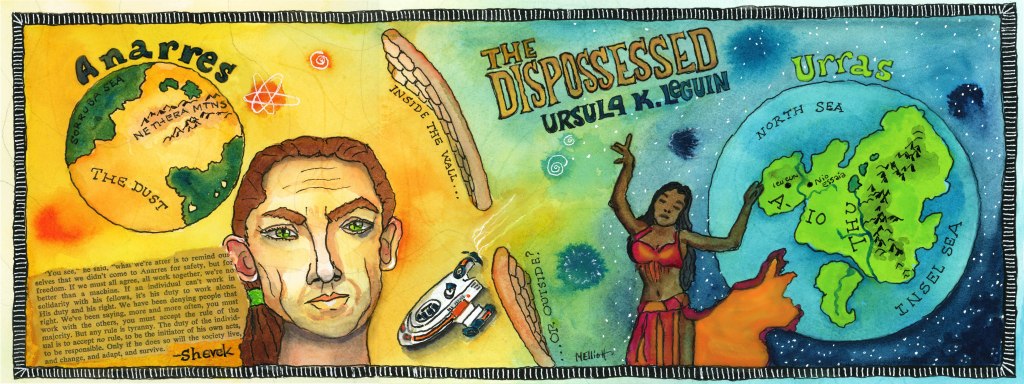
Shevek grows up in this ascetic society, a planned utopia where no one takes precedence over anyone else, where each is valued but all are expected to make their contribution to society in return for a place in it. He does his part, planting trees in the desert, drawing food service or waste management tasks for 10 days at a time, and through it all manages to find a great love, Takver, and have children; but while he goes through these tasks of daily life, his brain is operating on another plain—trying to understand temporal physics—that demands discussion, the exchange of ideas, and a close relationship with those on his mental level who are capable of understanding his brilliance. Ultimately, he makes the choice, despite the possibility of losing his home, his family, perhaps even his life, to go back to Urras to see what the scientists of that world have to offer him.
The fascinating part of the book is how the society on Anarres was originally founded as a profound act of nonconformity, and yet ends up suppressing originality and demanding obedience from a man chafing under its restrictions. LeGuin achieves her objective—the exploration of the concept of freedom—by letting the reader recognize the virtues of the system under which Shevek lives and
then realize how stifling it has become, without being either polemical or strident.
If it weren’t for the “stigma” of being categorized as science fiction, I believe this book would take its place amongst the most important of classic novels, and that Shevek would be a much more well-known protagonist in the reading world.
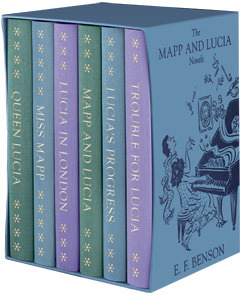
Some books you love for a protagonist, and some for an entire cast of characters. In the second category are the books by E. F. Benson that were latterly brought together in an Omnibus volume called Make Way for Lucia. There are six Mapp and Lucia novels in the series, and they must be read in order, for events take on importance in a specific sequence that must be appreciated.
At first glance, you might not think that a view into the social world of upper-middle class Edwardian village dwellers would be particularly compelling. But what you have to understand about the Mapp and Lucia books is the exaggerated degree of sheer triviality that guarantees a contrary fascination. Benson had a disdain for middle class people pretending to a rank to which they are not entitled, and his satires of these mushrooms trying to push their way into high society are brilliant and also funny as hell.
The books feature the feuding doyennes of Riseholme and Tilling, whose decidedly bourgeois residents get flustered in the presence of noble titles but king and queen it in the presence of everyone else. The main protagonists—or should we call them pugilists?—are Emmeline Lucas, designated “Lucia,” and Elizabeth Mapp. Though the stories begin with each of them ruling their respective roosts with total social supremacy in their separate villages, fate brings them together to hilarious effect. But the reader is not solely reliant on Lucia and Miss Mapp in these stories; Benson has created a whole cast of characters, including the dashing Georgie Pillson, aging bachelor, with his elbow-length cape and carefully trained piece of hair draped over his scalp; the drunken and slightly naughty Major Benjy; artist and naked sunbather Irene Coles; Mrs. Boucher with her daughters, Piggy and Goosie, in tow; and so many more. The tempests in the teapots that are the meat of these ’20s and ’30s comedies of manners are hilarious, witty, and slightly nasty. In other words, inspired. Auberon Waugh, eldest son of Evelyn, said,
“I might have gone to my grave
without ever knowing about
Lucia and Miss Mapp. It is not a risk
anyone should take lightly.”
It’s about time for me to read them for the third time.
I hope you have enjoyed this meander through some character-driven books, and that it will inspire you to look them up for yourself or to reflect on the characters that have come to life for you during your lifetime of reading. If any compelling ones occur to you, please share!
 The Book Adept