What makes a mystery?
This is a question I have been pondering this week as I started reading Anthony Horowitz’s Magpie Murders, a book that has been recommended over and over again by readers on the various Facebook reading groups to which I belong. I am a big mystery fan—in fact, it’s probably my third most-read genre, maybe second, behind fantasy and possibly science fiction. I love a good mystery; but I specifically love one that has some quality of individuality and that arrests my attention and reawakens a somewhat jaded appetite. As I began reading, I discovered that Magpie Murders was not it.
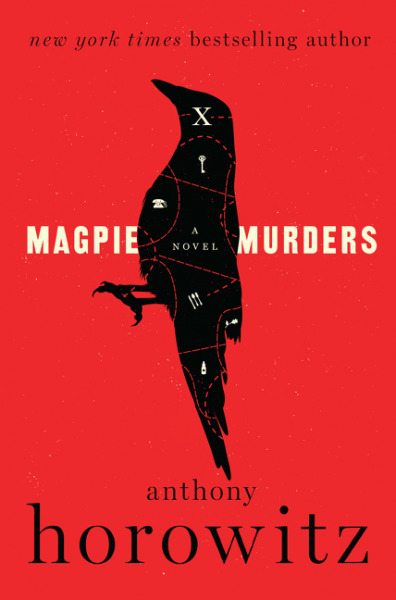
This book has been touted as the heir to Agatha Christie and Dorothy Sayers (and probably to Conan Doyle), and I can see the attempt, but to me it was a bland, by-the-numbers imitation (possibly attempting to be a parody?) rather than a “brilliant recreation of vintage English crime fiction.” When I was almost 50 percent into the book, I seriously considered posting it as a DNF. I honestly didn’t understand why there was any hoopla at all when it comes to this book.
It’s a typical cozy setting in a small town in the English countryside, with the requisite landowner, vicar, shop keepers, eccentric spinsters, surly handymen, and so forth. The detective’s only point of uniqueness in this setting is that he is German by origin; but given all his mannerisms, quirks, and habits, he might as well be Sherlock or Poirot or Jessica Fletcher. He has the slightly dense assistant, he asks seemingly unrelated questions and makes leading remarks that he won’t explain, and then he claims to know who the murderer is before anyone could possibly expect him to have solved the crime, given the vast number of suspects and the meager number of clues. The publisher described this book as “masterful, clever, and ruthlessly suspenseful,” and my response was, sadly, “none of the above.”
When I hit 50 percent, though, we stepped out of the book and into the office of the publisher of Alan Conway’s series about the detective Atticus Pünd, and I realized that the page I quickly skimmed past at the beginning of the book actually had something to do with the story and wasn’t just an introduction or something. So I went back and read it with attention this time, and realized that this was a book within a book and we were now getting to the real story.
I’m going to say here that although it was my fault that I wasn’t paying sufficient attention at the beginning, I’m also going to hold both the format and the author accountable for a little of my confusion. First, I’m reading it on my Kindle, and the way it was structured didn’t lead the reader to recognize that the start of the book was before the start of the book! As for the author, do you really tell the entire story within the story without its reader ever breaking away from it? I mean, Susan Ryeland sits down on a rainy afternoon with a bottle of wine and some chips and salsa to read a long manuscript; it’s more than plausible that she gets up at some point to replenish one of those (it says later that she had gone through more than the one bottle of wine), get something more substantial to eat (she would have needed it, to cushion the effects of all that alcohol), use the loo (I repeat, lots of wine!). A break halfway through that 48 percent of the book to remind the reader that this is a false construct, so to speak, of what the book is really about would have been helpful—and also both realistic and logical.
Anyway…
Once I hit the end of the manuscript and returned to the “real world” of Cloverleaf Books, a small publishing company whose owner and top editor were both reading the manuscript of Alan Conway’s ninth Atticus Pünd novel over a long weekend, I thought things would pick up and we would get the explosive and fascinating book we were promised by reviews and cover blurbs alike—but alas, that faith was misplaced. Others have commented how much more exciting they found the actual mystery that unpacks itself from the pages of Magpie Murders (the book within the book called Magpie Murders), but if so, I certainly wasn’t reading the same book.
Susan Ryeland was a dull and ambivalent character who constantly expressed her frustration that she couldn’t “do” the mystery thing the way all the great characters of literature were able to master it. When she wasn’t being tentative and indecisive about her attempts to solve the mystery, she was whining about her boyfriend, Andreas, who wants to whisk her away to Greece to run a small hotel with him. What an inconsiderate guy!
The other characters are likewise less than charismatic, and Alan Conway himself is written as a cold, devious, and thoroughly unlikeable person about whom it was hard to care. And there were too many instances of clues that were discovered to be clues, but then weren’t explained. Maybe Horowitz is saving something for the next novel? If so, it yielded an unfortunate sense of frustration while reading this one.

I hung in there and finished the book, but it was a near thing, and I regretted spending the time on it once I was done. I won’t be visiting the next in the series, which is 604 pages of the same, according to another Goodreads reviewer who characterized it as “ponderous, overly complicated, and too long.” I spent a decade recommending Horowitz’s Alex Rider series to many teen readers, but I can’t do the same for this one. There are so many better mysteries out there, and I’m going to go find one to expunge the irritation from my brain!
Discover more from The Book Adept
Subscribe to get the latest posts sent to your email.

 The Book Adept