A pirate and a serial killer
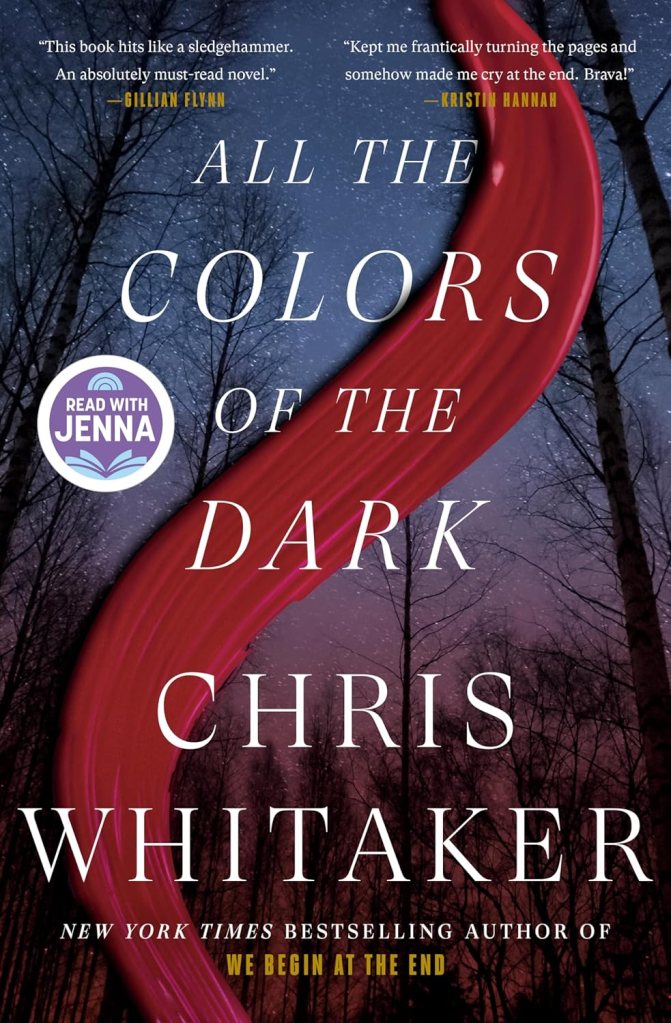
All the Colors of the Dark has been widely touted on all the Facebook readers’ pages I frequent, yet never really explained. The title alone made me curious, so I put it on the holds list at the library and waited a very long time for it.
When I started it, I was immediately filled with a sense of dejá vu; it reminded me forcefully of another dark, complex book I had read a few years back, but I couldn’t remember the name. I looked on Goodreads because I knew I had listed that book in my “coming of age” section, and then laughed; it was by the same author, Chris Whitaker, whose novel We Begin at the End bowled me over when I read it four years back.
I looked up my review of that book, and was not surprised to see that my description would pretty much do for both books:
“It is the saga of multiple people caught up despite themselves in various forms of tragedy they are mostly unable to avert.”
There are other similarities: The main characters begin as young teens with absent or derelict parents; they live in a small town and are outliers in their peer group; and they have an odd array of adults who try to look out for them but are mostly no match for what’s coming to them.
There are two characters around which the story revolves. The first is Joseph “Patch” Macauley, a boy born with one eye. His mother tried, in his younger years, to ameliorate this by sewing him a series of eye patches and buccaneer vests to let him play the pirate, but that may have made him even more of an outcast. The second is his best friend, Saint, a girl raised by her grandmother to be uniquely herself. In a small Missouri town where 13-year-old girls are mostly yearning to dress up, wear makeup, and start going on dates, Saint is more inclined to wearing overalls and keeping bees. The two are pretty much inseparable, each for their own reasons. Saint loves Patch and also wants to help him; Patch believes that Saint’s primary emotion for him is pity, because she invites him to dinner as often as she can, knowing that his mother can’t seem to hold down a job or keep the electricity on and the refrigerator stocked.
There is a girl at their school named Misty, a girl so far out of Patch’s league that even to speak to her might be considered sacrilege by her crowd of friends, a rich girl, a beautiful girl, a girl who takes life lightly—until the day she is kidnapped. Patch becomes her unexpected rescuer, and this act is like the butterfly that causes the tornado, enveloping everyone in his vicinity in chaos.
This book, like the other, is a complex interweaving of mystery, thriller, love story, and coming of age—or perhaps not that, but coming into one’s own. It’s about friendship, love, obsession, degradation, inspiration, hope. As with the first book of Whitaker’s, I don’t want to say too much more about the plot, partly because it’s too complicated to describe, but mostly because when you read it you need to do so without knowing what’s going to happen.
The thing that makes me know this is a great book is that it has some flaws that I would normally have been critical (or even scathing) about in a review. It’s far too long; at one point I thought I must be at least three quarters done, but looked at my Kindle gauge and discovered I was only 52 percent in. It has vastly unbelievable details and plot twists that, again, in another book I might have scoffed at. And he does what I dismissed in my review of the book Things You Save in a Fire as unforgiveable: He writes what feels like the end, but there are five more chapters, each of which also feels like the end until you finally get to the end. I usually hate that, but here I wanted so much to know what happened in every circumstance that I was grateful to turn a page and find more book behind it.
It’s not an easy book to read, for many reasons. There is a lot of tragedy and, just when you feel like you have encountered the worst, there’s more. But it’s also a book full of unexpected lightness and even humor, and if you are a fan of beautiful language and imagery, you will be captivated.
I won’t say it’s not a challenging read; but for me it was all-enveloping and, in the end, vastly satisfying. I will think about it for a long time.
Discover more from The Book Adept
Subscribe to get the latest posts sent to your email.

 The Book Adept