Effortless reads
I’m not quite sure about that title: I wanted to convey that it is about the reading of books that aren’t literarily complex, that don’t challenge you in any way, but simply present a story that is hopefully enjoyable, fairly light-hearted, and not taxing to read. But I’m not sure that’s strictly true of any book, simply because if it’s too much that way, you may have a compensatory challenge to not be actively irritated by it! I read two such books recently, one more successful than the other at distracting me and not irritating me.
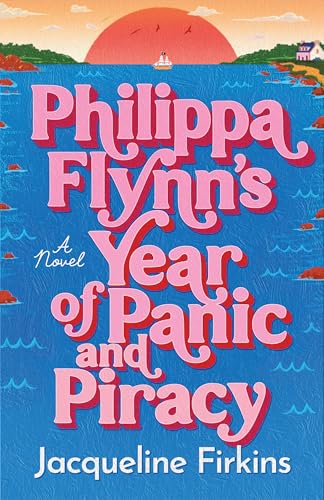
The first, less problematical one, was Philippa Flynn’s Year of Panic and Piracy, by Jacqueline Firkins. I have to confess that it was the word “piracy” that drew me, considering that I have made my way through too many clichéd books (and movies!) about adult children who return to their roots because they A. lost or quit their job, B. got dumped by someone, or C. had some kind of catastrophic loss of income or physical problem from which they need time and space to recover. And “going home” almost always conveniently features a grandmother’s house sitting empty, an aunt who has left an unexpected bequest, or a town that needs (for instance) the big-city fancy-schmancy doctor to change her perspective and become, instead, a beloved general practitioner in a small town. Said book reliably features a house rehab, a rediscovered old boyfriend who has magically become available / appealing, or a meet-cute of someone new who’s not their typical “type” but nonetheless has the pecs and the personality to win them over.
But piracy! that’s more like it. I’m a little sad to say that there’s not any actual piracy in this book, but there is a real ship and a pirate facsimile, and I settled for those. (You should know I am similarly sucked in by anything to do with circuses.)
Philippa has been a college history professor for a while, and has discovered that (at least in her current position) it is a world of misogyny and disappointment. She presents ideas that are rejected, only to see them greeted enthusiastically and implemented when recycled by one of her male colleagues. Promotions and decent office space aren’t forthcoming, and tenure definitely hasn’t been all it was cracked up to be. A brush with a near-death incident (she’s almost swallowed by a giant sinkhole) causes Philippa to re-evaluate her current existence, and what follows is a shucking-off of all her heretofore solemn commitments. Her grandmother, Iris Flynn, a successful novelist who specialized in pirate romances, left her old house at the seaside to Philippa when she died, with the stipulation that her reclusive writing partner be able to live in it as long as the house remained in Philippa’s possession, which he has for some years now. But it’s a big house, it’s her house, and it’s about the only place she can think of where she can retreat and live off little money while considering her options.
What she doesn’t discover until she arrives is that the writing partner is decades younger than her grandmother, and is also the male model who appeared on the cover of Iris Flynn’s saucy novels about a bare-chested swashbuckling pirate king.
There’s a lot more to the story, but I think that sums it up pretty well in terms of expectations. The complications introduced to the plot by things like difficult familial relations, financial awkwardnesses, and the lure of sailing away in an actual masted sea-going ship made it much more entertaining than I expected it to be, and all in all I was pleased with my foray into this genre.
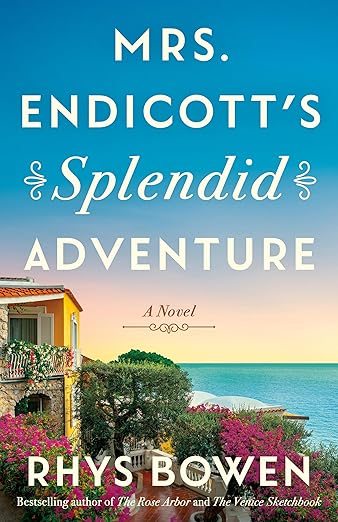
The second book, for which I had higher expectations, actually turned out to be the less successful of the two, at least for me. It was by Rhys Bowen, an author whose books I have read before, mainly from her historical mystery series about Molly Murphy, a young Irish lass who flees her homeland under a cloud and takes up residence in New York City, where she solves mysteries in late nineteenth-century America. This book wasn’t a mystery, although there are a few mysterious sub-plots to be found; it is, rather, historical fiction about World War II, mostly set in the south of France beginning in 1938.
Mrs. Endicott’s Splendid Adventure has a beginning somewhat reminiscent of the 1989 British movie Shirley Valentine, although some of the facts are reversed. Shirley, a working-class woman, is lured away from her mundane life by a spontaneous friend who wins a trip for two to Greece, while Mrs. Endicott, definitely on the business end of upper class, is blindsided by her husband’s request for a divorce and his plan to move her out of their beautiful home and into his former bachelor pad where he had his affair with the pending second wife. Both, however, are fleeing from the gloomy weather and staid British lifestyle, lured by fantasies of a better life in Europe. Mrs. Endicott decides that rather than being relegated to such a humiliating position after a life of catering to her husband’s every need and whim, she will seek out her fantasy. She retains a lawyer to get her a healthy sinecure and settlement, then steals her husband’s Bentley and sets out with her housekeeper, Mavis, who has been on the receiving end of her own husband’s fists too many times, and her elderly acquaintance, Dora, who has an equally compelling reason for departure, for the south of France.
Serendipity plays a large part in determining the three women’s fates, when the Bentley breaks down in a small fishing town without a garage. Their necessarily extended stay, coupled with the rumors of impending war, cause them to decide to settle there, and Mrs. Endicott daringly rents and re-habs an abandoned villa where they hope to weather the war unnoticed. But when the Germans cross the Maginot Line into France, things quickly become more fraught than expected.
I have to say that for about the first half of this book, I enjoyed it more than Philippa Flynn. I identified with the protagonist, both as to the stifling nature of her former existence and the wonderful adventuresome independence she embraced when she let herself imagine a different life. The whole thing has a bit of a Mrs. Harris Goes to Paris vibe that I really liked. I enjoyed the side characters and the adaptations the British women had to make to fit into their new environment. But as the story went along, there were some things that just didn’t work for me.
First of all, the war impinged very lightly on them until two-thirds of the way through, but then as its challenges became more apparent, I felt like Bowen made strange and somewhat unlikely choices for how to include it. And when things did happen, rather than letting the tragedies be a stark contrast with the characters’ former idyllic existence, she made all but one loss temporary and did that thing that I heartily dislike, which is to tie up each and every person’s situation with a big fat bow, until absolutely everything is resolved into a happily-ever-after ending that feels wrong unless it’s attached to an obvious romance novel, which this was not. Don’t get me wrong: I enjoyed the potential of reconciliation with the husband that was portrayed in Shirley Valentine, and the fortuitous meeting of someone who would help her achieve her dream of a Dior dress in Mrs. Harris Goes to Paris; but in both cases, there was some air left in the story. There was room for things to go either way, there were possibilities that took the imagination beyond the last page into the future, whereas in Mrs. Endicott it wrapped up and wrapped up and wrapped up…and ended.
It was by no means a bad book, and I’m sure others might not find the number of faults with it that listed themselves in my head; but the open feel of infinite possibilities with which it began felt shut down by the end and left me disappointed. Go watch Shirley Valentine or the lovely 2022 movie of Mrs. Harris portrayed by Lesley Manville (or read the novel by Paul Gallico) instead.
Discover more from The Book Adept
Subscribe to get the latest posts sent to your email.

 The Book Adept