Partita
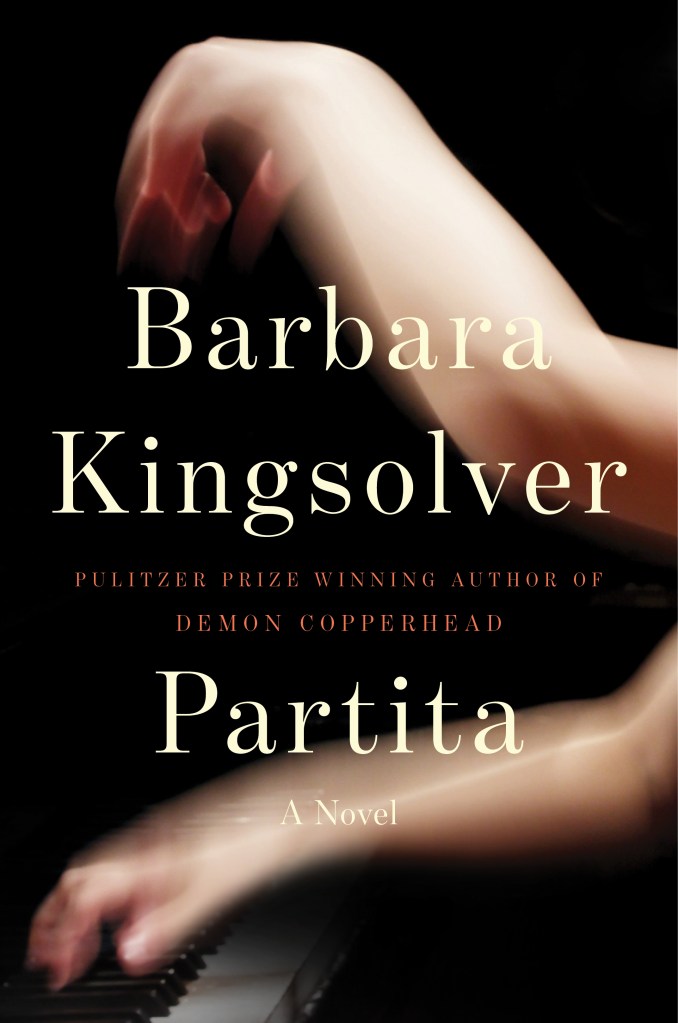
The thing I love about Barbara Kingsolver’s writing is how she puts so much wisdom or feeling or humor into one quirky sentence that just jumps off the page at you, not because she’s being self-consciously clever, but simply because that’s how she phrases things. What a wonderful brain she has, to form such sentences, and how lucky we are that she shares them with us.
Want to know what I mean? Here’s a simple one from her new book, Partita, that’s not even particularly significant in the context of the story, but if you have been “away” to college, especially a small private one with a homogenous student body where you lived on campus somewhat sequestered from the world (I have), this should resonate with you:
College is a cloister. You go a few years without knowing anybody older or younger or different from yourself, and you forget what a thin little spine you are on the big loud bookshelves of the living.
A partita is a musical concept, “…a composition made of a lot of parts with different paces and moods. A partita will never be all happy rondos, or all andantes in a minor key. You’ll usually have a prelude, a thrilling allemande, maybe a slow, sexy sarabande—the contrast is the point. The parts are all different, and the artist’s work is to make them all add up to a something that
feels whole.”
This book is about Livia Bohusz Cable, and it alternates between two timelines: her present-day life as a married dairy farmer and piano teacher in rural Tennessee, and her past as a young college student in 1989, at a Bloomington, Indiana music conservancy school, a scholarship prodigy whose most dearly held dream was to become a concert pianist.
The story is structured like the Baroque musical suite for which it is named, taking the reader on an emotional journey of highs, lows, trauma, resolution, loss, and joy. The story is introspective in the extreme, all of it stemming from a phone call from someone she thought she had left behind forever and now has to decide whether to let back in for even a brief moment. The delirium and trauma of those days has been supplanted by a quiet life a world away from what she had hoped and planned, and this contact jerks her back to those days and reveals to her how unresolved are certain of her feelings. Kingsolver uses the music as an allegory to explore that trauma, with a lyrical, poignant, but down-to-earth narrative that was utterly captivating to me.
I’m not an audio book person, but I am tempted to, at some point, return to this book to listen rather than read, because Kingsolver created a playlist to go with the story, and that is included as background and interludes on the audio book. I could have chosen to seek out the music and listen on my own in between chapters, but honestly, I didn’t want to pause long enough to do so! But I will definitely be looking online for a live performance of Maurice Ravel’s Gaspard de la Nuit, the soundtrack to the most eventful scenes of the book.
Discover more from The Book Adept
Subscribe to get the latest posts sent to your email.


