
Person, place, thing
I wrapped up my wallow through the writings of familiar authors by reading two books that I really should have saved for six weeks or so but, once discovered, I couldn’t resist them. These were Jenny Colgan’s latest, a two-parter with the same characters and location, The Christmas Bookshop and Midnight at the Christmas Bookshop. Colgan has made a habit out of returning to the scene of a previous novel but setting the action at Christmas (Christmas at the Cupcake Café, Christmas on the Island, Christmas at Rosie Hopkins’ Sweetshop, etc.) but these sequels usually arrive after she has segued to another story or two and then returned. This two-fer is an almost-continuous tale all taking place within about a one-year period bracketed by Christmas seasons, so I was glad that I discovered them both at once and could read straight through from page one of #1 to the last page of #2.

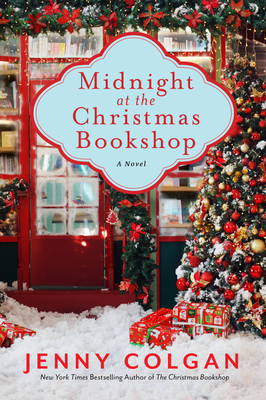
My title for this review takes into account a particular skill of Colgan’s, which is to present us with compelling characters with a specific objective in a spectacular setting that becomes every bit as important to the story as the protagonists. In this case it’s the city of Edinburgh, specifically the Old Town shopping district, so far holding out (for the most part) against the store chains and gimmicky tourist fare to present an authentic experience of one-off original shops, from a hardware store to a chic dress shop to a witch’s herbarium. The focus for Colgan’s bevy of characters is, as frequently happens in her books, a bookshop, in this instance a failing one. Mr. McCredie’s ancestors started the rare book store on the rambling bottom floor of their home, and he has lived and worked there his whole life but, despite his affinity for and encyclopedic knowledge about every sort of book, he’s a terrible salesman, a worse marketer, and is on the verge of forfeiting everything. Enter Carmen Hogan.
Carmen has, in rapid succession, lost her boyfriend, her job, and her apartment, and has been living in a state of denial at her parents’ place, tediously and repetitively grousing about everything and eating way too much junk food. Carmen’s parents are rather desperate to get her out of their house and back on her feet, and enlist Carmen’s sister, Sofia, to help them.
Sofia and Carmen have always been polar opposites: Sofia is the elder type A overachiever, and is now a successful lawyer with a happy marriage, three children (and another on the way), and a beautiful home in Edinburgh, and Mr. McCredie is one of her clients at the law firm. Carmen decided to skip college, and has worked in retail in a large department store since high school until the store closed and made her redundant. Sofia somewhat reluctantly asks Carmen to come live with her family, telling Carmen there is a job for her revamping an Edinburgh rare bookshop; what she doesn’t tell Carmen is that the sole objective is to get the store to turn enough of a profit during the next three months so as to make it an appealing prospect to a buyer, and that as soon as a sale takes place, Carmen will again be out of a job (and presumably a place to live).
While initially reluctant to go live with her sister, Carmen sees that she needs a change, and she loves books, so off she goes to Edinburgh. She is horrified by the magnitude of the job she has taken on: The store is in an advanced state of disrepair and disorganization, and Mr. McCredie is absolutely no use unless someone comes in looking for that one eclectic title about which he happens to know something. But she takes a deep breath and pitches in, and starts to make some headway, particularly when she is able to get a famous writer of self-help books to do a signing at the store. This guy and a student/lecturer at the college are the two love interests in the story, and Carmen goes back and forth between the glamour of the first, with his casual attention and expensive dinners, and the quiet regard of the second, a young Quaker with an intensity she has never experienced.
Carmen and Sofia continue to be mostly at odds, but Carmen discovers an affinity for children, specifically her young nieces and nephew, that she didn’t expect, and bonds particularly with the second daughter, Phoebe, who shares many character similarities with her Auntie Carmen.
There are other fun, although somewhat over the top, characters such as Skylar, Sofia’s yogini nanny, and Jackson, the millionaire who is out to ruin the quaint shopping district by remaking all the stores into purveyors of cheap “tourist tat” sporting too much Scottish tartan, and there are a few improbable story elements that made me say “hmm.” But…
I was truly astounded to see a bunch of two- and three-star ratings of these books on Goodreads, where Colgan normally has solid fours and fives. I thoroughly enjoyed both of them; the magical descriptions of Edinburgh in winter at Christmas made me want to go there despite an almost pathological dislike of cold weather; the children were funny and endearing and memorable; the bookshop’s problems and mysteries were involving; and I liked Carmen as the protagonist and driver of the narrative. I was totally immersed in this two-part story for four days, and was sorry when it ended. I’m hoping, as she occasionally does, that Colgan will go back for a third installment set in this world with these people, because I’d love to know what happens in their next chapters. If you’re looking for something to read to put you in the holiday mood, look no further.

Riches

Sometimes forgetfulness or inattention is a gift. I was so busy for a while there trying out new authors and new titles garnered from various Facebook reading groups that I quit paying attention to the yield of some of my favorite mystery writers, with the result that I built up a backlog and got to enjoy three of them in succession: First I read the two Bosch/Ballard books by Connelly, then I followed up with the latest Cormoran Strike; when I finished that (which took some time, since it was 960 pages!), I remembered that I hadn’t checked on Deborah Crombie’s output in a while (I don’t check her too often because she’s an exceedingly slow writer, with as much as four years between books), and discovered she’d published a new one in February! This was a case of gulping down a dessert and then wishing retroactively that I’d made it last a little longer. I was still reading at the intense pace necessary to peruse a Cormoran Strike, but the latest Crombie book in the Kincaid/James series was only 368 pages, and I got through it in under 48 hours, reading at mealtimes and in the middle of the night when histamines from a recent prescription drug reaction kept me awake, and before I knew it, it was over.
I really enjoyed this one although, again, contrasting with the Strike tome with all its wealth of detail made me wish Crombie went a little more in depth into some of her subplots and red herrings to stretch out my experience! Still, we got a nice dose of the main protagonists, the secondaries, the friend circle, and a bunch of new and intriguing characters, and they sucked me into their messy, complex lives and made me want to figure out both the mystery and the relationships.
If you’re not familiar, Crombie’s series is about two detectives who are married to one another—Detective Superintendent Duncan Kincaid, and Detective Inspector Gemma James—although they didn’t start out that way at the beginning of the series (so this is a spoiler for those who haven’t read any of it yet, sorry!). They share a house and a life in London with children from separate previous relationships plus a recently added foster they acquired while together, and some dogs and cats. The books are populated with several significant co-workers and some old family friends from both sides who are ongoing, and then introduce one-off relationships related to the various cases in which they find themselves embroiled. I particularly like this literary pairing because Crombie alternates the lead detective in each book, so one will have Kincaid as the primary while the next will feature James, keeping things both fresh and non-sexist!
In this instance, Gemma has just taken a new position heading a task force on knife crime that places her primarily at a desk rather than in the field, so it’s Duncan who is called out to the scene when a young woman is murdered while walking through the well-populated Russell Square. But Gemma is rapidly involved as well when it turns out that Sasha Johnson, a young trainee doctor at a local hospital, has been stabbed. Is it part of the gang activity that Gemma and colleague Melody Talbot are investigating? It seems to have no connection; but another stabbing in a public park just days later seems to indicate a disturbing trend that will keep everyone looking for associations as they try to solve both cases.
This was well thought out and compelling, and I enjoyed the variety of characters and situations brought into the investigation as all involved look for clues to who might have wanted these people dead and why. Crombie is great at building suspense by switching POV, finding one fact, then changing again, letting each isolated realization begin to form a picture for the team. This was multi-layered with many threads, but they were and remained interesting right through an exciting climax and a satisfying wrap-up.
This series is now 19 books long, and it’s well worth your time if you haven’t tried it yet. I’m envious of those who haven’t, because once you’re caught up, it’s a long time to wait for the next! I keep threatening to start over at the beginning for a massive re-read, and I may well resort to that in the interim before #20.
Re-invested!
I just finished #7 in the Cormoran Strike/Robin Ellacott series by J. K. Rowling, and my complaints from the previous book are all forgotten in the sheer pleasure of reading this one. The Running Grave (named for a line from a Dylan Thomas poem that I find quite frankly incomprehensible) is likewise long, clocking in at 960 pages, although that still makes it 400+ pages shorter than #6; and the lack of those 400 pages may be one thing that improves this book to no end. But what caught me up in it was the subject matter (the culture and operation of a religious cult) and the resulting changes in the protagonists from their pursuit of this case.
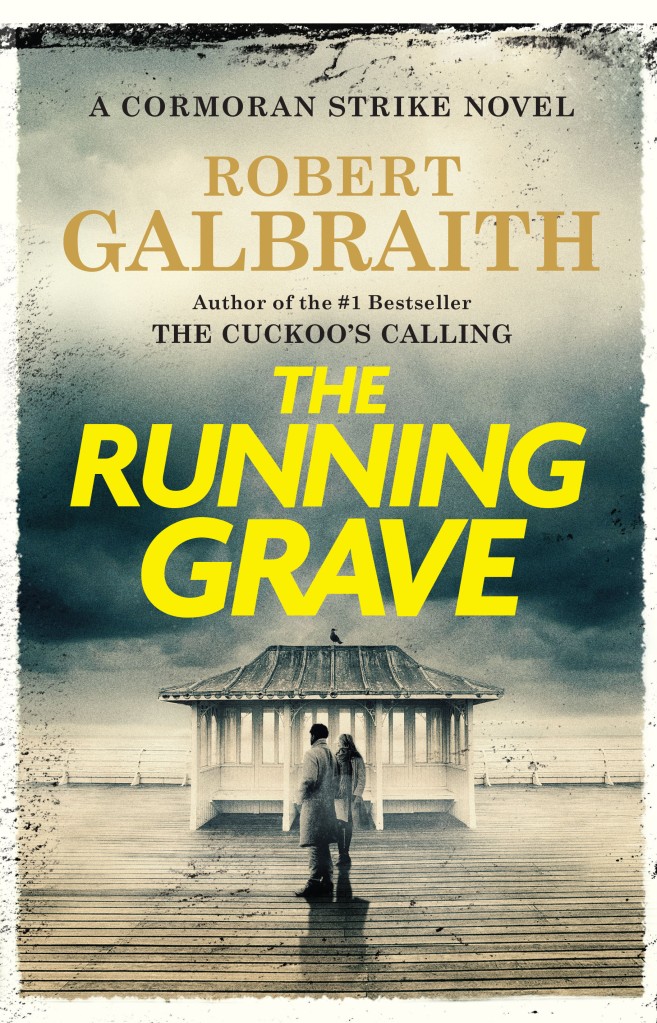
Rowling was so clever in the staging and pacing of this story: Cormoran and Robin are hired by a frantic father to try to extricate his son, Will, from the Universal Humanitarian Church, on the surface a seemingly innocuous organization focused on a general sense of spirituality in service of creating a better world. But after hearing the father’s concerns about how they have prevented all contact between his son and anyone outside the bounds of the cult and then reading up on such rumors as unexplained deaths, compulsory sex, and severe punishments for the slightest infractions, Robin decides to infiltrate the cult. Strike is reluctant to let her be the one, but he is too well known himself to be able to create and maintain an alias, so Robin attends a public meeting of the church designed to recruit new members, and allows herself to be absorbed into their midst and transported to their “farm” in Norfolk for an undetermined length of time, her goal being to contact Will Edensor and see if he is amenable to leaving with her.
This is the genius of the book, creating the world of the cult members living at the farm for Robin to inhabit while keeping Cormoran outside following up on all their other cases, essentially unaware of what’s happening with Robin. They have a tenuous connection: She sneaks out of her dormitory every Thursday night and leaves him a note detailing her week’s experience, putting it in a hollow plastic rock situated in a blind spot near the fence to the outside world; but this weekly check-in is her only fall-back position to get out of what is turning into a seriously sticky situation. Being Robin, she is determined to stay until she achieves results, no matter how precarious things become; and being Cormoran, he is constantly worrying whether he needs to storm the front gate and pull her out of there for her own good. The back-and-forth detailing of the mundane running of the agency (and some rather amusing case work for Cormoran and the gang) with the surreal situation at the farm kept me turning pages every night long after I should have turned out my light and sought sleep.
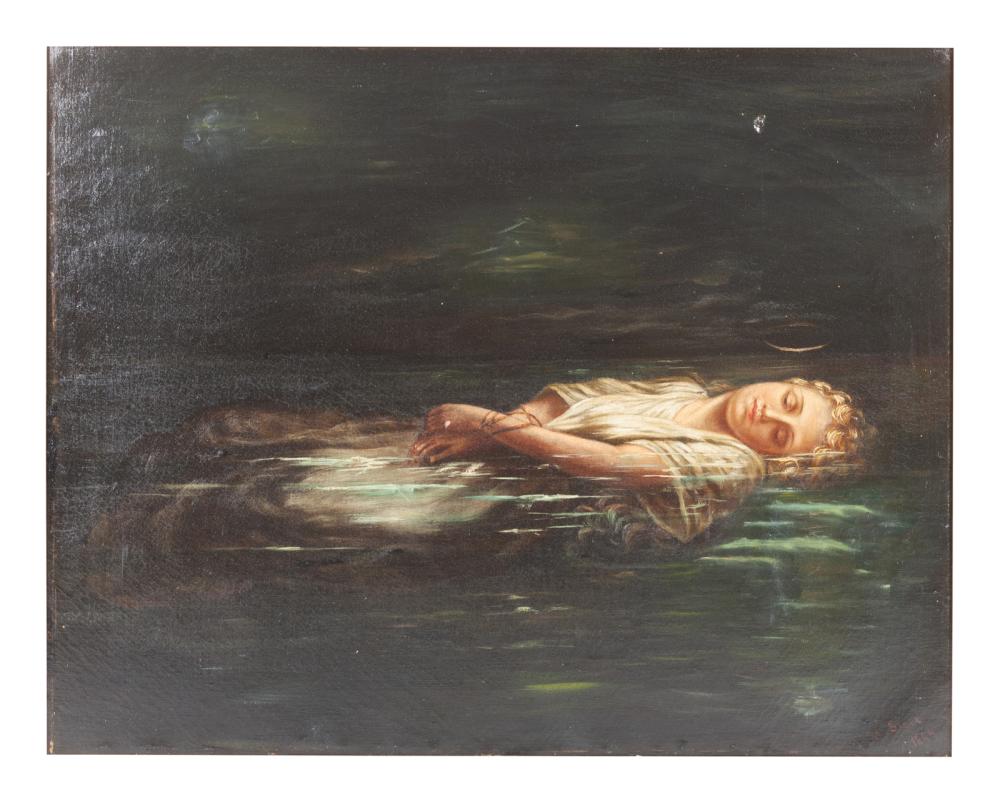
(female saint in water, painter unknown, 1894)
There is also, of course, the ongoing situation between these two business partners who treat each other like best friends while dating other people because they’re afraid of ruining what they have professionally and are also both a bit cowardly about stating their feelings in the absence of certain knowledge about the reaction that revelation would receive. Robin is currently seeing Detective Inspector Ryan Murphy, while Cormoran uses typical bad judgment in his effort to find sex with no ties by getting involved with someone wholly inappropriate and potentially damaging to his (and the agency’s) reputation. But the longer Robin is sequestered in the cult, the more clear Cormoran becomes about what he really wants, and although nothing definitive happens in the relationship arena for most of the book, it’s not the frustrating experience we have endured for far too long, because we can feel something coming, and the cliff-hanger at the end of this one doesn’t disappoint.
What I am telling you is, if your loyalty has floundered in the face of weird plots on the mystery side and stalled emotions in the romantic sub-plot, I think based on this book that Rowling has hit the tipping point and things are going to get increasingly interesting in future tomes. Read The Running Grave and see if you agree!

Harry Bosch is 70
Speaking of a Golden Bachelor…it had to come sometime. Has there ever been another police officer who has joined and left the LAPD and joined up again so many times? and had a career that spanned three or four departments and several separate locations and even a different police department or two? Not to mention a brief foray as a private eye. Yep, Harry’s getting up there, and I don’t want to say that Connelly is phasing him out just yet, but the fact that he has, in each of the past five books, shared star billing with Renée Ballard says “transition” to me. Seventy isn’t so old these days, but after being exposed to cesium during a previous case, Harry’s mortality is apparently something to contemplate more immediately.
I’m not real happy about that; although I liked Renee well enough in her debut novel, when she appeared to be an outsider to rival Bosch—sleeping in a tent on the beach with her dog, and dividing her time between the police force and surfing—I have mainly read the Renée Ballard books because she always appears in conjunction with Harry, and when he’s no longer with us, I’m not sure she has the moxie to carry a series alone. While I would definitely call the Bosch books police procedurals, the focus has always been squarely on Harry, and his personality defines and permeates every story; but Renée doesn’t have the same spark, and I fear that once Bosch is no longer even an outlier, I won’t find enough pizzazz left to keep reading.

I read the latest Harry/Renée book, and then realized that I had missed the one just before that, so I went back and read that one. In The Dark Hours, Renée is still working “the late show” (the overnight shift) without a partner, but when she gets in too deep or needs some backup, she doesn’t call on a fellow officer, most of whom seem to be phoning it in since the twin discouragements of the “defund the police” movement and the Covid epidemic, but rather on the retired Harry Bosch, at home and at loose ends. This could ultimately get her in a lot of trouble with the department, but she’s a risk-taker and knows what she needs to get a solve on her cases; what she needs is Bosch. In this book the two have an almost instinctual camaraderie that is fun to watch.

There’s a big contrast between that book and the next one, Desert Star. In this latest Bosch/Ballard pair-up, Ballard has become almost unrecognizable as the junior-grade maverick following in her mentor’s footsteps. Towards the end of The Dark Hours, a disgraced Ballard had quit the force and was considering teaming with Bosch in a private detective firm, but at the beginning of this one she is back in the LAPD, and has been made head of her own department, examining cold/unsolved cases for the Robbery/Homicide division, and reopening ones that are viable for moving ahead, due to DNA evidence or other new information. This promotion seems to have turned her into a cautious, uptight, stuffy version of herself, and it takes practically the whole book for her to unwind back into the Ballard we’ve met before.
The inclusion of Harry is made legitimate this time, since Ballard is empowered to recruit him as a volunteer and he is more than willing to fill his time focusing on a multiple murder he was never able to solve. He’s supposed to be working on a case that is important to the city councilman sponsoring the new unit, but as usual Harry prioritizes what he believes to be more essential, and in so doing gets both himself and Ballard in hot water more than once. Most of it is believable, but when he takes off for Florida without telling either Ballard or his daughter that he’s going, it was one step too far into uncharacteristic behavior for me. I ultimately enjoyed most of this book, but it certainly didn’t make me warm up to Ballard or cease to dread the retirement of one of the best detectives any mystery novelist ever created.
Literature as solace

I’m not sure what to say about Good Night, Mr. Wodehouse, by Faith Sullivan. I was intrigued by the title, since I love what I have read by Wodehouse, notably the Bertie Wooster and Jeeves pairing. This book made me want to seek out his other books to see what I’ve been missing…but it didn’t particularly make me want to seek out others of this author’s. I did enjoy the book, but it’s what I would call a quiet read, almost too quiet for my taste.
It’s an old-fashioned story, told in a rather demure style (I wasn’t sure, initially, that this was a modern novel) about a woman who lives in a small town called Harvester, Minnesota, at the turn of the 20th century. The action begins around 1900 and finishes up when Nell Stillman is in her 80s, so the story encompasses many of the big changes of that century, including technological innovations (indoor plumbing, the telephone, airplanes) and two world wars, but all seen from the vewpoint of a 3rd-grade schoolteacher in a semi-rural, insular setting.
There isn’t much of a story arc; it’s more an accounting of one woman’s life as she moves through both historical and personal events. Hers has its share of tragedy and not a huge amount of joy; she is widowed young, loses her child’s sanity to the after-effects of war, and is plagued by the small-minded gossips and nay-sayers who surround her. But her growing love of all kinds of literature sustains her through many of her trials, particularly the writings of P. G. Wodehouse, with whom she has a personal relationship in her active imagination.
Life could toss your sanity about like a glass ball; books were a cushion. How on earth did non-readers cope when they had nowhere to turn? How lonely such a non-reading world must be.”
Nell Stillman, reader
The story has the feel, although not quite the literary quality, of the books of Kaye Gibbons; I haven’t read those for many years, but Gibbons’ book Charms for the Easy Life kept coming to mind for some reason while I was reading this—another small-town saga of generational and community ties featuring eccentric characters.
There were aspects that I found disappointing: A truly major character in the first half of the book (and my personal favorite) leaves the town in disgrace and the author simply drops her character except for a few sparse references towards the end. Similarly, when Nell is elderly she takes three young girls under her wing; they feature briefly but vividly, and then nothing more is heard about them. These weren’t major flaws, but they did cause my enjoyment of the book to be considerably less than if their arcs had been followed through.
I found Good Night, Mr. Wodehouse to be a pleasant read, but it left me with no desire to find out more about either the main character herself or the town of Harvester, which is apparently featured in others of Ms. Sullivan’s works. I did, however, identify closely with all her sentiments about the blessings being a reader brings to one’s life, so I do plan to find and peruse a copy of Love Among the Chickens!
A deep dive into fantasy
While I was a teen librarian I had the pleasure of discovering the book Graceling, by Kristin Cashore. It’s one of those fantasy books that was (perhaps) written with teens in mind but which appeals more widely to fantasy readers in general, and I recommended it, during my tenure, to as many adults as I did to teens.
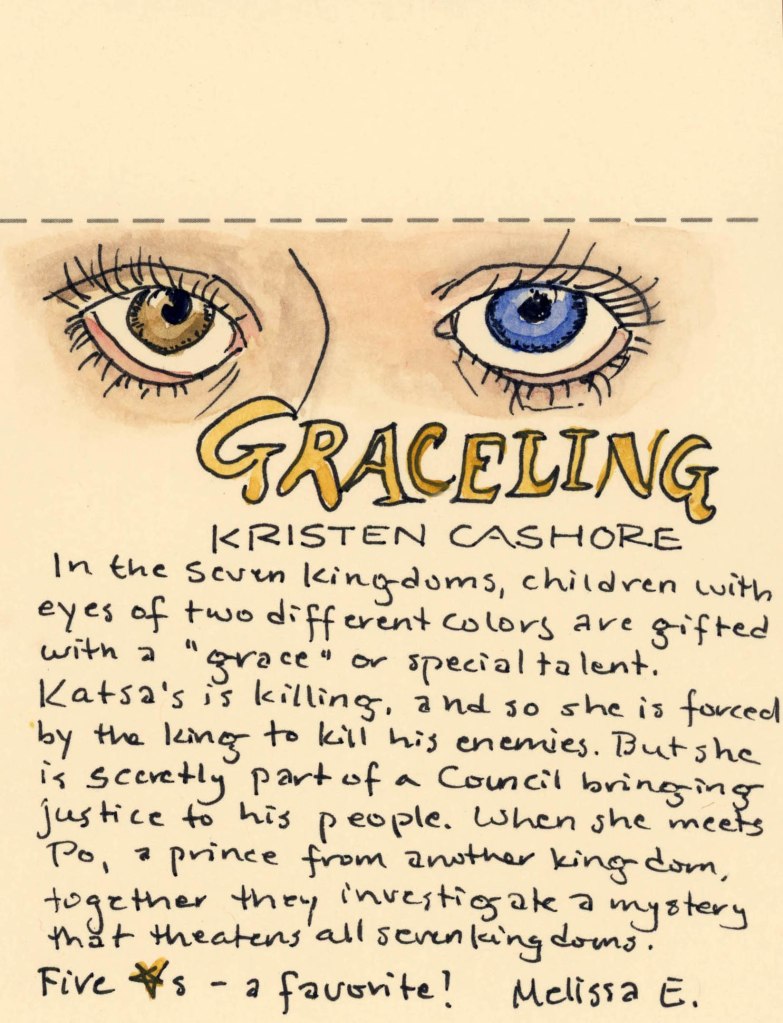
A “shelf-talker” I made
Since I read it with two of my book clubs, I ended up reading the book three times, and it held up well. I was excited to read the sequel, Fire, but although I did enjoy it, it was a companion novel rather than a continuation of the story of Katsa, Po, and Bitterblue, and I was disappointed not to find out what happened to them after the conclusion of Graceling.
When Bitterblue came out, I thought, Finally! but I think I was not in the right place to enjoy Cashore’s envisioning of the continuation of King Leck’s kingdom, and I actually put the book down without finishing it, feeling disappointed in its air of quiet misery, disillusionment, and bewilderment.
I had always meant to reread it, but had no pressing reason why until I recently noticed that there were not one but two “new” sequels to the story, all still incorporating the original characters to an extent but also expanding beyond them to open up the world of the Seven Kingdoms and venture into the lands beyond. So a few weeks ago, I resolved to reread Bitterblue, no matter how lackluster I might find it, in preparation for Winterkeep and Seasparrow.
I was delighted to find that the story engrossed me, that I was able to feel the mood Cashore had wanted to convey as one appropriate to the history that came before it, and that it was no longer a letdown.
Some background: Graceling
The main character in Graceling is Katsa, an orphan who lives at the court of her uncle, a ruler of one of the Seven Kingdoms. Katsa was born with eyes that are two different colors; people who are born with this “tell” are gifted with a “grace,” a special skill or talent. It can be something silly, like the ability to open your mouth wide enough to swallow your face; something practical, such as skill with baking; or something serious, in Katsa’s case a grace for killing. In her uncle’s kingdom, it is mandatory that all children born with a grace be surrendered to the king, who makes use of their graces for his own benefit. Katsa, who killed her first man at age eight when he made inappropriate advances, is acting against her will as her uncle’s enforcer.
To counteract this, she has banded together with several likeminded people of the court (including the king’s son, her cousin Raffin) to form a secret society to help people solve big problems. While working one of these missions, Katsa meets Prince Po, who has snuck into the kingdom to rescue his kidnapped grandfather, and the two team up and plan a journey that is partially to return the old man home and partially to seek out a wrongness in a neighboring kingdom that is causing trouble to seep over the borders in every direction. Thus begins the story that brings Katsa and Po to the attention of a terrible power from which they must save the young heir to that kingdom, 10-year-old Bitterblue.
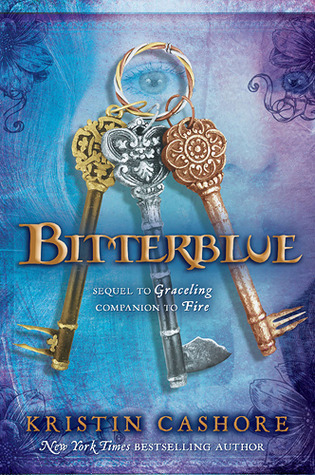
The book Bitterblue takes up eight years after the conclusion of Graceling. Bitterblue is now the young queen of Monsea, and is struggling, with the help of a bunch of stodgy advisors, to salvage her kingdom from the disaster of the past 35 years when her psychopath father, Leck, terrorized everyone under his rule. The kingdom has supposedly moved on from this dark time in its history, but Bitterblue is uneasy at the anomalies and discrepancies she discovers between the rosy picture her advisors paint for her and the truth she sees once she begins sneaking out beyond the walls of her castle and into the surrounding communities, seeking for answers.
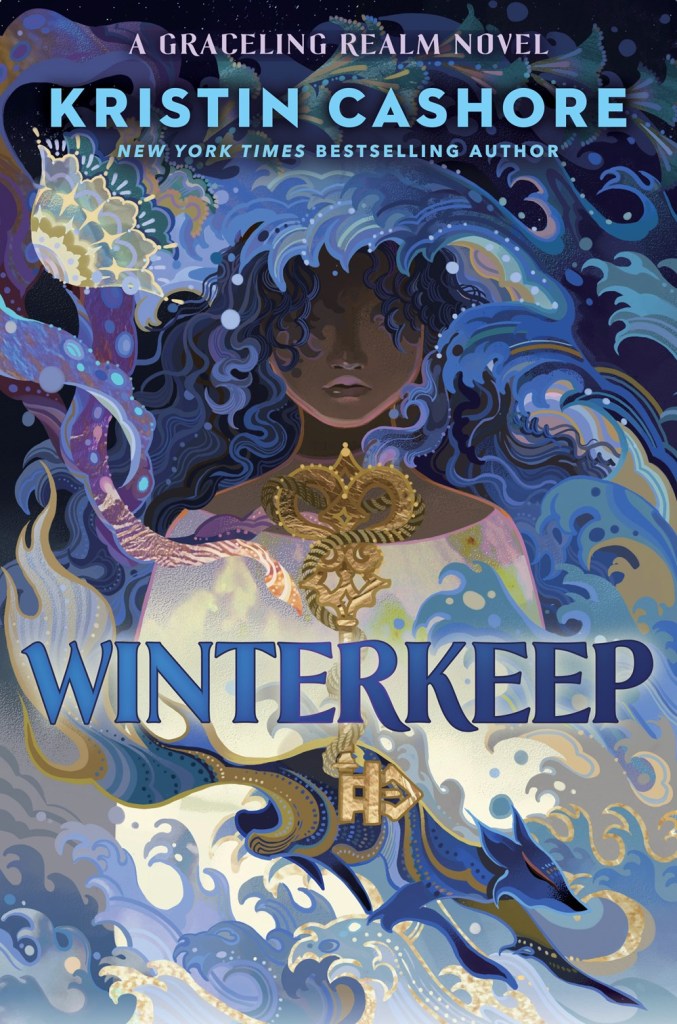
Bitterblue is an intensely in-turned story, focusing primarily on Bitterblue herself as a ruler and on the well-being of her kingdom. But with Winterkeep, the story goes out into the world, and introspection and the minute solving of vague puzzles is replaced with new terrain, new characters, and a lot of action. Torla, a land new to the Seven Kingdoms, has been discovered, a democratic republic with two political parties—Scholars and Industrialists—and some fascinating technologies (dirigibles, for one). Bitterblue sends envoys to Winterkeep, but when she discovers they have drowned under suspicious circumstances, she decides, along with her friend Giddon and her half-sister, Hava, to travel there to discover what Torla is trying to cover up. A key player in the story is Lovisa, daughter to the two ranking heads of the opposing parties, whose position places her in a unique situation when it comes to solving secrets and helping Bitterblue and her friends.
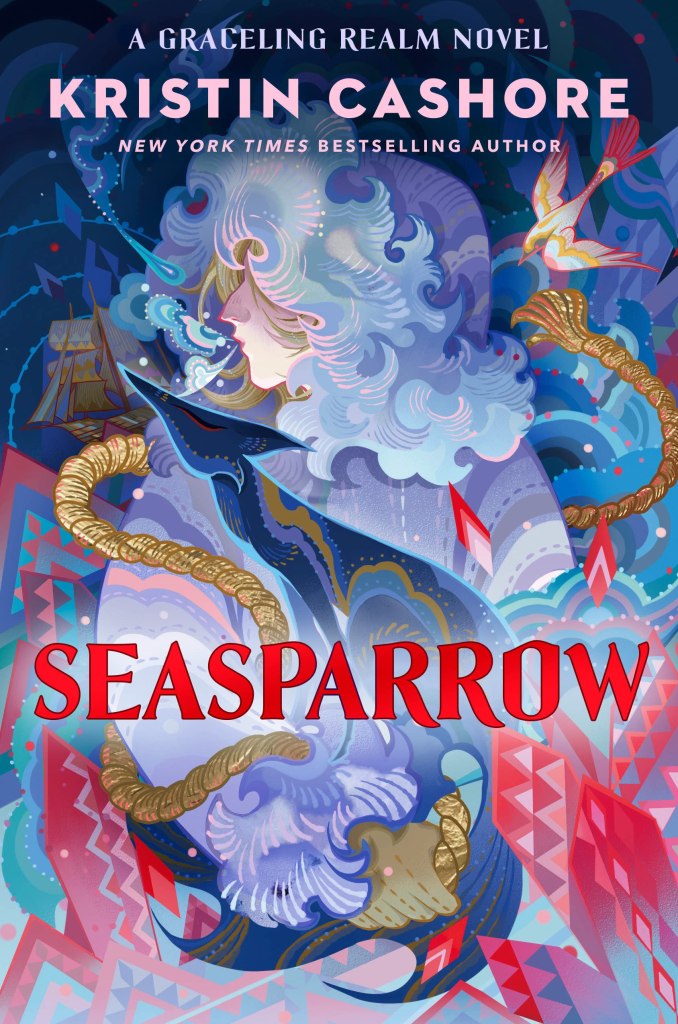
Seasparrow takes place in the immediate aftermath of the events of Winterkeep, and is narrated by Hava, Bitterblue’s half sister, the secret and forgotten daughter of King Leck and the sculptor Bellamew. Bitterblue, Giddon, and Hava and their three advisors are on a ship bound for home, but a shipwreck in the frozen North puts all their bodies and spirits to the test. It especially becomes a personal journey for Hava, who needs to heal her childhood trauma while coming to terms with her own identity in the middle of political upheaval and a tangible threat from a frightening new technology. Although the latter is a big plot point, this book is primarily character-driven, and encompasses the healing of many different kinds of relationships, for Hava and others. I think this book, of the five, is my favorite next to the original Graceling, because of its depth of character and the nicely balanced introspection and adventure.
I’m glad I finally embarked on this continued journey through the Seven Kingdoms and beyond, and would recommend this series to anyone who likes an engaging, thoughtful, somewhat philosophical story that also happens to be set in a world where there are telepathic blue foxes!

Travel fiction
A “beach read” is defined as “a book, usually fiction, that one might enjoy during a vacation or a day at the beach because it is engaging, entertaining, and easy to read.” And without doubt a subgenre of the beach read is the vacation saga, the “let’s run away from our lives for a while and see what happens” theme, or what I like to call the sub-subgenre “travel fiction.”
The question you have to answer, with this subgenre, is how much bad writing you are willing to endure in order to have the escapist experience because, let’s face it, books that carry their British or American or Irish protagonists away from their various unfortunate events (break-up, lost job, eviction) and their inhospitable environments (damp, gloomy weather, or a small town where they can’t avoid their ex-whatever) are turned out without a lot of editing by a bunch of publishers on a quest to score the next Emily Henry or Elin Hilderbrand or Jenny Colgan novel.
Even with the bad writing contained by those novels not written by the top 10 authors in this field, it’s hard to stay immune to their charms. All of us have a fantasy of what we would do should we decide to abruptly leave our mundane lives behind and simply refuse to come home when our dream vacation is supposed to end.
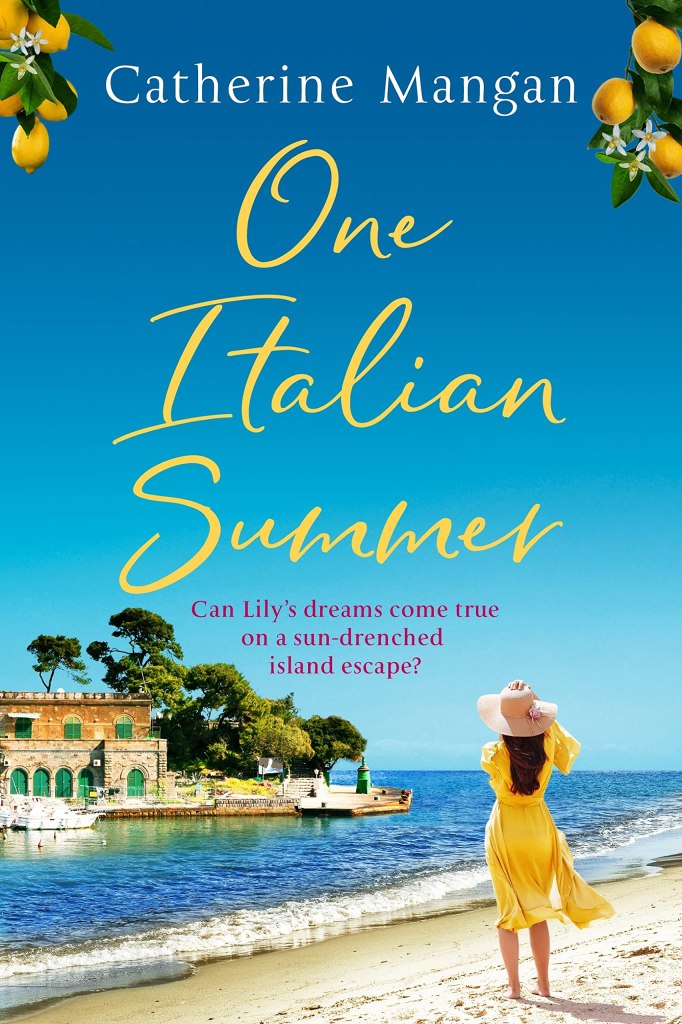
I recently read two such novels, and have to say that I extended my tolerance for bad writing almost to the breaking point in order to go with the transporting experience of escaping to an unfamiliar and potentially beguiling part of Italy. The two books were One Italian Summer, and The Italian Escape, both by Catherine Mangan, and the constant balancing act was the repetitive language and clichéd sentiments expressed by and about the characters on the one hand, versus the heft of lyrical descriptions of the balmy atmosphere, delectable food, and romantic prospects.
I have never understood why writers make such heavy work of finding original language with which to tell their story—it’s sloppy. I, myself, when writing a book review, an essay, or a paper, simply read each sentence and paragraph aloud to discover if I have used the same word twice (or three times or half a dozen) within the given piece of writing, and then I go back and find another word or another way to express the sentiment, using a thesaurus to good purpose to give my writing the variation necessary to make it feel fresh. Furthermore, if the writer isn’t up to this task, the editor needs must.

I therefore laughed out loud, after reading the painfully repetitive prose of the first chapters of One Italian Summer, when I came to an exchange on pages 70-71. The main character, Lily, having escaped from a break-up in New York City to be maid of honor at a “destination” wedding, is breakfasting alone early on her first day at an Italian resort on the island of Ischia. At a nearby table is an American named Matt, who murmurs “Cranky person. Ten letters.” She asks if he is talking to her, and he replies that he’s two clues away from finishing the New York Times crossword puzzle. She supplies the word “Curmudgeon,” and he expresses doubt that that’s even a real word.
“It’s my job to know words,” she replied matter-of-factly.
“You’re a writer?”
“No, but I write for a living.”
“Okay, is that supposed to be cryptic? How can you write for a living but not be a writer?”
“I’m a copywriter. I write for a living, but it’s just blurb for adverts and products, so I honestly can’t call myself a writer, not in the true sense of the word.”
Then she goes on to provide his final word, which is “capricious.”
“You’re like some sort of crossword Olympic champion!”
“I just need to know a lot of words in my line of work because you can’t keep saying the same thing over and over.”
Lily, p. 71
I laughed because this came after pages of heavy-handed, somewhat pedantic scene-setting narrative and excessive use of the words “so,” “like,” and “really,” not to mention describing someone as a “hot sweaty mess,” then a “shiny mess,” then a “pathetic mess,” in the space of six consecutive paragraphs.
If you can get past such pet peeves, the basic story lines of both of these books are sufficiently escapist to entertain anyone seeking a light read about a fantasy trip; in addition, the location of said trips, slightly off the beaten path of the usual retreats (Ischia rather than Capri; and Liguria, rather than Milan), make for some entertaining speculation about exploring them for yourself someday.
Both books include a little romance for their protagonists, but that is refreshingly not the main theme; rather, it’s the discovery of unexpected depths that lead to life changes. The first book details a week-long itinerary surrounding a lesbian wedding celebration, all of it fraught with way too many drunken evenings described in excruciating detail, while the second is the transformation of a Dublin girl who’s been dating her boss at a business with which she has little affinity who decides, after she’s dumped, that a big change is in order, and refuses to go home when her week in paradise is up. There’s a bit too much interference of a deus ex machina in the form of a wealthy, powerful, and indulgent older woman who takes a liking to protagonist Niamh and smooths her way to a ridiculous degree for a chance-met stranger, but hey, who doesn’t dream of a fairy godmother and wish to immerse themselves in this kind of fantasy?
Bottom line: Not too demanding, pleasantly diverting and, if you’re a foodie, way too provocative!
How it is
Laurie Frankel’s book is called This Is How It Always Is, I believe with the direct message (and hope) that someday it will not be this way. I am happy to say that I picked up this book without knowing anything about it, and therefore got to have the “clean,” straightforward experience of reading it without expectations. If you are contemplating reading it and okay with having its contents be a surprise, perhaps you should stop reading my review right here and go put your energy into the book instead.
If you do have some idea of what it’s about and want more perspective, or a simple reassurance that it will give you a distinctive understanding of the issue, then read on.
A few reviewers on Goodreads called this book sentimental (one even said “cloying”), but I didn’t find it so in the least. I thought it was a lovely, honest, positive depiction of the foibles of one large, eclectic family when confronted with the difficulties of navigating life in our culture.
Rosie and Penn already have a set-up that is not the norm in America: Rosie is an emergency room doctor, while Penn is a stay-at-home father working on a novel and caring for their large family—four boys, when the story opens. After having two in a row followed by twins, Rosie is longing for a girl (and fairly convinced she will finally have one), but Claude comes along and they are happy with their new baby, boy or not. But at an early age, Claude begins the show-and-tell process of becoming someone whose name for the next eight years will be Poppy.
After the initial surprise that when he grows up he wants to be a girl, Rosie and Penn step up for Claude. He is allowed to wear what he wants, play how he wants, and call himself the name with which he feels most comfortable, making an almost seamless transition at home between pronouns and names, from Claude to Poppy, son to daughter. But the transition for his brothers, his school, and the people in their orbit is not so seamless. After several parent-teacher and parent-administration discussions at school, the absurdity of the rules for a transgender child make themselves apparent: Wisconsin schools have accommodations for a trans student, but still somehow manage to insist that the gender binary be enforced. This is best illustrated in quotes from his teacher, Miss Appleton:
“Little boys do not wear dresses.
Little girls wear dresses. If you are a
little boy, you can’t wear a dress. If you are a little girl, you have to use the nurse’s bathroom.
***
“Meaning if he is a girl, he has gender dysphoria, and we will accommodate that. If he just wants to wear a dress, he is being disruptive and must wear
normal clothes.”
Meaning, in other words, that trans students must still check one box or the other, and adopt all the expected characteristics of the “selected” role of “male” or “female,” thus invalidating any character trait that might not conform to our static and polarized cultural gender norms. (Please note that I put the word “selected” in quotes on purpose.) One character comments,
“This is a medical issue, but mostly
it’s a cultural issue. It’s a social issue and an emotional issue and a family dynamic issue and a community issue.
Maybe we need to medically intervene so Poppy doesn’t grow a beard.
Or maybe the world needs to learn to love a person with a beard who goes by ‘she’ and wears a skirt.”
When Wisconsin proves to be hostile in several ways to the child Poppy is becoming, Rosie and Penn decide it’s time to go somewhere their child can find a greater degree of acceptance, and they move the entire family to Seattle, shaking up all their children’s lives in order to accommodate the needs of the youngest. For the eldest, Roo, this means leaving behind all those things that are precious to a high school teenager who has lived his entire life in one place with one group of friends. It has similar, though lesser, effects on the other three boys, who are divided between accepting the necessity of providing safety for Poppy while also believing it won’t make much difference. In this, they are perhaps more realistic than their parents. On the first day in their new house, Rosie and Penn reveal Poppy’s “secret” to their next-door neighbors (intending to be similarly honest with everyone in their new city), but the neighbors encourage them to allow Poppy to be a girl without revealing her past as a boy to anyone. This is how the entire family’s never intentional life of deception begins, and continues until Poppy is on the verge of puberty and the whole thing blows up in their faces.
I won’t say much more about the story, because I have already outlined the first half pretty thoroughly, and would like you to have a reading experience unfettered by expectations for the remainder of the book. I will say that I appreciated the author bringing in the situations of transgender individuals in more fluid societies, which is why I feature this painting at the end. If you read the book, which I hope you will do, you will understand its significance and inclusion.

Immersive

I just finished a re-read (for the third—or fourth?—go-round) of Rosamund Pilcher’s book, Coming Home, which has to be one of my favorite books, as much as I try not to name favorites (because it always provokes a way-too-long list in my head and ends up getting re-ordered during hours of insomnia). Pilcher is sometimes under-rated because of a handful of (short) books she wrote that are obviously formula-driven romance novels, and people expect all her writing to be the same, when, in fact, it’s almost as if (except for the Cornwall setting, which remains pretty constant) there are two writers, with the second waiting to emerge when all the formula stuff was out of her system.
Her most famous books are The Shell Seekers and Winter Solstice, and I love (and re-read) those as well, but for me, Coming Home is the definitive book of her career. It’s a coming-of-age story set within the framework of World War II, beginning in the pre-war years and ending after the war is over. It follows the life of Judith Dunbar, whose father works for a company in Ceylon; Judith spent her first 10 years there, but when her younger sister, Jess, came along, her mother brought the two girls back to England, to Cornwall, leaving her father to a bachelor existence. (This was a common living situation in a time when it was considered dangerous to try to raise Caucasian children in that hot climate.) Now Jess is four years old and Judith is 14; in 1935, their father receives a promotion to a position at the company’s offices in Singapore and wants his wife with him, so Mrs. Dunbar and Jess are traveling back out to the East, while Judith will stay in Cornwall, attending a boarding school in Penzance and holidaying with either her father’s or her mother’s sister, both of whom live fairly close by.
Judith’s existence is transformed by her friendship with a week-to-week boarder at the school, Loveday Carey-Lewis, who returns home each weekend and invites Judith to accompany her. These British aristocrats have an extensive estate called Nancherrow, out at Land’s End, with luxuries about which Judith has never dreamed—a butler, a cook, a nanny, stables, their own cove and beach—and soon Judith is welcomed as one of the extended family by Loveday’s glamorous mother, Diana. But the war imposes hardships on everyone, lower class to royalty, and Judith has her share of life changes that determine her responses to both love and tragedy as the years pass.
It doesn’t sound like such an exciting story, detailed here, but there is something so poignant and so immersive about the stages of Judith’s somewhat lonely teenage and young adult years, especially set against the magical backdrop of Cornwall (and her adoptive family) and dealing with the sobering consequences of living in a country at war. The joys, the sorrows, the suspense about which way the story will go next always hold me enthralled from beginning to end.

I also confess that the artistic aspect Cornwall represents, with its Newlyn School of painters (that are also detailed in Pilcher’s The Shell Seekers), is an additional draw for me. Pilcher’s books, along with Daphne du Maurier’s, are the reason I spent 10 days in Cornwall in April of 2002; my cousin Kirsten and I rented Whitstone Cottage from the National Trust, formerly inhabited by the blacksmith for the Penrose estate between Helston and Porthleven. After reading about it for all those years, it was like coming home for me!
If you’re in the mood for an intimately personal tale with an historical backdrop and multiple settings that portray various ways of life during that time, be sure to check out this book. If you’d like to read an amusing anecdote about our stay in Cornwall, go here.
Resolution

I just finished reading the last two books in Elly Griffiths’s Ruth Galloway mystery series: The Locked Room, and The Last Remains. For those who aren’t familiar, Ruth is (now) a 40-something archaeologist/professor at the University of North Norfolk, and lives in a cottage overlooking the Fens (marshlands) and the ocean. Norfolk was settled in pre-Roman times and then taken over by the Romans; during the Middle Ages it was a center for the wool trade, resulting in the building of many churches. Since it has remained a largely rural county, this makes the area a rich archaeological source of artifacts and, as Ruth discovers in her role as a forensic consultant to the police, bodies both ancient and modern.
I don’t want to get too spoiler-y in this post, but the arc of the books is partly professional and partly personal, and it is the personal for which all we fans and readers have been waiting resolution for many years and volumes. In her role as a consultant, Ruth is thrown into the company of Detective Chief Inspector (DCI) Harry Nelson, a married man with a couple of children, and an impulsive one-night stand results in a pregnancy for Ruth. She doesn’t ask for anything to change, knowing how deeply dug into married life is Nelson, and although she has doubts about her own abilities to raise a child effectively by herself, her love for her daughter, Kate, conquers all.
Kate is born at the end of book #2, and there are 13 books that follow after. In each one, the discovery of a body or bodies draws Ruth into the subsequent police investigations, regularly renewing questions about her relationship to Nelson. There are at least two books that constitute partial departures from proximity: In one, Ruth and Kate travel to Italy without Nelson, while in another they actually move away from Norfolk to Cambridge and in with a “boyfriend” of Ruth’s for a period of time. But if you are a long-term reader of this blog, you will perhaps remember how many times I have complained about the on-again, off-again nature of their interactions, the glacial slowness with which things have moved, and the constant wondering: Will they ever get together? Will Nelson get up the courage to leave his wife for Ruth? Will Ruth ever let her growing exasperation prompt her to kick Nelson to the curb for good? This speculation has overshadowed the mysteries in more than one book in this series and has caused me to swear off reading them on several occasions, but there’s something appealing about the awkward archaeologist that I have found hard to resist, and I have always come back to get caught up.
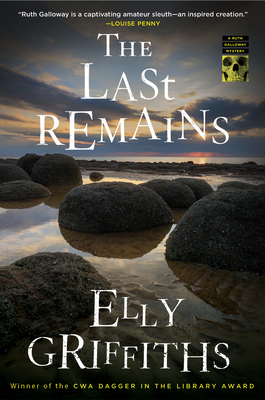
At last, however, that is at an end: Book #15 is the last in the series, and finally we have resolution to the decade-long question: Will they or won’t they? But first we have to participate in the perpetual angst throughout Book #14 and part of the last.
I’m not going to reveal anything else here, so let’s take a look at the mysteries detailed in these two books. As I have commented before, the books have seemed to alternate, throughout the series, between one that is compelling and one that phones it in, to the point where there were at least two books I recommended that readers skip, going instead to a synopsis to find out the details about the personal relationships while avoiding the somewhat boring plots. That has held true to the end; The Locked Room‘s mystery is both confusing and slight, while The Last Remains has a tight, interesting story line that includes several characters both new and old and nicely ties up some dangling questions by taking us back to the very first mystery on which Ruth and Nelson collaborated. The one thing that does distinguish The Locked Room is that Griffiths set it during the recent pandemic and imbued her story with all the inconveniences and tragedies we experienced during that time period, which was both refreshingly real and disturbingly uncomfortable, a reminder of all that we did and didn’t do and all that we lost.
I still struggle a bit with the idea that Ruth and Harry have taken 15 years to confront their feelings, but I congratulate Elly Griffiths on a largely successful and mostly involving mystery series. I hope with her Harbinder Kaur books that she draws us into many more murderous adventures.

 The Book Adept