The test of a good book

When I first read The Gravity of Birds, by Tracy Guzeman, in 2013, I said, “This is one of those books that I wanted to turn around and read again as soon as I finished it.” After having read it for the second time 10 years later, I experienced the exact same impulse as soon as I turned the last page.
There can be a few reasons for doing that:
1. You liked it so much that you don’t want to be done;
2. It was so complex that when you got to the end you said, Hey, wait a minute…and went back to see if you completely understood how to get to where you “got”;
3. You wanted to wallow more in the writing or the characters or the imagery or the story.
Parts of all three of those play into my desire to start over. Paradoxically, this is a fairly simple story, and simply written, yet the complexity of human emotions and betrayals involved made it intricate and nuanced, as does the language.
A reclusive artist who quit painting 20 years ago summons an art authenticator and an art historian who has documented the artist’s career to reveal to them that there is a painting of his that no one has ever seen. It is a triptych that includes a self portrait of the artist, Thomas Bayber, with two young girls. Bayber has the main central panel, but the two side panels are missing; he wishes to sell the work, but will only do so if it is complete, and he tasks the two men with locating the other panels. The pair set out on this quest, but the historian, intimately familiar with Bayber’s foibles, soon realizes it’s not just about the paintings but about the subjects contained within them; Bayber wishes to track down the “girls,” now in their 60s.
Natalie and Alice Kessler (19 and 14, respectively) are sisters, spending a month with their parents at a cottage by a lake, next door to the precociously talented painter, Thomas Bayber (28). The family befriends the young man, but there is a special bond between him and the young Alice, who is just beginning a lifelong challenge from rheumatoid arthritis. Their friendship is resurrected eight years later when Alice is on the cusp of some life decisions and goes back to the cottage for a contemplative weekend, unexpectedly encountering Thomas, who is on the outs with his family and staying next door again. Their relationship shifts to something more intimate until Alice figures out something from the past that causes a permanent rift, and there is no contact between them for 30-odd years. Meanwhile, Natalie keeps her thoughts to herself…
The characters are complex and three-dimensional, especially the sisters. But there is a lot of set-up and it took a long time to appreciate their subtleties, so once I did, I wanted to spend more time understanding them than the author had given me.
The imagery is powerful and descriptive—I so wanted the artists in this book to be real, so that I could look them up on the internet and see their paintings and sculptures. I could almost picture them, but I wanted to see them “IRL,” as they say.
The story took place on a triple timeline in multiple locales, so I felt the need to go back and check exactly when certain things happened and who knew what at the time they did.
It was a compelling first novel, but although Guzeman mentions in her afterword that she is working on another, none has been forthcoming. It would be a shame if this author never wrote anything else; but this book is a solid accomplishment that can stand as a testament to her talent. An evocative book that will stick with you.
Quiet transformation
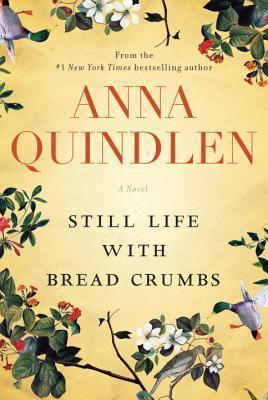
Still Life with Bread Crumbs, by Anna Quindlen, is a book that doesn’t have an initially heavy impact, but it sticks with you. It’s about a woman in a situation to which many of us in our 60s can relate: We were “somebody” once (or if we weren’t exactly prominent, we were at least identified as a certain kind of person who does a specific kind of thing, whose identity is wrapped up with that activity), and now we’re beginning a downsizing of that role; and this narrowing could be an end, or it could be an avenue for change, depending on how we react to it, how we see it through, what we are willing to allow.
Rebecca Winter was a famous photographer who produced iconic images relating to womanhood and motherhood—views of common items that grew in importance to express a certain kind of lifestyle or mindset in those who viewed them. Once, she was revered, sought out, exhibited, solicited for new works, invited to lecture, sometimes even recognized on the street. But now her sales are dropping off while her responsibilities (and bills) are growing, so she has chosen to solve the problem of her scant bank balance by renting out her costly Manhattan apartment and moving to a cheap rental in a small town in the middle of nowhere in particular. This will allow her to pay for her parents’ old age care until she can figure out what her next step should be.
It’s initially difficult for her to adapt to the dramatic change in circumstances, and she finds herself unprepared for the solitude, the immersion in nature, the lack of stimulation formerly provided her by big-city living, the inability to solve her problems by throwing money at them. But gradually she sinks into her place in this small community, finds regular routines, changes her expectations about what constitutes a success, and begins to tentatively create something different for herself. And these shifts in perspective also allow her to look at herself, her work, and her relationships in a way that finally breaks down the wall she has built between the idealized world of a woman behind a camera and the everyday experience of someone with nothing between herself and reality. It is a kind of coming-of-age story, but at the end, rather than at the beginning, of the spectrum.
Some reviewers really pick this book apart, belittling the transformative experience of the main character and calling it overly sentimental or even trite. Some also focus heavily on the May-December (well, perhaps July-December) romance, which to me was only one small element in the bigger picture being presented, not nearly as important as all the rest of it. Perhaps I am just a naive reader, or easily satisfied, but I would call this book a sort of “comfort food” read on the surface, but with strong underlying themes that give it a universal affect. I enjoyed both the superficial story and the deeper ruminations. I liked the storytelling, and tapped into the emotion, and I liked Rebecca’s authenticity and transparency, as well as the humorous side stories and anecdotes that keep the narrative lively and unexpected. It may not be to everyone’s taste, but for me, where I find myself in life, it was just the thing.
What I wished for
The Unmaking of June Farrow, by Adrienne Young, is the book I have been wishing to read. It’s both an elegantly written and a beautifully told story that incorporates a curse, a murder, something sort of like time travel but not exactly, and an emotionally complex web of relationships that are a pleasure to try to untangle. If I had to label it, I guess I would call it magical realism.

June Farrow was born into a family in which the women are believed to be cursed, and June intends to be the last member of this family in order to break that curse, resolving never to marry nor have children.
At some point in each of their lives, the Farrow women are overcome by madness—seeing, hearing, and experiencing things that aren’t there as their minds slowly unravel. June’s own mother, Susanna, became increasingly troubled, finally abandoning the infant June to be raised by her grandmother, then disappearing, never to be seen again. In the past year, June, 34, has begun to experience the warning signs that she, too, is beginning to lose touch with reality. She’s hearing phantom wind chimes, seeing a man’s silhouette looming and smelling cigarette smoke on the breeze from the open window, but there’s no one there. And then there is the red door that appears, standing in the middle of a field of tobacco or at the side of the road outside of Jasper, North Carolina, as if waiting for her to walk up, turn the knob, and step across the threshold. This is the story of what happens when she yields to that impulse.
I don’t want to tell much more than this, because you should be allowed, as I was, to unwrap this tale for yourself. I think it will be enough to say that it is immersive, atmospheric, romantic, and mysterious, and I thoroughly enjoyed it from beginning to unexpected end.

Scalzi saves the day
So…I have a couple of rules that I rarely break here. One is that I don’t utterly pan a book, but rather try to say something nice even if it wasn’t a book I enjoyed, and if I can’t do that, I simply ignore it. The other is not to review books that I haven’t finished, because I spent so many years as a librarian having to argue with self-righteous people who wanted to get books pulled and banned from the library shelves simply on hearsay when they hadn’t personally read the book for themselves. But…sometimes I succumb to temptation. And I’m not trying to persuade anyone not to read a book, I’m just saying why I quit after five chapters.

After a lot of positive hype in two Facebook book groups, I decided to read Go As A River, by Shelley Read, as my first book of the year. The description was intriguing—a combination of historical small-town fiction and coming-of-age novel—and people had praised it for its literary language. Within a few chapters of beginning it, not only was my interest flagging, but I was becoming actively irritated; when I finally decided to quit reading, I skimmed some reviews on Goodreads (fives down to twos) and decided that this time I would leave one, even though I had categorized this book as “Changed my mind.” Here is that review:
I’m wondering why no one is focused at all on the thing that has stopped me reading Go As A River after five chapters?
The people who disliked the book mainly say it’s because of the too minimal dialogue and too florid description, or the theme of unrelenting heartbreak, or their lack of interest in nature or motherhood. And many who disliked the book still cite the writing as beautiful and lyrical. Not one seems to have been bothered by the thing I dislike the most in storytelling, which is foreshadowing. I don’t know if it continues throughout the book, but the first few chapters are rife with text dedicated to phrases (or sentences or paragraphs) of “if only she had known,” or “she was to learn this lesson from him one day, but not just yet” or “she came to wish that he had left town that day instead” or some such. It completely steals both the momentum and the element of delightful surprise that comes from reading a story from start to finish without all the ominous “da da da DUM” of foreknowledge.
Also, the so-called beautiful writing is so over the top! Just to use one example: The main character, Victoria, mentions that her uncle-in-law went away to fight in World War II just a few short months after he married her aunt. Then she seemingly cuts away to describe an event that took place in her town, in which a man stalls out his roadster on the railroad tracks and the car is hit and destroyed by the train. She mentions that it grew into an elaborate tale about the supposedly gruesome details of the death of the driver (decapitated, splatted on the windshield of the train engine, etc), despite the fact that he had actually jumped clear of the car before the train hit. But this detail has absolutely nothing to do with how the author is using this simile, because after going on for three full paragraphs about it, she then says that what that train did to that car (i.e., mangled it beyond recognition) was what World War II did to Victoria’s Uncle Og, changing him from a young, enthusiastic, engaging, funny guy into a bitter, mean, spiteful slob in a wheelchair who delights in provoking discord. And she keeps doing this kind of thing, but as far as I can tell it’s just an exercise in “look at me,” because few of these passages materially advance the narrative, or give any significant perspective to either the main thread or any side story. She could have just said “the war didn’t treat my uncle kindly” and his nastiness and lack of mobility would have revealed what she meant. My ultimate reaction to the part of this book that I did read is total exasperation. No thank you.

After this inauspicious beginning to my reading year, I was about to begin searching my TBRs for something else when Los Angeles Public Library let me know that a book on my holds list had become available—Starter Villain, by John Scalzi, a completely different genre of book, without either baggage or literary pretensions—so I checked it out to my Kindle and began to read. I’m so glad that this book popped up when it did, because it completely saved my mood and provided a delightfully fresh interlude.
Scalzi seems to write two kinds of books, the first being the fairly straightforward story of something-or-other happening in space and/or on other planets—colonization, exploitation, war, murder mysteries with a technological twist—the kind of thing that Heinlein wrote about, but considerably updated. These would be his Old Man’s War series, his Interdependency trilogy, the Locked In books. The second category is when he takes some premise based in more outlandish science fiction—environmentally challenged dinosaurs on an alternate-dimension Earth, aliens on a religious quest, sentient fuzzy monkey-like beings threatened by a planetary takeover—and goes to town with all the wry and unexpected humor he’s been storing up while writing the serious stuff. While I have enjoyed all his books, I think these are my favorites; The Android’s Dream is one of the funniest books I have ever read, in any genre. Starter Villain joins the ranks of this second group of books and, despite its fairly short length, gives full value to those looking for a clever, twisty, funny read.
Charlie had a career as a journalist, but when everything went digital he lost that gig, along with the majority of other newspaper writers on the planet. Around that same time, his dad got sick, so rather than find a new job, Charlie elected to do some substitute teaching to fill in the financial holes while living with his dad and caring for him. But after his dad died, he felt both stalled and trapped, and hasn’t really made a move since. He’s still living in his dad’s house, but he shares the inheritance with three half-siblings, all of whom want him to move out and sell up, and the subbing doesn’t really pay the bills.
His new dream is to buy the town’s most popular pub—both the business and the building it’s in are recently up for sale, and he’s trying to think of a way to finagle it, but the bank looks askance at a divorced part-time substitute teacher whose meager liquidity is dependent on three uncooperative siblings. Then his Uncle Jake dies, and he is distracted from his life plans when his uncle’s right-hand assistant shows up at his house with a request from his uncle to conduct the funeral. Despite the fact that Charlie’s father and uncle were estranged from the time Charlie was five years old, he feels some obligation, as Jake’s only remaining next of kin…not to mention that Jake was an extremely wealthy man and there may be something in it for Charlie.
Becoming involved with his uncle’s estate, however, also means he has come to the extremely unwelcome attention of the other wealthiest men in the world—rich, soulless, and very curious about what will happen if and when Charlie inherits. But Jake has left Charlie some unexpected advantages to help him with his new profession as a “starter” villain, and he finds himself carried along in his uncle’s wake, trying to make sense of what is happening and what will happen next if he fulfills his destiny as heir apparent.
This is one of Scalzi’s most entertaining ventures. Charlie is a wonderful character—innocent, sincere, and somewhat bumbling, but not unintelligent; and although part of him is reluctant to become ensnared in Jake’s labyrinthine business dealings, he is nonetheless fascinated by some of their more outlandish results. The supporting characters are intriguing, the villains are, well, villainous, and it doesn’t hurt that genetic engineering has provided some unlikely spies who are on Charlie’s side—at least for now. It has a decidedly contemporary vibe, what with its themes of income inequality, workers’ rights, animal liberation, unions, nepotism, and corruption in capitalism. It’s also whimsical, silly, irreverent, and occasionally laugh-out-loud funny. Grab this one with gusto. [Warning to those who care: Lots of strong language, and a fair bit of over-the-top violence.]

Witchy women

I just finished the book Weyward, by Emilia Hart. It’s one of those books that seduced me both with its cover (a crow and a bunch of beautiful botanical illustrations) and the first third of its description, which sounds like a gothic novel written by Victoria Holt or Mary Stuart. You know the plot—a young woman inherits a cottage in the country from an aunt she hasn’t seen since she was six years old, and retreats there to escape from danger, only to encounter more mysteries from her past, and ultimately comes into her own by recognizing how she fits into her family’s history.
I would have been happier, I think, had the plot just stuck to that, with some flashback through the lens of the character Kate. Instead, what this book does is present parallel stories of three young women from the same family/bloodline who lived in the cottage at widely disparate times, from 1619 to 2019, and it didn’t quite work for me. I felt constantly dissatisfied by the amount of information we would get about one of the three before jumping to one of the others; although I liked the characters, I felt like each of them was given short shrift because there wasn’t enough space to tell their stories as completely as might have been done. I also wasn’t sure I needed to read three such desperate accounts of physical, sexual, and emotional abuse!
The book is touted as empowering, but although each of the women—Altha, Violet, and Kate—triumphs over tragedy in the end, the fact that it is with the help of some witchy magical realism makes it harder to focus on their progress. And honestly, the story is quite polarizing, in that all the men are uniformly horrid (except for Kate’s father, who’s dead), and all the women are victims hyper-focused on childbirth and legacy, who manage to rise above with assistance from their connection with nature. I can’t decide if the book was too long or not long enough, because I felt periodically bored while reading it, but also wanted more details on some aspects!
Bottom line, I didn’t hate it but wish I’d spent my time reading something less depressing, for which I had more affinity. If you want a good witchy/magical book, read The Once and Future Witches, by Alix Harrow, instead, or try any one of half a dozen of Alice Hoffman‘s.
Kudos to the cover artist, though.
Cozy does a morph

I just finished reading Murder at an Irish Wedding, the second in the Village Mystery series by Carlene O’Connor. I enjoyed it almost as much as I did the first book. The occurrence of a celebrity wedding taking place in the village at Castle Kilbane gives the opportunity for a whole new cast of suspects in the death of the best man, with exciting red herrings. But…I’m wondering if O’Connor knows the “rules” for cozy mysteries.

See, although there are other common characteristics (small town setting, quirky cast, violence taking place off the page), the one thing central to them is that the person who is solving the murders is doing so by accident, or because she is nosy and gains access to information she shouldn’t have, or she thinks of it as a hobby. So with a cozy you get, not a detective, private or otherwise, as your protagonist, but an amateur—a gardener, a yoga instructor, a baker, a priest; you get Jessica Fletcher!
But in the synopsis for the third book in this series, O’Connor has revealed (not really a spoiler, it’s in the Goodreads summary) that Siobhán O’Sullivan, eldest of six siblings, manager of Naomi’s Bistro in Kilbane, County Cork, Ireland, and the solver of two murders, is about to become part of Garda Síochána, the Irish police force.
So…does this series remain categorized as cozy?
A good time for cozy
After I finished the “regular” mysteries by Carlene O’Connor (my previous post) I had another book lined up to read, but I tackled the first couple of chapters and found I had no desire to continue. I checked for other O’Connor books on my Kindle Unlimited account, and discovered that the first in her Irish Village Mystery Series was on special for a reasonable price, so I grabbed it and started reading, and was immediately taken with it.

The book, Murder in an Irish Village, stars the six O’Sullivan children—Siobhán, James, Grainne, Ciaran, Eoin, and Ann, with Siobhán (Shuh-VAWN) being the eldest at 22 and in descending steps from there. The clan runs Naomi’s Bistro in the village of Kilbane in County Cork, Ireland, a restaurant named after their mother, who died along with their dad in a drunk driving accident earlier in the year. The drunk in question is in prison, but his brother has just revealed to Siobhán that someone besides Billy (he won’t say who) was actually responsible for the crash that killed them.
Then a dead man turns up, seated at a table in their bistro before opening, dressed in a suit and tie—and with the handles of a pair of pink scissors protruding from his chest. Siobhán’s brother James is first suspected and then arrested for the murder, but though the rest of the village believes it’s likely, Siobhán knows her brother couldn’t have done it, so she sets out to solve the crime and save the family and their livelihood (murder on the premises presumably putting a damper on the appetite).
This was a somewhat suspenseful and utterly charming example of a cozy mystery. The insular small-town attitudes were right on, the characters and scene-setting were both compelling and convincing, and the somewhat bumbling attempts of Siobhán to “help” her crush, the garda (policeman) Macdara, solve the crime were mostly pretty funny, though ingenious as well. I will happily keep reading this series while waiting for some of O’Connor’s more serious mysteries to drop.
On to Murder at an Irish Wedding!
“New” mystery writer
I have just discovered the County Kerry mysteries by writer Carlene O’Connor, who is American by birth but Irish by heredity and has made the most of it. I initially thought she was a new author, because she only had two books out in this series, one written last year and one this: No Strangers Here, and Some of Us Are Looking. But it turns out she has been penning mysteries for some time, but in a different subcategory. She has two other series, both of them “cozy” mystery: The Irish Village Mystery Series, (8 books so far), and The Home to Ireland Series (2 books). But these County Kerry ones are not cozies, they are straight-up mystery.
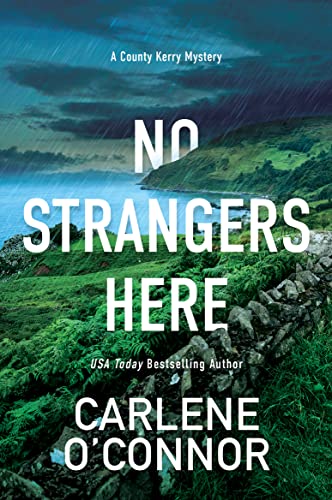

You could maybe call them borderline cozy, because one of the regularly featured characters isn’t a detective, she’s a veterinarian—the diminutive but feisty Dr. Dimpna Wilde. But there is also a main policeman, Detective Inspector Cormac O’Brien, recently transplanted from Killarney to the Dingle peninsula, and a local policewoman, Barbara Neely, under whose jurisdiction the somewhat grisly murders from both books fall. In addition to these principal protagonists, there is a highly colorful bunch of characters who could only be Irish, including Dimpna’s idiosyncratic extended family (parents, brother, son, and a few more sinister connections), Cormac’s Mam, office staff members at the veterinary clinic, subordinate officers at the police station, and a plethora of fascinating villagers only too ready to get up in each other’s business and then spread the gossip far and wide. There are also, thanks to Dr. Wilde’s veterinary practice, a supporting cast of endearing animals, from cats and dogs to donkeys, sheep, bulls, and bunnies.
The world-building is effective, making excellent use of the natural setting of the Dingle peninsula and all the towns, villages, nature preserves, cliffs, harbors, and wild places that exist there, nicely described and incorporated into the action.

The mysteries are complex, there are plenty of promising red herrings, and the personal relationships developing amongst the characters—particularly between Dr. Wilde and DI O’Brien—keep you reading to see what happens. In short, based on these two books I will definitely keep going. And, also based on these, I will try out her cozy series, even though my general preference is for mainstream mystery, because the totality of her story-telling is that good.
Unhappy fans
I miraculously got a checkout from my library for Emily Henry‘s latest, Happy Place, in about a third of the time I expected to wait. Then I read the reviews on Goodreads, which may furnish some explanation. Don’t get me wrong, every second or third review awarded five stars, but there were also those critical reviews between them for three, or even two or one star, a phenomenon I believe has not previously been experienced by this popular author.
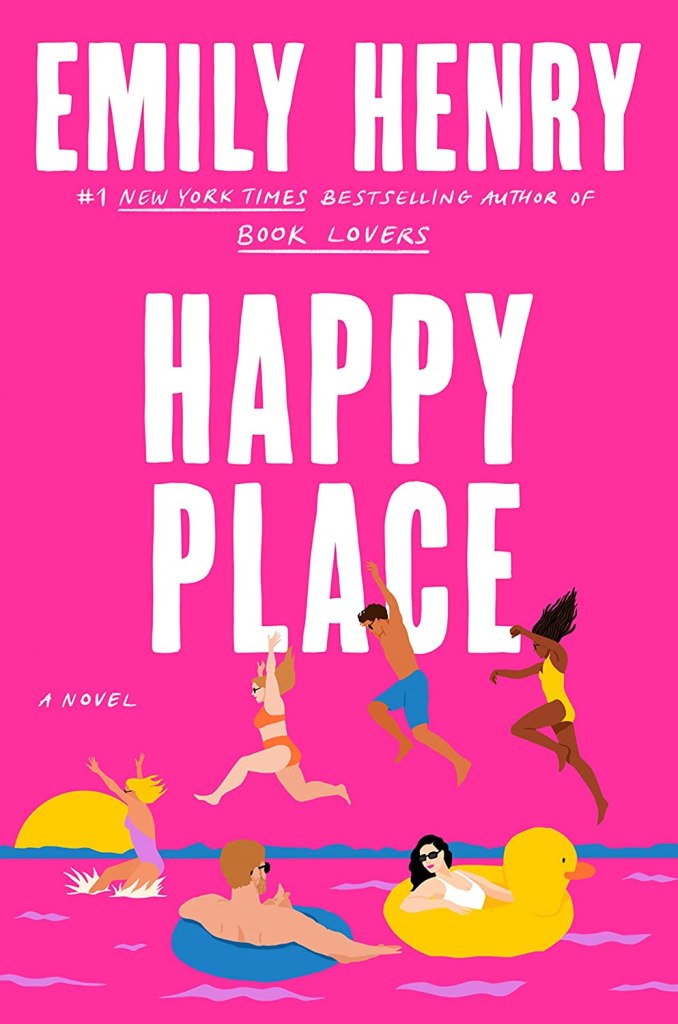
The story involves six friends, five of whom bonded in college and have remained uncommonly close, and one extra who was pulled into the group when she became part of a couple with one member. In fact, four of the original five have coupled up with one of the others, and this is the source of the current problem.
Their “leader,” Sabrina (I call her that because she’s the impetus behind keeping them all together), comes from wealth, and a tradition the group has had for their entire friendship has been to spend a summer week together at her father’s Maine “cottage.” But her dad’s most recent spouse doesn’t want to maintain the association of the cottage to his first wife and insists that he sell it, so this is the friend-group’s last gasp at a holiday together there, fraught with all of the traditions they have created over the years.
Sabrina and Parth have made the week into even more of an event by surprising their friends with their engagement, with a wedding planned for the end of the week on Saturday before they all pack up to leave the cottage forever on Sunday. Given this special occasion, none of the friends feels like they can refuse the invitation, let alone spoil it with bad news, so this makes it difficult for Harriet and Wyndham, who broke up four months ago but haven’t told anyone. Their plan was for Wyn to bow out of the week with some excuse while Harriet broke the news to the rest of them, but instead they are both on premises with nothing revealed, and have been awarded the best room together, a double en suite featuring a bathroom with no door. Awkward. And painful, and sensitive, and embarrassing and almost impossible to endure. But Harriet and Wyn don’t want to spoil the week for the others, and they do want to be at the wedding, so they are gritting their teeth and playing a part in public while taking turns sleeping on the floor in private. The third couple, Cleo and Kimmy, have secrets of their own, and there is building resentment between Cleo and Sabrina to cap off the basic tension in the air.
Harriet is a surgical resident in a prestigious program in San Francisco, and Wyn was living with her before going home to Montana to deal with family issues and never coming back. The two had been together for eight years, and happy for the first six, but once they relocated to San Francisco everything seemed to go wrong for them, as individuals and as a couple. But Harriet never dreamed the result would be a few devastating sentences on the phone that severed their connection permanently.
I personally enjoyed the book, both because I am apparently a hopeless romantic at heart and because I relished the vicarious experience of having a solid group of friends on whom I felt like I could depend forever. Who doesn’t want people in their lives who know you, are there for you, and will reliably show up for your highs and your lows? It threw me back to seeing the movie The Big Chill in 1983 and wondering, 10 years after high school graduation and five years after college, who of my friends I would still know 10, 15, or 20 years later (answer: one). So I liked being immersed in the group dynamic.
I also found Harriet’s and Wyn’s descriptions and chemistry with one another compelling, and cringed at what they had to go through as they maintained a façade for their friends. And I coveted everything about that vacay in Maine, from the weather to the food to the Lobster Festival to the opulent yet cozy cottage. Basically, I plopped myself down in the middle of the plot and went with it.
Others, however, were not pleased. One pointed out that “miscommunication” was the worst trope ever, and when I reflected on it, I had to agree; I realized that I myself didn’t identify that as a problem because I, like Harriet, tend to hang back, keep my mouth shut, and wait for someone else to make the important moves, so it seemed familiar and therefore not bad. But it was! They were both thinking one thing in their heads and allowing different information to come out of their mouths; they were both pretending to be happy while being oh so sad; they were lying a lot; and if, after eight years together, neither of them could bring themselves, through embarrassment or shame or fear, to fight for the other person or for the relationship, they probably deserved to be unhappy. Another reader actually said “The pacing of this book, the alternating timelines, the character development, the relationships were all beautifully and expertly written,” and then gave it three stars because of that trope. Finally, one of the one-star awarders said “Fake, awkward, contrived, and so, so dull. I simply cannot read another novel held together by the characters’ absolute refusal to communicate.” So there’s that…
Someone else said they felt the side characters had no personality, that they had been crafted as one-note cardboard characters whose most prominent feature was anxiety, and then left to function on their own. Another called them “unlikeable and underdeveloped…I just didn’t feel like I could root for them as I have others of Emily Henry’s characters.” I certainly didn’t feel this way about the characters during the flashback portions of the book, but in the present-day renderings I could kind of see it.
Finally, a surprising number of people found fault with the sex scenes, which I personally thought were both convincing and, well, sultry!
My conclusion is that with this story you will either identify with some/one of the characters and go with the flow, or you will get caught up in the frustration presented by the miscommunication trope and dislike it. I imagine that my review and thoughts will have absolutely no affect on those who are die-hard fans, while others may broach the book out of curiosity, taking a 50-50 chance on their reaction. Feel free to comment below on which person you ended up being!
Frivolous
The dictionary definition of that title is “not having any serious purpose or value.” You would think that at my age I would consider carefully the books on which I am going to spend my remaining reading time, and look for those that are worthwhile, or profound, uplifting, meaningful,, maybe educational; but it seems that I instead have the occasional need to abandon all thoughts of quality of phrase, good characterization, or realistic world-building to read something that is the snack food equivalent of Cheetos or Skittles. I believe there’s no type of book more addictive than a good thriller, and even the bad ones have the power to keep your attention if the plot points are sufficiently twisty. I proved that point to myself by reading The Housemaid, by Freida McFadden, and then the sequel, The Housemaid’s Secret.


This book has been touted on the “Friends and Fiction” Facebook page I have started to follow as a slightly more upscale version of the “What Should I Read Next?” crowd. The post-ers on F&F seem to read more, more varied, and generally better fiction, but the common denominator of “Oooh, I couldn’t put it down!” still prevails, regardless of quality. Here I am, sounding like a total snob, when one of the tenets of readers’ advisory is “Never apologize for your reading taste!” (Betty Rosenburg’s first law of reading, Genreflecting, 1982), and another is “There is no such thing as an objectively ‘good’ book.” While I try hard to refrain from shaming people for their book choices, what would a review blog be without a little gentle mockery now and then? Especially when it’s directed at myself…
The Housemaid and its sequel star Millie, a down-on-her-luck ex-con who’s trying desperately to find a job that will give her somewhere to sleep besides the back seat of her Nissan. Since she went to prison in her teens and stayed there for 10 years, she has few marketable skills; while she has done her share of fast food gigs, the holy grail at the moment is a job as a live-in housekeeper. The problem is, most people run a background check on someone they plan to hire to fill that role, and once they find out Millie’s past, they politely shut the door. But finally, Millie’s luck changes: Nina Winchester, beautiful and poised on the surface but giving off a bit of a weird vibe, offers Millie a position cleaning, cooking, and occasionally nannying for her little family—husband Andrew and daughter Cecelia—and Millie jumps at the chance. She rapidly discovers some disturbing nuances in the household, but beggars can’t be choosers, so she puts up with Nina’s foibles and her spoiled brat of a daughter, all the while trying not to covet Nina’s lifestyle, not to mention her handsome, soulful, and much put-upon husband. Then things take a dark turn…Dum Dum DUUUUUMMMMM!
The narrative in this book is first-person, and pretty much at the level of “Dear Diary.” It’s hard to tell whether the characterizations are kept purposefully opaque or whether McFadden is just not a good describer. The point of view switches around for sections of the book, but the voice stays a little bit too much the same. The plot twists are arresting, but some of the events on which they are based are laugh-oud-loud ridiculous, as in sitting in your chair reading along and then shouting “Oh, C’MON!” at the text as your cat bolts off your lap in terror. The redemptive value of bits of dark humor here and there can’t be overstated. But still…there’s something that keeps you reading. I loved how one Goodreads reviewer, Dan, put it in his synopsis:
This book is not as clever as it thinks it is. You probably won’t want to put it down. But you may be asking yourself what the hell you just read.
DAN, GOODREADS REVIEWER
As for the sequel, it is exponentially less believable than the first. And yet, I finished it and went looking on Goodreads to see when book #3 in this series will be published (June 2024). Let’s face it: Even Cheetos and Skittles can be addictive.