
Psycho Thriller
Yes, “psycho” is an abbreviation for psychological thriller, but also…well, there are characters in this book that might qualify for the title without the abbreviation.
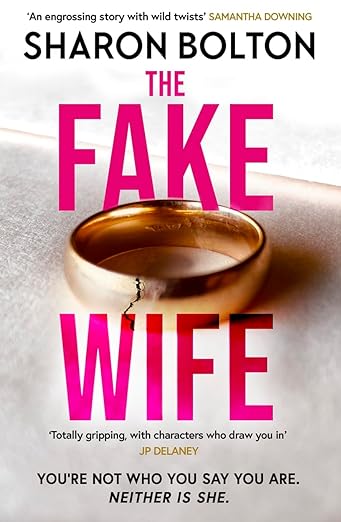
The Fake Wife was not my favorite Sharon J. Bolton thriller, but at this point Bolton is almost an automatic read for me. The book is certainly full of twists and turns, some expected and some definitely not. It’s complex and intriguing, but you really have to pay attention to know what’s happening at any given moment. There are multiple flashbacks from several characters to follow, and we get threads of the story from all directions—the victims, the perpetrators, the cops—that all weave together to gradually reveal what’s going on.
As the book opens, Olive Anderson is having dinner on her own in her hotel dining room in Hexham. A beautiful stranger walks up and seats herself at Olive’s table as if she belongs there, and then starts an elaborate game of pretense, engaging the waiter in banter and implying she is Olive’s wife. Olive is intrigued and decides to play along—it’s a lot more fun than sitting there by herself mulling over her marriage to Labour MP Michael Anderson. But as the evening goes on, the lighthearted pretense morphs into something else, and soon Michael is reporting Olive as missing and DS Lexy Thomas and traffic cop PC Garry Mizon are teaming up to try to solve what becomes an increasingly complex and bewildering situation.
This is an immersive domestic puzzle combined with a police procedural, adding more characters into the mix as the plot continues, with back stories that completely change what you were thinking at the beginning. It’s almost impossible to figure out who is telling the truth—if anyone is. The characterizations are excellent, and as for the setting, the beautiful but frigid winter scenery in the north of England provides both background and an extra sense of menace. If you like reading books that are set at the same time of year and in the same climate you are currently inhabiting, this is definitely a winter tale!
I’m kind of hoping Bolton decides to bring back the odd police couple in another book—their relationship provides both depth and humor in a story that is otherwise kind of dark. But if you enjoy dark (and confusing and exciting and suspenseful), this book might be a good one for your reading list.
Life
Every once in a while I want a break from the drama of a murder mystery, a thriller, a fantasy of some kind. I want to read about and immerse myself in the personal and intimate details of one particular life, to match my emotions to the character’s and perhaps compare how we deal with the daily events that are, on the surface, mundane, and yet affect each of us dramatically when experienced. I suppose there are a lot of authors who write that kind of story, but I find there are few who keep things strictly to the believable without unnecessary embroidery, and without feeling the need to ameliorate discomfort. One of those, in his own small way, is Robin Pilcher, the author son of Rosamunde Pilcher, whose books I have mentioned here.
He sets his books in venues similar to those of his mother, having grown up, of course, in the same environment as she, in England and Scotland, partly in the city and partly in the countryside. He definitely has a formula, which is the triumph over personal adversity, many of his characters picking themselves up from some disaster and starting over, whether emotionally or financially (or both). Again, a familiar theme, but there’s something both sweet and intense about his characters that make his books rise above a simple statement of events to involve the reader more closely than perhaps other authors are able to achieve.
I had read and enjoyed his work before, and when I hit a lull in the parade of new books from favorite authors, I looked at my backlist of “want to read” and, seeing a couple of his titles, decided he was just the thing for me right now. I’m having a bit of a difficult time with my health and find myself wanting something immersive but not overly stimulating, if that makes sense. You could call it comfort reading, but it’s not the type like Jenny Colgan, which is more like wish fulfillment; it’s about real people who work things out, which is encouraging in itself.
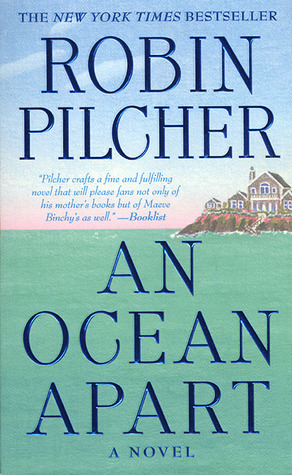
The first book I picked up happened to be the first one he wrote, called An Ocean Apart. It’s about a man in pain who can’t quite figure out how to get past it. He’s the father of three children, and his wife, who felt meant to be his life partner from the first time he met her, has died of cancer. The children are coping fairly well, mostly by going back to boarding school and immersing themselves in familiar routines with schoolwork and friends, but David can’t seem to deal with the reality of her absence, and has desperately pursued the hard physical labor of restoring the gardens at his family’s ancestral home where his parents live, as a distraction from his thoughts.
In his despair, he has shunned his place of work, leaving his father and a new employee to fill the gap left in his absence; the family owns a whiskey distillery, and David is meant to be the marketing manager. An emergency of sorts comes up that needs addressing, and the new operations officer persuades David’s father that they should send David to a series of meetings in New York to cope with it, hoping that a change of scenery will work a transformation. Instead, David comes straight up against his memories of Rachel when one of their new client’s administrators asks if his wife will be joining him, and has an emotional breakdown complicated by a bad bout of the flu.
He ends up deciding that he simply cannot go back to Scotland yet to face his regular life, and takes a job as gardener to a family living on Long Island. The interlude provides the respite he needs, until a threatened takeover of the distillery wakes him up to his responsibilities to save the family business for his father, his children, and his community.
This book has just the right balance in its story and was quietly involving from beginning to end. It’s a bit of a slow start, but by the end I couldn’t put it down. So when I was finished, I decided to move on to…
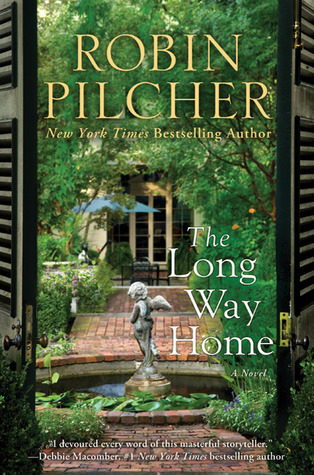
The Long Way Home. I think I liked this book even more, although I didn’t know if I would at the beginning of it. Claire’s father dies when she is young, and her mother remarries to a man named Leo, with two children of his own. Although neither her mother nor she get along with the new steps, they try their best for Leo to create a family, and the three of them, at least, are very happy with one another at Leo’s large estate in the Scottish countryside. Claire also has a best friend, Jonas, who lives at the neighboring farm tied to the property, and the two are inseparable until one day when Jonas rejects her and walks away from the friendship without explanation.
Claire, who has had a crush on Jonas for the last couple of years, is devastated, and goes traveling for her gap year between high school and college to try to forget. She ends up meeting Art, a young chef, in Australia; the two of them migrate to America, and she never goes back to her childhood home until her mother dies and she returns for the funeral and for Leo.
It gradually becomes clear that Leo’s memory isn’t what it once was, and that he will need some significant assistance to continue living at the estate. His two children prove both uninterested and unhelpful, so Claire and Art step up, as does Jonas, who has returned to the neighborhood and bought his father’s farm from Leo, and is high in Leo’s confidence.
Claire and Art have the idea to turn Leo’s house into a conference center—it’s in the middle of golf course territory in Scotland and everyone thinks it’s a wonderful idea—and build him his own adjacent apartment near his beloved greenhouses. But as their plans move forward long distance while they run their restaurant in New York City, they gradually realize that both Jonas and another consortium of buyers are scheming to take over the property, pushing Leo out into a retirement home. Claire is determined this won’t happen, but she and Art first have to figure out what’s going on, and (whether it’s for profit or for revenge) how to make it work for Leo.
I think the thing I enjoyed most about this book was that it didn’t end in what I call a “reconciliation romance.” You know, those stories where the woman returns to the town of her youth, runs meet-cute into the former love of her life, and ultimately abandons everything to fall into his arms. There was a point early in the book where I thought, “Oh no, he’s going to tank Claire’s relationship with Art somehow, so she can finally be with Jonas,” but Pilcher is a better author than that, and actually allowed for the possibility of a story being sufficiently engaging without total wish fulfillment being satisfied! And he did it cleverly and with much entertainment value.
These are not scintillating NYT bestsellers, and since they were mostly set in the 1980s you will have some issues with the technology (especially the prevalence of the fax machine!), but if you are looking for a quiet but satisfying read that will leave you with a happy feeling without going over the top, you might want to try a few books by Robin Pilcher.
Another old faithful
I first discovered the books of Robert Crais when I picked up one of his stand-alones at a library sale, and that one—Demolition Angel—remains a favorite; I think I have read it three or four times over the years. I found and read his other stand-alone novels, and liked them all quite a lot (my next favorite being The Two Minute Rule), so then I went on to his series, based on a private detective named Elvis Cole and (after book #10) his enigmatic pal, Joe Pike. The first Elvis Cole book is The Monkey’s Raincoat, and he’s pretty much on his own until The Watchman, which is Cole’s 11th outing and Pike’s debut.
I have an up-and-down relationship with these, because I find them to be somewhat uneven. Elvis is kind of a goofy guy, always joking around (although he takes his work seriously), and sometimes there’s just too much tongue-in-cheek banter. Joe Pike is the ultimate wordless action hero, and sometimes there’s too little personality there to make you care. And the mysteries are sometimes compelling, sometimes weird, and occasionally implausible. So although I think I have read most of the series (which is long—10 books for Cole, nine with Cole and Pike, and another seven with just Pike), I never know whether I will finish up the current book with a sense of satisfaction or feel vaguely let down.
In general, however, this is a reliable series and, like Michael Connelly’s Bosch, Elvis lives in the Hollywood Hills, so all the terrain is familiar to this Los Angeles resident, which is always a bonus. Who doesn’t like to be able to know exactly where the characters are and what things look, feel, smell, and taste like while reading a book? Or maybe that’s just me? Crais is particularly adept at both scene-setting and dialogue, having been (before his career as a novelist) a screenwriter for the TV shows Hill Street Blues, Cagney & Lacey, and Miami Vice. These, coupled with his love for such writers as Raymond Chandler and Dashiell Hammett, gave him the basis for his mysteries.
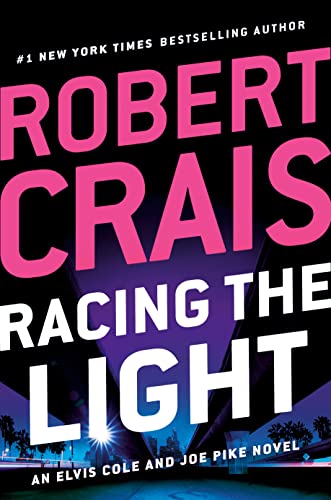
Anyway, I just finished the latest offering in the Cole+Pike batch, called Racing the Light, and it definitely didn’t disappoint. Although it starts out with everyone (i.e., the reader and Elvis himself) thinking that Adele Schumacher may be paranoid and possibly crazy when she asks Elvis to find her son, plunks down a bag full of cash, and starts talking about aliens and government conspiracies, it soon becomes clear that there is something going on with “Josh Shoe,” a controversial though small-time podcaster.
It seems that Elvis isn’t the only person looking for him, and the others are a few steps ahead in their search. Elvis needs to figure things out fast, before these guys with their sophisticated resources and extra knowledge do something permanent to keep Josh from telling what he knows. What starts out as humoring a mother about her maybe-missing adult son (who could just be ducking her calls because he’s trying to live his life) turns into a deadly race to save him from himself before he gets caught and dealt with by some people with a lot to lose if he exposes them.
Joe Pike is enlisted in the search and he, in turn, calls on Jon Stone, a former government “spook” with both connections and equipment a private eye can’t access, but this one will strain all their resources to figure out the magnitude and complexity of the government corruption over which Josh has stumbled.
Elvis’s private life also expands a bit in this one, with the return of his sometime girlfriend Lucy Chenier, who retreated to Baton Rouge a few books back after it became clear to her that the lifestyle of a private eye was too precarious for her to want it affecting her young son, Ben. But it’s been a few years; things have changed. Ben has grown up into a self-reliant teenager, and Lucy has realized that her overprotectiveness may have masked personal doubts, so she’s back to explore options, to Elvis’s simultaneous delight and dismay.
This was a solid offering, and I read it with quite a bit of breathless anticipation, particularly in the second half when the action starts to heat up and the players begin to come into focus. I don’t want to downplay the series too much; Crais won the Anthony and Macavity Awards for The Monkey’s Raincoat, and was nominated for the Edgar Award; and a later title, L.A. Requiem, was a New York Times and Los Angeles Times bestseller. So if you’re looking for a “new” series that has been around for a while and will therefore give you many hours of reading pleasure as you catch up, then check out the first Elvis Cole book, and also look into his non-series novels. (One of them, Hostage, is also a Bruce Willis movie….)

Writer of the dark
I have been a longtime fan of Sharon J. Bolton‘s books, variously characterized as mystery, suspense, or thriller. I defined the difference between those in a previous post; let me recap here:
First of all, neither a suspense novel nor a thriller is about solving a crime, they are about stopping a killer or a crime. So they are not necessarily a whodunit as is a mystery; we may know who the villain is from page one.
In a thriller, the protagonist is in danger from the outset, and action is a required element. Pacing is the key ingredient. In suspense, danger is more important than action, and the protagonist becomes aware of danger only gradually. Setting and mood are key. There must be terror, confusion, upset, and conflict.
A thriller has to start off with a bang, and have a clearly defined hero and villain, because the thriller is all about the push and pull between the two. By contrast, the only real requirement of a suspense story is that it build, and that it keep the reader on edge with a series of reveals or surprises until the final one. Suspense can be present in any genre; a suspense novel is simply one where the reader is uncertain about the outcome. It’s not so much about what is happening as what may happen. It’s about anticipation.

Bolton is a nuanced writer, with examples of all of these in her repertoire, sometimes putting the characteristics of all three into one volume. I would call Daisy in Chains a psychological thriller, and perhaps The Craftsman as well, while Dead Woman Walking would probably fall more into the suspense line. And then there is her ongoing mystery series, featuring Detective Constable Lacey Flint, from which I just read #5, The Dark. I am always thrilled when a new book in this series is published, because they are so involving, so ingenious, and so suspenseful—they leave me breathless. This one was no exception.
Lacey is, first of all, such an intriguing character. She comes out of nowhere, makes a name for herself by exhibiting “derring do,” aka extreme recklessness in solving cases for the London police by any means necessary (including dangerous undercover work), and then takes a baffling sidestep from advancement up the ladder to instead become part of the Marine Policing Unit, working on the Thames river. She’s aloof, almost secretive, even with her best friends and occasional love interests, and as the series progresses you learn that her secrets are not garden variety and she has a good reason (several, actually) for maintaining her solo status; but at the same time, you wish for her that she could let it all go and simply be happy! In short, it’s hard not to get involved with her life story.

Then there are the mysteries, and this latest is a doozy. It relates to what’s been happening in the world during the past few years as women’s rights have begun to be rescinded and certain men scheme to steal even more freedoms in their attempt to turn the world back to when they ran things without dispute and the women stayed home and had babies. In The Dark, there is an underground movement lurking on the dark web that is stirring up the “incels”—men who are involuntarily celibate and therefore harbor a deep dislike of the women who deny them—as well as any other guy who has felt overlooked in favor of a woman, for whatever reason. They target women who (they claim) have benefitted from affirmative action, those who they perceive as having favored the rights of women over men, and pretty much all women who choose more successful, more attractive men (or other women) over them.
And they aren’t just talking—they are inciting men to violence, staging actions such as harassment of women walking alone on the street after 10 p.m., intensive catfishing on dating sites, and the like. The women are both terrified and outraged, and the police are using every traditional and cyber tool at their disposal to figure out who are the ringleaders. And Lacey is, of course, smack dab in the middle of all of it, having been in the right place at the right time to foil their opening act, when a baby is stolen from its carriage and tossed into the Thames on a pool float and Lacey is in the area in her kayak to pull off an audacious rescue.
The scariest part of the story is when one of the incel leaders figures out that he has a past connection with Lacey, and she suddenly becomes the focus of everything he hates in women. All of the regulars from previous books—Dana, Helen, Victoria, Mark Joesbury—are present, along with some new characters from Joesbury’s team, plus Emma Boston, a reporter who plays a pivotal role. The book is as dark as its title, and scarily believable, given recent activities by the religion-obsessed right wing active in many countries today.
The suspense throughout is riveting, and I will confess I lost some sleep sitting up to read this. It’s been a while since Bolton wrote a Lacey Flint, and I was so glad she was back. Bolton has a new book (not in this series) coming out on November 9th, and I already have a pre-order destined for my Kindle the minute it’s 12:01 a.m. on that date! If you’re not familiar with Bolton’s books and you crave more thrillers and mysteries, start reading!
Fictional memoir
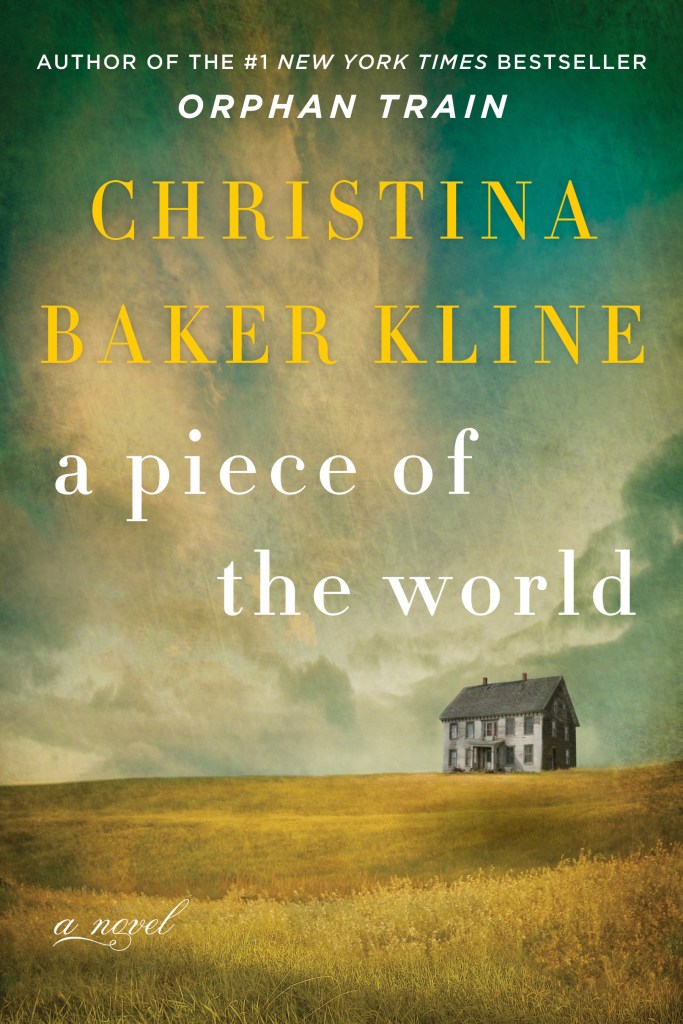
A Piece of the World, by Christina Baker Kline, is in a special category: Although the overall story is fiction, it is based on facts about real people, and reads like memoir.
The book is based on Andrew Wyeth’s painting called Christina’s World, pictured here. People have always noticed something slightly odd about the figure in this one—she’s not just reclining in that field, she looks like she’s wanting to get to that house, or perhaps even pushing or dragging her body along in the attempt. This is the germ of the idea for the entire book, which, although it does showcase some of Wyeth’s career, is primarily about the subject of the painting, Christina Olson of Cushing, Maine.

The book documents Christina’s entire life, which turns out to be a small one except insofar as she serves as muse to the famous painter. Christina suffers some kind of illness at age three (they never state what, but my thought was polio) that twists her legs up and makes her awkward and clumsy in all her movements. This and her own pride and self-reliance make her an outsider, both in her family and in her community, with the result that the chances others have for happiness seem to pass her by, no matter how hard she tries to grasp them. She grows up in the house previously occupied by generations of her ancestors; she cares for her brothers and her aging, ailing parents as her disability gradually worsens; and she is finally left with one brother to live out her days in an ever-diminishing daily routine circumscribed by her physical condition…until one day Andrew Wyeth’s young wife, Betsy, a family friend, brings him to visit, and he becomes fascinated with Christina, her brother Alvaro, and their house and farm in all its aspects. No detail is too large or too small for him to tackle in his art—he paints the rusty padlocks and spiderwebs, the sheer curtains blowing in the breeze from an upstairs window, Alvaro smoking his cigar—and this begins an almost 20-year relationship between himself and the two remaining Olsons, resulting in possibly his most famous picture/portrait.
“Later he told me that he’d been afraid to show me the painting. He thought I wouldn’t like the way he portrayed me: dragging myself across the field, fingers clutching dirt, my legs twisted behind. The arid moonscape of wheatgrass and timothy. That dilapidated house in the distance, looming up like a secret that won’t stay hidden.”
CHRISTINA OLSON
In some ways this is a dark, dour portrayal, but it is rescued from being too depressing by Christina’s will and strength of spirit, and by wanting to know what happens next. The book deals with complex issues; resentment, shame, lost dreams, family challenges, and social classes are explored, and the writer makes us realize that there is depth and intensity to even such a simple existence devoid of major events. There are some fine lyrical moments of expression, and Kline paints pictures with the words she chooses. I didn’t expect to like this book as much as I did—it kept me reading through one sleepless night, and I was a little sorry when it ended. It’s a great example of what an author can do with the kernel of a story, some thorough research, and a vivid imagination to bring them both to life.
Two authors, one story?
In my last post, I wrote about two books by Jenny Colgan, set in a derelict bookstore in Edinburgh. The protagonist’s task is to work in the bookstore and try to help its elderly and somewhat hapless owner get it back in the black. In the course of doing this, she meets two men—one a wealthy, successful author, the other a penniless but quietly charming student—and has to choose between them. Against all odds, she manages to keep the bookstore going long after everyone thinks it will fail.

Just as I finished reading those, a hold from Los Angeles Public Library became available—The Lost and Found Bookshop, by Susan Wiggs. In it, the protagonist inherits her mother’s foundering bookshop in San Francisco. She needs to sell it, to settle the debts and also to provide for her grandfather, whose health is failing, but she can’t because it turns out he is the owner of record, and refuses to sell. So she has to jump in and try to save the store. In the process, she meets two men—one a wealthy, successful author who she persuades to do a book-signing, the other a carpenter/ handyman/musician who she hires to do some repairs around the place—and she has to choose between them. Through a series of happy accidents plus a lot of hard work, she keeps the doors open and makes her grandfather happy.
Leo Tolstoy said, “All great literature is one of two stories: A man goes on a journey, or a stranger comes to town.” A 1919 writing manual penned by Wycliff Aber Hill posited that there are only 37 basic plots in the world. In 2015, Matthew Jockers used a computer analysis of 40,000 novels to conclude that all literature follows only six possible stories. And how many people have repeated the old saw, “There is nothing new under the sun”? Still…when the formula already involves a bookshop in financial trouble and a young female protagonist sent in to save the day for its elderly owner, maybe its author could check other books about bookshops to see if at least some of the rest of the tropes could be tweaked or avoided?
Since The Lost and Found Bookshop‘s publication preceded that of Jenny Colgan’s books by about a year, Jenny is probably the one who should have done the checking; but I have to say that I preferred her books by a considerable margin for a couple of reasons, the first of which was a less-than-satisfying protagonist in this one. Natalie Harper is simply too self-involved and angsty to be as likeable as Carmen, and I found myself getting annoyed with the author about the things she left out that would have made this character more well rounded.
I did like the manner in which she addressed the subject of grief, and I enjoyed the mentions of actual books and authors throughout. Some of the historical back-story was interesting, especially the bits about the San Francisco earthquake. But the other reason I didn’t care for this one was the series of three discoveries based on that history, and how the characters dealt with them; this subplot was too implausible (and convenient).
There were also some nitpicky little omissions that bugged me. One example: One of the love interests notices that Natalie has amazing abs “that you only get from a lot of yoga,” but we never see her take an exercise class, participate in any kind of physical activity or, in fact, even mention something about exercise. Yeah, I know, it’s a small thing, but don’t you find it annoying when authors throw in details and then don’t follow through?
Finally, I hated the way she ended the book. I am a person who doesn’t care for totally open-ended stories; I like a real conclusion. But I also have a pet peeve, which is the use of an epilogue as a tool to tie things up with a bow (or multiple ribbons!) and that’s what Wiggs does here, in a cutesy way (everything is presented via a series of newspaper articles). I reviewed another book on this blog (Things You Save In A Fire, by Katherine Center) and panned it because I loved it until the 20-page epilogue, where the author ruined it for me by ruthlessly and thoroughly tying off every possibility other than the ones she chose.
So—not a bad read, but probably not one I would recommend over some other bookshop stories.
Person, place, thing
I wrapped up my wallow through the writings of familiar authors by reading two books that I really should have saved for six weeks or so but, once discovered, I couldn’t resist them. These were Jenny Colgan’s latest, a two-parter with the same characters and location, The Christmas Bookshop and Midnight at the Christmas Bookshop. Colgan has made a habit out of returning to the scene of a previous novel but setting the action at Christmas (Christmas at the Cupcake Café, Christmas on the Island, Christmas at Rosie Hopkins’ Sweetshop, etc.) but these sequels usually arrive after she has segued to another story or two and then returned. This two-fer is an almost-continuous tale all taking place within about a one-year period bracketed by Christmas seasons, so I was glad that I discovered them both at once and could read straight through from page one of #1 to the last page of #2.
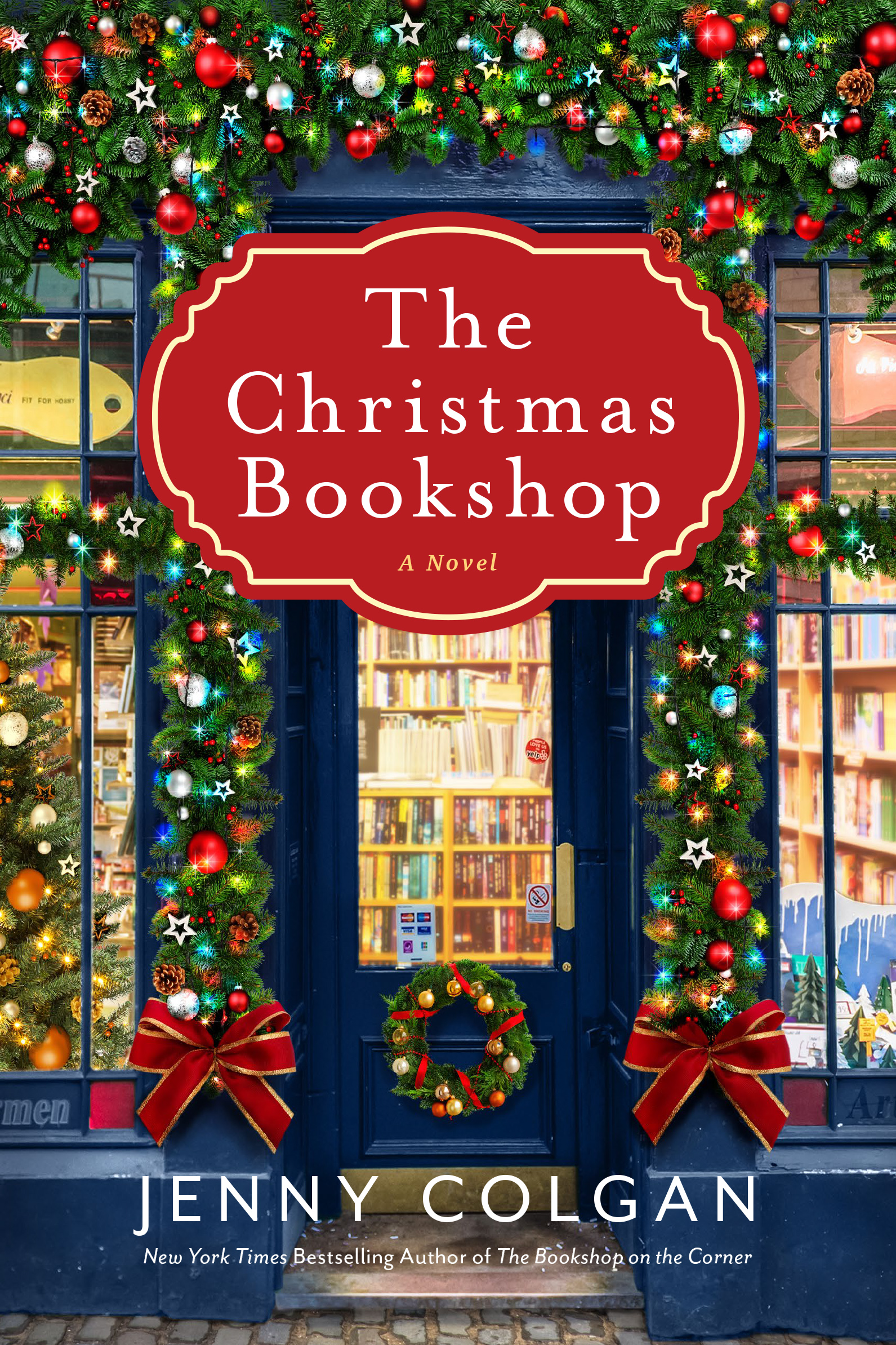
My title for this review takes into account a particular skill of Colgan’s, which is to present us with compelling characters with a specific objective in a spectacular setting that becomes every bit as important to the story as the protagonists. In this case it’s the city of Edinburgh, specifically the Old Town shopping district, so far holding out (for the most part) against the store chains and gimmicky tourist fare to present an authentic experience of one-off original shops, from a hardware store to a chic dress shop to a witch’s herbarium. The focus for Colgan’s bevy of characters is, as frequently happens in her books, a bookshop, in this instance a failing one. Mr. McCredie’s ancestors started the rare book store on the rambling bottom floor of their home, and he has lived and worked there his whole life but, despite his affinity for and encyclopedic knowledge about every sort of book, he’s a terrible salesman, a worse marketer, and is on the verge of forfeiting everything. Enter Carmen Hogan.
Carmen has, in rapid succession, lost her boyfriend, her job, and her apartment, and has been living in a state of denial at her parents’ place, tediously and repetitively grousing about everything and eating way too much junk food. Carmen’s parents are rather desperate to get her out of their house and back on her feet, and enlist Carmen’s sister, Sofia, to help them.
Sofia and Carmen have always been polar opposites: Sofia is the elder type A overachiever, and is now a successful lawyer with a happy marriage, three children (and another on the way), and a beautiful home in Edinburgh, and Mr. McCredie is one of her clients at the law firm. Carmen decided to skip college, and has worked in retail in a large department store since high school until the store closed and made her redundant. Sofia somewhat reluctantly asks Carmen to come live with her family, telling Carmen there is a job for her revamping an Edinburgh rare bookshop; what she doesn’t tell Carmen is that the sole objective is to get the store to turn enough of a profit during the next three months so as to make it an appealing prospect to a buyer, and that as soon as a sale takes place, Carmen will again be out of a job (and presumably a place to live).
While initially reluctant to go live with her sister, Carmen sees that she needs a change, and she loves books, so off she goes to Edinburgh. She is horrified by the magnitude of the job she has taken on: The store is in an advanced state of disrepair and disorganization, and Mr. McCredie is absolutely no use unless someone comes in looking for that one eclectic title about which he happens to know something. But she takes a deep breath and pitches in, and starts to make some headway, particularly when she is able to get a famous writer of self-help books to do a signing at the store. This guy and a student/lecturer at the college are the two love interests in the story, and Carmen goes back and forth between the glamour of the first, with his casual attention and expensive dinners, and the quiet regard of the second, a young Quaker with an intensity she has never experienced.
Carmen and Sofia continue to be mostly at odds, but Carmen discovers an affinity for children, specifically her young nieces and nephew, that she didn’t expect, and bonds particularly with the second daughter, Phoebe, who shares many character similarities with her Auntie Carmen.
There are other fun, although somewhat over the top, characters such as Skylar, Sofia’s yogini nanny, and Jackson, the millionaire who is out to ruin the quaint shopping district by remaking all the stores into purveyors of cheap “tourist tat” sporting too much Scottish tartan, and there are a few improbable story elements that made me say “hmm.” But…
I was truly astounded to see a bunch of two- and three-star ratings of these books on Goodreads, where Colgan normally has solid fours and fives. I thoroughly enjoyed both of them; the magical descriptions of Edinburgh in winter at Christmas made me want to go there despite an almost pathological dislike of cold weather; the children were funny and endearing and memorable; the bookshop’s problems and mysteries were involving; and I liked Carmen as the protagonist and driver of the narrative. I was totally immersed in this two-part story for four days, and was sorry when it ended. I’m hoping, as she occasionally does, that Colgan will go back for a third installment set in this world with these people, because I’d love to know what happens in their next chapters. If you’re looking for something to read to put you in the holiday mood, look no further.

Riches
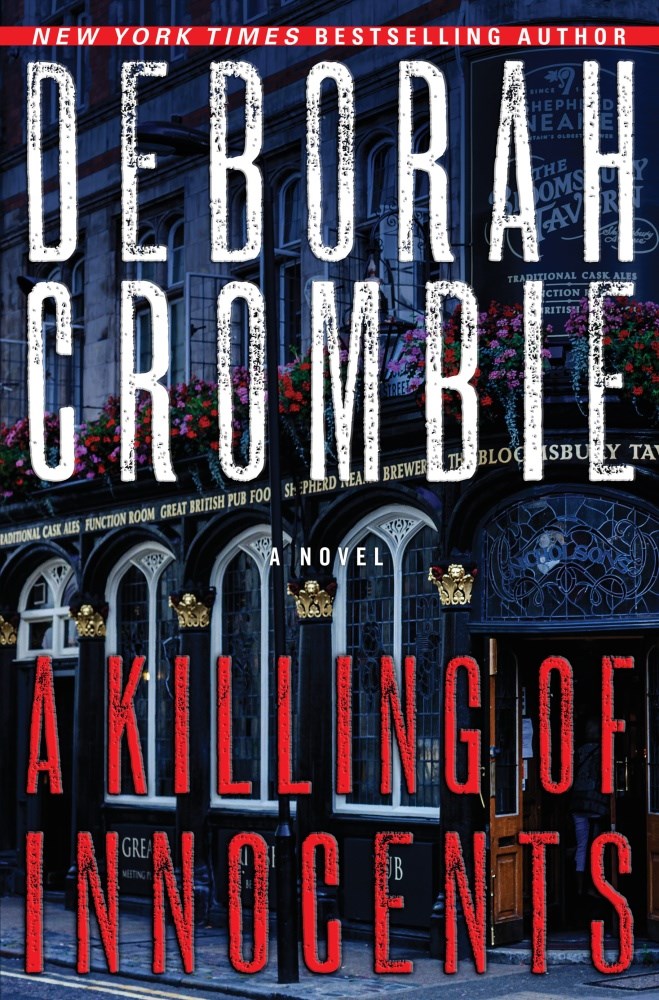
Sometimes forgetfulness or inattention is a gift. I was so busy for a while there trying out new authors and new titles garnered from various Facebook reading groups that I quit paying attention to the yield of some of my favorite mystery writers, with the result that I built up a backlog and got to enjoy three of them in succession: First I read the two Bosch/Ballard books by Connelly, then I followed up with the latest Cormoran Strike; when I finished that (which took some time, since it was 960 pages!), I remembered that I hadn’t checked on Deborah Crombie’s output in a while (I don’t check her too often because she’s an exceedingly slow writer, with as much as four years between books), and discovered she’d published a new one in February! This was a case of gulping down a dessert and then wishing retroactively that I’d made it last a little longer. I was still reading at the intense pace necessary to peruse a Cormoran Strike, but the latest Crombie book in the Kincaid/James series was only 368 pages, and I got through it in under 48 hours, reading at mealtimes and in the middle of the night when histamines from a recent prescription drug reaction kept me awake, and before I knew it, it was over.
I really enjoyed this one although, again, contrasting with the Strike tome with all its wealth of detail made me wish Crombie went a little more in depth into some of her subplots and red herrings to stretch out my experience! Still, we got a nice dose of the main protagonists, the secondaries, the friend circle, and a bunch of new and intriguing characters, and they sucked me into their messy, complex lives and made me want to figure out both the mystery and the relationships.
If you’re not familiar, Crombie’s series is about two detectives who are married to one another—Detective Superintendent Duncan Kincaid, and Detective Inspector Gemma James—although they didn’t start out that way at the beginning of the series (so this is a spoiler for those who haven’t read any of it yet, sorry!). They share a house and a life in London with children from separate previous relationships plus a recently added foster they acquired while together, and some dogs and cats. The books are populated with several significant co-workers and some old family friends from both sides who are ongoing, and then introduce one-off relationships related to the various cases in which they find themselves embroiled. I particularly like this literary pairing because Crombie alternates the lead detective in each book, so one will have Kincaid as the primary while the next will feature James, keeping things both fresh and non-sexist!
In this instance, Gemma has just taken a new position heading a task force on knife crime that places her primarily at a desk rather than in the field, so it’s Duncan who is called out to the scene when a young woman is murdered while walking through the well-populated Russell Square. But Gemma is rapidly involved as well when it turns out that Sasha Johnson, a young trainee doctor at a local hospital, has been stabbed. Is it part of the gang activity that Gemma and colleague Melody Talbot are investigating? It seems to have no connection; but another stabbing in a public park just days later seems to indicate a disturbing trend that will keep everyone looking for associations as they try to solve both cases.
This was well thought out and compelling, and I enjoyed the variety of characters and situations brought into the investigation as all involved look for clues to who might have wanted these people dead and why. Crombie is great at building suspense by switching POV, finding one fact, then changing again, letting each isolated realization begin to form a picture for the team. This was multi-layered with many threads, but they were and remained interesting right through an exciting climax and a satisfying wrap-up.
This series is now 19 books long, and it’s well worth your time if you haven’t tried it yet. I’m envious of those who haven’t, because once you’re caught up, it’s a long time to wait for the next! I keep threatening to start over at the beginning for a massive re-read, and I may well resort to that in the interim before #20.
Re-invested!
I just finished #7 in the Cormoran Strike/Robin Ellacott series by J. K. Rowling, and my complaints from the previous book are all forgotten in the sheer pleasure of reading this one. The Running Grave (named for a line from a Dylan Thomas poem that I find quite frankly incomprehensible) is likewise long, clocking in at 960 pages, although that still makes it 400+ pages shorter than #6; and the lack of those 400 pages may be one thing that improves this book to no end. But what caught me up in it was the subject matter (the culture and operation of a religious cult) and the resulting changes in the protagonists from their pursuit of this case.
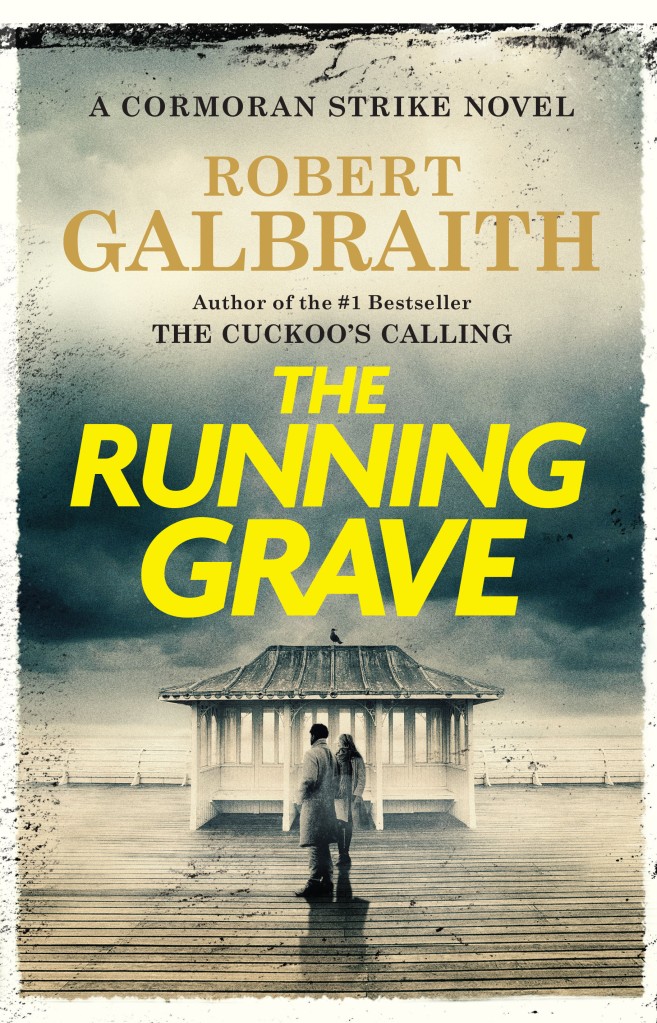
Rowling was so clever in the staging and pacing of this story: Cormoran and Robin are hired by a frantic father to try to extricate his son, Will, from the Universal Humanitarian Church, on the surface a seemingly innocuous organization focused on a general sense of spirituality in service of creating a better world. But after hearing the father’s concerns about how they have prevented all contact between his son and anyone outside the bounds of the cult and then reading up on such rumors as unexplained deaths, compulsory sex, and severe punishments for the slightest infractions, Robin decides to infiltrate the cult. Strike is reluctant to let her be the one, but he is too well known himself to be able to create and maintain an alias, so Robin attends a public meeting of the church designed to recruit new members, and allows herself to be absorbed into their midst and transported to their “farm” in Norfolk for an undetermined length of time, her goal being to contact Will Edensor and see if he is amenable to leaving with her.
This is the genius of the book, creating the world of the cult members living at the farm for Robin to inhabit while keeping Cormoran outside following up on all their other cases, essentially unaware of what’s happening with Robin. They have a tenuous connection: She sneaks out of her dormitory every Thursday night and leaves him a note detailing her week’s experience, putting it in a hollow plastic rock situated in a blind spot near the fence to the outside world; but this weekly check-in is her only fall-back position to get out of what is turning into a seriously sticky situation. Being Robin, she is determined to stay until she achieves results, no matter how precarious things become; and being Cormoran, he is constantly worrying whether he needs to storm the front gate and pull her out of there for her own good. The back-and-forth detailing of the mundane running of the agency (and some rather amusing case work for Cormoran and the gang) with the surreal situation at the farm kept me turning pages every night long after I should have turned out my light and sought sleep.
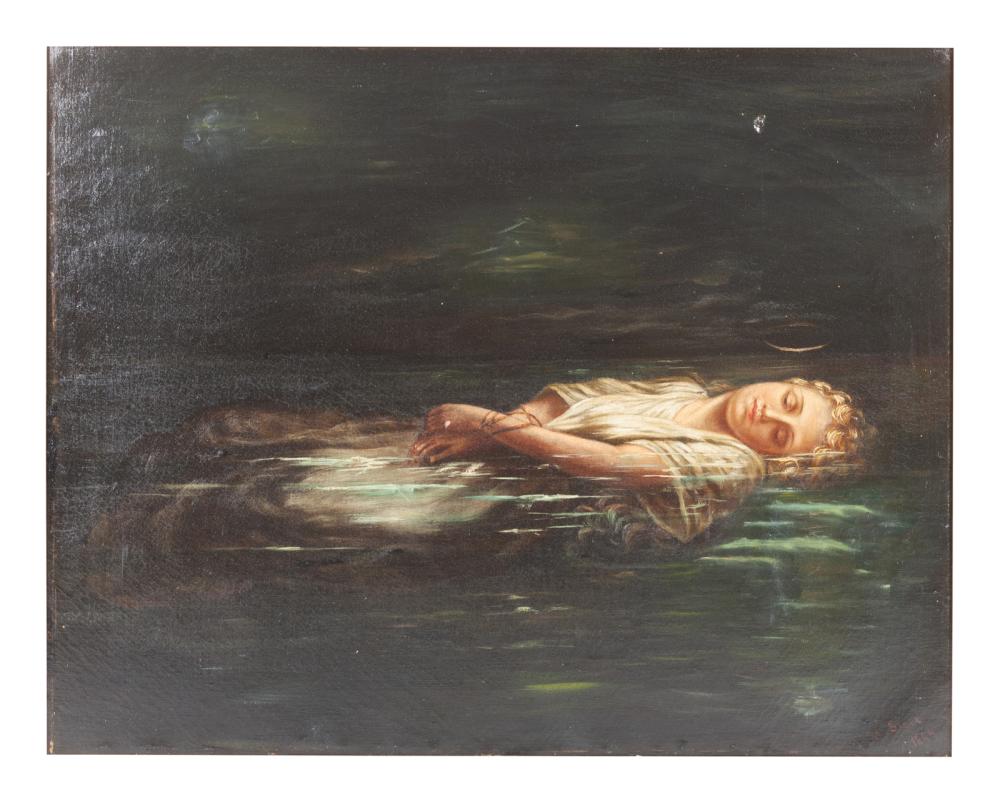
(female saint in water, painter unknown, 1894)
There is also, of course, the ongoing situation between these two business partners who treat each other like best friends while dating other people because they’re afraid of ruining what they have professionally and are also both a bit cowardly about stating their feelings in the absence of certain knowledge about the reaction that revelation would receive. Robin is currently seeing Detective Inspector Ryan Murphy, while Cormoran uses typical bad judgment in his effort to find sex with no ties by getting involved with someone wholly inappropriate and potentially damaging to his (and the agency’s) reputation. But the longer Robin is sequestered in the cult, the more clear Cormoran becomes about what he really wants, and although nothing definitive happens in the relationship arena for most of the book, it’s not the frustrating experience we have endured for far too long, because we can feel something coming, and the cliff-hanger at the end of this one doesn’t disappoint.
What I am telling you is, if your loyalty has floundered in the face of weird plots on the mystery side and stalled emotions in the romantic sub-plot, I think based on this book that Rowling has hit the tipping point and things are going to get increasingly interesting in future tomes. Read The Running Grave and see if you agree!