Romance and more…
My friend Judi commented that when she was at a loss for something to read or wanted to experience the comfort of a familiar story, she returned to the four-part Chesapeake Bay Saga by Nora Roberts. I had never read anything by Nora Roberts, but she is a prolific author and her books are ubiquitous, so I decided to check out this mini-series.
These books fall into what I would call the “relationship fiction” category, in that there is romance present that is a big feature of the story, but there is also some kind of content that reflects a family dynamic beyond just the true-love part. Roberts’s vehicle for these four novels was clever, in that she created a family of four “boys” who were turned into brothers by the charity of one couple who saved them from difficult beginnings, and then she wrote each book by focusing on the perspective and relationship of one of them.
Each of the boys, previously in an untenable situation, was discovered (in various ways) by Ray and Stella Quinn and adopted away from their pasts to be raised in a supportive and kind environment. As adults, the eldest three—Cameron, Ethan, and Phillip—have gone their own way, Cameron to a glamorous lifestyle mostly located in Europe, where he races fast boats and fast cars and lives on the prize money; and Phillip to a big-city career as an advertising executive with a generous income and an enviable lifestyle. Only Ethan has remained at home (although now in a house of his own) in the small fishing village of St. Christopher on the Chesapeake Bay, trapping crab for a living but investing time and hope into a boat-building business. Then, the acquisition by Ray of 10-year-old Seth, a fourth brother to join their family, is quickly eclipsed by the unexpected and tragic death of their father, who makes the brothers promise, before he dies, to rally around and raise Seth the way he, Ray, would have, given the chance. Although there are various levels of grudging reluctance to give up their chosen lifestyles to return home to take up this challenge, the three are all conscious of just what Ray and Stella (deceased some years before) did for them, and are resolved to honor their father’s memory and wishes by doing the same for young Seth.

The first, Sea Swept, is the story of Cameron, who was discovered as a runaway and car thief when he tried to boost Ray’s car at a young age; after realizing that his motivation was to get away from an abusive alcoholic father who beat him, Ray and Stella Quinn took him in. Now he has made a deathbed promise to his adoptive father to assist in the upbringing of new boy Seth, whose mother beat and neglected him, and Cameron is determined to bring the suspicious and untrusting Seth out of his shell and into the family the way Ray did for him. But an unexpected opponent is Anna, Seth’s social worker, who is playing by the rules of the child welfare system by assessing Seth’s living situation and determining whether it would be more appropriate to either place him in the foster system or reunite him with his real family. Despite his determination not to let this happen to Seth, whose psychological scars he recognizes as akin to his own, Cam is unbearably attracted to the spirited and determined Anna, as is she to him, and their involvement complicates an already fraught situation.
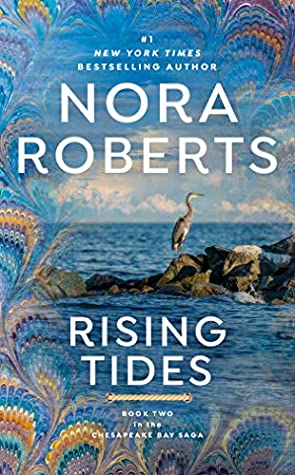
The second, Rising Tides, follows the story of Ethan, the quiet, reflective brother who has made a life for himself as a waterman on the Chesapeake Bay. Ethan’s mother, a drug addict, gave Ethan an unspeakable childhood that, despite his subsequent rescue by the Quinns, has made him determined never to marry or have children of his own, for fear of passing on some random evil gene. Local woman Grace, who despite her former marriage and the birth of her daughter has always cherished an unrequited love for Ethan, is determined not to let this be Ethan’s final word. Their romance plays out against the background of the campaign to keep Seth. In addition, the necessity for all the brothers to move back home in order to create a proper foster environment is the catalyst needed to involve Cam and Phillip in Ethan’s plans for a family boat-building business.
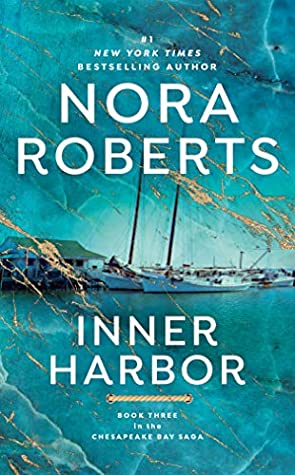
The third, Inner Harbor, is Phillip’s journey. Phillip is perhaps the most successful in terms of career, and also has separated himself the most thoroughly from his small-town origins. But after the Quinns gave him a life (almost literally—he was a gang member who was shot in a drive-by and was saved from death by Stella, the emergency-room doctor, before being adopted), he certainly can’t bring himself to turn down the opportunity for Seth to benefit from the same experience. Somewhat at loose ends after his move from his big-city lifestyle back to the tiny fishing village of his upbringing, Phillip notices Sybill, an intriguing writer who is making the town of St. Christopher the subject of her next book about the psychology of human interaction. But what he doesn’t know is that Sybill has a secret relationship to Seth that threatens everything the Quinns have tried to do for the boy.

The last book in the quartet, Chesapeake Blue, explores Seth’s own story in adulthood. Since it would reveal much about the way things went when Seth was 10, I won’t comment too much on this one, except to say that it, too, contains a romantic relationship, and the quartet is concluded with a happily ever after for many of its subjects.
There is much to like about this series. Yes, it contains multiple clichés or tropes—the macho, muscular, and ruggedly handsome brothers and their uniformly gorgeous love interests, the sex that is always incandescent for all parties involved, the meet-cute aspect of some of the relationships—but the thing that saves it is the back stories of the brothers and their sincere (and tender) determination to help a troubled 10-year-old boy the way that they themselves were aided by their adoptive parents. The thread that holds the book together is the development and transformation of the boy Seth and the creation of a welcoming family dynamic by all the other characters. The characters are nicely defined and feel, for the most part, like real people who express genuine emotions, and the small-town vibe is painted fairly realistically, with the charming offset by gossip and insularity. Wrapping it up as Roberts did with the story of Seth as an adult, showing the vulnerable cracks that remain in anyone who has survived a background such as those of these brothers, was the perfect way to end the story.
Although I don’t know that I would continue reading Nora Roberts as a favorite author (I am not a tropes and clichés fan, unless it’s Georgette Heyer!), I definitely enjoyed this foray into her genre and style.
Robert Crais
I’ve been busy these past couple of weeks, starting a new quarter teaching at UCLA and also doing some Zoom classes on contour drawing for LAPL, and the mood has dictated that I don’t need to be reading stuff that challenges me, so I’ve been revisiting some books from the past (as evidenced from my last review). This week I went for mystery writer Robert Crais.
Crais has a series starring Elvis Cole, a private investigator in Los Angeles, and his buddy and business partner Joe Pike. Elvis is a deceptively happy-go-lucky, casual guy in a Hawaiian shirt, with a smart-alecky manner and a keen sense of how to cut through the extraneous to solve a missing persons case or whatever else his clients bring to his door. Joe Pike epitomizes the strong silent type, has all kinds of commando training and slinky stealth operations in his past, and retains unexpected clearance levels with the Department of Defense, considering that he was hounded off the police force in Los Angeles once upon a time. Given his splendid physique, the arrows tattooed on his biceps, and the smoldering look in his eye, not many people are willing (or able) to mess with Pike.
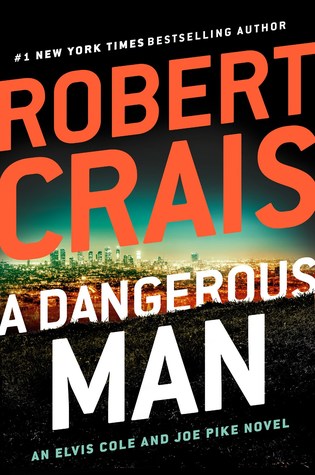
Crais has now written 19 books shared by these two partners (with the emphasis on Elvis Cole), plus a further seven featuring Pike as the lead. This series, like any other long-running one based on the same people in the same city, has had its ups and downs, but I generally enjoy anything Crais writes. An added bonus is the books’ Los Angeles setting, since I am familiar with most of the locales and landmarks, which is always fun.
A Dangerous Man is billed as an Elvis Cole/Joe Pike book, but it’s really mostly Pike, with Elvis in a supporting role. (Being #18 in the series, I imagine Crais was already migrating his thinking over to Joe as the new lead.) You can read an in-depth review of the book here, from when I originally read it.
Crais started a new series in 2013 featuring Scott James, a police officer, and his K-9 partner, Maggie, and wrote one follow-up book, but doesn’t seem to be pursuing it further than that.
He has also written several stand-alone books, and these are among my favorites. Hostage was made into a suspenseful and action-packed movie, starring Bruce Willis, and I keep hoping that someone in Hollywood will revisit his books and decide to make movies based on the other two, The Two-Minute Rule, and Demolition Angel, given their great story lines and compelling protagonists.

I re-read Demolition Angel this week, and it mostly held up to my initial enthusiastic reception (although the technology in the book has become increasingly dated, of course). This is the only book of Crais’s with a female lead (although he does feature strong female characters in other books), and Carol Starkey’s presence is palpable and painful. She is the survivor of a bomb detonation by which she lost her lover, who was also her partner on the bomb squad, and even three years later she is on the edge, constructed of equal parts gin, cigarettes, antacids, and insomnia. She is now working as a detective with the Los Angeles Police Department, and would like to get back to the bomb squad, but her therapist doesn’t hold out much hope of that, given her fragile and self-destructive state. Then the bomb squad rolls out on a report of a suspicious package at a strip mall and, after one of the bomb techs is blown up by its unexpected detonation, Carol Starkey is handed the case.
Starkey is terrified that either Homicide, ATF, or the FBI will take the case away from her, and determined to solve it herself before that can happen, which lends an urgency to the narrative. The components of the bomb itself suggest it was built by Mr. Red, an infamous shadowy character whose goal is to be on the FBI’s 10 Most Wanted list. An FBI agent named Pell does show up, but seems content to work with Carol, offering his long-running history with Mr. Red to support her case. Things escalate as Mr. Red himself engages with Starkey via a dark-web chat room, and Starkey begins to realize that this case may be much more complex than everyone else believes, and have less to do with Mr. Red than anyone imagined.
Carol Starkey is a truly great character, and the scene-setting all over Los Angeles is both accurate and entertaining. I was fascinated by the procedural parts of the book, and also enjoyed the interpersonal relations with her team, the ATF agent, and the bomber/serial killer. Reading this after revisiting one of the series books showed me how much Crais has to offer when he is building a story from scratch, rather than relying on the formula of the Cole/Pike team. I wish he would write more stand-alones like this one.
The Horse Dancer
 I decided on a re-read this week, and picked one of JoJo Moyes’s lesser known books, The Horse Dancer. I enjoyed it enough the second time around to want to revisit (for my newer readers) the review I wrote in 2019 when I first read it.
There are three intertwined stories in this book—one in the past, the other two present-day. The first involves Natasha and her soon-to-be-ex-husband Mac. Natasha is an up-and-coming attorney in the area of child protective services, and channels all her repressed feelings about the end of her marriage into her work and her tentative new relationship with a shiny partner at her firm. Mac is a freelance photographer, and appears to be fairly happy-go-lucky and irresponsible next to the upright and uptight Natasha, but seems to have major regrets about the end of the relationship. The two are in the process of sorting out their mutual possessions and financial issues on the way to divorce when their paths cross with Sarah.
Sarah is a 14-year-old girl who has two major loves in her life: her beloved grandfather, Henri, with whom she lives, and her horse, “Boo.” Her grandfather was, in his youth, a professional rider for the prestigious Cadre Noir, a French dressage academy, but he gave it all up to come to England to marry Florence, the love of his life, recently lost to cancer. Sarah’s dream is to follow in her grandfather’s footsteps and ride with Le Cadre Noir in Saumur, France. Meanwhile, she and her grandfather train the horse in the shadow of an old railway siding in the seedy part of London, where they stable the horse with Henri’s friend, Cowboy Joe. When something terrible happens to Henri, Sarah discovers the fragility of her situation as a child with too many adult responsibilities, and tries her best to deal alone with all the potentially terrible outcomes.
I found this book tremendously moving in several areas. The relationship between Sarah and her horse brought back memories of being that age and wanting that special partnership so badly. (My grandfather, an impulsive bidder at auctions, actually gave me a horse for my birthday when I was 12—an unbroken two-year-old palomino
stallion—and my parents, dismayed by the thought of dealing with the housing, feeding, and exercising of him from the comfort of our suburban lifestyle, made him take it back. I can hardly remember ever feeling more heartbroken.) The scenes that depict the tie between Sarah and Boo are so viscerally and immediately written as to be impossible to resist.
The interplay between Mac and Natasha was painful and confusing, and there were parts I flat-out had trouble believing, but ultimately the idea of the walls we build to protect ourselves that do us more damage than those we built them against resonated with me. The picture Moyes paints of a teen girl who depends on her grandfather and no one else, and of what happens to her when she is thrown on her own resources and believes she must cope all alone, is poignant, real, and frightening. The back story of the grandfather’s youthful experiences in Le Cadre Noir gave the book additional legs. All in all it was a satisfying and touching, albeit somewhat dark, read.
This is a book that is written for adults, but it explores the adult-child (or adult-teen) relationship from both sides, given that it shows both Natasha’s and Sarah’s views of the proper way to deal with the situation in which they find themselves; and I think that there are teens who would appreciate and even benefit from reading this book. Natasha has to transform her view of Sarah as a frustratingly opaque, surly compulsive liar and see that she is a child adrift in an adult’s world who is convinced she has to be as strong and resourceful as an adult; while Sarah has to get past her view of Natasha as a controlling authority figure and see that she is doing her best to be helpful even though Sarah is keeping the bulk of her life secret from everyone. The thing Moyes gets right is that final push through misunderstanding that is essential to a true and lasting love, whether it be between a couple, a parent and child, friends, or a girl and her horse.

Wish fulfillment
A lot of popular fiction these days seems to fall into a category I would call “wish fulfillment”—that is, books where nice things happen and people end up happier by the end. I just read two of those, and while I enjoyed both of them, they left me feeling a little…flat? It’s not that I don’t like a happy ending, but when it telegraphs itself throughout the book, one has to wonder: Did I really need to read this book?

The first was People We Meet on Vacation, by Emily Henry, author of the popular Beach Read, which I covered in a previous post. The title is a little misleading, because the person Poppy “meets” on vacation every year is her best friend Alex; the two shared a car ride home from college and have gotten together every summer for the subsequent 10 years to go on a vacation. (Poppy has engineered her career so as to become a travel writer, which makes the vacations much easier to navigate financially!) This yearly trip persists despite all complications, including moves to Chicago and then to New York for Poppy, job changes, other (dating) relationships for both—no matter what, Poppy and Alex have their trip.
The relationship is described by Poppy as 95 percent friend-zone and 5 percent what if? and this is probably a situation to which it is easy to relate for most people. I’ll bet if you think back, there was always that one person about whom you wondered, What if I acted on my impulse to change this relationship? but never quite dared. This premise, with inner waffling by Poppy to which we are privy, and some outer signs from Alex, to whose mind we are not welcomed until much later in the book, is what makes the whole thing work.
Like Beach Read, the main strength of this story is the witty banter between its two protagonists. Sometimes the back-and-forth from past to present trips with the accompanying descriptions both external and internal get a little wearying; but with the always tantalizing possibility that this trip is the one during which things will shift or change, the motivation to keep reading is pretty strong.
No spoilers, but it’s a feel-good book so you can probably guess what happens. In fact, the book’s cover blurb touts it as “a sparkling new novel that will leave you with the warm, hazy afterglow usually reserved for the best vacations.” Not exactly a cliff-hanger. So if you are going to read this book, you have to do so for the journey, not the destination, so to speak, which is kind of funny when referring to a book about travel.
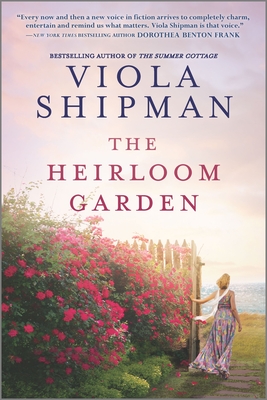
The second book I read was The Heirloom Garden, by Viola Shipman and, while this book had more depth and less wit to it than Emily Henry’s books, it was still within that realm of predictability that made the inevitable ending simultaneously satisfying and anti-climactic. It’s about Iris Maynard, an old woman alone, who lost her entire family early in life and walled herself off, both figuratively and literally, from all but the minimum human contact. She is a botanist who lives behind a tall fence enclosing a beautiful garden that she has both preserved and extended from her mother’s and grandmother’s initial efforts. She grew up in the house where she lives, while her grandmother’s old house sits next door, and this one she rents out.
I’ll bet you can almost write the story in your mind from these beginning details—I could and did. A young couple with a daughter move into the rental house. The daughter, Lily, is the same age as Iris’s Mary was when she died; the husband is suffering from PTSD from his time in Iraq, while Iris’s husband never returned from World War II. The child is irrepressible and worms her way into Iris’s life and affections; the wife, Abby, is an engineer whose career has, like Iris’s, been fraught with misogyny; and the husband and Iris share agoraphobia and a lack of the will to live. Everybody’s issues and natures work upon everybody else’s, with the inevitable outcomes.
I’m not saying this book isn’t well written—it is—or that the situations aren’t powerful and poignant—they are—but…they are also so predictable. The highlight of this book is all the abundant detail about horticulture, and the “relevance” factor of dealing with PTSD. But again, the journey (touching moments and interesting information) has to become more important than the destination, because that is a foregone conclusion. You can say that you don’t know what will happen—will Iris come out of her shell? Will Casey come back into the world?—but really, you do. So I guess the point of books like this is the feel-goods you get as you read them.
There is, of course, a story arc to every tale, whether it has a happy ending or not, but for some reason the predictability of contemporary fiction like this is rubbing me the wrong way right now and I’m wanting more. Maybe it’s time to go back to science fiction…
Diversity and superheroes
I just finished reading two books of a planned trilogy by April Daniels. I would slot them as young adult although, in the area of superheroes, fandom seemingly crosses all borders, including that of age. But since the protagonist is 15 when book #1 opens, and comes with a lot of the issues teens encounter, labeling them YA is plausible, whether or not the author intended that.
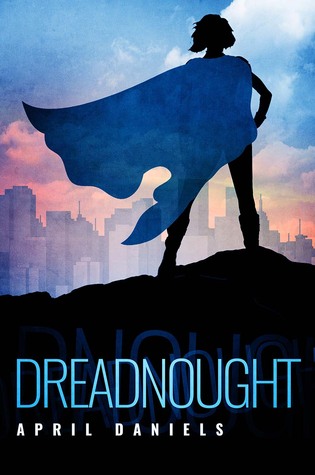
Dreadnought (Nemesis #1) follows the adventures of Danny Tozer. When the book opens, Danny is Daniel, an unhappy teen girl trapped in a boy’s body, with parents who adamantly refuse to see her for who she is or even contemplate the possibility of a transgender future. A miracle is shortly to follow, however; while hanging out alone behind the mall, Danny ends up on-scene at the murder of Dreadnought, a powerful superhero, and as he dies he passes the “mantle” of his powers to Danny. What comes with those powers is a transformation so epic that Danny’s life will be forever changed—she is gifted with a girl’s body as part of her new identity. Although becoming a superhero ought to be the most amazing thing that happens to a person, it is the realization of her secret dream of manifesting as female that is the overwhelmingly joyous news.
But Dreadnought was taken down by a “black cape” named Utopia, who shouldn’t have had enough power to faze him, let alone kill him, and now Danielle has to figure out how that happened and foil Utopia in her grand plan for the destruction of humanity. And she will have to do so while confronting the prejudice and paranoia of her parents, whose dearest wish is to find a “cure” that will turn her back into “their son,” a disillusionment regarding her best friend, who turns out to be an objectifyer when Danny turns into a girl (hey, eyes up here, dude) and, of course, her fellow superheroes in New Port, some of whom also have a problem with Dreadnought suddenly being a 15-year-old petite blonde.
This is such a fresh, wonderful, fun, and yet serious discussion of transgender in the context of fiction! The author shares the identity of the underrepresented and marginalized group in question, and in this series, the authenticity shines through. There is something for everyone here: While those who enjoy the cool powers, the fight scenes, and the trope of conflict between good and evil so characteristic of superhero books can revel in those things, there is also a lot of all-too-mundane psychology tied up with the issues of misogyny, abuse, identity, gender vs. sexuality, you name it. In addition to the transgender nature of the protagonist, we have her lesbian love interest, a non-binary superhero colleague, multiple people of color, and a villainous trans-exclusionary “feminist.” But none of these (well, with the possible exception of Graywytch, who turns into kind of a cipher as the plot progresses) is a stereotype: Danny runs the gamut of emotions—brave, terrified, powerful, weak, utterly secure, and totally lacking in self-confidence. The side characters are equally well developed, especially those who are in her inner circle of supporters and colleagues. The world-building is thorough, and especially enjoyable is all the focus on “hypertech” inventions.
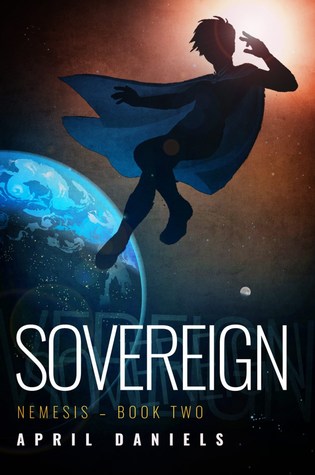
I enjoyed the first book a little bit more than the second, simply because I love a good origin story, and Dreadnought dealt much more with the emotions and challenges of a 15-year-old transgender girl who is suddenly in the spotlight as the heroine of the city and has to work through all her personal issues with family and friends while simultaneously maintaining a public image and fighting crime. Sovereign landed more heavily on the superhero role and focused less on the personal, although it almost made up for it with the relationship dynamics among the main characters, including a little romance. And the ongoing question of the wisdom of taking a survivor of childhood abuse with anger issues and encouraging them to beat up on people (well, admittedly bad guys, but still) is also a powerful theme.
Having read these two, I would have felt completely satisfied with a duology; but Daniels is writing a third book to wrap up the secondary plot of Nemesis, and I look forward to reading it. This is a solid recommendation for a positive and delightful treatment of diversity within a fictional shell, not to mention a dynamic story line and an enjoyable read! I would suggest this for teens 14 and up, plus anybody who enjoys a good superhero tale. To discover other diverse books, visit https://diversebooks.org/.
Aging, dying, living

The Brilliant Life of Eudora Honeysett (released as Eudora Honeysett is Quite Well, Thank You in the U.K.—a better title, in my opinion) is supposed to be a feel-good read. I chose it because someone on the “What should I read next?” Facebook page compared the writing of Annie Lyons to that of Linda Holmes, author of Evvie Drake Starts Over, which I liked quite a bit. I somehow got it into my head that one person had written both books, but learned my mistake after reading it, then looking up “other books by Annie Lyons” and then “Evvie Drake” on Goodreads.
I scrolled through Goodreads reviews checking to see if anyone at all had hated this book, and found only one “did not finish” (DNF) in two pages of reviews—that person called it A Man Called Ove rip-off. Otherwise, universal fours and fives out of five stars.
I have to say that it was an engaging narrative, with interesting, well-developed characters who made me care, and an alternating timeline that clearly explained how we had gotten to where we were at the opening page. Where Eudora was…
Eudora Honeysett is 85 years old. She is (that dreaded word) a spinster, and lived with her mother, Beatrice, for most of her life, caring for Beatrice until she died—after a series of incidents and illnesses—all by herself in a hospital bed. This experience shone a light for Eudora on exactly how she didn’t want to end up; so, since she is alone in life, without friends, siblings, or other relatives, and the effects of the aches and pains and obstacles of old age are beginning to become burdensome rather than just annoying, she decides that she will take steps to ensure she gets to go out on her own terms. She contacts a clinic in Switzerland that will give appropriately vetted patients “a good death” at the time of their choosing, and makes every effort to get them to see that they don’t need to doubt her motives or mindset—she is not depressed, she is simply done.
I am eighty-five years old. I am old and tired and alone. I have nothing I want to do and no one I want to see.
EUDORA HONEYSETT, protagonist
I don’t want to end up dribbling in an old-people’s home, wearing adult nappies in front of a shouting television. I want to leave this
world with dignity and respect.
Now, can you help me out?
I think I have to vet my books more thoroughly and quit reading this kind. I had an almost identical, visceral reaction to Dan Mooney’s The Great Unexpected, which is much the same theme, although Eudora remained mostly in control of her environment while Mooney’s protagonist, Joel, was already stuck in the nightmare of the nursing home Eudora dreads.
This book, like that one, posits that the infirm elderly can still find something to live for, if they open themselves up to life. In Joel’s case it was rebelling against his environment and reconnecting with his family; in Eudora’s, it is the acquisition, despite herself, of two new friends: Rose, the relentlessly inquisitive but also consistently kind 10-year-old girl who moves in next door and decides to adopt Eudora as her new best friend; and Stanley, an elderly widower who rescues Eudora when she faints and falls on the sidewalk in their neighborhood while out for her morning walk. Eudora tries hard to resist their interest in her, since she is determined to carry out her plan, but neither of them (especially Rose) will take no for an answer and, despite her best efforts, she finds herself caught up in their lives and drawn into a world with which she has been largely unfamiliar in the course of her life of disappointments and hardship. She discovers that people can be kind, that connections can feel welcome rather than burdensome or obligating, and that love is to be treasured, not avoided for fear of being injured.
The book was, I must admit, heart-warming, charming, and all the other accolades bestowed upon it. But my frame of mind while reading it somewhat poisoned the well for me, and I looked ahead, as with Mooney’s book, and wondered about my own fate. I have always possessed what they call “rude health”—I have had no operations (save a tonsillectomy at age 13), take one medication, and am never ill. I assumed, up until this year, that I could continue to rely on my robust constitution until I departed life in my 80s or 90s or, who knew, achieved the century mark like several of my immediate ancestors have done. But a recent health problem with a discouraging diagnosis has resulted in a major loss of mobility and suddenly, at age 66, I am wondering if an independent life will remain sustainable, or if I will end up trapped and alone as Eudora dreads and Joel experiences.
I think it’s time for some bibliotherapy: Georgette Heyer, Dick Francis, some good escapist science fiction? Four stars from me for Eudora, but I don’t really want to talk about it any more!
Dragonback
Well, the proclivity for the devouring of extensive series does wreak a little havoc with a regular reviewing schedule!
I continued reading Timothy Zahn’s Dragonback series through all six books and am finally back to report that it remains a charming and well wrought story arc that will appeal to lovers of science fiction, people who like a coming-of-age story, and those who are craving the adventure, hijinks, drama, and excitement of a “space opera.”

The parts are perfectly played by the humans—Jack and Alison—and the K’da—Draycos and, latterly, Taneem. The former are clever and wily, ingenious at dodging and weaving their way through a seemingly infinite number of challenges, yet also vulnerable and with the tendency to despair that young people who haven’t quite found their feet will fall into if left entirely to their own devices. But in this story, they are not—Jack has the poet/warrior K’da riding his back like a big golden dragon tattoo, and K’da is, in addition to being strong, resourceful and a heck of a song-writer, a stable, positive role model for Jack to emulate, in contrast to Jack’s Uncle Virgil, the good-hearted but self-serving conman who raised him.
Alison’s resources are a little more mysterious at first, and we’re never quite sure of either her motives or the identity of her allies as she and Jack meet and part during this complicated plot. While the only truly obvious bad guys are the sinister Vahlagua, operators of the Death ray and enemies of the K’da, there are a lot of other combatants in this field, emerging from the wealthy class, the government, from groups of mercenaries and land- and slave-holders, all of whose interests are somewhat aligned but none of whom can be trusted, and several of whom seem too familiar with Alison! Once she teams up with the innocent but fierce Taneem, however, Alison’s aspect begins to soften slightly, and the reader obtains glimpses of who they hope she will be in amongst all the trickery, as she and Jack draw closer.

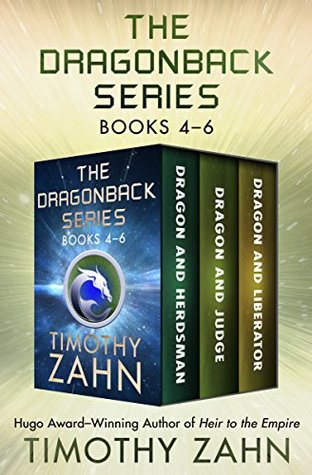
The books are: Dragon and Thief, Dragon and Soldier, Dragon and Slave, Dragon and Herdsman, Dragon and Judge, and Dragon and Liberator, with Jack playing all those roles in his quest to save the K’da. Thus, in addition to the long-term goal there are many short-term ideas pursued as part of the solution, with Jack in turn learning how to be a mercenary, coping with capture and enslavement, shepherding some innocent bystanders while attempting to remain hidden from his foes, and acting as both arbiter and liberator.
The twists and turns that set up each book are beautifully structured to further exhibit both the evolution of the human characters and their strengthening bonds of empathy with their friends, mentors, and symbionts. The strategizing sessions amongst the characters are clever and lead seamlessly to the next adventure. And although the story occasionally bogs down just a little in the details of an individual episode, the momentum never fails to pick up again and carry the characters forward towards their goals. There are also plenty of exciting scenes of battle, both personal/physical and also using their weapons and ships in space to outmaneuver the conspiracy mustered against them.
Altogether, I have seldom read a more satisfying example of story-telling that will engage its intended readers. Librarians, booksellers, and parents, put this series on your list to especially recommend to your teens ages 12-16. (Add it to the books of Anthony Horowitz and D. J. MacHale as a great alternative for reluctant boy readers.) And fantasy lovers of any age, check it out when you want something clever, fun, and action-driven to read.
NOTE: Art is by https://kaenith.tumblr.com/ ©2017.
Read Across America!
Have you ever heard the terms “Sustained Silent Reading” or “Free Voluntary Reading”? They are both contributions of Dr. Stephen Krashen, author of The Power of Reading, whose extensive studies into language learning for English as a Second Language (ESL) students caused him to draw the conclusion that “Free voluntary reading is the source of most of our vocabulary, our ability to handle complex grammatical construction, our ability to spell well, to write with a good style—much of our knowledge of the world comes from READING.” He discovered that “Students who did sustained silent reading on a daily basis did better on grammar tests than students who took grammar classes.”
The other quote about reading that I love comes from Margaret A. Edwards, regarded by most librarians as the first teen librarian. She said,
“Certainly we get essential information from factual books, but it is experience we need most. If we would live richly, we can expand our lives more by sailing down the Nile with Cleopatra, looking at the cherry trees with Housman, or sweating it out to triumph at long last with Moss Hart than we can by gathering all available information on Egypt, raising cherries, or
—Margaret Edwards,
writing for the theater.”
The Fair Garden and the Swarm of Beasts
So today, set aside some time. Make a cup of tea (and maybe furnish yourself with a cookie or two), sit in a nice comfy chair, and enjoy reading for however long you can spare from your busy day! What’s better than sinking yourself into STORY for an hour?
Feel free to post what you’re reading! I am currently making my way through Timothy Zahn’s science fiction “Dragonback” series, a great one for reluctant readers (especially boys) in middle and high school.
Genre assumptions
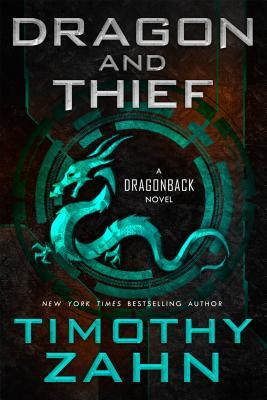
The book I chose to read this week was the perfect example of being led into genre mislabeling by certain aspects of content. The book is Dragon and Thief, by Timothy Zahn, part of the “Dragonback” series. Because of the presence of dragons, and also because of the series title (making it sound like people were riding on the backs of dragons), I assumed going in that this would be a fantasy. After all, dragons are mythical creatures, right? and their presence would probably indicate world-building that involves some kind of medieval setting?
I was dead wrong. The only thing I got right about this book was believing that it would be a solid addition to my list of books for middle school readers, and that I might possibly be fortunate enough to have discovered one that was particularly appealing to boys, who are more typically reluctant readers than are girls at that age.
Dragon notwithstanding, this is science fiction. The dragon is one of a race of poet/warriors (the K’da) who are symbiotic with other select species and need them in order to live. The dragons transform from three dimensions to two, and ride around on (and receive sustenance and life from) their hosts while giving the appearance of being a large and elaborate tattoo—so instead of people riding dragons, it’s the other way around. And all species involved in this book are space-faring, with much of the action taking place on ships and in spaceports and outposts on various planets.
There aren’t too many books with dragons that anyone would consider sci-fi; the dragons of Rachel Hartman, for instance, while able to shapeshift back and forth between their native shapes and human form, are set within a construct that is definitely medieval in nature, as are the conflicts explored in her books. Same with the dragons of Robin Hobb, Robin McKinley, Chris Paolini, Jasper Fforde, and, of course, Tolkien. Even Naomi Novik’s Temeraire books, alternate history in which dragons are the steeds ridden by the soldiers of the Napoleonic Wars, figure more as fantasy than anything else.
The only dragon books of which I’m aware whose author has attempted to claim science fiction status are those of Anne McCaffrey. Since these are telepathic fire-breathing dragons that bond for life with their riders, many have scoffed at McCaffrey’s claims. Her rationale for the premise is that mankind travelled to the planet Pern via rocket ships, only to discover that their new home was beset by deadly spores that traveled from a red planet to theirs in irregular cycles that lasted a decade or two every once in a while; they used their science to take the native fauna they called fire lizards (miniature dragons about the length of a forearm) and super-size them through selective breeding to wipe out the spores by breathing fire on them. (Her premise would be a lot more believable if she had also thought to use science to explain how these spores from the red star survive the unbearable heat of entry into the planetary system only to be destroyed by a simple toasty breath!)
Anyway, back to my middle school series. Zahn’s voice is perfect for his protagonist, who is a 14-year-old thief named Jack. Jack’s parents died when he was little, and his uncle Virgil, an interstellar conman, raised him to be an innocent-looking but precocious assistant for his various illegal exploits, so Jack has lots of talents like breaking and entering, computer program manipulation, and being a quick-thinking fast-talker. But his uncle died a little while back, leaving Jack alone except for the computer that runs Jack’s ship, upon which Uncle Virgil imposed his personality, so that “Uncle Virge” is still in some sense with Jack, imbued with the same sly, evasive, self-serving qualities that his human uncle possessed.
Uncle Virge is unhappy, therefore, when Jack decides to rescue and play host to Draycos, one of an advance team of K’da warriors who landed on a supposedly vacant planet where his people were intending to settle, refugees hiding out from their mortal enemies. Somehow their enemies already knew their destination, however, and managed to destroy all the advance ships and everyone on them save Draycos. Draycos has a few months to figure out what happened and from where, exactly, the threat lies, so that he can return to the main emigration ships of his people and re-route them somewhere safe, and Jack has undertaken to help him.
It turns out, however, that Draycos is at least as helpful to Jack as Jack is to Draycos, given his superb warrior skills. The two of them make a good team—the boy with lots of undercover experience to get them where they want to go with no one the wiser, and the dragon, honorable and principled, who can protect them along the way.

I finished book #1 and proceeded on to the second, Dragon and Soldier, and I plan to keep going with the rest of the series. So far, book #2 is as imaginative and delightful as was the first, my sole complaint being that each book ends rather abruptly so that you feel an immediate need to access the next volume, which is actually a decided advantage when it comes to luring the reluctant reader to keep going. I believe that those middle-schoolers (and anyone who loves science fiction and/or dragons) who discover these books will do just that.
What kind of mystery are you?
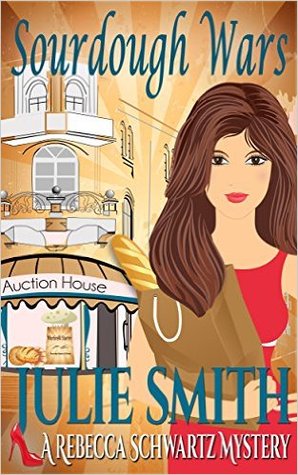
I just finished reading a series of five mysteries by Julie Smith featuring Jewish feminist attorney Rebecca Schwartz as the protagonist and set in San Francisco and surrounding counties, and I’m trying to decide where to slot them in the mystery panoply. They weren’t exactly cozy mysteries, by my definition: A cozy typically takes place in a small town, with a quirky set of local characters (some of whom are up to no good), and an amateur sleuth (frequently a gray-haired grandma) serving as detective. At the same time, I wouldn’t put them up against what I think of as “legitimate” mysteries, such series as the deadly serious Inspector Lynley books or the Harry Bosch saga. But in their way they do for San Francisco what Connelly’s Bosch books have done for Los Angeles—make the neighborhoods and idiosyncrasies of the City by the Bay a familiar and compelling backdrop to crime.
I have to say that I didn’t care much for the first book in the Rebecca Schwartz titles—Death Turns A Trick originates in a modern-day bordello, and the subsequent action and situations are just too ridiculous to be believable, as well as the mystery not being particularly compelling. I probably wouldn’t have revisited the series except for two factors: I had just finished reading a couple of uber-intense, rather lengthy items, and was in the mood for something light and not particularly challenging; and the second book is called The Sourdough Wars, which reminded me fondly of Robin Sloan’s book Sourdough. So I read that one, and was by then caught up in the momentum of Rebecca’s adventures and beguiled by the San Francisco milieu.
The books varied a bit in readability, my favorites turning out to be the latter three: Tourist Trap, Dead in the Water, and Other People’s Skeletons. So I guess you could extrapolate that Smith’s story-telling abilities improve over the course of the series, and I wouldn’t argue with that. I still felt that they were light and kind of silly, but on the other hand the characterizations are solid, the scene-setting is creative (one takes place at the Monterey Bay Aquarium, or should I say IN it?), and the story lines, while not truly riveting, definitely render the reader curious enough to finish them.
The website StopYou’reKillingMe.com ranks these not as cozies but as “humorous mysteries.” There is an element of humor to them; but there are also rather graphic murder scenes, and serious pondering on relationships, feminism, child welfare, and liberal causes. The covers on the re-released paperbacks seem to suggest more of a chick lit vibe, further confusing the issue. The jacket copy cites Janet Evanovich, Joan Hess, and Elizabeth Peters as read-alike authors, so if they are authors you enjoy, then Julie Smith might be for you.
Note that the Rebecca Schwartz books were Smith’s very first series (written in the ’80s); she has since completed two series set in New Orleans, one with Talba Wallis, a female black poet and computer expert as protagonist, the other starring Skip Langdon, a policewoman. Since she is consistent about featuring a female protagonist (and also presumably with the feminism standard set by Schwartz), if a female lead is your preference it’s another reason to seek out her books.

 The Book Adept