Christmas thriller
It’s that time of year when all the people in the Facebook group “What Should I Read Next?” are asking for Christmas- or holiday-themed books. The presumption, of course, is that these will be cozy, feel-good, Hallmark-type stories to foster that precise experience of flannel pajamas and plucked heartstrings by the fire. But who’s to say that a Christmas story can’t be perilous and full of drama?

On the recommendation of Ivy-the-Librarian (one of my colleagues also on FB), I picked up the Libby (OverDrive ebook app) global Big Library Read community book for the month of November, Five Total Strangers, by Natalie D. Richards. It’s categorized as Young Adult, although it should properly be New Adult, since all the characters but the main protagonist are college students. Mira, however, is 18 and still a senior in high school, so I guess that was the determiner. Honestly, though, this book could be enjoyed by anyone who likes a heart-pounding suspenseful ride.
“Ride” is used literally in this case: The back story is that Mira, who has been living in California with her father while going to an arts-based high school, is returning to her mom’s in Pittsburgh for Christmas. While she usually gives herself a lead of three or four days before the holiday to travel, this year she pushed it to the last minute and is flying in on Christmas Eve morning. Unfortunately, due to the onset of a record-breaking snowstorm, she arrives in Newark to discover that her connecting flight has been cancelled and the airlines are sending passengers to local hotels until the skies clear. But Mira is determined to make it home for Christmas with her mom—it’s the first year they will be without her Aunt Phoebe, her mother’s twin sister who passed away a year ago from cancer, and Mira knows that her mother will need support to get through it. So when her seatmate on the flight into Newark says she is renting a car with three other friends and will be happy to drop Mira off in Pittsburgh, Mira jumps at the chance to be a part of the ride-along with Harper, Brecken, Josh, and Kayla.
Harper seems to be a reassuringly mature and well organized person, as well as friendly to and protective of Mira, so Mira feels confident climbing into the SUV with her and her friends. What she shortly learns, however, is that none of the others knows each other—they met at the airport and agreed to share the rental car—and now she is living out any parents’ worst nightmare, your child in a car with four strangers. Who knows what could happen?
In fact, more disasters and drama occur than one could imagine, even in these adverse circumstances. Above and beyond the tension created by the truly terrible weather and the constant driving hazards it presents is the gradual realization that someone in the car is actively trying to sabotage the trip, making such essentials as cell phones and maps disappear just when they are needed the most. But why? This is essentially a locked-room (in a car) mystery, and the ramp-up of stress is palpable. I especially identified with Mira’s conflicting feelings as she went from being determined to make it home to be with her mom to realizing that perhaps her own safety was going to have to take precedence over a picture-perfect Christmas, could she but bring herself to run screaming from the car.
I had some basic caveats as the story progressed: There is too much speculation with no progress or resolution on at least one character, while another is left too vague, considering a role as a major actor in the plot. I was also a bit irritated by some of the too-pat coincidences. But overall, the suspense is well maintained, the red herrings are effective, the breathless quality keeps amping up throughout, and you are poised to let out a tension-generated shriek should a housemate tap you on the shoulder or a pet jump in your lap at a pregnant moment.
If you want a book with a Christmas vibe but without the hearts and flowers, Five Total Strangers is definitely a Yule tale with a different effect! Because this is the Libby book for November, most larger libraries have unlimited copies of the e-book available for remote checkout. Access it, curl up with your cocoa, and prepare to be traumatized.

Hits, misses, ?
This week has been a real mixed bag in the reading department. I started out with a book whose description was really exciting—A History of What Comes Next, by Sylvain Neuvel—only to end up with a did-not-finish (DNF) rating. I then started Beach Read, by Emily Henry, as some light relief, because my Kindle said I had read only 11 percent of it…only to realize partway through that everything was sounding quite familiar. And I finished up with a second book by an author where my first experience was excellent, only to realize that this was a different kind of story than I had expected.

The book by Sylvain Neuvel came highly hyped by many Goodreads folk. Having just finished 11-22-63 by Stephen King, it appealed to me as having a faintly similar premise: There were “people” (aliens) interfering with history to direct humankind to a particular path (in this case, leaving Earth for the stars). I am a big science fiction fan and, unlike some, don’t have a problem with hard science in my fiction. I am also a liker of alternate histories. This book includes science-heavy narrative, historical fiction, stuff about space exploration, a treatment of invisible minorities, mother-daughter relationships, and an intriguing take on aliens. It sounded perfect.
But…for me, at least, it was the most intriguing set-up with the most stultifyingly dull execution ever. The characters were one-dimensional, self-involved, and isolated amongst the true humans, so that you only got to know them through the conversations they had within their own minds. There was angst and personal insecurity (the protagonist is a teenager), a lot of violence, and not much in the way of story. The chain of mothers and daughters that culminates in this book with the 100th generation is relentless in pursuing their goal to send humans to the stars, but they have completely forgotten their origins, as have the other malevolent aliens who are sworn to stop them, so there is no interesting back story to be had, just the endless detailing of their day-to-day battle. Admittedly, I say all of this having read only 45 percent of the book, at which point I decided to cut my losses and give it a DNF. Goodreads people rave about some of the other books by this author, and maybe I will try one someday, but this one left me cold, tired, and impatient.

My experience with Beach Read was pretty funny; when I began it and started to get a feeling of déja vu, I chalked it up to having read books like it before. It wasn’t until a particular meet-cute scene that the light dawned and I realized I had read the book in its entirety about a year ago, and even reviewed it for the blog! I went ahead and finished the second read and enjoyed it this time around as well.
My third experience this week was The Mother-In-Law, by Sally Hepworth. I greatly enjoyed her book The Good Sister, particularly for the development of the character Fern, who really came to life on the page. That book, although billed as something of a thriller, turned out to be more of a family or domestic drama, although it had its tense moments at the resolution. With the description of this book, I was expecting more of a legitimate thriller, since the protagonist’s complicated relationship with her mother-in-law ends in murder…but that doesn’t end up being the case.
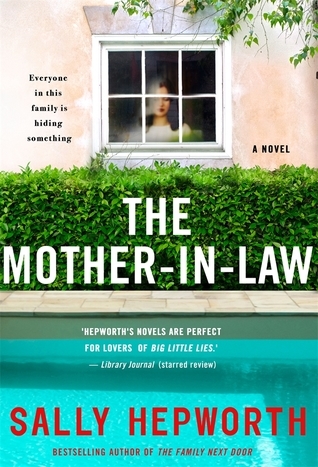
The book is presented (mostly) from two points of view—the wife, Lucy, and her husband’s mother, Diana. It is told by both characters in an equal division between “past” and “present,” the specific time periods sometimes not being noted but at other times being given as a particular year in the life. Because of the set-up, I was expecting a creeping sense of unease about the mother-in-law, culminating in her death and whatever would happen in the aftermath; instead, what is presented is two women with different goals and outlooks who are the victims, in their relationship with one another, of “unmeeting wishes.” Lucy lost her mother early in life and wants nothing more than to bond with a mother figure for a fulfilling relationship, while Diana is a rather aloof and self-contained person, due to her own background in which rejection played a large part, and doesn’t care to engage with Lucy in this way. Lucy sees Diana as cold and uncaring, while Diana regards Lucy (when she thinks of her at all) as self-indulgent and overly emotional.
The supposed central piece of the book—the murder—doesn’t factor much into the rest of the story, and the pool of potential suspects is small enough that I had a good guess fairly early on, though it wasn’t enough of a certainty for me to stop wondering until it happened. I frankly found that whole thread distracting—the book was trying to be too many things at once. There was domestic drama, there were specific agendas it seemed the author wanted to highlight through her characters—and adding the murder into the mix seemed like the author was trying to turn the path of this family saga in a direction it wouldn’t naturally go. (And presenting it as a fait accompli up front took any pizzazz out of its potential as a plot point!) The result, for me, was that I was alternately enthralled and bored, and in the end would have liked more back story and more relationship details and less of the somewhat forced nature of the “thriller” aspect.
I don’t feel strongly enough about it to wish I hadn’t read The Mother-in-Law, but it was definitely not the experience I was either expecting or craving, based on either the book’s description or because of my reaction to her other novel. She is a good enough writer that I will go on to try others of her books, but perhaps without reading the misleading blurb next time!
Another McTiernan

I just finished The Good Turn (Cormac Reilly #3), the third offering from Irish writer (although she now lives in Australia) Dervla McTiernan. I’m not going to have a lot to say in this review, except to note that McTiernan continues this excellent series with no momentum lost, and this third book is exponentially better than the previous, as I had both hoped and predicted.
This one has multiple threads running through it, with stories for both Cormac Reilly and Peter Fisher, and she braids them together seamlessly into one enthralling police procedural. There’s a potentially career-ending disaster for Fisher, followed by exile to his home village and a stint working under his small-town Garda father (whom he loathes); Reilly is caught up in this and scapegoated as a ploy to get him out of Galway for good; and there are story lines with missing girls, drugs, police corruption, villains masquerading as saviors…I love how all the characters are evolving, growing, becoming more clear as people and as officers, and the extra background development she has given to this one makes the story that much richer. Looking forward to the next one!
Altering the past
It’s been many years since I read a Stephen King book; not because I haven’t liked some of them, but for a combination of reasons including a dislike of most horror and a prevailing impulse to call his editor and tell him to automatically edit out 300 pages from everything King writes. There was a time, in my youth, when I gravitated towards gigantic tomes—the longer the better!—and managed to immerse myself until the deed was done. I find these days that I am a bit more impatient, and it takes some really good writing, story-telling, and character/world building to keep my attention.

But…as I have mentioned before, I am a sucker for time travel. Also, for all children of the ’60s, the biggest conundrum was and remains the assassination of President John F. Kennedy, that new, young, charismatic leader whose death was variously chalked up to Lone Gunman Lee Oswald or a mysterious shooter from the grassy knoll, and attributed to J. Edgar Hoover, Lyndon Johnson (impatient to succeed), or the CIA for some reason having to do with Cuba. Put those elements together, and it was inevitable that I would get around to reading 11-22-63 by Stephen King.
The idea of going back in time to kill Hitler or witness the birth of Jesus or whatever has always been out there; but most time travel writers find some unbeatable reason why it can’t be done—like simply stating, “If something happened, then it happened.” otherwise known as the Novikov self-consistency principle. Even if you allow for the possibility of paradox, the problem with changing something in the past is, of course, that it has the potential to alter all future outcomes, so even if it were possible, people might hesitate to do it—unless there was a really good reason. This is the idea upon which King’s book is built—that if JFK hadn’t died, everything would have turned out differently—presumably better (for instance, no war in Vietnam)—and that’s a really good reason to go back and thwart the assassination.
The method of time travel in this book is vague. It’s not even loosely based in science or invention—there’s no time machine, no De Lorean or Tardis, no black hole in space, it’s more like a version of Narnia, reached via a portal at the back of a wardrobe or, in this case, the pantry of a local diner. And it leads to only one place and time, a small town in Maine in 1958. It is from this place and time that Jake Epping, aka George Amberson departs 2011 and takes up residence in the ’50s, making a living as a substitute teacher while he scopes out Oswald, his associates, his various addresses, and his ultimate destination—Dallas, the Texas School Book Depository, and November 22nd, 1963, when JFK drives through town in an open car to meet his fate.
In the process of taking on this quest, “George” will also meet and change the lives of a bunch of other people, and fall for the love of “his” life, small-town school librarian Sadie Dunhill, thereby endlessly complicating what was already nigh impossible to achieve.
All the potential for a roller-coaster ride of a story is built right in, and King provides a lot of exciting moments…and a lot of sitting and waiting. Since the only entry point to the past is 1958, and returning to 2011 means the time on the “other side” resets to 1958, Jake has no other choice but to take on an identity that will allow him to live in the past for five years while waiting for the right moment to take out Lee Harvey Oswald. Even though there is research involved, and even though we are provided with such distractions as a rescue mission for an unrelated family and Jake’s romance with the beautiful but ungainly Sadie, it’s about 700 pages of waiting before we get to the ultimate climax, which then goes by quickly and with much less explanation than this reader would have liked.
Also, you have to keep in mind that even though this is presented as an alternate history, Stephen King is, when all is said and done, a horror writer. He can’t resist adding in sinister bits involving characters or even whole towns that give him the willies; he makes the hero the target of various ill-intentioned people or groups, leading to a fair amount of violence and uncertainty; and history itself is cast as the “monster” of the tale. Jake comments (more than 60 times, as another Goodreads reviewer helpfully provided) on the immutability of the past and its obduracy, and this irrevocable tendency manifests as a series of catastrophes that intervene between Jake and his goal. No, it’s not a clown, but it’s still creepy.
The part I found most disap-pointing is the many oppor-tunities King misses to comment on the time and place as it was; instead, he does a virtual whitewash. Despite some of the threatening characters, questionable neighborhoods, and ominous events, the 1950s are primarily presented as a place where the “real” food tastes so much better (butter, root beer, deep-fried lobster), people in the ideal small town are trusting (leaving their doors unlocked and greeting one another as they walk down the street), and the automobiles are an aficionado’s dream (tailfins). He mentions the ever-present smoking of cigarettes and the bad smells of unregulated industry and diesel-belching transport, yet fails to find them particularly offensive; he gives (and then repeats) exactly one example of the separate-and-unequal state of bathrooms for whites vs. “colored people” but neglects to further notice or comment upon any inequities he sees, whether they be race-related or examples of rampant sexism. I think I could have forgiven this aspect of the book more easily had it been a fast-paced thriller; but there are at least (the aforementioned) 300-400 pages where we wander from New Orleans to Dallas to Fort Worth and back again, pondering what little is known about Oswald, attempting to observe he and his family and his associates, and waiting, waiting, waiting. Some of that waiting could have been more profitably spent.
Ultimately, I did enjoy more than half of this flash to the past…but for all the reasons cited above, I could have loved it better.
More Irish mystery
I was thrilled this week, just when I encountered a lull after the problematic vampire book, to be notified that the next Dervla McTiernan mystery featuring Cormac Reilly had arrived from the library on my Kindle.

The Scholar features Cormac’s girlfriend, Dr. Emma Sweeney, and finally reveals her back story, which I mentioned as a somewhat frustrating absence in McTiernan’s first book, The Ruin. We get more of the details of Emma’s new job, which is as a researcher on an exciting project for Darcy Therapeutics, Ireland’s most successful pharmaceutical company. Unfortunately for Emma, the way we go about getting those details is by her being the first person to come upon the aftermath of a deliberate hit-and-run murder just outside her lab, only to realize that the victim may be one of her colleagues—and not just any co-worker, but the granddaughter of the company’s founder and CEO.
Instead of calling in to the garda station to report her discovery, Emma calls Cormac to the scene of the crime, and Cormac goes against policy to keep the case in order to minimize Emma’s exposure. It’s not that he believes she has any involvement; he is simply trying to protect her from stress. It seems that this isn’t the first time Emma has been involved with a murder, and the move to Galway, the new job, and their burgeoning relationship have had a positive effect on her recovery from that experience. He doesn’t want this new trauma to re-ignite her anxiety, and believes that he can protect her. But the high-profile nature of the case works against him, and soon, as the murder is more closely linked first to the lab and then to Emma herself, Cormac must consider the worst…
This book, like the first, is strong in characterization: We get to discover the nuances of the relationships between Cormac and his equals, his boss, and those he supervises, and certain of them—Carrie O’Halloran and Peter Finch—are becoming strong secondary characters in support of Cormac’s lead, just as his supervisor, McCarthy, and the sour and venomous officer Moira Hanley seek to undermine and discredit him, for reasons both political and personal.
The story line is likewise complex and beautifully structured, with lots of twists and turns and multiple diversions. McTiernan really knows how to craft a story to lead you in the expected direction only to surprise you on the next page, maintaining interest throughout. I like that the mystery is realistic and believable yet not predictable. I feel like my confidence that she would grow more assured with subsequent books is well justified by this one, and can’t wait to read #3, which I just discovered is available (today, anyway) from Amazon for the Kindle for 99 cents! Don’t ask me why it’s discounted, given how good it is, but I snapped that right up. I’ll report back.
Ambivalence and vampires
After not quite embracing the witch book, I thought I’d give some vampires a shot, as my last read of October. But the one I picked…well, let’s just say it’s not what anyone would expect from a story about the undead.

Matt Haig’s The Radleys features a middle-class family living a somewhat suffocating existence in a small, declining village in North Yorkshire. Helen and Peter used to travel in the fast lane in London, but decided, once they married, to move to suburbia to raise their children, Rowan and Clara, who at this point are both in high school. Helen seems like your classic up-tight suburban mom, while Peter is showing signs of mid-life crisis in his yearning after his neighbor, Lorna. Rowan is painfully shy, has a nearly constant headache, suffers from various skin rashes, and is bullied relentlessly by the jocks at his school; Clara is trying to save the planet by going vegan, but nothing she eats seems to agree with her poor stomach, and she gives a convincing imitation of someone suffering from bulimia.
Despite her poor health, however, Clara still has the spirit of the rebellious teenager buried deep within her, and manages, in a moment of inattention from her father, to get permission to go to a party. This proves to be the pivotal event of the story: A drunken lout attacks her and tries to rape her, and she bites him on the hand with which he is covering her mouth. Suddenly, Clara is no longer feeling weak and sickly, and manages to fight back very effectively…because the one thing their parents neglected to tell Rowan and Clara is that they have made the choice for the family to live as “abstainers,” but what they are denying is vampirism! When Peter calls upon his brother, Will, an unregenerate blood drinker, to come sort out the tricky situation with Clara, their secret, restrained lifestyle is upended and new choices have to be made.
Well, first of all, I was somewhat disappointed because I picked out this book based on the name—I thought maybe someone had written the back story for the character of Boo Radley in To Kill A Mockingbird! (You have to admit that it would make sense for the pale and reclusive Boo to turn out to be a vamp!) No such luck. Maybe someone will write it someday, however, after this book in which the name “Radley” is revealed to be that of an old vampire family of natural-borns.
The premise of the book—that vampires could choose to be “vegetarian”—echoes the choices of the Cullens in the Twilight saga—no eating the neighbors, utter secrecy, etc. But in those books everybody gets to choose, while in this one Rowan and Clara are miserable because unaware of and without access to their true natures. Also, although everyone in the family (except the martyr Clara) eats a lot of meat, it doesn’t seem to be an option to drink animal blood, which I found peculiar.
The truth is, this isn’t so much a book about vampires as it is about bourgeois values: The well-behaved Brits are fighting their baser instincts in order to lead an upstanding existence by engaging in a lot of typical repression. What it is they are repressing is supposed to make it more interesting, but I felt like that in some ways they were just too stereotypical to make it work. The middle-aged malaise about sex with one’s long-term partner, the yearning over the forbidden neighbor (or wicked brother-in-law!), the hasty steps taken to keep what’s really going on a deep dark secret—even from their children—doesn’t explore much new ground. I was thrilled when Clara finally bursts her restraints, but that had to be covered up like everything else.
The various temptations that present themselves once the truth comes out result in both triumphs and tragedies for the conflicted Radleys, and there is an eventual resolution…but by the time it happened I had become wearied by all the dithering. The writing is both descriptive and clever, and there are some dark moments and some redemptive ones that appeal, but ultimately it felt like just another story about child abuse, with parents deciding for their children who they are to be without ever consulting them. That may sound like a harsh conclusion to draw, but when you find yourself applauding as the dainty teen protagonist takes large chunks out of the school bully, well…there’s just something not quite right about that!
Witchy? or whiny?
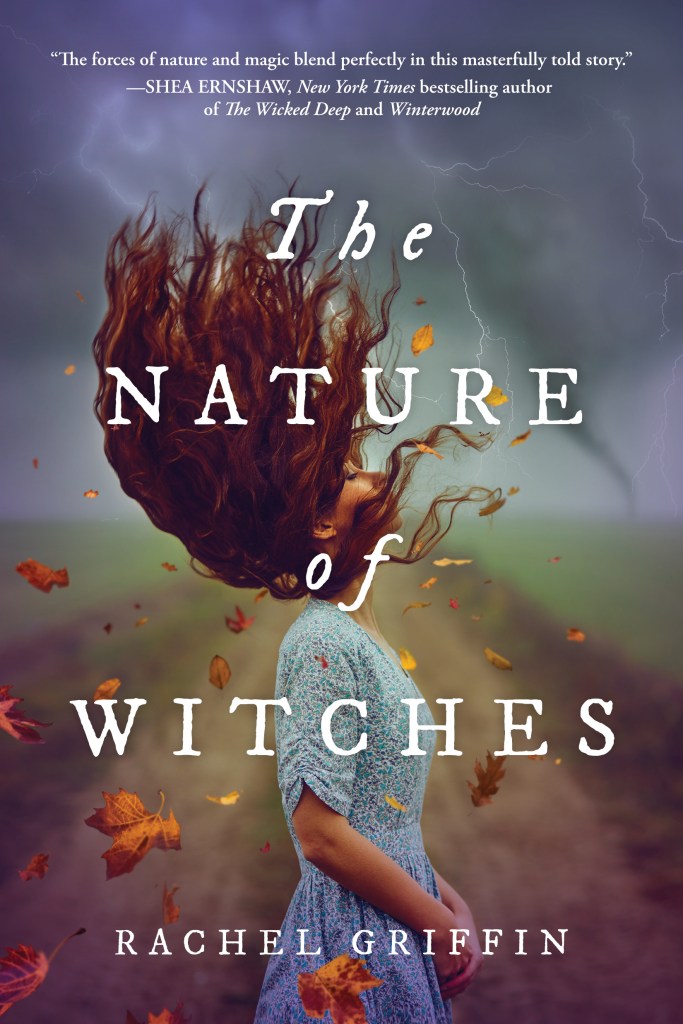
I will be teaching Young Adult Literature at the UCLA library school again this coming spring quarter, so I am starting to gear up for that by trying to catch up with a couple of years’ worth of teen fiction. Although I teach the history of the literature, I also like (and need) to be up on the latest thing in as many genres as possible. This week I chose a fantasy/paranormal by a first-time author—The Nature of Witches, by Rachel Griffin—partly because, well, it’s October! Time for witches.
The book has an interesting premise: There are weather witches, who are each attuned to a particular season—Spring, Summer, Fall, or Winter—and their gifts allow them to manipulate both the weather and the well-being of the earth, in ways that specifically relate to that season. So Spring-born witches, for instance, are skilled at digging their fingers into the earth and making plants spring from seeds and grow to maturity in whatever time period they wish, while Winter-born witches are better at manipulating water, making it rise up out of the ground into the atmosphere, creating storm loops that provide more precipitation. All witches draw their power from the sun.
In their world, as in ours, the populace is in general ignoring climate change, and its effects are worsening. In this story, the depredations to the earth by greedy developers and exploiters are beginning to outweigh the witches’ abilities to preserve the status quo, and witches are burning out attempting to keep the earth from spiraling into a decline. The general population of non-witches are called “shaders.”
The protagonist of the book is Clara, who is a rare and special “Ever” witch—that is to say, she has an affinity with all seasons, not just one, and can use her powers no matter what the season, while those identified with a particular quarter of the year are powerful during those three months and much more helpless during the other nine. But Clara doesn’t have good control of her powers; she has, in the past, injured or killed people when she unintentionally diverted her power and overwhelmed them, and as the book opens, she is considering staying outside during a total eclipse, which would strip her of her powers, in order to be able to live a normal life. But the fact that she is an “Ever,” able to work in every season and to harness powers not available to regular witches, means that this would be an incredibly selfish act on her part, so she is torn.
On Goodreads, I rated this a three, for concept, and also for some of the truly beautiful visual images the author presents as a part of her earth-loving witches’ consciousness. But you could definitely tell that this was a first effort on the part of the author, without some of the world-building skills necessary to a good fantasy, and also with a particular kind of teen vibe that, while common in YA Lit, is neither endearing nor enjoyable.
I loved the idea of weather witches, and having them be identified with one season, with all those season’s priorities and perspectives, was effective. Also effective was to have the one “special” witch, the “Ever,” as the protagonist. So far, so good. But to characterize everyone not a witch as a “shader” and give so little attention or perspective as to who the “shaders” are (yes, we know, the “common person,” but there’s a big spectrum there!) was to slight the entire background of the story.
First of all, am I being obtuse when I don’t comprehend how the word “shader” relates to ordinary non-witchy people? I don’t get the term. Second, although it is mentioned multiple times that the shaders have ignored the limits of the witches’ abilities to maintain the world in their eagerness for continued expansion and growth, there is little attention paid to how those communications between the two factions take place, what specific warnings have been delivered, who is in charge, etc. There are a couple of organizations mentioned by name and subsequently by initials that you have to keep looking up because they are so unmemorable, but nothing is included about their interactions except that, latterly, shaders are “beginning to pay attention.” Not good scene-setting. We needed more detail, some history of association, some BACKGROUND.
As for my second caveat about the specific teen nature of the protagonist…what I am talking about is a self-involved view of the world that relates anything and everything back to the feelings and emotions of the main character. The world revolves around her, and her obsession with her powers cuts in front of any regard she may have either for her loved ones or for the world at large. Yes, she spends a lot of the book protesting that she would give up her powers in order to keep her loved ones safe…but then she continues on, justifying and hedging her bets and putting them in danger anyway, only to cut them off again when playing with her powers gets her in trouble. And she continues to muse fatalistically on the necessity for her to be stripped of her powers in order to live a happy life, regardless of how it would deprive the earth at large of a savior of whom it has desperate need. In other words, she’s selfish, self-involved, myopic, and kind of whiny!
Far from being reserved to this particular book/author, this kind of character is prevalent in a percentage of teen-directed fiction, and although a certain amount of the observation of teen behavior and (lack of) emotional maturity may be true and accurate, it’s not fun to read. I’m not saying that authors shouldn’t write teens authentically, only that there might also be a little bit of aspirational imagining of them as rising above those thought patterns and behavior, and not at the end of an interminable 300+ pages but nearer the beginning!
This book got some enthusiastic five-star ratings, and I’m betting a lot of those are from teens who felt the romance and allure but didn’t mind the erratic and selfish thinking so much. But I would have enjoyed more back story and less angst. I call this “dithery fiction” because we spend the entire book listening to the character saying “what if” but taking forever to settle to a decision. Yes, she shows moments of resolution…which dissolve like sugar in water at the first sign of opposition, and then it’s reset: start over, dither some more. It’s ultimately so tiresome that it makes it hard to enjoy the rest of the story.
(I did like the cover image!)

in the meadow where she and Sang meet.
Happy endings

I suppose it’s slightly ironic, given that my last post was an enthusiastic recommendation for half a dozen Regency romances, that I don’t normally care for books with blatantly happy endings. Given that statement, it’s even more unlikely that I would bother to pick up a book actually titled The Keeper of Happy Endings. But Barbara Davis combined several elements that lured me in, including the presence of Paris as one backdrop for the story, an artist whose dream was to open a gallery, a seamstress who created couture wedding gowns (yet another form of art), and historical elements set in World War II.
The basic set-up for the story is that it takes place partly in the present day, which in this book is 1985 Boston, and partly (in flashback) during the middle years of World War II, in German-occupied France. It brings together two women who share a similar tragedy in their lives: Soline Roussel, whose fiancé drove an ambulance for the Red Cross in France, and went missing, presumed captured and killed by the Germans; and Rory Grant, whose fiancé is kidnapped, presumably for ransom, while working in the Sudan for Doctors Without Borders.
When the story opens in 1985, Rory’s fiancé, Hux, has been gone for about six months with no word of his fate. Her life has become a waiting game, and she has dropped all pretense of continuing without him; although she is supposed to be preparing for a return to college in the fall, followed by an internship in Paris, she sits at home and reads romance novels, for the distraction and also because she hopes for her own happy ending.
In flashback, Soline Roussel is a young woman working with her mother in their bridal salon. Generations of the women of her family have created “lucky” wedding gowns: a “wish” or charm is embroidered into the dress, and so many of the brides who marry in a Roussel gown end up with good relationships and generally lucky lives that the women (and gowns) have gained a reputation for magic. But the onset of World War II and the occupation of Paris by the Germans has put an end to the business and, after her mother dies of cancer, Soline is at loose ends. She ends up volunteering at a hospital, where she meets Anson Purcell, a Yale man from Boston who drives an ambulance, and he soon becomes the love of her life. Fearful that the Germans will capture Soline and use her against him so that he will reveal details of the Resistance work in which he is secretly involved, Anson sends her off to America
Back in the present day, the two women come together when Rory decides that she will revisit a dream (in which Hux encouraged her) to open an art gallery to exhibit previously unknown artists, and discovers the perfect location for it, the former bridal shop (in Boston) belonging to Soline Roussel. The building was decimated by a fire four years previously, and was partially rebuilt but remains empty. Rory persuades the reclusive Soline to lease it to her and, in the process, Soline recognizes a kinship between herself and the heartbroken girl, and a friendship is born.
This book has a lot going for it. There is a nice balance between the story in the past and the one in the present. There are complex relationships, notably Rory’s with her mother, Camilla, and Soline’s with her own mother and also with Anson. The historical details of the flashback portions of the book feel real and explore some uncommon details about World War II . I wished for more information about Soline’s career in couture as well as the methodology behind Rory’s chosen art form, but both were adequate to the story. The romance was satisfying. There were interesting twists and turns that kept me reading until far later than prudent into the early morning hours.
Are you sensing a “but”? Well…in many ways this was a beautiful and complex story that I wanted to love. But at a certain point, things became too predictable and certainly too coincidental to suspend disbelief, and I know, I know, I should have seen it coming from the title of the book, but the wrap-ups and happy endings for so many of the characters set my teeth on edge. Yes, there is a part of me that thrilled to the fulfillment of everyone’s dreams; but there is a reason I don’t read much romance, and it’s this: There is also a cynic in me that flat-out doesn’t believe it, and wants the complexity of a partial fail or, at least, a tiny bit of the unknown to remain.
I will, therefore, give a qualified recommendation for this book, which is, if you are fond of the perfect ending, especially after a lot of intervening suspense about what will happen, you will adore it. But if you are like me, with an inbred cynic who sits on the sidelines and scoffs, then you will like it, but not nearly as much.
Recap of heroines
I am sure that I have enthused on here about the Regency novels of Georgette Heyer far too much for most people’s taste, so I’m going to just plant a teaser and let you do what you will: I did a re-read of The Convenient Marriage this week, in between other books, and it made me think about which are my favorites of hers and why, and it all has to do with the protagonist. I’m sure you could say that about many books, but with these, in particular, if the main character doesn’t shine, it’s going to fall flat, no matter how beloved the genre, period, scene-setting, etc. So here are mine (and some double as the name of the book):

ARABELLA
FREDERICA
SOPHY (from
The Grand Sophy)
HERO (from
Friday’s Child)
HORATIA (HORRY) (from
The Convenient Marriage)
NELL (from April Lady)
KITTY (from Cotillion)
And yes, upon reviewing these, it has also to do with the male leads: Mr. Beaumaris, the Marquis of Alverstoke, Viscount Sheringham, the Earl of Rule, Lord Giles Cardross, and Freddy Stanton from Cotillion, who is the best anti-hero ever.
So I guess, if pressed, these would be my favorites out of the 28 (?) she wrote (in no particular order, except that the one I’m currently reading is always the favorite!). If you’re not a complete ninnyhammer, you will read them and see for yourself!
The birthday of the world

…is the title of one of Ursula K. LeGuin‘s short stories, and today is (or would have been) Ursula Kroeber LeGuin’s 91st birthday (she passed away in 2018 at age 88). I am moved to talk a little about her legacy on this significant date because she is one of my favorite authors and has had a profound affect on both my reading tastes and general philosophy over the decades since I began devouring her stories, novels, essays, and writing manuals.
LeGuin was the first woman to win both the Hugo and Nebula awards for her fantasy and science fiction, going on after that to win seven more Hugos, five more Nebulas, and 22 Locus Awards. In 2003 she was honored as a Grand Master of the Science Fiction and Fantasy Writers of America, after a controversial career in which she defied many of the traditions of this organization and its members.
She was perhaps best known for her fantasy series about the land of Earthsea, which embraces the theme of equilibrium in a coming-of-age saga, and for her extremely forward-looking book about gender and identity, The Left Hand of Darkness; but she wrote more than 20 novels and 100+ short stories, as well as poetry, essays, translations, literary criticism, and children’s books. Prominent social and political themes ran through most of these, including race, gender, sexuality, and political/social structure, and her named influences were varied: cultural anthropology, Taoism (she made her own translation of the Tao Te Ching), feminism, and the work of Carl Jung.
Some of the seminal ideas in her books include the concepts of equilibrium or balance, the reconciliation of opposites, and the necessity for leaving things alone, exploring sociology, psychology, and philosophy through her characters’ experiences. Likewise her writer’s voice was distinct, using unconventional narrative forms. Literary critic Harold Bloom described Le Guin as an “exquisite stylist,” saying that in her writing, “Every word was exactly in place and every sentence or line had resonance.” According to Bloom, Le Guin was…
…a visionary who set herself against all brutality, discrimination, and exploitation.
Harold Bloom
If you are unfamiliar with her writing, I urge you to seek it out. I have probably read the original three of the Earthsea trilogy half a dozen times (and the subsequent sequels at least thrice), and I re-read her book The Dispossessed, a moving personal treatise on anarchy and utopia, at least once a decade. Her Hainish novels are delightfully engaging story-telling, and the last one, The Telling, was the catalyst that sent me off to library school in my late 40s. Her short stories, mainstream fiction, and poetry are likewise intriguing, and as an essayist she can’t be topped. Introduce yourself to her books, or recall the ones you remember fondly and revisit them as a tribute to a giant of literature with, as author Michael Chabon wrote after her death…
the power of an unfettered imagination.”
michael chabon


 The Book Adept