
Discworld
As I mentioned in my Cat Day post, I continued on with Terry Pratchett’s witch tales by reading Wyrd Sisters, and then when I finished that I ducked out of the witch-specific books and instead assayed Mort, the first of the series with Death as its narrator.
For me, although I love the witches themselves, the most delightful part of Wyrd Sisters was the traveling actors with whom a certain very important player in the fate of the kingdom of Lancre shared a river boat, a wagon, and a stage. His talents there also serve him well when it comes to inhabiting his true destiny on Discworld, but the descriptions of the individual performances, some untrammeled but others under the influence of the witches’ meddling with time, are hilarious homages to Shakespeare.
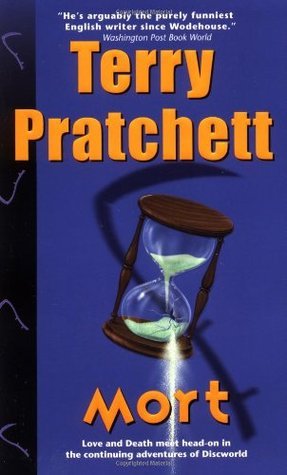
The brief cameo of Death in this book led me to read his shared autobiography with young Mort, whom Death solicits as an apprentice of sorts, so Death (or DEATH, as he is known colloquially) can take a vacation to experience what it’s like to be human. He assiduously takes part in all the pursuits that humans seem to enjoy most (fishing, drinking, and so on) and is somewhat underwhelmed. But while he’s off getting his human on, Mort is messing with the fabric of time, destiny, and fate by refusing to off some of the people whose hourglasses have run out. Mort is horrified by the prospect that he might have to inhabit this role forever if DEATH continues AWOL, and takes steps, assisted by DEATH’s adopted daughter Ysabell.
I think I can sum up Pratchett’s sense of humor when I tell you that DEATH’s pale stallion that he rides across the wind and stars to usher souls into the next world is named Binky.
While I generally prefer books with more gravitas, I can see that an occasional foray into the bounds of Discworld will be a welcome vacay read for some time to come.
One fierce moggy
I forgot about my usual post of cat stories for International Cat Day (today), so I’m going to do an abbreviated one honoring a single cat from the book I’m currently reading.
Wyrd Sisters, by Terry Pratchett, is one amongst 40-odd books of his Discworld series, but is also second of the six “Witches” books contained within that larger saga. It features Granny Weatherwax, Nanny Ogg, and young Magret, who get themselves into some good trouble when they decide to meddle with politics in the kingdom of Lancre, in which they reside.
Playing an important role in bringing together the witches with the ghost of Lancre’s former ruler is the cat Greebo. He is a one-eyed, foul-tempered gray tomcat who has aggressively fathered about 30 generations, but Nanny Ogg still characterizes him fondly as her sweet kitten (although privately she has been known to refer to him as a fiend from hell).
He features in other books of the series as well—Witches Abroad, Lords and Ladies, and Maskerade. At one point he is transformed into human form, but maintains his scars and his retractable claws, and exudes the raw animal magnetism that allowed him to claim paternity to all those descendents; but he is still handicapped by a cat’s inability to work door handles, and has an unfortunate and disconcerting tendency to groom himself with his tongue.
There are some illustrations of Greebo online, but they are copyrighted so I don’t like to poach. So here, instead, is a photo of my old feral cat, Papi, who was likewise tough, one-eyed, and prolific. He and Greebo were, as the Brits would say, fierce moggies.

Happy International Cat Day!
Pratchett

I don’t know how, in my decade-long exclusive pursuit of all things science fiction and fantasy, I managed to miss out on Terry Pratchett. I discovered some of the contemporaries to whom he is frequently compared (Douglas Adams, Piers Anthony), but it took another 30-some years and a degree in library information studies before I was introduced to him via the Tiffany Aching portion of the Discworld books. As a teen librarian, Pratchett came to my attention through the offices of The Wee Free Men; I was really taken aback when my high school book club didn’t love it as much as I did, but I didn’t let that deter me. I read every Tiffany Aching book (five total) that was out or came out thereafter, and loved them all, but for some reason I still didn’t go back (as I normally would) and explore all the other Discworld books.
Perhaps it was because of the sheer volume of the series—41 books is a lot to tackle, and I no longer read with the obsessive one-track mind that I did in my 20s, when I let nothing stop me from completing a series start to finish. But I was at extreme loose ends this week after finishing In This House of Brede; I initially moved on to another Rumer Godden but discovered that i was satiated for the moment and was craving something different. None of my holds are even close to arriving, so I went searching for something else by running my eye down my “Want to Read” list in Goodreads.
This is when I most miss being mobile; my finding process used to entail going to the library and looking at the new books and the just-returned shelves, and then wandering down aisles of my favorite genres—mystery, fantasy, science fiction—to see if old authors had new (or older) works I hadn’t yet discovered. It’s a lot easier to find an unknown treasure that way than it is to scroll through lists on the internet, as I do now that I am essentially housebound. There are the visual, physical, tactile elements of cover art, author quotes, flap summaries, the feel of the paper, the choice of font, the smell of the book, all of which yield up something that helps me make a decision. By comparison, it’s a sterile (and also endless) process to scroll through (sometimes erroneous) Goodreads descriptions, look at the ratings posted by other people, and speculate about whether I can choose something just based on these paltry factors.

This is partially what took me to Terry Pratchett—there was at least some experience, some familiarity with his story-telling and writing style, his characters, his world-building. I did pay heed to several people who said the first two books in the Discworld series, while introductory, were not his best writing, and that to start with #3 was a good beginning, particularly because it is also the debut of Granny Weatherwax, with whom I was already familiar from the Tiffany Aching books. So I acquired a copy of Equal Rites from Kindle Unlimited, and began my exploration of Discworld.
One thing you forget, if you go long periods between Pratchett tales, is his sense of humor and how he exploits old sayings, puns, wordplay. And even though Pratchett’s powers developed exponentially as he wrote each subsequent book, the humor is here from the beginning. The first one I wanted to write down the instant I read it was when Granny Weatherwax decides to find accommodations in a new town; she comments that she has specifically elected to live in an apartment next door to a talented and successful purveyor of stolen articles, because she has heard that good fences make good neighbors. Ba dum bum.
Equal Rites is the story of young Eskarina, who is mistakenly selected to be an heir to wizardry. A wizard comes to Granny Weatherwax’s village of Bad Ass seeking the child to whom he is to hand over his staff before his imminent demise; the smith of the town is an eighth son whose wife is about to give birth to his eighth son, which is highly propitious. So when the wizard realizes he has six minutes to live and Granny, having just delivered the baby, carries it into the room, the wizard places the child’s tiny fingers on his staff to claim it, and then expires before he can discover that the eighth son is actually a girl.
On Discworld, gender equality is a dream—at least for women. Only men are wizards, just as only women are witches. Men have, of course, tried being witches (because they don’t take no for an answer), but it has never worked out well; but those same men have banded together and insisted that “the lore” absolutely forbids women to be wizards, and no woman has ever been admitted to Unseen University as a candidate. Granny W, however, is determined that Esk should at least have the chance (as is Esk herself), so the two set out on a journey to the city of Ankh-Morpork, for Esk to try her luck. This is the basis for the chaotic hijinks that ensue for the remainder of the book.
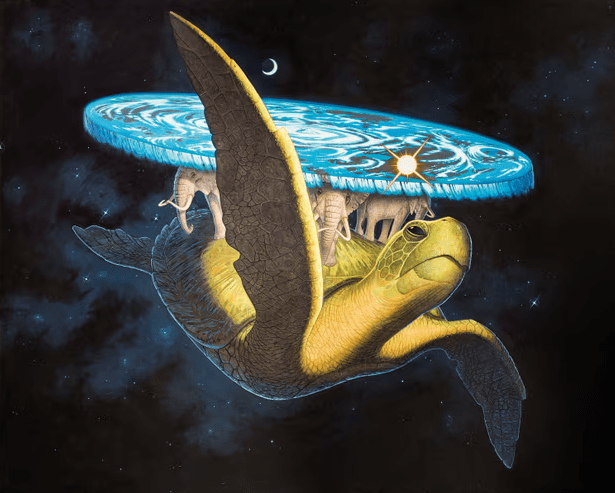
I really enjoyed both the introduction to Discworld and the reacquaintance with Granny W. (and with Pratchett). I think I will continue on for a while; they say you can just read the “witch” books (of which there are six) on their own, but I might also branch out into other characters’ tales set on this flat world carried on the back of a giant turtle and four elephants.
Harking back
After I finished the latest Vera Wong, I decided to reread yet another of Rumer Godden’s books. I recently described the plot of In This House of Brede to my cousin, and it made me want to experience it again for myself after so long. It was kind of a masterpiece of its day, although it’s a weird book for an atheist/agnostic like me to enjoy so much, considering that it’s about the life of a cloistered nun and her abbey; but I have a soft spot for it because it was my introduction to her writing.

I remembered finding it on my parents’ bookshelves, which is equally strange, because as fundamentalists, they didn’t even consider Catholics to be Christian. But I finally figured it out: My parents loved to read but weren’t good about going to the library and also didn’t frequent the bookstore. My mom did, however, have a subscription (de rigueur back in the 1960s and ’70s) to Reader’s Digest Condensed Books. During the long, sometimes boring summers of my youth (I was an only child in a neighborhood with no other kids my age), I would lie on the floor of my dad’s study and devour all the stories contained therein, and that was how I happened upon this book. (I was amazed, in later years, to pick up and read the uncut versions of some of those books and realize all that I had missed!)
The book begins with the protagonist’s life-changing decision to give up her exceedingly busy and successful life to try to become a cloistered Benedictine nun. Philippa Talbot is 42, a widow who has made a great success in a government position in finance in the days after World War II when she would have been the only woman in the room who was not taking dictation. The story begins with her leaving her job on her last day—handing out her treasured possessions to some of the people who worked for her, entrusting her cat to her beloved housekeeper of many years, and getting on a train, with one small carry-on bag, to travel to the 120-year-old abbey in Sussex in the south of England. Should she successfully stick out her years there as a postulant and a novice, receive her preliminary clothing, and take her final orders, she would become a permanent fixture for life at Brede Abbey.
The humanity of each of the characters strikes you from the first page. The interaction between Mrs. Talbot and the young secretary from the typing pool; her detour, once she gets off the train, to the nearest pub for a last whiskey (or three) and a farewell cigarette; and her admission through the door into the enclosure, surrounded by the entire community (90-some nuns) in their wimples and habits, is vivid and engaging.
The story remains so throughout. It is a neat balance; it depicts life within the walls of the abbey—the structure of ceremony and ritual, the customs, the traditions, the pageantry—but it also focuses in on each of the characters, describing the tests, the deprivations, the stumbling blocks, and also the joys as they struggle to live with purpose, outside of the mundane world of competition and financial success. The nuns and other characters are beautifully drawn, both individually and in their complex interactions with one another. The back stories are not dictated in a straightforward way, but are instead dropped here and there between the recounting of the current day-to-day life of the cloister, giving the entire book a freshness and cohesion despite the rapid switches in time and perspective.

It is an earnest look at the examined life of a community formed by diverse personalities who share a world view, but it is also a gorgeous, colorful kaleidoscope in its descriptions of the minute details of living in this world with its sights, sounds, thoughts, and feelings. The sacred and the mundane are present in equal measure, as are Godden’s luminous observations of the natural world and the beauty to be found in a cherry tree against the sky, a soaring lark, a stone statue, or the transcendent face of a soloist whose voice rises to the rafters in devotion.
It may not sound like your cup of tea, but you never know; it certainly gave me a few totally absorbed afternoons, and this was for the third time!
The Wong way

Vera Wong rises to another occasion in Vera Wong’s Guide to Snooping (On A Dead Man), by Jesse Q. Sutanto, the second (but hopefully not the last) in the saga of this intensely curious proprietor of a Chinatown tea shop in San Francisco. (The first was Vera Wong’s Unsolicited Advice for Murderers, reviewed here.)
Although the dead body didn’t land on the floor of her shop this time, he did, in some sense, seek her out. When Vera pays a visit to the police station to see Officer Selena Gray (the woman she hopes will marry her son, Tilly) about a problem of her own, she notices a troubled girl lurking outside the station, pacing back and forth and wringing her hands but unable to bring herself to enter. Vera knows, as a Chinese grandmother, that it is her duty to interrogate, er, offer a sympathetic ear until the young Millie gives up whatever is bothering her, so Vera takes her back to the shop for a sustaining cup of tea. Millie tells Vera that her best friend, Thomas, is missing…but Vera knows there’s a lot Millie is holding back.
That weekend, while cat-sitting at their apartment for Tilly and Selena, Vera discovers a treasure trove of information (she looks at the files in Selena’s briefcase) about a young man who has been fished dead out of Mission Bay, presumably a suicide, and although the man is listed as John Doe, it soon becomes clear that this is Millie’s missing friend. But as events progress, we learn that he had a public face as well, under a different name, as a prominent “influencer” on social media; four other people besides Millie who have possibly suspicious connections to the dead man convince Vera that this was murder, not suicide. Vera, bored since her last adventure as an amateur sleuth, jumps in with both feet to meet, interrogate, and adopt her new list of suspects into the chosen family she acquired the first time around. Despite Selena’s warnings to stay out of her investigation, Vera is determined to be one step ahead of everyone in figuring out this mystery, thus proving she is as intrepid at solving it as she was last time.
I think I liked this book even better than the first, which I thoroughly enjoyed. Vera has no filter, and her misunderstanding of American slang and her slyly manipulative cozening of people to get what she wants—which also usually corresponds to what they need from her—provides a lot of humor. It also lets us get acquainted with the cast of characters much more quickly as Vera grills them mercilessly in her quest to solve the murder. But although she can be a bit much, Vera makes up for it with her caring, which she exhibits in her preparation of vast quantities of food and tea for all and sundry. (Don’t read this when you’re hungry. You will immediately spend a fortune on DoorDash, and then be disappointed that it doesn’t measure up to the cuisine of Vera Wong.)
I was initially a little put off by yet another book with a prominent character who is an Instagram influencer, especially having recently read Sutanto’s previous book You Will Never Be Me, which was a much darker tale about two women obsessed with their online presence as “momfluencers.” But before I decided to put it down, I was drawn further into the story as each subsequent character revealed what they knew and a complicated back story emerged about the actual life of “Thomas” that led to his death.
I loved the moments in the story when each member of the motley crew that Vera assembles has the realization that…
“[L]ife gets much easier when you hand over the reins to Vera.”
Some on Goodreads said they didn’t like it that Sutanto took the story in that more serious direction, but I felt it was the perfect balance—a cozy with substance when it comes to societal issues such as family relationships, loneliness, generational differences and expectations, and also the fatal effects of greed and exploitation. It had a little bit of everything, but for me the Wong way was the right way, ha ha!
And, judging from the closing chapter, we may not have seen the last of Vera…and the next adventure could take in a much wider world than San Francisco’s Chinatown!
Perfect stone fruit
Halfway through my reading of The Mare, my checkout period at the library ran out, and I couldn’t get the e-book back on my Kindle for about a week, so I took a break and read something else. I think reading The Mare may have provoked a subconscious connection to this book, which is also a coming-of-age story with a narrator on the cusp between child and teenager, but at a time when a “teenager” wasn’t what it is today. It is a book I have read before, but not for about 30 years, so the story has its place in my memory but has softened and faded to the point where I could experience it fresh.

The Greengage Summer, written by Rumer Godden in 1958, is the story of a mother with five children who, at the end of her rope one summer, impulsively decides to pack them all up and take them to France—not as a reward, but to show them the battlefields and mass graveyards there in the hope that they will all become less obnoxious and selfish! There is a father, but he is a botanist who travels extensively for his work, leaving his family behind in Southstone, a provincial English village in which they live a thoroughly mundane existence under the watchful if stodgy eye of their Uncle William. They are not a well-to-do family; they wear uniforms to school and the rest of the time mostly hand-me-downs from their next eldest sibling, and their weekly pocket money is counted out in pence, not pounds. The children range widely in age: Joss is 16, Cecil 13, Hester 10, Willmouse (the only boy) is eight, and Vicky is five.
The family takes a long and exhausting train trip down to the Vallée de la Marne, in the Champagne district of France, their destination the Hôtel les Oeillets, a small pension in the countryside. But during the journey, the mother is bitten on the leg by a horsefly, and by the time they arrive she is so ill that she must be hospitalized with blood poisoning. The patronesse, Mademoiselle Zizi, is inclined to cut the children loose (despite their being unsupervised with nowhere to go), but Elliot, an English guest at the hotel, is prevailed upon by the mother to keep an eye on her family until she returns from hospital, so the five move in and start their holiday in France under his casual supervision.
None of them save Cecil speaks any French (Cecil had to learn endless French poems by heart as punishment for poor schoolwork, and it stuck with her), and all of them approach the holiday on their own terms. The book is narrated by Cecil, with insights provided both from her own observations and from the experiences of her siblings. Cecil is sitting squarely at that transition point between child and adult during this summer, while her sister Joss has suddenly crossed over to that place held by beautiful young girls in the first flush of their power as women. The others, known to the family as “the littles,” also go through some changes, as they all encounter their first introduction to an adult world in a different culture, untrammeled by the careful routines of their normal lives.

The name, The Greengage Summer, comes from the fruit orchard that is part of the grounds of the hotel, where greengage plums are ripening on the trees and plopping to the ground, begging to be consumed by the children who laze under their shade in the long afternoons by the river Marne. And like the fruit, the summer is filled for the children with flavor and sweetness that surrounds some hard stones or truths at the core.
There is more to the story—undercurrents, background information, and a mystery in which both the residents and the guests become caught up—but I don’t want to give away too much, because the book is a delight to read and I am happy to have rediscovered it, for myself and for those who read my reviews and might pick it up based on this introduction. In addition to story, there is a specific rhythm and artfulness in the way Godden tells a tale that makes me happily revisit most of her books, and this is one of my top five (out of the 60 she wrote). It’s also a great read to choose for the hot, languid month of August.
The characterizations of everyone involved—the children, the hotel employees, the guests—are wonderful, diverse and memorable, and the mood she creates of this leisurely sun-filled holiday fraught with dark undercurrents is engaging in the best way. It may be that switching over to this book halfway through my reading of The Mare is what gave me a certain dislike for and disappointment in that story, because The Greengage Summer has everything I love in a perfectly realized arc, right down to the last line of the novel.
The Mare (the girl)
Having read Horse, by Geraldine Brooks, a few months back, when someone recommended the book The Mare, by Mary Gaitskill, I was primed to read it, especially because the teenage main character was named Velvet, immediately transporting me back to the joy of reading National Velvet in my childhood. And, similar to that book, this story was about a disadvantaged child whose encounter with horses changes things for her, although the child in this one is a much more extreme example. I didn’t grow up in a financial or social environment that would indicate the need for escape, but I was an introverted, solitary child who longed for the connection with horses in lieu of any relationship with people, so books like this spoke to me, and still do.

Velvet (short for Velveteen) Vargas is the daughter of a single mother, Sylvia, an immigrant from the Dominican Republic. They, along with Velvet’s little brother, Dante, live in Crown Heights (an inner city section of Brooklyn), and it is a limited, hand-to-mouth existence. Sylvia is hard and bad-tempered, shaped by the fearful responsi-bilities she has been forced to take on from a young age, and she is alternately loving, manipulative, and abusive with her children. The effect on Velvet’s sense of self, in particular, is both negative and confusing, and Velvet is a troubled, conflicted child.
Through Velvet’s school, they find out about the Fresh Air Fund; although the actual organization apparently sends children to six-week summer camps so they can have outdoor experiences and take leadership workshops, the program in this book pairs up inner-city children with more well-to-do host families from the country, with whom they spend a couple of weeks’ holiday. Both Dante and Velvet participate, although we never hear any more about Dante’s experience after he is put on a bus at Penn Station that first summer.
Velvet, age 11, is matched with Ginger and Paul, from rural upstate New York. Ginger is a painter, although she has been blocked for a long time; she is also a recovering alcoholic. Paul is a teacher, and met Ginger at an AA meeting. They have been together for some time without having children, and Ginger longs for some kind of connection; they initially sign up to host because Ginger wants to experience what it might be like to adopt an older child. (Paul has a daughter from a former marriage and is lukewarm, at best, about this.)
Ginger and Paul live near a horse stable, and it is the incentive of being able to ride horses that most appeals to Velvet about the experience. The book carries its characters through several years, as Velvet transitions from child to teenager while paying sporadic weekend and holiday visits to the couple’s home, and is told through the primary viewpoints of Velvet and Ginger, with a few scattered chapters giving added perspective from Paul and Sylvia.
The surface story is a coming-of-age saga, but the underlying context is the stark contrasts inherent in race and socioeconomic class. The switch between Velvet’s world and Ginger’s holds up the realities of inequality in our country by showcasing minority poverty and its relationship to white liberal guilt and its accompanying savior complex.
My reaction to the first part of the book was positive; it’s written in a rather quirky style that appealed to me because it was so internal. Conversations are had, but they don’t exist as present-tense dialogue; rather, each person is narrating from her sole point of view, and relating the conversations second-hand as she perceives them. It makes for an experience that is simultaneously cerebral and intimate.
The path of the story is choppy; sometimes we get to see the same scene and actions as experienced by Velvet and then again by Ginger, but at others we see things only from the one point of view and then the timeline is continued by the other, as when Velvet narrates her day at the barn and Ginger takes up the story when Velvet returns to the house and Ginger tries to get an account of the day’s events out of a recalcitrant and somewhat inarticulate teenager. Everything about the story is filtered through one or the other psyche (with the exception of the few short chapters related by Paul or Silvia), so there isn’t really a factual feel about it, since both viewpoints are opinion colored by personality and emotion.
Where the book started to break down for me was when Velvet (at home in Brooklyn) started paying attention to boys, and one boy, Dominic, in particular, and her attention is riveted on him to the exclusion of her own family, her host family, and the horses. Although it was probably a natural development in the life of a young girl from this neighborhood and, more widely, that of a pubescent girl from any neighborhood, it was a disappointing distraction from Velvet’s previous one-track focus on her almost mystical relationship with the horses and with one mare in particular.
The mare was a problem horse from whom everyone was warned off, as she was both unpredictable and occasionally vicious, but Velvet felt a kinship with the horse that developed, over the course of several years, into something so compelling that to draw the attention away from that to a helpless crush on an older boy who doesn’t really want her was disappointing. (Some of the best writing in the book is when Velvet is trying to articulate the feelings and internal dialogue between herself and the horses and how those translate into action.)
I also have to say that although I don’t mind stories that are more character- than plot-driven, I truly loathe ones that are open-ended, and when I got to the last page of this book I had a momentary flare of irritation that I had spent so much time persevering to finish reading it. In retrospect I don’t exactly regret it, but I really wish there had been a more definitive story arc with an end as engaging as its beginning.
Malbrey #2
I had no real intention, after finishing Gentlemen and Players, of continuing to read the Malbrey series (or at least not now), but the sequel was available at the library while everything else in which I was interested was wait-listed, and I did kinda want to know what happened next and to whom, so…I checked it out.
I almost quit reading Different Class about 30 percent in because, in the flashback portion of the story, one of the little sociopathic boarding school boys tortures a mouse, and I really don’t need to be reading about that right now.

But…I kept going. And it was for one specific reason, which was that I haven’t recently encountered another author whose use of metaphor and language spoke to me like Joanne Harris’s does.
One example was when a new teacher joins the staff and the protagonist (Classics Master Roy Straitley, still) notes that he’s a “Suit,” and basically falls into line in every respect with Dr. Devine, his mentor on the staff. Straitley remarks that the new teacher is “a bonsai version of himself,” the most vividly literary way ever to say that Dr. Devine has a “mini-me.” I love a literary phrase that also makes me laugh out loud and picture Mike Myers in a bald cap and a white suit.
Another is when Straitley is reflecting about the new school Head, who has turned out to be one of Roy’s troubled students from 20-some years ago, and ruminates, “”He’s the one releasing the ghosts, like a child with a magic lamp that, instead of casting light, releases nothing but darkness…”
Then I hit the 50 percent mark and decided that, after all, literary language could only make up for so much. The animal torturer moved on to multiple and then increasingly more horrifying subjects to satisfy his “condition,” as he calls it, and yeah, it turns out that I’m one of those bleeding hearts who can cheerfully regard the murder of a fellow human being when it furthers the mystery, but draws the line at killing off the dog (or pulling the wings off of flies, for that matter). Basically, the balance shifted and I cared less about literary expression and more about not putting any more nightmarish visions into my long-term memory. So Joanne Harris will have to find another reader, because although this guy will probably get his in the end, I can’t bear to read through all the things he did to deserve it. On to less disturbing material…
Plagued by the penultimate
Have you ever reached the denouement of a book, the place where all the hints and clues and separately insignificant moments are tied up for you so that you have that blinding flash that the author has purposefully manipulated, that one in which you say “aHAH!” and suddenly understand everything that has been happening? You feel so satisfied with that moment of revelation, only to turn the page and realize, after flipping even further, that there are still multiple chapters to go in the book—and maybe you felt impatient and somewhat robbed of your moment at having to keep reading?
I, like so many other people, have incorrectly thought of the word “penultimate” as meaning the last, or the greatest, something that is somehow beyond the ultimate when, in fact, the definition of penultimate is, in Brit-speak, “the last but one,” or in American, next to last. It is the part just before the last. And this is what I see as a big flaw in so many books, the most recent one I have read being Gentlemen and Players, by Joanne Harris of Chocolat fame.

I have mentioned several times in various reviews on this blog how much I loathe an epilogue—the wrap-up in which the author apparently grows tired of showing the reader and decides to tell instead, an action I almost always consider an easy out. I wrote about it most notably in my review of Things You Save in a Fire, in which the author wrote a near-perfect ending but then continued past it to wrap up each and every little hangnail, robbing the reader of the feeling of completion in order to give the author the satisfaction of thorough explanation. I concluded that review by saying, “The difference between an author who knows when to quit and one who doesn’t can be as slight as 20 extra pages, but what a difference it makes. After all, isn’t imagination a big part of enjoyment when it comes to the peculiar habit of reading?”
This was also my experience with Gentlemen and Players.
There are two narrators in this book about a posh British boys’ school called St. Oswald’s: the classics professor, Roy Straitley, otherwise known as Quasimodo (his room is in the Bell Tower and, yes, he’s a bit hunched), and a mysterious antagonist who shares a complicated past (and a deceitful present) with the school and whose stated intent from the beginning is to bring the school down by irretrievably tarnishing its reputation. Straitley (for the most part) narrates the action taking place in the present, while the mystery person is concerned with telling about the experience of being raised in close involvement with the school and its professors, students, administrators, and staff, but nonetheless remaining an outsider, never being able to be of the school. It is an exploration of age, gender, class, work ethic, and values—but all of those are subsumed in its identity as a psychological thriller, a cat-and-mouse game.
The prose is literary, as is appropriate for a tale about a school that still values the teaching of Latin (its motto is Audere, agere, auferre—to dare, to strive, to conquer); but we are at the juxtaposition of old and new as dusty classrooms make way for computer labs and crusty eccentrics have to learn how to check their email to get departmental updates.
The mystery part of the plot is undeniably thrilling; but in order to reach it, there is a lot of set-up in the present and a lot of flashback to the past that is occasionally a slog to navigate. I’m not saying it’s not necessary; I’m just not sure the payoff is adequate. I will say that it is quite crafty, and the twists and turns the story takes are worthy of a Patricia Highsmith novel. But after experiencing the major revelations near the end, I could have wished that they had been the finale, rather than the penultimate. Granted that there are sequels and the extension of the story beyond its climax does lead the reader towards those stories; but I’m not sure I believe the let-down from that rather spectacular revelatory climax was justified.
There are three sequels to this book, although I find it hard to image there is that much more material to explore here, and you could easily read this as a stand-alone and be done. I may read the others at some point, to find out. I have vastly enjoyed some of Harris’s other works, including Chocolat and Peaches for Father Francis, Five Quarters of the Orange, and Blackberry Wine.

One purely cosmetic warning about this book: If you decide to read it in Kindle form, as I did, you may find it quite confusing when the narrator switches from one protagonist to the other, because there is no indication of who is speaking, beyond tone and context. In the hardcover and paperback books, symbolism in the graphic form of a White King or a Black Pawn from a chess set at the beginning of each chapter signalled from whom we were hearing. This would have been easy to incorporate on the Kindle version, and that they didn’t was a problem.
HEA with soundtrack

At some point, for some reason, I put The Happy Ever After Playlist, by Abby Jiminez, on my library holds list, and it turned up about a week ago, so I read it. It was good timing, because I was in the mood for something involving but not taxing, if that makes sense.
The culmination is sorta promised to you in the title, but there is a lot (a LOT) of angst and drama between the first page and the last to keep you on your toes. One Goodreads reviewer described this as Justin Bieber fan fiction for adults, which is a little unkind but also somewhat accurate; but there is definitely more to it.
Some of the tropes were a little much: insta-love, co-dependency, traditional role-play, unnecessarily complicated situations provoked by hasty assumptions. But there were some winning characters and situations that retrieved it from cliché and, overall, I enjoyed the read.
The female protagonist, Sloan Monroe, is a painter, which caught my interest. She is also stuck firmly in the aftermath of losing her fiancé to a motorcycle accident almost two years ago, and has gradually let go of avocation, family, friends, and all but the most necessary of functions as she allows her grief to bury her in a trench of depression and inactivity. Only her best friend, Kristen, and Kristen’s husband, Josh, refuse to allow her to be solitary; they are constant in bringing over meals, binge-watching TV shows for an evening, and making a point to phone her every day to check in.
Then coincidence (or fate) takes a hand. Sloan is out doing errands when a stray dog runs into the road, forcing her to slam on her brakes, whereupon the dog climbs up her car and drops down through her sun roof. He’s chipped, so Sloan calls the phone number listed for his owner, Jason, but there is never any answer, and after more than a week, the voice mail is full. So although she never planned on having a dog, she decides, with this lack of response from his owner, to take Tucker on, and having him around reshapes her life into a more healthy profile. Now, she has to get out of bed, get dressed, and leave the house in order to walk the dog. This one change leads to others, and soon Sloan is feeling more like herself.
Jason finally gets in touch and wants his dog back, but Sloan is suspicious; why did it take him so long? Is he really a fit pet parent? This provokes a back-and-forth of texts and phone calls revealing that Jason took a break to go walkabout in Australia for two weeks, leaving his dog with someone who turned out to be untrustworthy. As they keep calling and texting, they both realize there is something between them, some spark, and look forward to meeting. But Jason, a musician on the rise, is on the cusp of a big shift in his career, and Sloan doesn’t know whether she will be able to come second to such an all-consuming lifestyle.
I thoroughly enjoyed both this set-up and the early days of the relationship, but there were parts of the book where I wanted to lecture (or slap) one or the other of them for making things so much more difficult than they had to be. Also, the insta-love was exceedingly insta (one week in, they can’t live without each other?), and the misunderstandings between them seemed avoidable if only they would sit down for 15 minutes and have a good heart-to-heart. And finally, the dog, Tucker, needed to be more prominent throughout!
Still, it kept my attention and proved as entertaining and non-taxing as I had wished. I also really liked the musical playlist that Jiminez incorporated as chapter headings, which, if you listen to the songs as you go, enhance the mood of the book. A fun conceit.
(There is a prequel, called The Friend Zone, which is the story of Kristen and Josh.)

 The Book Adept