Through-story
I ran out of time and out of steam before completing Jane Smiley’s Horse Heaven this week, and didn’t make it to the finish line. To tell the truth, I lost impetus before the library due date arrived, and switched to another book.

It’s not that I disliked Horse Heaven; in fact, the stories, characters, and language are actually quite wonderful. But that’s what it seems like—not a novel, but a series of short stories, strung together because they are all about the same subject—horses and all the people who surround them (owners, trainers, jockeys, etc.) in the racing business. And while I love horses and stories about them, I have never been a short story person. Short stories are, to me, like all the worst parts of starting to read a new book, with none of the payoff of getting to enjoy it once I’m invested.
As I kept going, the anecdotes and vignettes were beginning to add up, and I had hopes they would eventually converge into something, but it was taking a long time. I liked the picture she was painting, but a “through story” never developed, so the book didn’t drag me along in the way a novel would, making me want to know what would happen next.
While “through-story” isn’t a concept commonly used in readers’ advisory when we talk about appeals, maybe it should be. Without it, a compelling quality of story—momentum—is missing, and without momentum some readers have trouble getting to the end of a book. Even those of us who revel in language, character development, and world-building can have trouble with a book essentially lacking a plot—that ordered sequence of events that includes exposition, conflict, rising action, climax, falling action, and resolution. While a plot may exist in Horse Heaven, its presence is so diffuse as to be indiscernible (at least to me).
After reading it for at least an hour a day for about a week, I received an email notice from the library that my book would be due in three days. I felt sure I was getting close to the end, or at least the three-quarter mark, and could beat my deadline, but when I checked the page count on my Kindle I discovered that I was at page 267 out of 543! At that point I decided to go read something (shorter) with a beginning, middle, and end that is all of a piece. I’ll come back to Horse Heaven someday when I’m in a different mood.
Diana Wynne Jones
I have spent a lot of quality reading time with the novels of Diana Wynne Jones. Although she writes mostly for middle-schoolers, there are also a handful of books that, while ostensibly for the younger set, have content possibly more suited to the adult fantasy reader. My favorite of hers is Howl’s Moving Castle, which is definitely one of those that appeals to a wide range of ages; I also enjoyed its two sequels, which are not up to the first one but are nonetheless good. And I will argue with devotees of Miyazaki that if you have only seen the animated movie made about Howl, you have not experienced Wynne Jones’s version; while the film is a truly delightful visual expression, it doesn’t begin to offer the nuance of the book itself. The other series of hers I have read and enjoyed is the Chrestomanci Chronicles, which are near-perfect fantasies for middle-schoolers. I have not read Dark Lord of Derkholm, but will no doubt get to it one of these days, as I will the Dalemark Quartet.
Her stories often combine magic with science fiction, bringing in fairy tales, heroic legends, parallel universes, and a sharp sense of humor that sometimes verges on satire or parody. There are levels to her books that are the key to making them enjoyable to a wide age range; young children can read them for surface enjoyment while older teens and adults get the jokes.
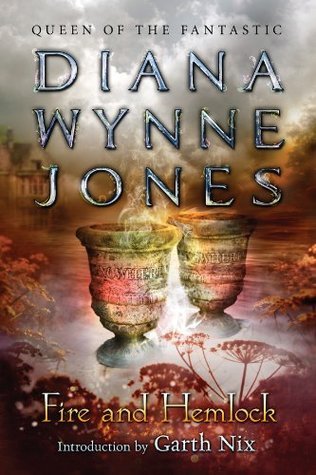
This past week I discovered that she also has some free-standing novels, and picked up Fire and Hemlock, which had an intriguing story line for which, in hindsight, I should have been better prepared.
The book owes its structure and character line-up to the ballad of Tam Lin, which dates from 1500s Scotland, and also to the story of Thomas the Rhymer, an actual Scots laird who lived from 1220 to 1298 whose story is confusingly similar to that of Tam Lin (both of them were kidnapped by the Queen of Elfland, although their destinies diverge after that initial act). I was embarrassingly unfamiliar with either of those legends going into reading this novel, and should have stopped the minute things got complicated and consulted Wikipedia for the synopses I finally ended up reading after I was done! Take heed of my experience and do that before you read this book if you want it to make sense. There are also echoes of both Hero and Leander and Cupid and Psyche, with echoes of T. S. Eliot. Diana Wynne Jones has written an explanation of her thoughts about the heroic that was included with my Kindle copy of the book, though it doesn’t appear except in later printed editions.
In the book, Polly Whittaker, 19, suddenly realizes that she has a set of double memories that began at the age of 10, which some entity is trying to make her forget. In the mundane set, she has been living an ordinary life: school, books, athletics, friends, irresponsible and uncaring parents, a loving but acerbic grandmother, and a boyfriend she’s not sure she wants. In the fantastical one, many of her actions are dictated by her sporadic but compelling friendship with a man she meets at a funeral, with whom she has an odd affinity. They experience some strange, inexplicable adventures together—are they truly magical?—but their friendship is threatened by menacing characters and events from which Tom Lynn attempts to shield Polly. She finally figures out what’s happening when it’s almost too late, and takes drastic action to secure both the memories and the relationship.
The book is such an odd mix of juvenile and adult that it was hard to read at some points, because it fluctuates between the mind of a young, naive girl and the definitely adult legend of a man in thrall to a wicked force that wishes to control his life. The narrative is carried by Polly, so we see everything through her clever and imaginative but innocent eyes, and if you are reading the book without knowledge of the backstory, it can be both frustrating and confusing, as well as long. I ended up liking it pretty well, and it’s probably Wynn Jones’s most ambitious plot in terms of the multiplicity of strands she introduces, but I was definitely happier with the straightforward, more mature, and somewhat humorous world of Howl’s Moving Castle.
What makes a mystery?
This is a question I have been pondering this week as I started reading Anthony Horowitz’s Magpie Murders, a book that has been recommended over and over again by readers on the various Facebook reading groups to which I belong. I am a big mystery fan—in fact, it’s probably my third most-read genre, maybe second, behind fantasy and possibly science fiction. I love a good mystery; but I specifically love one that has some quality of individuality and that arrests my attention and reawakens a somewhat jaded appetite. As I began reading, I discovered that Magpie Murders was not it.
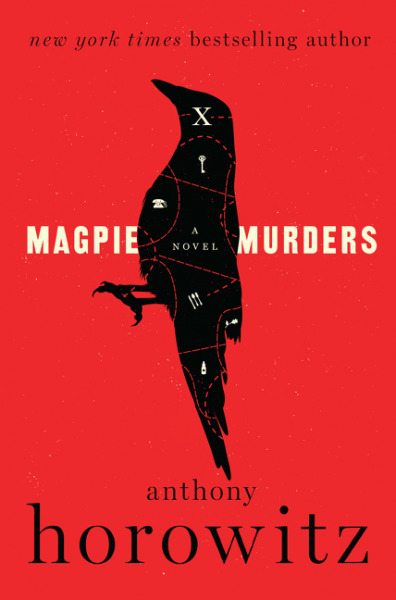
This book has been touted as the heir to Agatha Christie and Dorothy Sayers (and probably to Conan Doyle), and I can see the attempt, but to me it was a bland, by-the-numbers imitation (possibly attempting to be a parody?) rather than a “brilliant recreation of vintage English crime fiction.” When I was almost 50 percent into the book, I seriously considered posting it as a DNF. I honestly didn’t understand why there was any hoopla at all when it comes to this book.
It’s a typical cozy setting in a small town in the English countryside, with the requisite landowner, vicar, shop keepers, eccentric spinsters, surly handymen, and so forth. The detective’s only point of uniqueness in this setting is that he is German by origin; but given all his mannerisms, quirks, and habits, he might as well be Sherlock or Poirot or Jessica Fletcher. He has the slightly dense assistant, he asks seemingly unrelated questions and makes leading remarks that he won’t explain, and then he claims to know who the murderer is before anyone could possibly expect him to have solved the crime, given the vast number of suspects and the meager number of clues. The publisher described this book as “masterful, clever, and ruthlessly suspenseful,” and my response was, sadly, “none of the above.”
When I hit 50 percent, though, we stepped out of the book and into the office of the publisher of Alan Conway’s series about the detective Atticus Pünd, and I realized that the page I quickly skimmed past at the beginning of the book actually had something to do with the story and wasn’t just an introduction or something. So I went back and read it with attention this time, and realized that this was a book within a book and we were now getting to the real story.
I’m going to say here that although it was my fault that I wasn’t paying sufficient attention at the beginning, I’m also going to hold both the format and the author accountable for a little of my confusion. First, I’m reading it on my Kindle, and the way it was structured didn’t lead the reader to recognize that the start of the book was before the start of the book! As for the author, do you really tell the entire story within the story without its reader ever breaking away from it? I mean, Susan Ryeland sits down on a rainy afternoon with a bottle of wine and some chips and salsa to read a long manuscript; it’s more than plausible that she gets up at some point to replenish one of those (it says later that she had gone through more than the one bottle of wine), get something more substantial to eat (she would have needed it, to cushion the effects of all that alcohol), use the loo (I repeat, lots of wine!). A break halfway through that 48 percent of the book to remind the reader that this is a false construct, so to speak, of what the book is really about would have been helpful—and also both realistic and logical.
Anyway…
Once I hit the end of the manuscript and returned to the “real world” of Cloverleaf Books, a small publishing company whose owner and top editor were both reading the manuscript of Alan Conway’s ninth Atticus Pünd novel over a long weekend, I thought things would pick up and we would get the explosive and fascinating book we were promised by reviews and cover blurbs alike—but alas, that faith was misplaced. Others have commented how much more exciting they found the actual mystery that unpacks itself from the pages of Magpie Murders (the book within the book called Magpie Murders), but if so, I certainly wasn’t reading the same book.
Susan Ryeland was a dull and ambivalent character who constantly expressed her frustration that she couldn’t “do” the mystery thing the way all the great characters of literature were able to master it. When she wasn’t being tentative and indecisive about her attempts to solve the mystery, she was whining about her boyfriend, Andreas, who wants to whisk her away to Greece to run a small hotel with him. What an inconsiderate guy!
The other characters are likewise less than charismatic, and Alan Conway himself is written as a cold, devious, and thoroughly unlikeable person about whom it was hard to care. And there were too many instances of clues that were discovered to be clues, but then weren’t explained. Maybe Horowitz is saving something for the next novel? If so, it yielded an unfortunate sense of frustration while reading this one.

I hung in there and finished the book, but it was a near thing, and I regretted spending the time on it once I was done. I won’t be visiting the next in the series, which is 604 pages of the same, according to another Goodreads reviewer who characterized it as “ponderous, overly complicated, and too long.” I spent a decade recommending Horowitz’s Alex Rider series to many teen readers, but I can’t do the same for this one. There are so many better mysteries out there, and I’m going to go find one to expunge the irritation from my brain!
Best or worst?
It is almost unprecedented that contemporary romance writer Emily Henry would have a rating under 4.0 on Goodreads for one of her books, but Great Big Beautiful Life is scoring a 3.99. It is even more rare for people to actually write “DNF” (did not finish) and discard one of her books before finishing it but, again, that has happened here. And yet, minus a few issues, it has been my favorite of her books to date.

Perhaps that is because I almost always want more than just the meet-cute, the enemies-to-lovers, the fake relationship, or whatever trope this genre’s authors employ while trying to make the rest of the story unique by the choice of professions for the protagonists or whatever other quirks they can throw in to make it distinctive. And this book has two story lines in it, each somewhat dependent on the other, that to me made it so much more interesting than the standard fare.
Alice Scott is a reliable writer of biographical stories and celebrity puff pieces for a reputable magazine. But she dreams of getting that big break that will take her to the next level and let her write more serious work, whether it’s articles or a book. Hayden Anderson just published his biography of a celebrity who struggled to capture his legacy as Alzheimer’s stole his memories, for which Hayden won a Pulitzer Prize. And now these two writers are in competition for a story that would be a huge score—the biography of Margaret Ives, the heir to a vast family fortune and an enduring social impact.
In her youth, Margaret lived a privileged existence as a frivolous and charismatic fixture of the society pages and the tabloids; but family tragedies and scandal drove her underground, and no one has heard from or about her in decades. Alice, however, fascinated by her for both personal and professional reasons, has tracked her down to a small island off the coast of Georgia, where she is living a secluded and anonymous life, and Alice has gone to see her, to pitch the idea of working with her to write her story. She has competition, however, that she didn’t count on, and is dismayed to discover that it’s a famous writer with a Pulitzer already under his belt. Margaret, both canny about the value of her story and also deeply distrustful of journalists (and people in general), offers them each an opportunity: Stay on the island for one month, meet with her regularly (and separately) to talk about her past and also to outline how each of them thinks her story should be told, and abide by her decision at the end of the month when she picks one of them with whom to move forward.
In addition to being in competition and not wanting to reveal their strategies to the other writer, Alice and Hayden are bound by airtight non-disclosure agreements they signed for Margaret, swearing not to talk to anyone about the contents of their meetings with her, including with one another. But it’s a small island with limited places to stay, eat, walk, and shop, and it’s inevitable they will run into each other; so they have to work out a relationship that is civil while avoiding all talk of why they are actually in this place. This proves challenging for several reasons. (Yeah, you see where this is going.)

The story switches back and forth between Margaret’s first-person reminiscences of growing up rich, famous, and beleaguered by notoriety, and the present-day thoughts and feelings of Alice and Hayden as they weather this month of testing by Margaret and their burgeoning feelings for one another. This is apparently what a lot of her fans didn’t like—both the jumping back and forth between past and present, and the intrusion of another person’s life story into the middle of their romance. But I found it an effective contrast and was caught up in both stories as they evolved.
In the contemporary story, we are much more involved with Alice, while Hayden remains a mystery. The story is primarily driven by Alice’s inner thoughts and by her encounters with and reflections on Hayden, which works with their personalities—Alice’s sunny and outgoing, and Hayden’s secretive and a bit dour. But ultimately we figure out what he’s thinking and feeling too, based on his actions and responses to her, and begin to hope that things might work out between them despite all the obstacles in their path. Picture, for instance, the feelings of a person in a relationship who loses out on a dream job to the person with whom they are involved. Also, they live in different places (Alice in Atlanta and Hayden in New York) and come from and pursue completely different lifestyles. But…there is a spark. More than a spark. So one way or another they have to figure it out.
There was only one thing that didn’t work for me about this story and, while it wouldn’t normally faze me, in this context I found it both inappropriate and awkward. It was all the sex. I wouldn’t normally believe I’d ever say something like that, but in this case I found it positively jarring in the way it distracted from the story. In fact, it was more than just a distraction—I felt like it flat-out didn’t work and shouldn’t have been there.
When Alice and Hayden figure out that they have feelings for one another, they make an agreement that it would be just too much, too weird, too tragic for them to get physically involved during their audition month with Margaret, because of what will happen at the end of that month. So they promise to “be harmless to one another,” and put off a physical relationship despite the attraction between them. That all makes sense. Then they (Alice in particular) do everything they can to test that resolve and flout every rule they make for themselves. I’m sure the author thought that making them irresistible to one another would be exciting, but for me it was offputting to see that they couldn’t stick to their resolve for a month, in the interests of not hurting the other person long-term. And the way that the physical relationship was portrayed was likewise distracting to the story, in that it “just happened” at strategic intervals, almost as if an editor looked over the manuscript and said to Emily Henry, “Oh, your readers won’t put up with no sex in a romance,” and Henry responded by writing calculatedly provocative scenes, and then counted off pages and dropped one in here and there almost out of the blue. It was so inorganic!
Don’t let my irritation with this stop you from reading this book; it’s interesting, and convoluted enough with its twists and big reveals to be a compelling story. But after you have finished it, see if your reaction was the same as mine, and let me know!
Egypt by another name
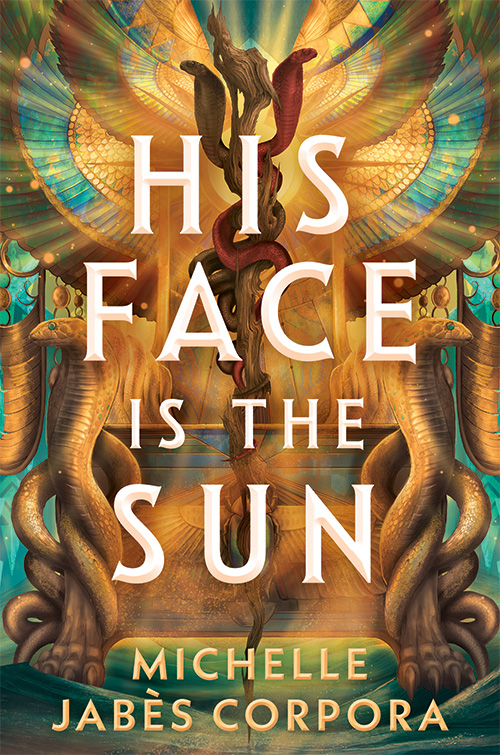
I picked up a Kindle deal for a new YA fantasy a few weeks back, and finally got around to reading it. The book is His Face is the Sun (Throne of Khetara #1), by Michelle Jabès Corpora, and it’s being billed as something that the readers of several other teen fantasy writers (Bardugo, Mafi, Tahir) would enjoy. And although I believe that is true, I’m not sure they should have focused it so relentlessly at the Young Adult market. In fact, I often feel that way when it comes to fantasy and science fiction.
In other genres (realistic stories, romance, coming of age), the audience can be clearly demarcated as teens, ages 13-18 or whatever—many adults aren’t interested in teen angst-ridden 15-yo first love stories. But with fantasy, if the world-building is thorough and convincing and the protagonists are engaging, I often feel these books are done a disservice not to be marketed widely. This one, for instance, ended up pretty quickly in the bargain Kindle bin (I think I paid $1.99), and it shouldn’t have, because it’s a really beguiling read. So adult fantasy lovers, pay attention and check it out, because if you enjoy it, there are two more books to come. (Also, this series is directed at more mature teens, due to some frank content, just fyi.)
The kingdom of Khetara is a faintly disguised Egypt, with some of the same gods under the same names and also under different ones, and similar dynasties of rulers and conquered peoples. It could almost be historical fantasy, but the author chose to create her own stage within the auspices of Egyptian history. There are priests and oracles, there are competitors vying for the pharoah’s throne, there are rebellious mistreated commoners, all set against a background of desert, river, village, palace, and temple, brought to life in beautifully detailed descriptions (that don’t slow the story at all). There is a mythology-based magic system that winds through the entire story in an organic manner and, although there is a little romance, this is primarily an epic fantasy focused on history, politics, magic, and destiny.
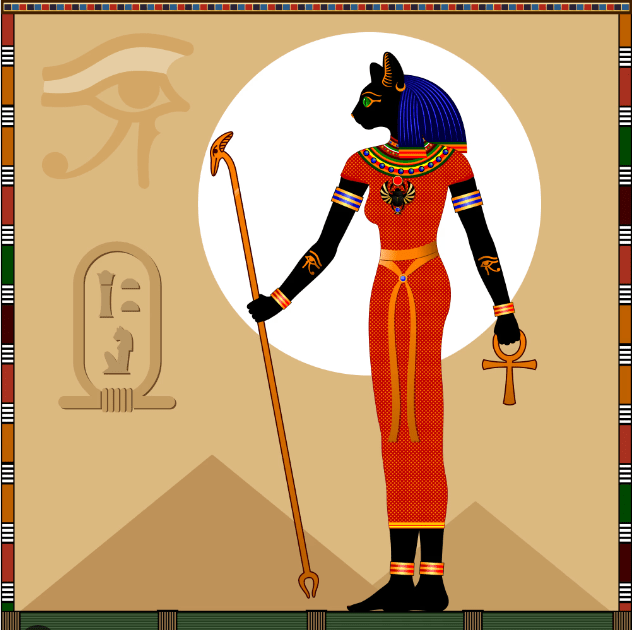
The main characters are four people who couldn’t be more different: Princess Sita, one of the triplets to whom the current Pharoah is father; Nefermaat, a bewildered young village girl who, after a spontaneous vision brought on by the annual parade for the goddess Bastet, has been whisked from her home to the capitol to train as a priestess; Raetawy, leader of a rebel group of farmers oppressed by the pharoah’s punitive taxes; and Karim, a young grave robber who unearths more than he bargained for and sets in motion some of the events envisioned by Neff and anticipated by Sita’s brother Mery, who is determined to rule Khetara sooner rather than later.
Although four protagonists is a lot, Corpora does a wonderful job of developing each of them with clear personalities and motives, and separates their subplots (politics, magic, rebellion, and fortune-seeking) while intersecting them at the appropriate moments to keep us intrigued. (Oh, and there’s a delightful fifth narrator—only encountered a few times—who further draws things together.)
I was completely involved in this story from beginning to end and, when I encountered that cliffhanger and realized that this book had just been published in May and I would have to wait at least a year for the next one, was sorry that I had read it so quickly. I will do a reread when the sequel comes out, to catch all the delightful detail that I may have skimmed over while trying to absorb the book as a whole. If you ever thrilled to the stories of adventures down the Nile, hotly contested dynasties and mysterious portents, you will want to read His Face is the Sun.

Yours Truly…except…

I wanted something a little more realistic after immersing myself in the sci-fi/fantasy of Discworld, but nothing too heavy. So I picked up Abby Jiminez’s most recent contemporary romance, Yours Truly. I am always torn when I read romance, because there is a tiny portion of my brain (heart?) that wishes things could go the way they do in these books, but a larger percentage that keeps saying “C’mon!” every few chapters.
There were things to like about this book. The male protagonist, Dr. Jacob Maddox, is almost too good to be true, except for one major thing that makes the story much more realistic: He suffers from nearly paralyzing anxiety (and, although it’s not named, possibly a little OCD as well). I liked the way the author incorporated this, because we don’t see much of these very common yet hidden conditions in this kind of fiction. The female protagonist, Dr. Briana Ortiz, is a quirky, interesting person with a hair-trigger temper and a great sense of humor who is currently dealing with some serious issues: divorce, a brother who needs a kidney transplant, work stress. Again, the sensitive and stark way the author dealt with the brother’s need for a new kidney and the likelihood he wouldn’t get one was a positive element. The way the author introduces the two characters and the initial misunderstandings followed by Jacob’s unusual solution to their hostility drew me in. (I love some epistolic fiction…)
Having acknowledged those elements, I now have to say that the book was not ultimately a success in my eyes for one reason: TOO. MANY. TROPES. Yes, I did all that capitalization and punctuation on purpose, because, as I noted earlier, “C’mon!”
We have:
• Workplace competition (rivals to lovers)
• Recovering from a breakup (both of them) so, rebound!
• Fake dating (pretending they’re in a relationship when they are not…or are they?)
• Uncomfortable (but suggestive) situations caused by the above
• Realization that they are soul mates
• Miscommunication that pollutes the relationship
• LACK of communication (bordering on the ridiculous) that rips them apart
The whole thing ultimately made me so tired.
I will admit that I really liked the characters, which is probably what carried me through the rest of the sturm und drang. And there were a couple of hilarious incidents that will make this book forever memorable. (In one case it’s killing me not to drop a spoiler here.) But the completely unnecessary angst that resulted from each of the characters being too cowardly to ask a simple question of the other for fear the answer wouldn’t be what they wanted to hear was not only implausible but became unbearable as the situation was drawn out for about 85 percent of the book. And the interminable inner monologues about said miscommunication made me want to bang their heads together (or mine against a wall).
I don’t quite know what to say; it was one of those books that you liked pretty well when you finished it, and then began to pick apart as you gained the perspective of days away plus other, better books as contrast. I won’t say don’t read it; but go in knowing that it is in some ways almost a parody of its genre.
Best in Show
Today is National Dog Day, and I usually do some sort of post noting books that I have enjoyed that include dogs as characters. This year, however, I didn’t discover any new titles since last time, so I decided instead to be a diligent research librarian—I’d go online to see if someone else had done the work for me!

I found a couple of “best dog books” lists. This is, of course, highly subjective, dependent on what you consider to be the “best” and why. But there were some familiar titles and also some that were new to me, so I’m going to satisfy today’s post requirement with a couple of URLs to other people’s lists.
The first is titled 100 Best Dog Books of All Time, and although it forgot a few of my favorites (such as A Boy and His Dog at the End of the World, by C. A. Fletcher, and the Beka Cooper Trilogy, by Tamora Pierce), it did include quite a few favorites.
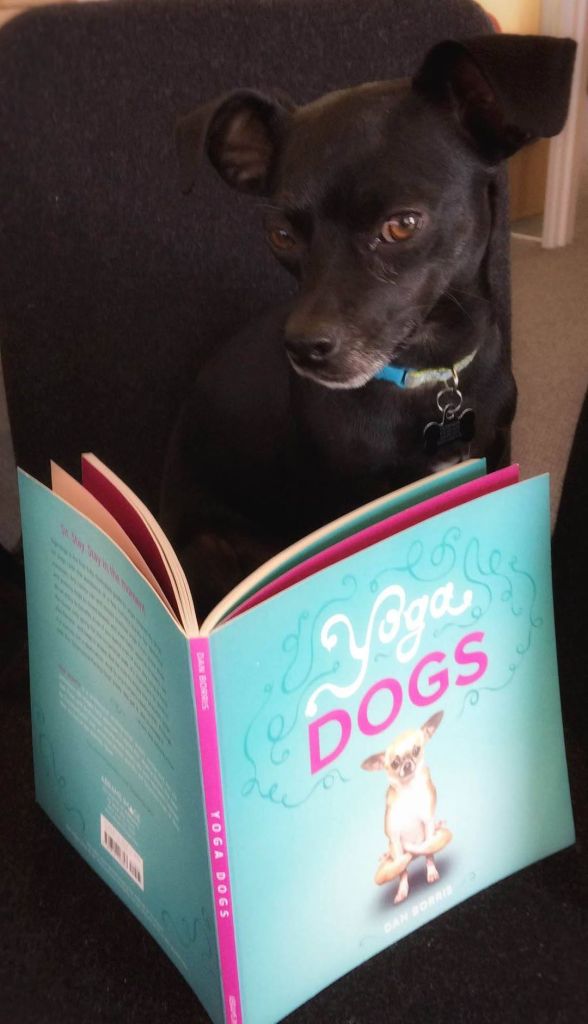
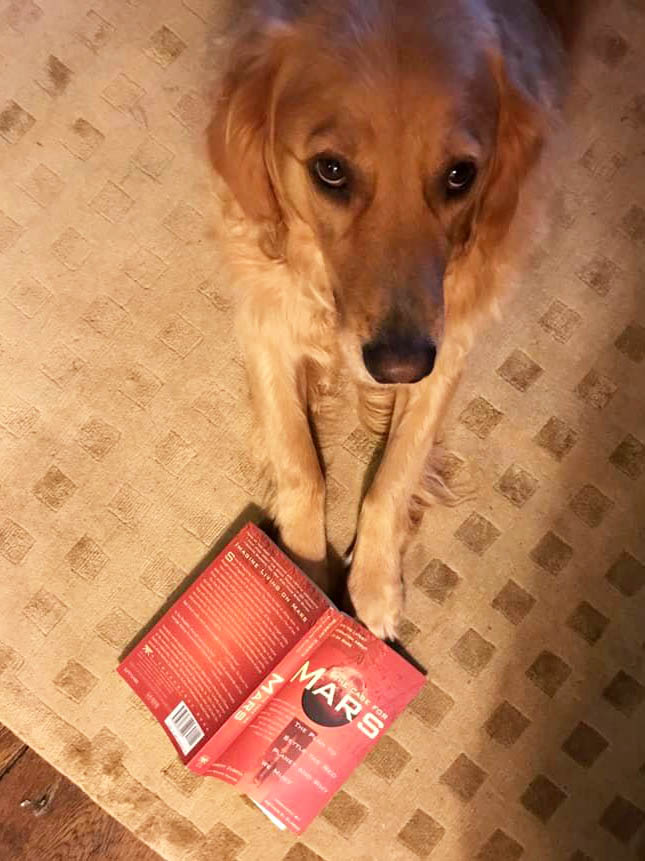
Then I found something of a treasure—it’s a list, on Wikipedia, of “fictional dogs,” which includes dogs that may not feature in either the title or description of “their” book. While the list is woefully incomplete (I may have to do some Wiki editing myself!), it named some names I hadn’t encountered before, so it was a profitable find.
Esquire Magazine contributed “The Long Tail of Dogs in Fiction,” taken from readers of the author’s Twitter page, while Flavorwire listed the “most beloved” amongst them, and Barkwells’ Dog Blog listed the “Pups who stole our hearts.” The Center for Fiction showcased “Dean Koontz’s Five Favorite Books About Dogs,” with a couple that were new to me. The blog Argos and Artemis went for “The Best Critically Acclaimed Books About Dogs.” (I should note that many/most of these lists are not current, but range back over the past decade.) And finally (because, at 69, I am still a girl), here is A Mighty Girl’s blog post “A Girl’s Best Friend: 50 Books About Mighty Girls and Their Dogs.”
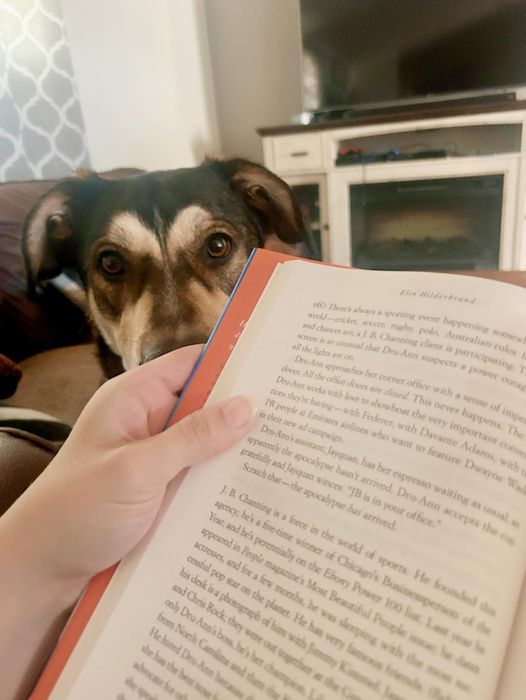
Amongst all of these lists, most dog lovers should be able to find something that appeals to them and their dog(s). (That’s right, don’t forget to read aloud to that face gazing persistently at you over the top of the book cover!)
Or, you can jump back to one of my NDD posts from previous years, Dog Days of Summer and Dog Day Afternoon.
HAPPY DOG DAY!
Discworld
As I mentioned in my Cat Day post, I continued on with Terry Pratchett’s witch tales by reading Wyrd Sisters, and then when I finished that I ducked out of the witch-specific books and instead assayed Mort, the first of the series with Death as its narrator.
For me, although I love the witches themselves, the most delightful part of Wyrd Sisters was the traveling actors with whom a certain very important player in the fate of the kingdom of Lancre shared a river boat, a wagon, and a stage. His talents there also serve him well when it comes to inhabiting his true destiny on Discworld, but the descriptions of the individual performances, some untrammeled but others under the influence of the witches’ meddling with time, are hilarious homages to Shakespeare.
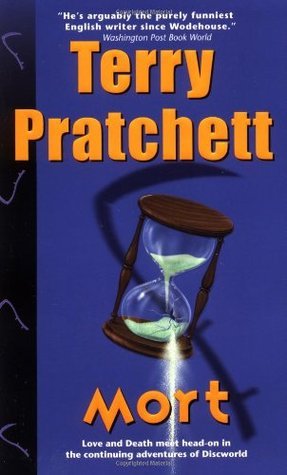
The brief cameo of Death in this book led me to read his shared autobiography with young Mort, whom Death solicits as an apprentice of sorts, so Death (or DEATH, as he is known colloquially) can take a vacation to experience what it’s like to be human. He assiduously takes part in all the pursuits that humans seem to enjoy most (fishing, drinking, and so on) and is somewhat underwhelmed. But while he’s off getting his human on, Mort is messing with the fabric of time, destiny, and fate by refusing to off some of the people whose hourglasses have run out. Mort is horrified by the prospect that he might have to inhabit this role forever if DEATH continues AWOL, and takes steps, assisted by DEATH’s adopted daughter Ysabell.
I think I can sum up Pratchett’s sense of humor when I tell you that DEATH’s pale stallion that he rides across the wind and stars to usher souls into the next world is named Binky.
While I generally prefer books with more gravitas, I can see that an occasional foray into the bounds of Discworld will be a welcome vacay read for some time to come.
One fierce moggy
I forgot about my usual post of cat stories for International Cat Day (today), so I’m going to do an abbreviated one honoring a single cat from the book I’m currently reading.
Wyrd Sisters, by Terry Pratchett, is one amongst 40-odd books of his Discworld series, but is also second of the six “Witches” books contained within that larger saga. It features Granny Weatherwax, Nanny Ogg, and young Magret, who get themselves into some good trouble when they decide to meddle with politics in the kingdom of Lancre, in which they reside.
Playing an important role in bringing together the witches with the ghost of Lancre’s former ruler is the cat Greebo. He is a one-eyed, foul-tempered gray tomcat who has aggressively fathered about 30 generations, but Nanny Ogg still characterizes him fondly as her sweet kitten (although privately she has been known to refer to him as a fiend from hell).
He features in other books of the series as well—Witches Abroad, Lords and Ladies, and Maskerade. At one point he is transformed into human form, but maintains his scars and his retractable claws, and exudes the raw animal magnetism that allowed him to claim paternity to all those descendents; but he is still handicapped by a cat’s inability to work door handles, and has an unfortunate and disconcerting tendency to groom himself with his tongue.
There are some illustrations of Greebo online, but they are copyrighted so I don’t like to poach. So here, instead, is a photo of my old feral cat, Papi, who was likewise tough, one-eyed, and prolific. He and Greebo were, as the Brits would say, fierce moggies.

Happy International Cat Day!
Pratchett

I don’t know how, in my decade-long exclusive pursuit of all things science fiction and fantasy, I managed to miss out on Terry Pratchett. I discovered some of the contemporaries to whom he is frequently compared (Douglas Adams, Piers Anthony), but it took another 30-some years and a degree in library information studies before I was introduced to him via the Tiffany Aching portion of the Discworld books. As a teen librarian, Pratchett came to my attention through the offices of The Wee Free Men; I was really taken aback when my high school book club didn’t love it as much as I did, but I didn’t let that deter me. I read every Tiffany Aching book (five total) that was out or came out thereafter, and loved them all, but for some reason I still didn’t go back (as I normally would) and explore all the other Discworld books.
Perhaps it was because of the sheer volume of the series—41 books is a lot to tackle, and I no longer read with the obsessive one-track mind that I did in my 20s, when I let nothing stop me from completing a series start to finish. But I was at extreme loose ends this week after finishing In This House of Brede; I initially moved on to another Rumer Godden but discovered that i was satiated for the moment and was craving something different. None of my holds are even close to arriving, so I went searching for something else by running my eye down my “Want to Read” list in Goodreads.
This is when I most miss being mobile; my finding process used to entail going to the library and looking at the new books and the just-returned shelves, and then wandering down aisles of my favorite genres—mystery, fantasy, science fiction—to see if old authors had new (or older) works I hadn’t yet discovered. It’s a lot easier to find an unknown treasure that way than it is to scroll through lists on the internet, as I do now that I am essentially housebound. There are the visual, physical, tactile elements of cover art, author quotes, flap summaries, the feel of the paper, the choice of font, the smell of the book, all of which yield up something that helps me make a decision. By comparison, it’s a sterile (and also endless) process to scroll through (sometimes erroneous) Goodreads descriptions, look at the ratings posted by other people, and speculate about whether I can choose something just based on these paltry factors.

This is partially what took me to Terry Pratchett—there was at least some experience, some familiarity with his story-telling and writing style, his characters, his world-building. I did pay heed to several people who said the first two books in the Discworld series, while introductory, were not his best writing, and that to start with #3 was a good beginning, particularly because it is also the debut of Granny Weatherwax, with whom I was already familiar from the Tiffany Aching books. So I acquired a copy of Equal Rites from Kindle Unlimited, and began my exploration of Discworld.
One thing you forget, if you go long periods between Pratchett tales, is his sense of humor and how he exploits old sayings, puns, wordplay. And even though Pratchett’s powers developed exponentially as he wrote each subsequent book, the humor is here from the beginning. The first one I wanted to write down the instant I read it was when Granny Weatherwax decides to find accommodations in a new town; she comments that she has specifically elected to live in an apartment next door to a talented and successful purveyor of stolen articles, because she has heard that good fences make good neighbors. Ba dum bum.
Equal Rites is the story of young Eskarina, who is mistakenly selected to be an heir to wizardry. A wizard comes to Granny Weatherwax’s village of Bad Ass seeking the child to whom he is to hand over his staff before his imminent demise; the smith of the town is an eighth son whose wife is about to give birth to his eighth son, which is highly propitious. So when the wizard realizes he has six minutes to live and Granny, having just delivered the baby, carries it into the room, the wizard places the child’s tiny fingers on his staff to claim it, and then expires before he can discover that the eighth son is actually a girl.
On Discworld, gender equality is a dream—at least for women. Only men are wizards, just as only women are witches. Men have, of course, tried being witches (because they don’t take no for an answer), but it has never worked out well; but those same men have banded together and insisted that “the lore” absolutely forbids women to be wizards, and no woman has ever been admitted to Unseen University as a candidate. Granny W, however, is determined that Esk should at least have the chance (as is Esk herself), so the two set out on a journey to the city of Ankh-Morpork, for Esk to try her luck. This is the basis for the chaotic hijinks that ensue for the remainder of the book.
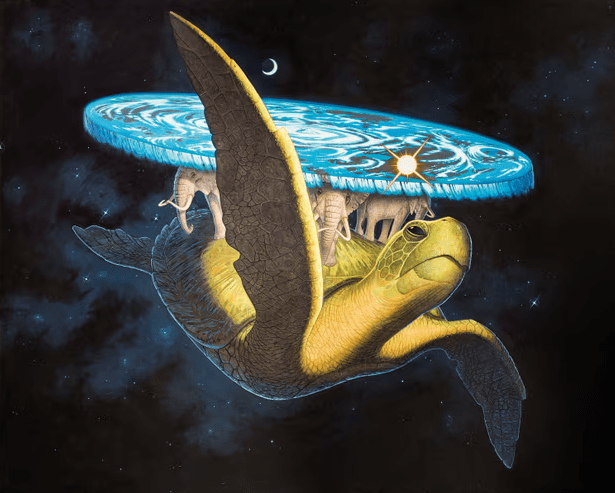
I really enjoyed both the introduction to Discworld and the reacquaintance with Granny W. (and with Pratchett). I think I will continue on for a while; they say you can just read the “witch” books (of which there are six) on their own, but I might also branch out into other characters’ tales set on this flat world carried on the back of a giant turtle and four elephants.