Disappointed in love
I rarely publish negative reviews of books. I have mostly embraced the viewpoint of the reviewing journals, which simply don’t recognize anything they didn’t like. But occasionally I get so outraged by the level of my disappointment that I need to vent. I should probably restrict that impulse to private conversations instead of featuring it on-line in writing, but…I don’t want anyone else to feel the resentment I do at the time wasted reading this in a world full of better books.
 I picked this up as a daily featured discount e-book, which I guess should in and of itself be a warning, but I have found other books among the discounts that I enjoyed. I liked the cover, and I was attracted to it because of the last name of the author, which he shares with one of my favorite Irish writers, Maeve Binchy. It turns out that she’s his aunt. Let me clarify, however, that I wasn’t upset because he didn’t write like her or step up to carry on her legacy. I simply made a space for him on my shelf based on his connection.
Chris Binchy is billed in the book’s description as “bestselling” and with a “formidable talent” and all I can say to that is…Really?! If so, maybe this was an unfortunate choice from among his titles.
The description of the book claims that two men who are lifelong friends both fall in love with an “unforgettable” woman. Already we are straying into the realm of untruth. Apart from one passage where it talks about how she is direct and friendly and draws people in, and another where the eyes of every man in a bar follow her across the room (which could happen with the least charismatic woman if she’s the only female in the bar!), there is no evidence to suggest this woman rises above the mundane. Although the protagonist is obsessed with her, from everyone else’s point of view (including the reader’s, who has little information to go on) she seems like just a regular gal.
The style of writing is odd. The entire book is told by one of the two friends, and his narration is as stilted as he is, which did initially intrigue me. The protagonist, David, seems like a non-comical version of Graeme Simsion’s Don Tillman in The Rosie Project—a socially awkward computer geek who is probably somewhere on the autism spectrum, given his inability to understand or interact with virtually anyone without a great amount of thought, reasoning, and preparation. Also reminiscent of Simsion’s book, David’s best friend, Alex, is a hail-fellow-well-met kind of a guy, with friends in every bar and a way with the ladies. It is inevitable that when David draws Alex’s attention to a woman with whom he is taken, Alex will ultimately take her. Although David asks Alex for help to make a connection with her, Alex misperceives the extent of David’s interest and does his usual thing to make his own impression, and before you know it, Camille and Alex are an item and David is the bitterly unhappy third wheel.
At this point in the book, based on a cryptic remark of David’s that seemed like a veiled threat, I thought the way we were going to go with this story was for David to somehow take Alex out of the picture so he could win Camille for himself. I actually thought, based on his flat affect combined with his extreme self-absorption, that this guy was going to turn out to be a sociopath along the lines of the protagonist in the book You, by Caroline Kepnes! No such luck. Instead, we get another 200-odd pages of David living his life and detailing his dull job opportunities, his dismal solo vacation in Brazil, and his various unproductive encounters with Alex, Camille, and Alex-and-Camille.
Finally, once Alex does his usual thing of alienating himself from whoever he is dating by creating obstacles to the relationship, David has his shot, and…that would be spoiling the rest. But it’s not much of a spoiler, because this book has the flattest, most unsatisfying conclusion in the history of “Lad Lit.”
Seriously, don’t bother.
Robin McKinley
As I have mentioned before on this blog, I am a huge fan of fantasy writer Robin McKinley. I reviewed my two favorite books of hers, The Hero and the Crown and The Blue Sword, here. I think she has inventive ideas, compelling characters, and amazing world-building. A friend and I recently discussed, however, how unpredictable she can be—we have loved some of her books, hated others, and been bored to catatonia by at least one of them. Shadows, one of her lesser-known books, is one that I like.
 But how to describe this book? In a weird way, it’s a dystopia, because something happened a couple of generations back that changed the world and put a bunch of scary bureaucrats in charge of it. But it’s also a fantasy, because it’s all about magic and its banning from the world of science, and how it leaks and creeps back in again.
Maggie and her mom and little brother lost their dad/husband awhile back (car accident), and it’s been tough going. But now her mom has found someone new to love, and although Maggie would like to be glad for her, Val creeps her out on so many levels that she just can’t deal. There’s his wardrobe, and his weird accent, and his fairly unattractive exterior, but that’s the least of it: Val has too many shadows, which seem to loom and dart and rise up higher and create a stranger outline behind him on the wall than anybody’s shadow should, and Maggie is apparently the only one who can see them. I found it a little unbelievable how long she managed to ignore them and avoid him, rather than just coming out and asking, but on the other hand, if you put this behavior in the context of people in “science world” being jumpy about anything that smacks of magic, it made sense. And that’s where you have to “suspend disbelief” and be willing to go with it because you love McKinley.
As I said, in Newworld, where Maggie lives, there are regulations in place designed to keep people away from magic and magic away from people. In fact, there is a whole bureaucracy set up to defend against “cohesion breaks,” or cobeys, which are apparently alternate worlds or magical worlds (?) trying to push their way through to this one (or suck people out of it). It’s a crime to own magical artifacts, or to practice magic, or to BE magical, and this is a big source of Maggie’s worry about Val (who emigrated from Oldworld, where they still practice magic), because now that he’s living in their house, he puts them all at risk, even though he’s shown no obvious signs (other than the shadows) of risky behavior. Maggie’s family has a history of magic-wielders, but supposedly that gene was surgically removed from everyone awhile back—or was it?
Things I loved about this book: all the characters—her mom, her friends, Jill and Taks, her love interest, Casimir, the animals (she has a dog and also works at a shelter), the evolution of the plot. Things that frustrated me: Well, because it was McKinley I was willing to go with it, but the world-building is weird—incomplete and random, with lots of assumptions, confusing lingo, truncated history, tantalizing and infuriating hints that you could know more if only she would tell you! You are set down in the middle of a work in progress that you have to figure out as you go along, and I didn’t feel like I had completely understood it even by the end of the book—but I didn’t care all that much, because I was enjoying myself and the story.
The book ended satisfactorily, but it was more like the end of a chapter in this alternate history than the end of a world; it definitely left itself open for a sequel, but whether there will ever be one is anybody’s guess, since McKinley mostly doesn’t do sequels. I hope so, because I grew fond of these characters.
So–would I recommend it? Yes. But judging from the ratings on Goodreads, which range from one star to five, you definitely have to be a certain sort of reader to like it.
I’m tagging this with the YA Fiction category because it reads as if it could have been written specifically for teens; but as with most fantasy out there, if you are a fantasy reader you don’t discriminate between teen and adult fantasy, it’s all just fantasy!
Dystopian fantasy
I just finished the first two books in what I hope will be a longer series by Charlaine Harris, the author best known for her Sookie Stackhouse vampire books later immortalized as the TV show True Blood.
Harris has had a checquered history for me, with some of her books striking a major chord while others just struck out. I hated her cozy mystery series featuring Aurora Teagarden—I don’t know why, but I found the protagonist irritating and the plots excessively weird. I liked the vampire novels a lot for about the first five, and then they became increasingly silly and kind of desperate. I liked the Lily Bard mysteries that take place in Shakespeare, Arkansas, but they are grim and dark for recreational reading. The Midnight, Texas books are only okay, although I have a soft spot for the protagonist, psychic Manfred Bernardo. I tried a couple of her stand-alone novels from her early writing days but couldn’t get through them.
My favorites up until now have been a four-book series about Harper Connelly, a young woman who was struck by lightning as a teenager and survived it, only to discover that it had given her the power to know how people had died. She couldn’t see who killed them, but she could stand on her grave and reliably tell you if your wife accidentally drowned in the bathtub or if someone had pulled her under. Having no other skills that would earn her a living, she and her step-brother, Tolliver, team up (he acts as her manager) and hire her out to police departments and individuals who want or need to know cause of death. It’s an interesting lifestyle, to say the least, and the most enjoyable part of it is the sheer banality of their daily existence contrasted with the use of Harper’s particular gift. I have read the series three times.
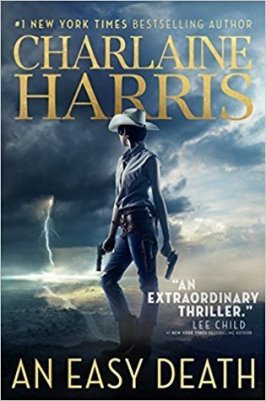 I say they are my favorites up until now because they may have just been aced out by some “new” books I didn’t even know she was writing. The first Gunnie Rose book, An Easy Death, was published in October of 2018, and the second, A Longer Fall, came out this past January. There is a Goodreads note for a third one on the way, no date indicated.
Although I shouldn’t be surprised at the extent of Harris’s imagination (especially after the cast she developed for the Sookie Stackhouse novels), I was so taken with the concept for this book. Perhaps it is conditioning from all the dystopian teen fiction I have read during my 10-year career as a teen librarian, but I do love an alternate history, and this one really delivers.
The setting is the former United States, but one event—the assassination of Franklin Delano Roosevelt—has significantly altered the history of the country. Without Roosevelt’s guiding hand during the Great Depression, the crippled country fractures, and various states were either absorbed into surrounding countries, taken over by former rulers, or banded together to form small nations. The original 13 Colonies pledged fealty to the British Empire; a few of the “top” border states became part of Canada; the south-eastern states are now “Dixie” while Texas and Oklahoma and a few others formed “Texoma”; the “flyover” states remained “New” American territory; the rest of the southwest was annexed by Mexico; and the biggest surprise was California/the Pacific Northwest, which was taken over—by a combination of invitation, treaty, advantageous marriages, and magic—by the tsar Nicholas and the remains of the Holy Russian Empire, which is now its new name.
 Yes, magic is what I said: This dystopia is not only an alternate history, but also includes wizardry, mastered primarily by the Russians, who value it, and the British, who don’t, so many British wizards have migrated to the new HRE on the Pacific coast, inter-
mingling with their Russian counterparts to maintain the rule of the Romanovs. Readers of history will remember that the Romanovs had a fatal flaw in the male bloodline—hemophilia—and it is this flaw around which Harris has built this first story about Gunnie Rose.
It seems that only the blood of Rasputin (and his descendents) can keep Nicolai’s heir, Alexei, alive, and now that Rasputin is deceased, the hunt is on to find the descendents who can help the Russians maintain their hold. Two wizards travel to Lizbeth “Gunnie” Rose’s home in Texoma, seeking an illegitimate granddaughter rumored to live in the state, and hire Gunnie to protect them while they make their search. Gunnie Rose is between jobs and desperate for cash, so she packs up her arsenal and takes them up on their offer, despite her distrust of Russia and wizardry. But Gunnie is nothing if not brave, and she has ample opportunities to prove this as people intent on preventing the wizards’ mission keep trying to take them out.
 This series is pure delight, from the elaborate world-building to the laconic Western flavor of Texoma, and the characters are so alive they could step off the page. Harris has written this with just the amount of detail you crave, without drowning you in either description or explanation, and the pace of this mystery/adventure story is perfect. The minute I finished the first book, I jumped without hesitation into the second one.
The second book takes Gunnie Rose and the reader on a train trip into Dixie with a crew new to her, guarding a crate with mysterious contents and not even knowing its ultimate recipient. The mission is quite literally derailed, along with the train, and Gunnie is left, once again, with most of her crew dead or disabled, wondering what could be so important that the people who wanted the crate’s contents would kill that many people by blowing up the train to get it. When her former partner and lover, Eli the grigori wizard, shows up, she begins to winkle out some answers, but the truth is stranger than anyone could imagine.
What a fun and imaginative read. I hope she doesn’t take too long to produce the third volume.
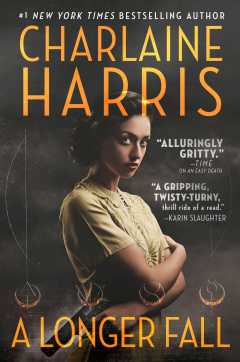
(I loved the cover on this one, showing Gunnie Rose basically sulking because in Dixie she has to appear ladylike by wearing blouses and skirts and petticoats and stockings—and foregoing her gunbelt—in order to fit in. I greatly sympathized with her sigh of relief when she could finally resume the jeans and boots of her everyday wear.)
Reading and art
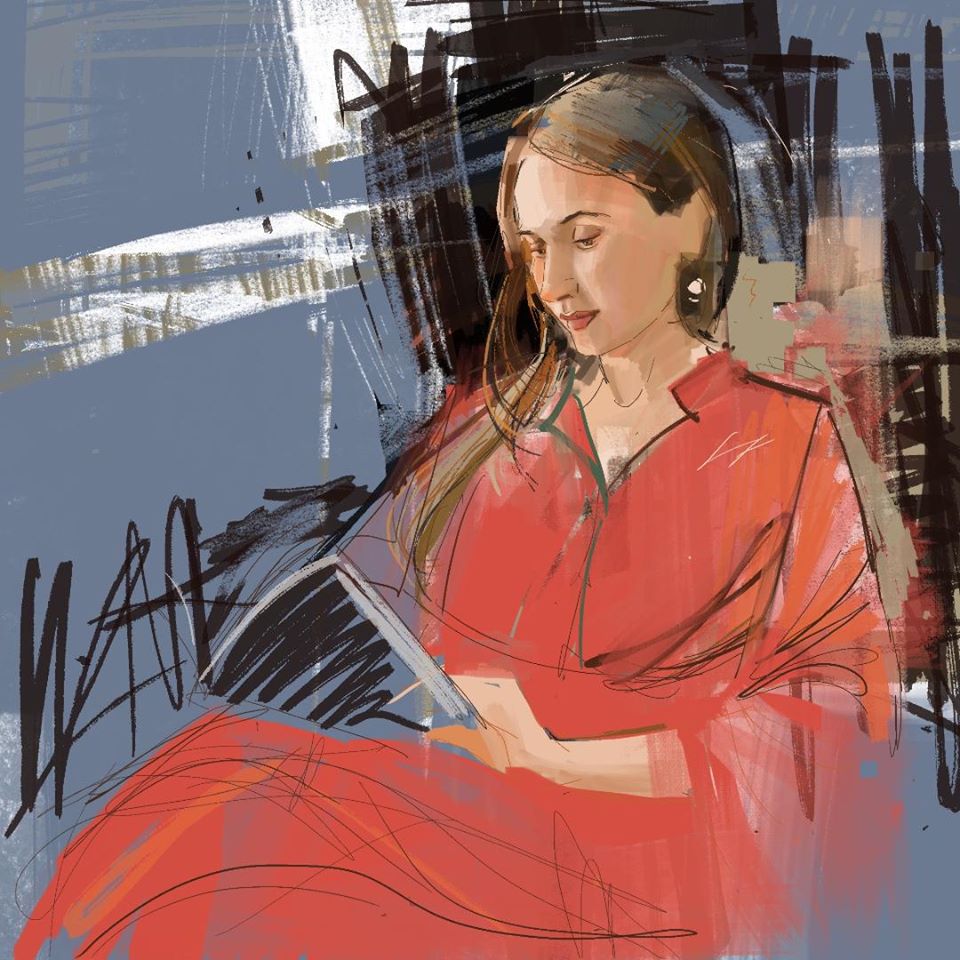
I’ve been working sporadically on a series of paintings of people reading, and so I always have an eye out for paintings like that made by other people. This one is from my Facebook friend, the talented Milind Mulick, who lives and works in Pune, Maharashtra, India. His usual paintings are stunning urban scenes and landscapes, but he has recently been showing some portraiture and figure paintings as well, and I was so taken with this one—simple, yet so expressive. I asked him if I could share it here and he graciously agreed. Enjoy!
Guns and diversity
 While scrolling through the Los Angeles Public Library’s e-book offerings, I came across a young adult novel that had been hyped to me, and it was available so I checked it out and started reading. The book is This Is Where It Ends, by Marieke Nijkamp, and I was curious to see how it would explore the incendiary subject of school shootings.
One of the reasons that several people encouraged me to read this book is that it is written by a “We Need Diverse Books” member, and has two female lesbian protagonists (and one is also Latina), a prominent character who is Middle Eastern, and so on. But what I found was that this was more of a problem than an advantage, because the author gave their credentials as if she were cherry-picking specific examples of ethnicity and sexual identification to appear in her novel for the sake of that alone. I guess what I’m saying is, not only did their diversity make no significant difference to who they were in the context of the story, but it seemed to further accentuate “otherness.” She stereotyped them.
The basic plot of the book is that a boy, Tyler, who dropped out of school the year before, is scheduled to come back and try again, but instead, while the first student body assembly of the year is taking place in the auditorium with only a handful of students and a couple of teachers missing, he locks all the doors from the outside, enters through a stage door, and begins shooting people.
The story is told from four points of view, two of them in the auditorium and two of them outside trying to figure out what is happening and hoping to help their siblings and classmates to escape. There are also some other viewpoints represented via a few students’ texts to one another and one boy’s entries on his blog.
The narrative jumps back and forth between flashbacks and the present moment. The protagonists are all related in some way to the shooter—one is his sister, one is his ex-girlfriend, one is his sister’s girlfriend, and the last is that girlfriend’s brother. All have a history with Tyler, and each of these, as recounted, gives perspective on their interactions with him. You do gain some knowledge in this way about what may be some of Tyler’s issues, but because there is never any internal, first-person view given by Tyler, most of that is left unexplored, and this becomes a huge flaw. Tyler is largely painted as an evil guy, and since he isn’t allowed to speak for himself, we never find out the nuanced details that brought him to this place. I’m not an apologist—I realize that not every kid who is abused or friendless or bullied turns into a murderer. But this book had the opportunity to explore that, and instead Tyler is a smiling, vindictive, one-dimensional jerk with a gun. And the protagonists, despite the sharing of their back stories, are also one-dimensional to the point where the two female characters’ narratives sound so similar it’s easy to get confused about who is speaking.
The book initially confused me as to its power, because it is written on a breathless timetable in which minutes are literally counted down (one chapter being the action taking place between 10:00 and 10:06 a.m., etc.), and that gives the book a pace and a tension that builds on initial foreboding to boost the reader onto an emotional high. The countdown and the jumps between narrators keep you enthralled as you wait to see what’s happening inside the auditorium while you’re outside, and what’s happening outside when you’re inside. It took arriving at the end of the book and feeling strangely let down (and also emotionally manipulated) to make me realize that although the pacing pushed me to the end, once I got there I was devoid of answers, or even of much content. The book is so thoroughly focused on the events of 54 minutes that it fails to provide sufficient context to explain them.
The charitable interpretation of this book would be that the author was well intentioned but simply overwhelmed by the scope of the issue and therefore told it as best she could but without diving below the surface. This problem was accentuated by the time frame she set herself in the plot—I feel like the need to keep the tension at a certain pitch precluded her flashbacks from going into sufficient detail to satisfy. The less charitable would be that this topical subject was sensationalized for the sake of book sales.
 My recommendation would be that you read Jennifer Brown’s Hate List instead, a book that is successful at breaking down the barriers between victim and villain in its shooter, at explaining the survivor’s guilt of the people who knew him best, and in showcasing the dark thoughts that everyone has but most never act upon.
Journalism & crime
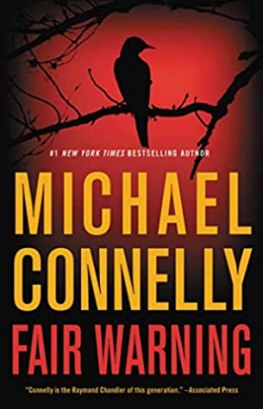 On May 26th, a surprise arrived via my Kindle. I had completely forgotten that I had pre-purchased Michael Connelly’s new novel, Fair Warning, to be delivered as soon as it was published, and suddenly there it was! I had another book mid-read, so I have just finished it.
Connelly leaves the world of Harry Bosch to hark back to gonzo journalist Jack McEvoy, the protagonist of two of his former books, The Poet and The Scarecrow. Although I read both of those books when they came out (I have to date read 34 of Connelly’s books!), it’s been such a long time that I toyed with the idea of revisiting them first before proceeding with the new one, but chose to forge ahead. Although there were a few references to the previous cases in this one, it essentially read like a stand-alone for those who hadn’t read them, so that was fine.
As well as being the title of the book, Fair Warning is the name of a non-profit consumer protection news website run by Myron Levin (which actually exists in real life). Jack is a reporter for this website, which feels like something of a come-down from his former hard-hitting crime beat for the L.A. Times (and his authorship of two best-selling books), but he is quick to point out that consumer reporting is a vital service to the public, especially in this age of accelerating scientific discovery, and that many major papers (the L.A. Times and others) pick up and run with his stories. Maybe he protests too much?
The beginning of this story, however, isn’t professional, it’s personal: Two homicide detectives show up at McEvoy’s door with the news that Tina Portrero, a woman with whom he had a fun, slightly drunken one-night stand (a year previous) has been brutally murdered, and he is a suspect. Jack cooperates to the extent that he provides a DNA sample in order to eliminate himself from their list of “people of interest”; but then, because of a curious mind and an eye for the anomalous detail, McEvoy gets ahead of the detectives on this crime and a bunch of related ones.
The method of the murder (which I won’t mention here) is so dramatic and so extreme that McEvoy researches it, and discovers that this method appears in widespread cases; then he notices that the murderer may have been using personal data shared by the victims themselves in a particular way, to select and hunt his targets.
At this point, McEvoy has ceased to think of himself as an accused murderer and started to see the potential for a really big story that involves solving the murders of a bunch of women, zeroing in on a serial killer, and even calling the government to account for lax practices in data protection. So he decides to reach out to his former lover, Rachel Walling, whose FBI profiling career he burned the last time they collaborated, to see if she can pull some strings for him.
Instead, Rachel jumps into the middle of his quest, perhaps to curry favor with and return to the FBI fold, helping Jack’s information stream but also setting up all kinds of conflicts of interest.
A big part of the story here is the moral quandaries in which the various characters find themselves. McEvoy does want to identify the killer and facilitate his capture; but he also wants to break his story, which means he can’t hand over all his information to the police until he “gets the scoop.” He and Rachel Walling have a chemistry between them that didn’t disappear with their falling-out years ago, so there is a motivation to perhaps rekindle that. In addition, Walling has been pursuing a necessary but boring job since she left the FBI, so the prospect of handing them a serial killer ignites her with the ambition to prove them wrong for firing her. A colleague of Jack’s at the website, who is added to the story by his editor, wants to make a name for herself without treading on Jack’s toes too much to do so; and Jack realizes that although he is the better researcher, she is the better writer, so he reluctantly acquiesces in her involvement but then keeps throwing her under the bus. And of course the police want to be the first, last, and final arbiters of what happens with this case, story scoop be damned. It makes for an interesting level of tension throughout the story.
Connelly has pulled off a gripping, fast-paced tale whose interest level is enhanced by having a reporter, rather than a detective, at the helm. Some of the true-to-life details of data collection and (the lack of) government regulation are chilling, and he also fills in the reader on some aspects of operating on the dark web, as well as providing the usual details of his Los Angeles setting that are fun for those of us who live here and recognize them. I enjoyed this book, and it was a nice change from the Bosch litany.
And no, I have no idea why there is a black bird (a crow? a raven?) on the cover.
Procedural?
 I just finished reading The Cold Cold Ground, the first book in the “Detective Sean Duffy” series by Adrian McKinty. The book was published in 2012, and although I had never heard of it, it won a couple of fairly prestigious awards. A friend on Goodreads thought highly of it, so I decided to check it out. I love getting stuck into a good mystery series, especially when its setting and time period are a bit unusual.
This one takes place in Northern Ireland in the 1980s, at the height of “the Troubles,” which is to say when the country was a battleground for multiple nationalist groups on both sides of the Catholic / Protestant fence, against each other and also against the vilified British government. Sean Duffy is a police sergeant, a recent hire to the Royal Ulster Constabulary, and a rare Catholic in a sea of Protestants. He doesn’t seem to hold his faith in particular esteem, but that fact doesn’t matter to the “Fenian” haters all around him, so he has a lot of proving of himself to do on two counts—being the new lad, and being an outsider.
Duffy doesn’t let it worry him overmuch, although he does do a daily check of the undercarriage of his car for bombs before he sets out each morning. It’s an odd period in history in which to set a police procedural because, with every street a potential hazard due to IEDs, gunmen, or just unemployed teenagers throwing cartons of milk and bricks at your car, it’s hard to concentrate on one particular crime. But Duffy does have a crime assigned to him, and it is itself an anomaly—it seems he may have a serial killer on his radar. He and his crew, nicely described and developed in the course of the novel, are investigating the deaths of at least two gay men who have been killed, mutilated, posed, and labeled by the murderer, as well as drawn to the police’s and media’s attention by a series of notes. Sean initially falls for the allure of the first serial case ever to crop up in Northern Ireland, but then begins to suspect there’s a deeper story that has little to do with a hatred of homosexuals and more to do with political undercurrents amongst all the players on scene.
The descriptions are first-rate, the characters compelling, and the action fast and violent, while the writing doesn’t suffer because of the pace. I enjoyed the story from beginning to end, but can’t help but note that this is not an ordinary police procedural. Although Duffy and his mates do a conscientious job of exploring all the clues (sometimes at great risk to themselves), the inferences Duffy then draws from them proceed mostly from his instincts and sometimes wild beliefs than they do from any evidence, which is sparse. The leaps of faith that he makes (and that the author apparently expects you to make along with him) are sometimes a mile (or would it be a kilometer?) too far. Add to that an ending in which Duffy steps far outside his persona as a policeman in order to obtain justice and this book doesn’t dwell very well within its subgenre. Nevertheless, it’s an engaging story, and based on it I would read another by McKinty.
Ninth House
I have been anticipating reading Ninth House, by Leigh Bardugo, for several reasons: Although I didn’t care for her Grisha series because it was so full of angsty teenage indecision, I absolutely loved the duology Six of Crows and Crooked Kingdom, particularly the latter. I felt like Bardugo had stepped up her style and discernment by a lot in the second series, and also, I can’t resist a “gang of thieves” story.
 I’m really not sure why Ninth House has been identified as an adult, rather than a teen, book. Admittedly, it’s far too gory and explicit for younger teens, but I could definitely see some of my former book club members from the 10th-12th grade club enjoying this. After all, the philosophy in writing for children or teens is that they always want to read “up,” which is to say, they want to read about a protagonist who is a year or two older than they are. As a freshman at Yale, the Ninth House protagonist, Alex Stern, is just the right age to appeal to seniors in high school. I imagine many parents of said older teens would still quibble with me, because they feel their children should be protected from such graphic fare; and there is a part of me that thinks everyone should be protected from it! But as you learn from reading a lot of books, sometimes you need that stuff to make a point, to expose a wrong-doing, to create empathy in your reader. (Plus, of course, for dramatic effect in your adventure story.) There were certainly plenty of opportunities for that here!
Within the first few pages of this book, I seriously considered putting it down without finishing it. There is a scene early on in which a group of students from one of the magical “houses” at Yale performs a “prognostication” by reading the innards of a man who is still alive (although sedated), with his stomach cut open and pinned back; when they’re done, they stitch him up and send him off to hospital without another thought for his well-being. Also present at the ritual were a group of “Grays,” ghosts who gave off a really frightening vibe. The entire scene turned my stomach, and since I hadn’t as yet invested much into either the story, the scene, or the protagonist (and didn’t really want to encounter more of this), I thought about stopping. But surely all my friends—both personal and Goodreads-type—who were bowled over by this book couldn’t be wrong? So I kept reading.
Ultimately, I was glad I did. Although it took a long time to understand what was happening and also to bond with the main character, I eventually came to appreciate both the bizarre behind-the scenes action and the dogged, flawed, yet honorable Alex, who didn’t give up no matter what.
“Could she grasp the ugly truth of it all?
That magic wasn’t something
gilded and benign, just another
commodity that only
some people could afford?”
Some things I liked about the book:
It gives this Ivy League school an ulterior motive for existing that is both completely creepy and also believable. The concept of a university elite is nothing new, but the idea that they became that way by the practice of necromancy, portal magic, splanchomancy (the reading of entrails), therianthropy (basically, shape-shifting), glamours, and the like is certainly novel!
The funniest part of this is at the end of the book, in an appendix, where the author describes the eight occult houses, reveals in what talent or magic each is invested, and then names graduates (from the real world) who have benefited by being members of the houses during their careers at Yale.
This is not just an amusing commentary, however, on how these students one-upped their futures by participating in magical solutions on the sly. As highlighted in the quote above, Alex comes to realize that magic, while theoretically accessible to whoever was trained or born to practice it, was in reality a tool of the rich and privileged that was sought after at the expense of the poor and defenseless. This is a huge theme of the book, and this is why the reader is able to bear with all the dark scenes, because they are so illustrative of our own contemporary world where billionaires are tripling their wealth during the pandemic while so-called “essential” workers are flogged back to their minimum-wage jobs, despite the danger, by the threat of unemployment. I don’t know if she intended it, but Bardugo here reveals the true “deep state” of influence, bought and traded favors, and a deep disregard for anyone who gets in the way.
Up against this mostly impenetrable and nearly unbeatable system of advancement is Galaxy “Alex” Stern, an underdog heroine if there ever was one. She is recruited (and given a full ride to Yale) to be a member of a secret society, Lethe, whose officers are trained to monitor the other eight houses for stepping over the line, and to report and penalize them when they do. Alex wants to use her special abilities for good, but quickly realizes that her job is mostly for show, and that there will be few consequences for any of these offenders, because to bring their activities out into the light would mean embarrassment for alumni, for administrators, and for Yale itself as an institution. What the people who recruited her don’t realize, however, is that first, Alex has abilities about which they (and at first she) are unaware, and that second, Alex has been conditioned by life as an almost constant victim to fight for herself and for other victims no matter how hard the going.
At its heart, Ninth House is a giant (and cleverly structured) mystery. There is a contemporary murder, there are disappearances of vital personnel, there is a string of dead girls from the past that may tie in, and Alex, despite discouragement from both her mentors and her opponents, is determined to solve it in order to bring justice for the have-nots that she sees as her equals.
But the book is not single-minded. There are also themes of friendship and (nonromantic) love, and a lot of social commentary. There is the gradual evolution, also, of the book’s characters as they confront issues and reflect upon their responses. One early-on thought from Alex that I loved was when she was pondering how easily things change from “normal” to not:
“You started sleeping until noon, skipped one class, one day of school, lost one job, then another, forgot the way that normal people did things. You lost the language of ordinary life.”
There were also, in amongst some fairly gruesome scenes that (if you are squeamish, you should be aware) include drug abuse, coercion, murder, rape, and the like, some inside jokes about college that I enjoyed, including some funny dormitory moments among roommates. One library-oriented joke, as noted by my Goodreads friend Lucky Little Cat, was, “I especially liked the special-collections library where occult search requests result in the delivery of either an avalanche of barely relevant books or one lonely pamphlet.’ Anybody who has been to college has encountered this result, with absolutely no occult assistance whatsoever!
Be aware that some readers have accused Bardugo of racism (because of a few comments on Alex’s Mexican origins), and of blatant sexism and misogyny in her portrayal of the rape scenes in the book (because they are pictured from the observer’s point of view rather than that of the victim’s). You will have to decide for yourself how you feel about these accusations.
Bottom line, apart from a rather confusing and disjointed few pages at the beginning, I found this to be a clever, nuanced read about white privilege (as symbolized by magic!) and the lengths to which people will go to cling to it. It also has both a protagonist and a secondary character that, while the book has a satisfactory ending, you are longing to follow into the sequel, which will hopefully be produced quickly.
Light fare, redux
 The Mistletoe Matchmaker, by Felicity Hayes-McCoy, popped up on my e-book shelf from Los Angeles Public Library this week, and since I had already read the first two in her trilogy about the Finfarran, Ireland peninsula, I slotted it in between my book club read of Searching for Sylvie Lee, by Jean Kwok (which I finished some time ago but can’t report on until after the book club discusses it on June 2), and my next planned read of Ninth House, by Leigh Bardugo.
I read it to round out the trilogy, but honestly, I needn’t have bothered. The main character, who is the granddaughter of the best friend of Hanna’s mother, Mary, from book #1, and is visiting from Canada, was introduced but not particularly well developed. The relationships in the book were awkward and in many cases the author failed to follow through, giving the story an uneven quality and leaving the reader wondering who was important and who was not. There were several “red herring” set-ups that were complete let-downs when you found out the real stories.
It almost felt like Hayes-McCoy had the seed of an idea and then, instead of really developing it, she took all the leftover, left-out scenes from the previous two books and strung them together to make a third. (In fact, there was one scene that was repeated almost verbatim, like she forgot she had already used it in book #2! Bad writing, and BAD editing.) The cumulative result was the discovery of some additional fun facts about certain favorite characters (Fury and the Divil), but no real continuity or resolution. Yawn.
Also, authors be advised: The word “matchmaker,” when it appears in the title of your book, sets up certain expectations that were NOT fulfilled here.
My conclusion: There is a difference between writing light fare and leaning too hard on a location and some nostalgia to carry a book. My suggestion: Enjoy the first two books of this trilogy and stop there.

 The Book Adept