
Three hours in June?
I just finished Anne Tyler’s book Three Days in June. I picked it up because it kept popping up everywhere on people’s faves lists; I knew I had read Tyler before, but it was so long ago that I didn’t remember what, so I looked at her bibliography and was surprised to find that I had actually read three—The Accidental Tourist, Dinner at the Homesick Restaurant, and Breathing Lessons. Since these were all written back in the 1980s, it was long before Goodreads was available to keep track of thoughts and ratings and, frankly, I hardly remember any of them. (A LOT of reading has been undertaken since then, at a rate of 50 to 150 books per year for about 35 years.) But I did remember thinking they were good, so I confidently picked up this latest, published this year.

Hmm.
Here’s a synopsis: A socially awkward mother of the bride narrates her experience on the day before, the day of, and the day after her daughter’s wedding. The book follows Gail as she grapples with her feelings about the past, the present and, possibly, a different future.
Well, first of all, although the book is billed as “a novel” right on its cover, it’s 165 pages long, which I believe qualifies it for novella status. The technical definition is in words, not pages, but if you ask Google to convert it to pages, it comes out to “between 70 and 160,” so I guess technically she made it by five pages? Yeah, no. It’s a novella. Which is what I referenced by saying “three hours in June” in my title—actually, I think it took less than that to read it.
Some people raved about this very thing, by saying that Anne Tyler writes what is necessary and no more. I guess you could make that case; on the other hand, another reviewer said “feels like half a novel.” I have to confess I was torn; in terms of length, I wanted more, but not if these characters didn’t become a little more interesting and also less opaque and slightly more warm and fuzzy.
I will say that Anne Tyler is a keen observer of everyday life and writes believable (if not always charismatic) characters. The protagonist, Gail Baines, is 61, and has just lost her job as assistant headmistress of a private girl’s school in Baltimore, primarily because of her lack of “people skills.” The headmistress is urging her to move on with the next chapter of her life by finding something else to do, and Gail (as most of us would at 61) is thinking, “What?! I got the degree! I worked my way up! And also, I’m effing 61!”
It also happens to be the day before her daughter’s wedding, and her ex-husband (who was invited to stay with their daughter, Debbie) lands on Gail’s doorstep because he comes accompanied by a cat he is fostering, and Debbie’s fiancé is wildly allergic. The job situation, the wedding (with some unforeseen complications on top of the natural sense of loss felt by a parent whose child is marrying), and the reunion with her ex all cause Gail to reflect on what brought her here, as we progress from the day before the wedding through the big day and on to the aftermath, with a few passages of flashback to explain some of the current situation.
And…that’s it.
The story does have a pleasing natural arc to it, but some of the resolutions are both messy and unexpected, given the circumstances, and I was left feeling a bit flat. If you have never read Anne Tyler, I’d take a trip back to the ’80s and check out some of her more complex (and more masterful) works rather than hanging your opinion on this one.
Digging Finlay
I just finished the newest offering from Elle Cosimano in the Finlay Donovan series, and it definitely lived up to its predecessors and gave me a good time during the three days I took to read it. I have reviewed all the other books in the series on this blog; if you read the review of the first one, it will tell you all you need to know to pull you into this tale of the single mom/romance author who gets mistaken for a contract killer.
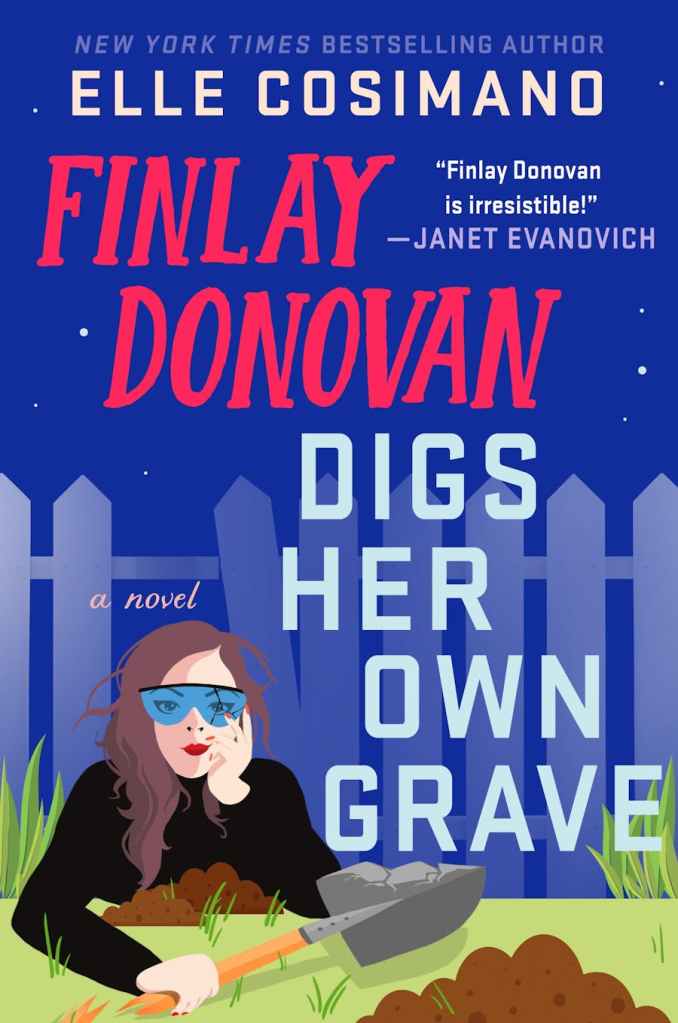
The books are, in order: Finlay Donovan is Killing It, Finlay Donovan Knocks ’em Dead, Finlay Donovan Jumps the Gun, Finlay Donovan Rolls the Dice, and this latest, Finlay Donovan Digs Her Own Grave. (There is also a book 3.5, a novella of 107 pages that reveals some of the back story of nanny Vero Ruiz, called Veronica Ruiz Breaks the Bank. That’s the only one I haven’t read…yet.)
As with the others in the series, not a lot of time has passed since the events of the previous book, but this time Finlay and her nanny/business manager Vero don’t actually create trouble for themselves, but are helped into the thick of it by Finlay’s elderly neighbor, Mrs. Haggerty. Margaret Haggerty has featured in all the other books, mostly as the busybody across the street who keeps a pair of binoculars next to her front window and writes down all the transgressions and suspicious behavior of the people in her neighborhood. (She’s the one who revealed to Finlay that her husband was stepping out on her with his real estate agent, Theresa.) But this time it is Mrs. Haggerty who is under suspicion—a dead body has been found buried under her backyard rose garden, and she’s the prime suspect. The police can find no connection between her and the victim, so she is cleared, but since her house is an active crime scene, she insists on moving in with Finlay, Vero, and the kids until the yellow tape comes down and the heating and electricity are restored.
Finlay, who has just finished a book and has a little breathing room before needing to get on with her next, had been looking forward to some calmer down time, hopefully including some fraternization with hot cop Nick, while Vero is negotiating her reinvigorated relationship with childhood pal and current love interest Javi. Neither of them is overjoyed to welcome Mrs. Haggerty into their home, but when her grandson drops her off and disappears, they haven’t much choice.
Then things take a turn that pulls them into the investigation, when Finlay’s cheating ex-husband, Steven, becomes a suspect! There is a small part of Finlay that wouldn’t mind Steven getting his comeuppance…but he is the father of her children, and ultimately she doesn’t believe he’s a murderer. But how to prove his innocence?
After re-reading the other four books before jumping into the new one, I have to say that I appreciated the slightly less fraught tone of this story. There were still twists and turns and surprises, but it was neither as convoluted nor as frantic, with a little more time to develop characters, and that was a needed development. The cast list was pared down (the last book had several criminals, a half dozen extra cops, multiple murder victims, and enough incidental characters that I kept thinking as I read, “Who is this guy again?”) We didn’t just get to know more about Mrs. Haggerty, but we also deepened our acquaintance with Cam, the teenage computer hacker; we saw Finlay and Nick get to know one another better; and I also loved the vignettes of the children, Delia and Zach, as they navigated being bullied at school and conquering potty training, respectively. There were quite a few laugh-out-loud moments, some genuine suspense, and some big surprises, but it felt like we settled down into a better understanding of the principals, which makes me anticipate the next book with greater pleasure.
If you’re looking for a cross between mystery and French farce, with a dose of middle class angst and some fancy crooks, you will want to try this series for yourself.
Cozy with nuance
I don’t remember who recommended this book to me; maybe I just read a review of it somewhere, or it popped up in my Kindle best buys or something. But probably someone told me about it because the main character is a librarian. (When you yourself are a librarian, people do that.)

Fried Chicken Castañeda, by Suzanne Stauffer, is a first book for this author, who was also a librarian for 20 years in New York City and Los Angeles, and then got her Ph.D. at UCLA in 2004 (I missed her by a year!) and went on to teach at the School of Information Studies at Louisiana State University. She is also a historian of libraries (you can see a list of her published papers on Wikipedia.
But the protagonist of her book, Prudence Bates, is bored with her career at Cleveland Public Library, and decides to go on hiatus to try something new. It’s early 1929, and Prudence has thus far led an extraordinarily limited life. Her father died a few years back, and her life choices have been truncated by the desire to spare her mother solitude. She wanted to go away to college, but instead attended one close to home so as not to leave her mother alone. She wanted to be an anthropologist who travels for research, but instead chose library science because she could get a local job to be there for her mom. But now her mother and Prudence’s nice enough but, yes, rather boring boyfriend are both pressuring her to settle down, and she’s so tired of fending them off that she almost succumbs.
Her boss at the library senses her ennui in the nick of time, and proposes that she attend a library program about young women couriers for the Fred Harvey Southwestern Indian Detours, who lead tours from the Santa Fe Railroad depots in the West to explore Native American art and culture. The stated goal by the library director was for her to emulate the presentation by developing similar programming for the library, but Prudence is so entranced by the life these nomadic tour guides describe that she packs her bags and heads out to New Mexico to train for a courier job. She has the college degree they require but not the familiarity with the terrain, so she stops off for a week on her way to the interview in the small town of Las Vegas, New Mexico, to begin to get acquainted with life in this corner of the world that is so different from her native Cleveland.
This book reminded me, for some reason, of the Molly Murphy mysteries by Rhys Bowen. They are not superficially too similar; but both protagonists are young, optimistic, and somewhat cheeky, and they both travel far outside their childhood norms to experience a different kind of life. The story also made me think of Dead to Me, by Mary McCoy, yet another librarian author (this one works at Los Angeles Public Library), because it’s set in a particular part of the past that yields extra interest; that book takes place during Hollywood’s Golden Age, while this one navigates the perils of Prohibition.
Stauffer has done her historical research, with the result that the background is filled with details about Pullman train travel, the fashions of the day, and the specific environment in the small New Mexico town Prudence chooses to explore. But what I liked best is that she didn’t shy away from permeating her narrative with the huge cultural divide of that era between the well-off white folk traveling on the trains and the Indian cultures these people are “touring” from a position that could be described as both superficial and patronizing. She is not at all heavy-handed, but does manage to insert reactions and observations designed to highlight such themes as racism, wealth inequality, and cultural diversity as her heroine gets to know the people who actually live and work in the towns through which she will be leading her tours, employed by the railroad and by the Harvey company.
The mysteries in this book are not quite as compelling (probably because there is so much character development and scene-setting to accomplish), but they are mixed up with a bit of romantic tension between Prudence and Jerry Begay, a Navajo man she meets on the train, that lend an extra spark.

the Castañeda Hotel in Las Vegas in 1926.
It’s not a book I would rave about and recommend to everyone I know; but it was certainly one of the better cozy/historical mysteries I have read, good for a couple of afternoons of entertainment. I would willingly pick up a sequel to find out more about the career of the gutsy Prudence as she pursues her dream. I hope she writes one!
New series from Connelly
I am a steady reader of mysteries. I’m not a fanatic, and I prefer fantasy and science fiction, but it’s my number one category in terms of number of books read, probably because when I find a writer whose detective and style I like, I stick with them until I have read the entire series (and mystery writers are generally pretty prolific). I enjoy different kinds of mysteries: cozies, historical, thrillers, police procedurals. When I first heard the title of that last category, I thought “procedural” made it sound dull, but the truth is that, in skillful hands, all the minute details of how a case is built and a murder is solved can be fascinating to the reader, as well as to the detective.
With Los Angeles County Sheriff’s Detective Stilwell as its lead character, Michael Connelly is starting a new series featuring someone other than Harry Bosch, Renée Ballard, or the Lincoln Lawyer. While he could still be termed loosely within the “Bosch Universe,” which is based in Los Angeles, Detective Stilwell, or “Stil,” as his friends and colleagues call him, is off the beaten path; he is the detective presiding over the police substation on Santa Catalina Island, 22 miles off the coast of Southern California. He has two subordinates and an office manager who work directly under him, and liaises with a coroner’s department and with the Harbor Master (who is also his girlfriend).

He’s been on Catalina for a year; he was exiled there from the L.A. Homicide desk after he crossed horns with another detective and was deemed at fault in their dispute. His duties now consist mostly of dealing with petty thefts and drunk-and-disorderly cases that proliferate on the weekends when the tourists come to the island to let off a little steam. While he was initially somewhat bitter about his demotion and didn’t appreciate being shunted to this backwater, he has come to love the island and seems to feel that he’d like to stay there, at least for a good long while. But when a shrouded, weighted-down body washes up into the bay, Stilwell refreshes his skills at solving a murder, despite resistance from both his boss and his old nemesis at LAPD Homicide, who is assigned the case.
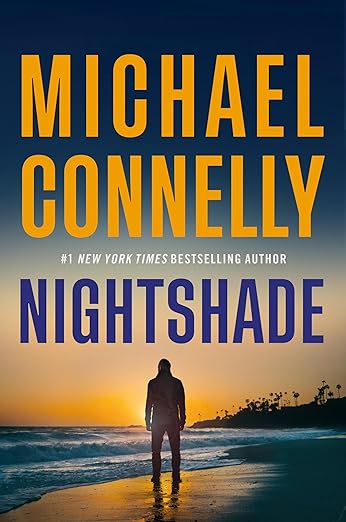
About halfway through this book, I became increasingly irritated by several things. First, although it’s fine that the guy has been nicknamed “Stil” from Stillwell, it would seem normal and necessary to know the detective’s actual first name, but that hasn’t been revealed. Are we going to have to wait to meet his mother (if he still has one—we also know nothing about his family situation or past associations) to find out his given name?
Second, while there is a wealth of detail about what differentiates a ketch from a regular sailboat (I couldn’t care less), or what color hair dye the victim used for the streak in her hair (“Nightshade” purple), we have absolutely no physical description of the main character. The only hint is that when he feels he may need to overpower a guy in his custody, he notes that he is taller than the 5-foot-eight-inch perp by at least four inches, and outweighs him by 25 pounds. So we know that he is about six feet tall, and has more meat on his bones than this slender, wiry criminal Connelly does bother to describe. But we don’t know how old he is, whether he is dark- or light-skinned, color of eyes, color of hair, whether he has a big nose or his ears stick out—not one measly iota of physical description is vouchsafed by the author.
Some people might see this as an advantage and, based on experience from other book series that have later been turned into movies or television, I can understand that viewpoint. People were outraged when Tom Cruise was cast as the protagonist in the first Jack Reacher movie, and quite vocal with their approval when the makers of the television series picked the taller, blonder, and more muscular Alan Ritchie, who conforms quite closely to the description of Reacher in the novels. And the reverse can also happen: I have been watching Will Trent on TV since the series began, and that led me to try one of Karin Slaughter’s books, since I enjoyed the TV series so much; but I simply couldn’t get past the fact that on TV, Will is short, compactly built, and Latino, while in the books he is tall, blond, and blue-eyed. I was really looking forward to exploring the stories in depth after seeing the show, but I stopped after book #1. Since Connelly’s other books have been optioned for movies or TV, perhaps he is thinking ahead to casting.
There is a difference, however, between giving a few details and giving absolutely none. For instance, knowing the approximate age of the character and how long he has been on the job will clue you in to how much experience he has and whether he’s plausible as an authority, but we don’t know if Stilwell is 28 or 50. Except for the exceedingly indirect clue I mentioned above (which would have been easy to miss), we don’t know any physical details. These are the idiosyncracies that help readers begin to build a picture of the character in their minds. In a lone-policeman or lone-detective type mystery series, it’s crucial that readers be able to identify with the lead character, who is the sole arbiter of each story. If that person is essentially faceless, it’s hard to care.
The third thing that bothered me—and this one may end up being the most significant—is that from the get-go Detective Stilwell comes off as Harry Bosch “lite.” Everyone who has read the Bosch books knows that Harry is a renegade, a person who, without fail, puts his own values and integrity first and therefore eventually runs afoul of almost every boss and many of his co-workers, who are either motivated by politics or tend to be lax about the work, seeing it as a job rather than as a calling. So when Stilwell turns out to have been sent to Catalina because he has burned down relationships at LAPD Central, that sounds too similar to Harry’s many reassignments to the wilds of the San Fernando Valley or the dead end of the cold-case bureau. It inevitably follows that he will have a problem with his fellow officers who are not as punctilious as he is about dogged follow-up, and that he will break rules and cross lines to get at the information he needs. Classic Bosch, which isn’t a problem for that character but is a problem (for me, at least) when Connelly claims to be launching a brand-new protagonist who bears all the characteristics of the old one except that he is presumably not near retirement age! It made the story seem stale from the outset.
As for the two mysteries in this book, they had their moments, but in light of the characters who seemed either stereotyped or kind of blah, it was hard to invest. I will try another when he writes it, but I’m afraid this “fresh start” isn’t different enough to pry people away from their Bosch worship and keep them reading Connelly. We will see.

Cream of the crop
I wasn’t going to post any further about my sojourn in the land of Regency Romance, but the last Heyer I reread was so delightful that I just have to share. I have previously mentioned a list of favorites here, and somehow this one didn’t make it onto that list, but I think it may be my new “best-of” pick. It’s The Foundling, written in 1948.

The name of the book is deceptive, because the foundling (orphan) in question is merely one small element in a much bigger story, and most of that story is about Adolphus Gillespie Vernon Ware (“Gilly”), the seventh Duke of Sale. Gilly is 24 years old, one year away from his majority, when he will take over control of his own estates from his guardian and uncle, Lord Lionel Ware. He is beset by irritations, but not the kind to which there seem to be any solution. He was a sickly child who has grown into a sturdy (if small and slight) adult, but his relatives and the raft of devoted family retainers who work for him will never let him forget that they have had good reason to mollycoddle him for his entire life, and he is constantly thwarted in the simplest of plans. He can’t do so much as take a walk to his club without his valet, his butler, or his agent insisting on ordering him a carriage for fear he will unduly exert himself or catch a chill. So when his young cousin, Matthew Ware, comes to him with a problem he is, himself, unable to solve, the Duke decides that he will take care of it without resorting to the advice of others. He will do so while masquerading as a plain “Mr. Dash,” not dependent on the benefits of birth and wealth; he manages to sneak off on his own, with no luggage, no carriage or horse, and no word to his servants or his uncle about either his intentions or his destination.
This incognito journey into the countryside to confront his cousin’s blackmailer leads to some interesting and signficant encounters that include a runaway schoolboy, a divinely beautiful but completely brainless orphan, and some villainous people and perilous situations. Meanwhile, back at his London abode, the hue and cry to discover his whereabouts is exacerbated by the belief by some that he may have run off due to an adverse reaction to becoming engaged to his lifelong friend, Lady Harriet. Others develop the theory that his cousin Gideon, who is his best friend but also his heir, may have “put him out of the way” in order to ascend to his title and massive fortune!
This is one of Heyer’s most complex and convoluted plots, with something happening every moment. Although the book is named after the fair Belinda (the foundling in question), her part in it is minor except as it motivates some of the adventures of “Mr. Rufford,” the name under which the duke is traveling. It is much less a romance (although there is a bit involved) than it is a coming of age of a man who, restricted from all autonomy since birth, finally rebels against all restraints, and his ensuing complicated adventures are the meat of the story.
I got through it in about 36 hours, because I couldn’t put it down. If you are inclined to try one of Heyer’s books for yourself, may I suggest this might be a good one to assay? (Yes, I am, at this point, speaking in the language of her characters. I think it’s time to move on to other literature.)
Escape from…
I have a number of books on my “TBR” list, but about a week and a half ago I decided to forego all of them for now and retreat into pure denial of everything that’s happening in the world and all the trials of my personal existence by rereading (some for the third time) a string of Georgette Heyer Regency romances.
I started out with three of my favorites—The Grand Sophy, April Lady, and The Convenient Marriage—and then took potluck on the public library website by reading whatever was immediately available, since the idea was a continued getaway rather than a long wait on a hold. And yes, most of her books still have holds on them, more than 50-75 years after their publication!
So I continued on after that with Charity Girl, The Unknown Ajax, and False Colours, which I just started. I have hopes, after this, of snagging Cotillion, Sprig Muslin, and The Foundling, by which time I’m hoping that I will have completely sated my appetite for drawing room drama, complicated toilettes, and witty banter, at least for a good while.
If you are, at this point, losing all respect for me as a reader and reviewer, let me tell you that you are “fair and far out” (under a misapprehension) should you believe that there is no redeeming value to these books. I defy anyone to find a contemporary romance writer who can rival their language, the sometimes labyrinthine plotting, the wonderfully droll characterizations, and the descriptive scene-setting, not to mention the perfectly evoked fashion in which everyone, male and female, is attired.
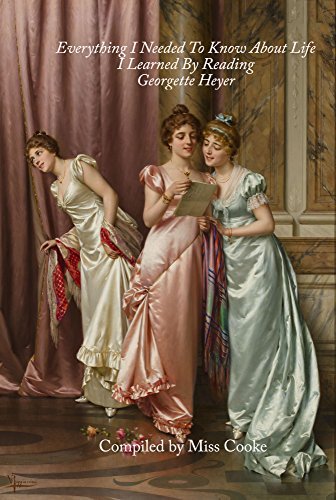
Perhaps I will follow up this binge by reading Everything I Needed to Know About Life I Learned by Reading Georgette Heyer, by Miss Cooke (2016). Although since this “book” is only 55 pages long, I suspect I could do a better job of writing a similarly titled volume!
Boarding-school books
I’m off on my own personal nostalgia kick right now, re-reading Georgette Heyer novels to escape from the depressing real world of politics and sub-optimum health. But on one of the book-lovers’ pages on Facebook, a mom was asking for recommendations for her teenage son who is a reluctant reader, so I combed through my various categories of YA fiction for some and was thus inspired to write about this sub-set of coming-of-age fiction, the boarding-school book.
I think those who have never attended a boarding school are in some way fascinated with the culture—I know I always have been, from the time I read my first children’s book with a protagonist who had been posted off by their parents to “sleep-over” school. And there are a lot (hundreds) of examples out there of the away-from-home scholastic experience, from Harry Potter to A Separate Peace. There are books in every genre, for almost every age, so I thought I’d mark some of my personal favorites and some that seem to be perennially popular.
The boarding-school book is by no means limited to children and teens—there are many written for (and sometimes about) adults as well, especially if you include the college boarding experience. I’ll give age groups and categories and (in some cases) some brief synopses, and if you have the same interest I do, you can gravitate to whichever piques your interest.

For children, a classic example is
A Little Princess, by Frances Hodgson Burnett, about a young girl sent home to England from India, where her father is a successful merchant, because it was believed that the climate of India was not salubrious for British children. They were separated from their families and entrusted to the care of an English boarding school, where they would hopefully get an education and a proper upbringing and be reunited with their families when they were grown. Young Sara Crewe goes from riches to rags when her father disappears and is presumed dead, and Miss Minchin’s Select Seminary can no longer collect hefty fees for her maintenance. I sometimes think of this book as the child’s version of the first third of Jane Eyre, by Charlotte Brontë (although Sara is much better-natured than Jane ever was!). It’s a romantic story with a protagonist who remains upbeat and optimistic in the face of cruelty, guaranteed to appeal to the kind of reader I was at a young age.

There are many boarding-school books with more fantastical settings, the most well known probably being the Harry Potter books, in which gifted children are sent to Hogwarts School of Witchcraft and Wizardry to hone their talents. But in the fantasy category are also the Harper Hall books by Anne McCaffrey, which take place on the planet Pern and feature dragons and fire lizards in these stories of children studying to be professional musicians; and The Rithmatist, by Brandon Sanderson, featuring another magical school, this time for math geniuses with a little something extra. These are all for younger children and teens (maybe 4th through 8th grades?), although older teens and adults can (and do) enjoy these books as well.

In the specifically Young Adult category, there are fantasies, mysteries, and realistic fiction all set at private academies that either offer the standard schooling or are geared towards inhabitants with a specialty. For the middle school set: One realistic one in which the rule of the bullies and the plight of the bullied are revealed is The Mockingbirds, by Daisy Whitney. Another fairly normal boarding school that is the site of a mystery is the backdrop for the Truly, Devious trilogy by Maureen Johnson, in which death visits Ellingham Academy. And the Gallagher Girls series by Ally Carter (beginning with I’d Tell You I Love You But Then I’d Have to Kill You) showcases a girls’ school that is supposedly for the upper-crust daughters of the snobby set but is actually a training curriculum for those who wish to become undercover agents for the CIA and like agencies.

Among the boarding-school franchise for older teens, there are also a variety of settings. In the realistic category are such mainstream stories as Winger, by Andrew Smith (at a boys’ school focused on rugby); and Looking for Alaska, by John Green and Saving Francesca, by Melina Marchetta, both with a challenging co-ed population. A fun book in its development of one character from age 14 to 16 as she figures out how to dominate her environment is The Disreputable History of Frankie Landau-Banks, by E. Lockhart. Another is the trilogy by Stephanie Perkins that begins with Anna and the French Kiss, following a Georgia girl who is transplanted to an American school in Paris for her senior year.

A huge boarding-school subset is the paranormal category, with vampires dominating and witches coming in a close second—the Vampire Academy books by Richelle Mead, the Hex Hall series by Rachel Hawkins, the Gemma Doyle stories by Libba Bray, and Evernight, by Claudia Gray. One series that I particularly like and admire is Wayward Children by Seanan McGuire, which could arguably be classed as either YA or adult; the books are unusual, smart, and varied in their approach. I reviewed them on this blog when I first discovered them, and continue to find them unique.

Moving on to books more appropriate for adults, there are some in every category. The Magicians (and sequels) by Lev Grossman have been billed as Harry Potter for grown-ups. Mysteries that feature boarding schools include Well-Schooled in Murder, from the Inspector Lynley mysteries by Elizabeth George; The Secret Place, one of the Dublin Murder Squad books by Tana French; and The River King, by magical realism author Alice Hoffman. A book that is written about young people but is (in my opinion) too intense for their age group to read is Brutal Youth, by Anthony Breznican, a co-ed Lord of the Flies set in a Catholic private school in Pennsylvania. I didn’t so much enjoy reading it as remain fascinated and unable to put it down. It’s definitely powerful, and in some ways brilliant, but also stark and frightening. Gentlemen and Players, by Joanne Harris, is written from the point of view of the teaching staff at St. Oswald’s Grammar School for Boys, a cat-and-mouse tale of revenge as one staff member with secret ties to the school tries to destroy it from the inside. Finally, Never Let Me Go, by Kazuo Ishiguro, is dystopian literary fiction with a boarding school setting that may not be what you had in mind when you read the initial description, but it’s a fascinating premise with a heartbreaking (and kind of depressing) outcome.
This is a mere drop in the bucket of what’s out there; if you want to research this category further, go to Goodreads, select “browse” and “lists” and type “boarding schools” into the search box, and you will find multiple lists containing all these and many more. But the books mentioned here are a great start if you, like me, enjoy that particular setting for your fiction.

Part of Your World #1
I reviewed Abby Jimenez’s book Just for the Summer in February, noting that it was the third volume of a loose trilogy without a through-story; the books simply share a few characters. This week I picked up the first in that series, Part of Your World, and was immersed in another meet-cute story about a destined couple with huge obstacles to conquer.

Alexis Montgomery is the latest in a formidable dynasty of doctors who have created their own stage on which to shine; they have all (except Alexis) been world-class surgeons whose total focus is continuing this family tradition at Royaume Northwestern Hospital, to which their award-winning research and procedures have brought both fame and financing for almost 125 years. Alexis’s twin brother, Derek, is the surgeon of her generation, leaving her free to choose to be an Emergency Room doctor instead, even though this is looked down upon by her autocratic, competitive parents. But Alexis’s saving grace (to them) is that for the past almost-decade she has dated and then lived with and become engaged to the hospital’s chief surgeon, Neil, who is the doctor they had hoped she would be.
Alexis has recently identified, however, how deeply unhappy she is with Neil; she has been subjected to a systematic program of denigration and gaslighting for most of their relationship, and has finally managed to break free, using the excuse of his affair with his department’s anesthesiologist to kick him out of the house they own together. Through therapy, she is getting a solid idea of how thoroughly warped she has been by his manipulative verbal abuse and is making strides towards being emotionally healthy; but everyone else in her life—Neil and her friends and parents included—expect the two will reconcile.
Daniel Grant’s family has lived in the tiny town of Wakan, Minnesota, for as long as the Montgomerys have ruled the medical community in Minneapolis. His many-greats grandfather built a beautiful home there that Daniel, the last of the family so far, has turned into a bed and breakfast, which he operates during the tourist season when people come for the river rafting, fishing, biking, and other outdoor pursuits. The rest of the year he makes a meager living with his woodworking, building both furniture and ornamental pieces in his workshop apartment over the garage. Daniel is also the mayor of Wakan, although this isn’t so much a position of esteem as it is a combination of social director and arbitrator of petty community issues. He knows everyone and everyone knows him, and they all look out for one another in the precarious atmosphere of a town that depends on its visitors for its living.
There could hardly be two more dissimilar lifestyles or outlooks than these, but when Alexis runs her car off the road on her way home from a funeral in Iowa and Daniel shows up to tow her out of the ditch, there’s an undeniable spark that leads one of them to think there could be something here, while the other resolves that there’s no way this can be anything but a short-term fling. Alexis, 37, has the weight of the Montgomery dynasty on her shoulders and a wealthy city lifestyle to support her long hours at the hospital; Daniel, 28, drives a pick-up truck with duct-taped seats, slaves for every penny, and doesn’t own a suit. It seems impossible that either could give up their world to be with the other; there is just too much baggage and too many extenuating circumstances. But there is that connection…
I loved about 85 percent of this book, and would say it is worth reading. The caveats that make up the other 15 percent are two. One of them is the ending; it was pretty obvious what would eventually happen, but the manner in which it did seemed way too easy after all the angst put into the situation by everyone involved, making it a little anticlimactic.

The other caveat is something I would never have expected would bother me, but it did. There is, in this story, an element of magical realism. I am generally a big fan of that literary device in fiction; I have devoured most of Alice Hoffman’s books, loved Chocolat by Joanne Harris, enjoyed some YA picks by Anna-Marie McLemore, and admired (but didn’t love) the works of Isabel Allende. I like realistic stories that include fantastical elements treated as if they are wholly normal, which is a basic definition of the genre, but in this book, this element was awkwardly handled. The first allusion to the magical nature of the town of Wakan was dropped early in the book by a minor character, but nothing occurred to back that up until about three-quarters of the way through, and then it was so abrupt and unlikely that it felt less like magic and more like one of those phenomena where it’s raining and fish suddenly fall from the sky, miles from any body of water. The whole nature of magical realism is to blend it in seamlessly with the everyday so that it is delightful but doesn’t stick out like a sore thumb, and Abby Jimenez has unfortunately not mastered this writing technique. Far from adding to the story, it pulled me right out of it.
But…I’d still give it four stars out of five (mostly for the totally hot carpenter/mayor).
#Momspringa
I wanted to continue the more lighthearted mood engendered by The Road to Roswell but wasn’t wanting more science fiction, so I decided instead to look for an entry in the “relationship fiction” category. I couldn’t find an available check-out at the library, so I searched my Kindle for a reread and remembered Kelly Harms’s The Overdue Life of Amy Byler, which I read back in 2019 and enjoyed quite a lot.
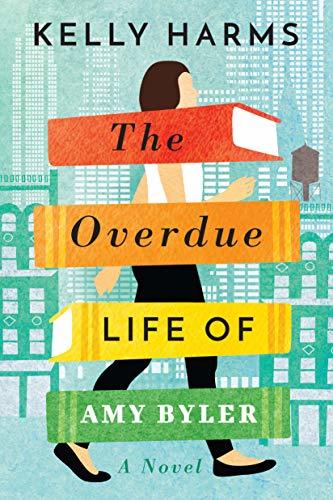
Rather than re-hashing, I will post a link to my previous review here, but will add that one of the reasons I appreciated this book (in addition to the book- and librarian-related story line and the makeover of “momjeans”) was because it dropped me into a world that, at a naive and hopeful 18, I thought might be a career choice.
At a certain age, we all look back at the possibilities we passed up, the roads we didn’t travel, and wonder what would have resulted had we made different choices; one of my fantasy life stories was to go to New York City to become a book editor or work for a high-end magazine publisher. (Sylvia Plath’s The Bell Jar had a big effect on me in high school.) Amy Byler’s friend Talia, the chic, single, city-loving editor of a fashion magazine, was the definition of my dream, and the summer Amy spends in the city housesitting her empty apartment while attending theater productions, going to museums, and discovering wonderful restaurants, sounded like a lifestyle I would have loved.
One of the few regrets I have is that I have never made it to NYC, even for a visit. I guess there’s still time left…but my dream was to conquer the boulevards by striding down them in my Reeboks on the way to the office with all the other up-and-comers, not to be a tourist taking the freight elevator to the top of the Empire State Building in my wheelchair. I guess Amy wasn’t the only one with an overdue life! I mostly don’t regret the one I have lived, but I certainly wish I had been more adventurous at key moments and thus had more on which I could look back with satisfaction. Perhaps I will stick with the fantasy fulfillment of books like this one and simply pretend to be the person living the story—isn’t that really what reading is all about?
Indy lassoes some humans
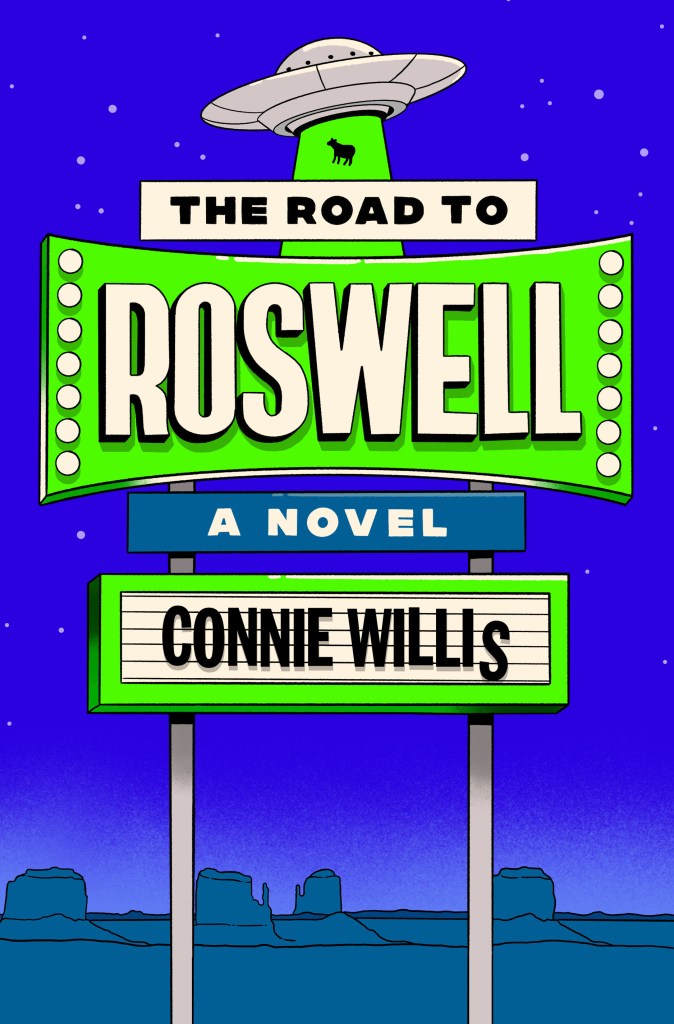
I just read a book recommended to me by my friend Kim, who is as much (or more?) a fan of science fiction writer Connie Willis as I am. I hadn’t heard of this one (and apparently of a few more, once I reviewed the list at the back of the book!), and I’ve been wanting a good new sci fi comedy (my last one was by John Scalzi), so I settled in this past week with Willis’s The Road to Roswell. I was surprised to discover that it was published less than two years ago; when Kim recommended it, I just assumed for some reason that it was an older book, perhaps because Roswell was a lot more popular setting a couple of decades ago than it seems to be now.
There were, contained within this book, both some unexpected and some entirely expected elements. The unexpected one was the nature of the alien. Not a Gray, not a Reptilian, he instead looks sort of like a tumbleweed (good camouflage in the desert!), a round shrub with branch-like tentacles; but when he wants to accomplish something, those tentacles stretch and flex and flatten, and shoot out to grab and hold whatever he is aiming to control. One of the protagonists thus gives him the nickname “Indy” (after Indiana Jones and his bullwhip).
The expected element was the nature and structure of the narrative. Connie Willis creates this peculiar kind of interaction in many of her books—sometimes subtle, more often extreme—in which communication between characters is constantly stymied. People start to say things but get interrupted. People mean to tell other people important information but forget, or get sidetracked, or are ignored. People try to pass on messages through a third party, who misunderstands and misinterprets them or, again, forgets all about them. The result is an ongoing escalation of tension over the missed opportunities, especially as questionable situations are further exacerbated by the ongoing lack of understanding. It results in a story full of dialogue that fails to move the action forward as intended, and when I read one, I find myself needing to take a break now and then to allow the anxiety from the escalating tension to subside!
This book begins with Francie, who has flown into Albuquerque and rented a car to drive to Roswell, New Mexico, where she will (maybe) be serving as maid of honor to her college roommate and best friend, Serena. It’s only a maybe because Francie has been in this position with Serena several times before, but no wedding has yet taken place; Francie’s role seems to be showing up in the nick of time to talk Serena out of marrying whichever oddball nut job for whom she has supposedly fallen head over heels. In this instance, it’s a UFO-obsessed alien-chaser who thinks the best venue in which to celebrate their marriage is the International UFO Museum.

Imagine Francie’s surprise, therefore, when aliens turn out to be real. She finds this out when she and her rental car are commandeered by one, who wants to go somewhere (although he can’t communicate where) and needs Francie to serve as his chauffeur. Soon, while on their surprise road trip, they also acquire a hitchhiker (maybe a grifter), Wade; an hysterical guy obsessed with alien abduction conspiracy theories; a little old lady on a bus trip to the Las Vegas casinos; and a retiree whose enormous RV becomes their new vehicle when Francie’s rented Jeep will no longer accommodate everyone the alien decides to lasso and bring along on this adventure.
Despite the kidnapping aspect, Francie and the others (except for the conspiracy guy, who can’t stop talking about invasions, probing and Men in Black) become convinced that “Indy,” as they call him, is in trouble and needs their help to get out of it. They go from unwilling abductees to a team devoted to understanding and helping their new friend, as they drive all over the southwest looking for who-knows-what and encountering rattlesnakes, Elvis impersonators, and people and aliens who may mean them harm. The book is a frenetic mix of abduction, expedition, and romantic comedy, and it’s fun. Really fun. If you need a silly story that also encompasses the best and worst of human foibles as illustrated by their reaction to aliens in their midst, this is one to read.


 The Book Adept