Water, water everywhere
I love dystopian and post-apocalyptic novels. I have a fairly long list on Goodreads of those I have already read, and I continue to look out for others amidst all the book recommendations I see online. Included in my favorites are A Boy and HIs Dog at the End of the World, by C. A. Fletcher; Starhawk’s Maya Greenwood trilogy set in San Francisco about the division of California into the good, bad, and ugly that includes The Fifth Sacred Thing (the best of the three); the seemingly neverending post-nuclear-war saga detailed in Obernewtyn and sequels by Australian writer Isobelle Carmody (that has taken her decades to complete); the weird and horrifying Unwind series by Neal Shusterman; and a few oddball stand-alones such as The Gate to Women’s Country and The Family Tree, by Sheri S. Tepper; Lucifer’s Hammer, by Larry Niven and Jerry Pournelle; and War Day, by James Kunetka and Whitley Streiber. I have about two dozen more on my list, and probably that many again that I still want to read. But Kassandra Montag’s After the Flood crossed paths with me purely by accident.
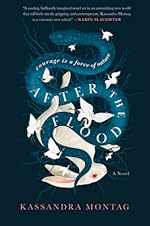
In December, I found a vendor on Etsy who put together cute “blind date with a book” packages including bookmarks, teabags, and a book, and thought this would be the perfect Christmas gift for a friend who seemed to be in an emotional slump; so I purchased the package and told the seller what book I would like her to include. Her response was to say that she didn’t take specific requests, but would try to accommodate if I gave her a list of preferred genres and some example titles. I felt that her advertising had been misleading, but ultimately went along with the program by giving her my friend’s favorite genres (romance and science fiction), with my sole request being that she send an upbeat story, since the whole idea was to cheer up my friend. Her choice was this dystopian novel by Montag, whose description alone should have warned her off.
After apologizing to my friend for this weird choice, I decided that I would read it myself to see just what she was in for; and after having finished it, I can say that it’s wholeheartedly depressing and that I’m really wishing I could get my money back. Not so much for me, but it definitely won’t be lifting my friend’s mood!
It’s set about 100 years in the future, when global warming has (presumably) done its worst…
We still called oceans by their former names, but it was really one giant ocean now, littered with pieces of land like crumbs fallen from the sky.
The ice caps melted and the water rose, first engulfing the coastlines and then, with the Six-Year Flood, the flatlands were likewise covered by water, and the remaining land consisted of mountaintops sticking up above the watery horizon. People fought to cling to the small settlements carved out of those elevated spaces, or they took to the water, living their lives on the sea and only docking to trade fish for vegetables, flour, fabric, and materials to repair their boats.
Myra and her daughter Pearl are eking out a precarious existence on their boat Bird, built by Myra’s grandfather when the water began to overwhelm their Nebraska farm. Myra’s husband Jason was so terrified of the encroaching floods that he decamped in a friend’s boat, kidnapping their five-year-old daughter, Row, while Myra was in her last month of pregnancy. Her grandfather and her mother didn’t survive the floods, and Myra was forced to set sail when Pearl was an infant still carried swaddled on her mother’s chest.
Now it’s seven years later, and Myra and her daughter are living day-to-day, keeping their heads down, avoiding other people for fear of their intentions. But one day Myra encounters a raider who inadvertently gives her news she never expected to hear; her older daughter, Row, is still alive, in a settlement up in Greenland. This hopeful news is offset by his comment that she’s nearly old enough (13) to be sent to a “breeder” ship, which is exactly what it sounds like; and Myra becomes determined to go and get Row, whatever it takes, to protect her from this fate.
Unfortunately, luck and nature are against her, and she has to team up with others to pursue her goals. But how many people is she willing (or right) to endanger to get what she wants?
The world-building in this book is excellent: visceral, realistic, and detailed. The disintegration of the moral integrity of desperate people also rings true, and many of her characters are compelling. But…there were a few things that work against elevating this to among my favorite dystopian novels. I found myself disliking the main character quite a bit for her ever-shifting moral compass and especially for all her justifications; so living inside her head in order to follow the story proved both exhausting and occasionally distasteful. And while the synopsis given by the publisher promises to serve up hope along with the angst, it seems like there is pitifully little room for that amidst all the catastrophe, and I didn’t feel like the end of the story justified the means.
Still, it was fairly engrossing, especially in the action-packed parts, and it also painted a poignant picture of the joys, the pains, the requirements of motherhood. So I would recommend it as a solid dystopian tale, but I wouldn’t rank it in my top ten.
Harking back
Somebody on Friends and Fiction (Facebook group) asked for a list of time travel books and, amidst the ones by Connie Willis, Diana Gabaldon, and Bee Ridgway that I have cataloged, I saw an old favorite from the late 1970s and decided to do a reread.

The book is The Door Into Summer, by Robert Heinlein, and it has the distinction of having been written in the 1950s with the expectation that by the 1970s we would already have things like autonomous robotic vacuum cleaners (i.e., android-shaped Roombas), and by the year 2000, well, sky’s the limit—teeth that regenerate, cream that removes a beard, “stick-tite” clothing fasteners (fancy velcro) and so on. It’s kinda fun to hark back to early science fiction and see the optimistic expectations with which the authors pictured our world. We still don’t have those hoverboards from Back to the Future, let alone a lot more practical gizmos, and humans haven’t colonized any other planets just yet, but on the other hand we do have stuff (like the internet and various fancy Apple products) that none of those sci-fi writers ever envisioned.
In this particular book, the protagonist, one Daniel Boone (D.B. or Dan) Davis is an engineer who retires from the military and hangs out his own shingle with his best friend Miles Gentry, with Dan doing the designing of fancy housewives’ helper-type machines while Miles (a lawyer) runs the business end. They are shortly in need of an office manager/secretary type, and hire Belle Darkin, with whom Dan immediately becomes romantically involved. Dan, being a mechanical genius but otherwise a naive trusting soul, leaves the daily doings to these two, who are up to some behind-the-scenes shenanigans and ultimately cheat Dan and expel him from the company. Dan, having lost both his life’s work and his fiancée, resolves to take “the long sleep,” which is basically cryogenic freezing of people, for 30 years. The idea is that you invest your money, go to sleep, and wake up however many years later with your investments having paid off, still young enough to enjoy them. But do these kinds of things ever work out as promised?

Two additional crucial characters are Dan’s cat, Petronius “Pete” Davis, and his (former) buddy Miles’s stepdaughter, Ricky, a precocious 11-year-old who adores both Pete and Dan. Since I have already perhaps given away too much of the story (although there’s a lot more to it), I’ll say no more about the plot. The title of the book comes from an anecdote about Dan and Pete; they lived at one point in an old farmhouse with a dozen doors, and in the cold and snowy winter-time Pete persists in crying to be let out of each door in turn, getting progressively more agitated that one of the doors doesn’t lead to better weather—obviously a metaphor for the rest of the activity in the story.
Heinlein is at once revered and denigrated for his career as a science fiction writer. On the one hand, he wrote some of the best “hard” science fiction stories (meaning he valued scientific accuracy in his books) from the period between 1941 and 1988 when he died (he was born in 1907). But he was also derided for his right-wing ideology, for the rampant misogyny (the condescension is palpable) in his books, and also for a kind of creepy obsession with very young women, all of which got more radical as he aged. This book has a bit of that (the focus on Belle being primarily on her buxom figure), but mostly it’s just a fun and offbeat story about the possibilities of time travel from dual aspects, and (with the caveat that parts are laughably old-fashioned) I wouldn’t hesitate to recommend it (as Heinlein himself would probably characterize it) as a “cracking-good” read, a nice change of pace from today’s fiction offerings. I seem to have been afflicted, as I read it, with a quaint language “bug,” so I’ll say give it a whirl.
One last book
I managed to fit in one more before the artificial barrier that is New Year’s Eve divides us from our past and pushes us into the future. Don’t we as humans have weird customs? I mean, I understand turning-point events like the solstices and equinoxes, where something actually happens (the day becomes longer, the night becomes shorter, or vice versa, the seasons change, etc.), but artificial constructs like New Year’s Eve/New Year’s Day are a bit baffling. It would seem more logical that the winter solstice would be the year’s turning point, but no, it’s 10 days later. Why?
Anyway, enough with the futile speculation; I read another book! And although I technically finished it on New Year’s Day, since I read 93 percent of it before the turn of the year, I’m counting it as last of last, instead of first of next.
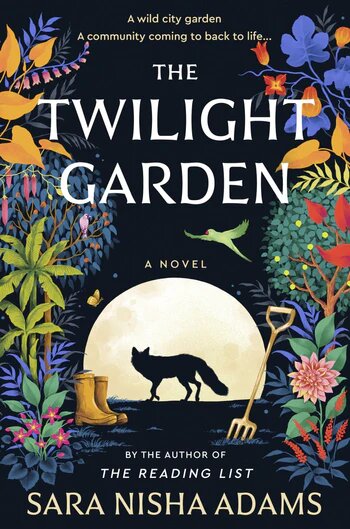
This one is called The Twilight Garden, by Sara Nisha Adams, author of The Reading List, which I previously reviewed here. That book caused a rather lengthy rant about all the things authors don’t know about librarians when they write their supposedly library-centered books; but while her research left a lot to be desired, she was a good storyteller and I like books about gardening, so I decided to give this one a try.
It takes place in a small neighborhood called Stoke Newington in the city of London, where two brownstone-like side-by-side residences (one owned, one rented) share a common garden space that was obviously at one point well cared for, but has been neglected by a string of tenants until it has become choked with nettles and bindweed, showing only faint outlines of its former glory. Living in one side of the property (renters) are Lewis and Winston, a couple who began as bankers at the same institution but who diverged sharply in their goals and aspirations when Winston decided the financial scene wasn’t for him and instead found a job as a clerk in a local grocery, while Lewis continued up the competitive ladder. On the other side (owners) are divorcée Bernice and her 11-year-old son, Sebastian (Seb), the mom prickly and privileged (Winston has nicknamed her Queen of Sheba) and the son friendly and disarming. None of them (except Seb) has any desire to spend a minute with the others and, in fact, Winston and Bernice have an initially adversarial relationship that annoys them both to no end. But when Winston, in the midst of life changes that make him desperate for something to occupy his time and his mind, begins laboring in the garden, prompted by some unexpected input, Bernice is first irritated but then intrigued. Soon the garden begins working its magic to bring these two and others together…
The book takes place with dual casts in two separate timelines, with the property as the unifying element; one timeline is in the 1970s-80s, while the other is (almost) present-day (2018-2019). With the exception of three people, all the major players are Indian immigrants or the children or grandchildren of immigrants, so there are some nice scenes featuring Gujurati cuisine and traditions accompanied by some less pleasant events tied to racism and prejudice. But the heart-warming scenes are far more prevalent than are the hints of discord, and the book is a lovely picture of what happens when people come together to celebrate their triumphs and share their losses while creating a beautiful garden that will have longevity. It’s populated by interesting and memorable characters and has enough specific gardening details to satisfy those who were drawn to it for that reason. A lovely read—not too heavy, but with plenty of depth. I also liked the perfectly narrative art of the cover.
Wrapping up

This year it feels more like a winding down than a wrapping up. I read the fewest books in one year since I started doing the Goodreads Challenge 12 years ago. That year I read 75 books; my highest number ever was in 2019, when I read 159 books while working full-time from January to October (I retired from the library in October of that year). You would think it would be the reverse, since I have so much more time now than I did then; but there were some factors at play that ensured I would read a lot more then. First, I was running three teen book clubs, so I had to read one book per month for each club, plus a couple extra books in each age range (the clubs were 6th- and 7th-graders, 8th- and 9th-graders, and grades 10-12) so I would have ideas to propose as the following month’s read. I was also reviewing books for both the teen and adult library blogs (both of which I supervised), so I was heavily invested in spending all my spare time reading new teen and adult fiction to showcase there. And finally, of course, there was a certain amount of reading for my own particular pleasure! I basically worked, commuted, ate, slept, and read, and did absolutely nothing else!
Nowadays there are circumstances that tend to decrease my reading time: With my particular disability, sitting in one position for long periods of time isn’t great for keeping my legs at their best possible condition for mobility. I also watch a lot more on television these days, now that streaming services let you binge-watch an entire five-season show, one episode after another for as long as you can stay awake, as opposed to waiting for one weekly episode for a 12- to 20-week season and then waiting in turn for the following season. And I spend way too much time “doom-scrolling” political stuff online, or keeping up with friends on Facebook. Finally, once I took up painting I started spending at least a few days a week focused on making a portrait or two or a still life featuring items from my antique collection.
Anyway, this year I read a meager-for-me 66 books. Some of them were literary and some of them were chick lit, some were re-reads of beloved stories, and others were authors previously unknown. My statistics include:
23,782 pages, with an average book length of 360 pages
(shortest was 185, longest was 698)
Average rating was 3.6 stars
Some favorite new titles were:
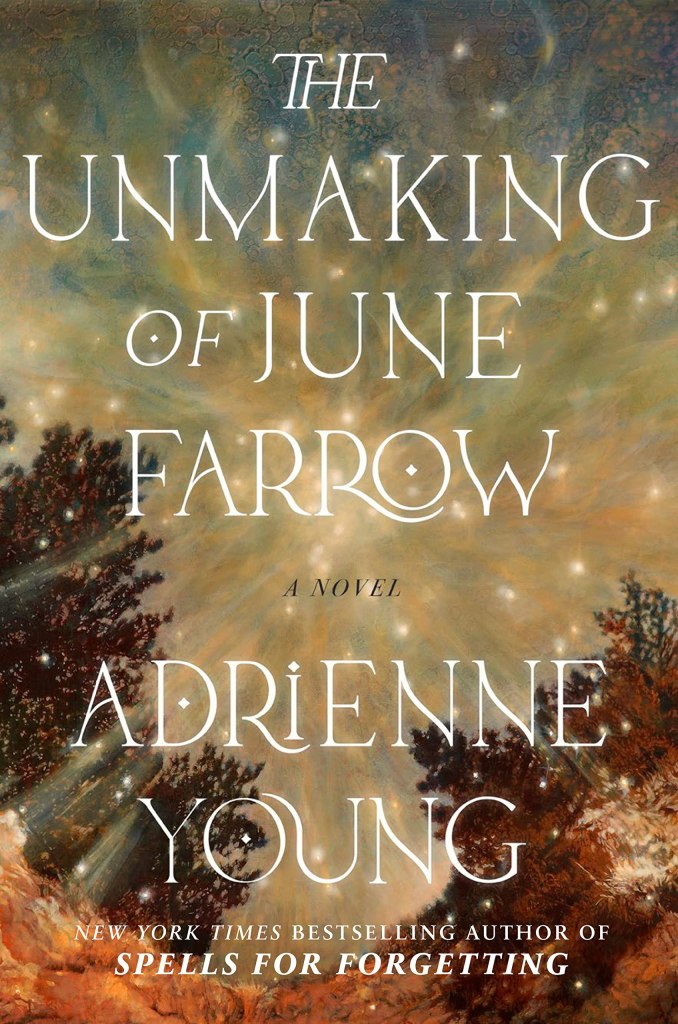
The Unmaking of June Farrow, by Adrienne Young
Starter Villain, by John Scalzi
Vera Wong’s Unsolicited Advice for Murderers, by Jesse Q. Sutanto
The Long Way to a Small, Angry Planet, by Becky Chambers
All the Dead Shall Weep, and The Serpent in Heaven, by Charlaine Harris
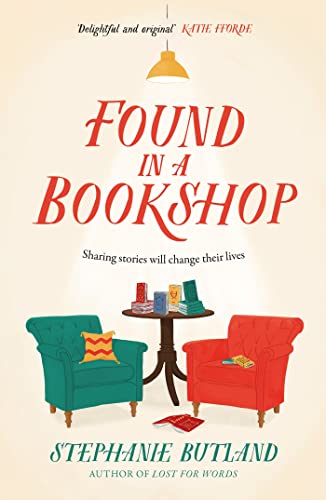
Found in a Bookshop, by Stephanie Butland
I felt throughout the year like I was having trouble discovering books that really resonated with me. Although I had some pleasurable reading discoveries, I never found that one book or series or author that really sucked me in and kept me mesmerized for hours at a time. I found myself reading during breakfast or on my lunch break and easily stopping after a chapter or two to go do something else, rather than wanting to settle in for a solid afternoon of reading. I’m hoping to find more compelling books in the new year. But reading continues to be one of my best-beloved pastimes.
Revisiting a classic
I believe that I have only read The Adventures of Huckleberry Finn once, somewhere around 6th grade, but I might have read it in high school as well. Certainly, though, it was all before I was 20 years old, so it’s been decades. I revisited it now because I decided I wanted to read James, by Percival Everett, but didn’t feel like I sufficiently remembered the events of the original to move directly to reading this updated story.

Although there are parts that drag (the lengthy saga involving the king and the duke) and parts that are actively irritating (the Tom Sawyer segment), I was surprised at how much I enjoyed the book as a whole. Hemingway famously labeled it as seminal to American fiction, and although I’m not sure I would agree as regards American fiction as a whole, it certainly is both masterly and intermittently brilliant as regards its own era. The breadth of subjects Mark Twain addresses in this book, supposedly a sequel to The Adventures of Tom Sawyer but in reality light-years beyond that “boys’ story,” is amazing: racism, of course, but also friendship, war, religion, and freedom, in some truly profound passages. The genius of it is that he refrains almost completely from proselytizing or moralizing, but conveys his message through the thoughts, actions, and dialogues of the people of the time.
The profundity of the story rests almost entirely in who Twain casts as his protagonists—first, an adolescent boy at the very bottom of white society, the uneducated, shiftless, indigent son of the town drunk, one whose morals should have been most suspect, given his upbringing in an atmosphere of alternating brutality and neglect. And of course, the second main character, because of the historical setting, is rated by other characters as even lower than Huck, because he is a man of color and therefore considered no more than a piece of property, in some instances valued less than a piece of land, a gun, or even a hunting dog. These two adventurers turn out to be the most honorable characters of the story, in contrast to the so-called “good people,” the supposed salt of the earth who are (with a few exceptions) seen to be primitive, ignorant, bigoted, and cruel.
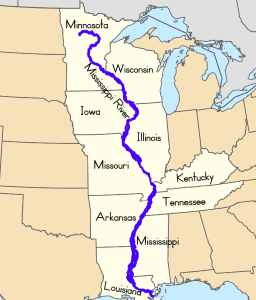
But it’s not just a story that was progressive for its day, shining a spotlight on the upside-down morals of the slavery-era South and poking at a society based on exploitation. It’s also a collection of frequently lyrical descriptions of the beauty of the world (Twain’s enduring love for the Mississippi River shines through), combined with sometimes hilarious tongue-in-cheek humor and poignant moments of reflection and self-realization that contrast beautifully with the specific historical context. The ultimate significance of the story is the moment when Huck decides that although the “right” thing for him to do, according to societal mores, would be to report the runaway slave Jim to his white mistress, he is willing to take “sin” upon himself by breaking the law, ignoring the common view, and refusing to turn in his friend. He firmly believes he is in the wrong, but is willing to embrace those consequences because the empathy he has developed by his daily existence living on a raft with this sweet man who has treated him with nothing but kindness is stronger than the “norms” to which he has been conditioned.
This book is frequently banned from schools and libraries, for one of two reasons: Either that segment of our society wishes to bury the shameful history of this era under a rug and refuse to acknowledge it, or (ironically) it wishes to make an example of it by citing the lack of political correctness inherent in the book’s language and attitudes. Both reasons, it should be obvious, miss the point of keeping this book in the classics lexicon. It takes place at a specific moment in time, and is voiced by a narrator with a perspective, an ideology, and a language consistent with that moment. We should rather be illuminating it for its honesty and using its characters as examples.
People are fond of saying we’ve come a long way from those times, but in many aspects that progress can be seen to be exceedingly superficial (particularly in the current political climate that is an excuse for misogyny and racism), and the perusal of this novel should point that out to us in a powerful manner. I am hoping that the book James that I plan to read after this will make best use of Mark Twain’s look at the hypocrisy of the America of his day, contrasted with Huck Finn’s astonishing moral evolution.
One Goodreads reviewer made the point that a classic is “a book that can still inspire discussions in a classroom some 135 years after its initial publication.” Another added that we are living in an era wherein this discussion would get a teacher fired in any number of states. All we can hope is that there are teachers still brave enough to bring the message of this book to their students, while pointing up the continuing diminishment of people of color in much of current American history and literature.
Metaphor
Flying is such a useful metaphor for all sorts of movement in life, and Jenny Colgan makes the most of this in her book, The Summer Skies, the first in the McIntyre books. (I recently read and reviewed #2, not realizing there was one before it.)
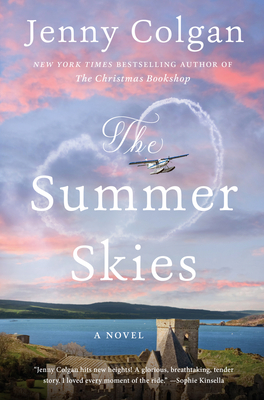
This is the book in which we meet Morag McIntyre, an accomplished young pilot, the third generation to learn to fly in her great-grandfather’s 18-seater Twin Otter prop plane, Dolly, above the windswept archipelago of northern Scotland. The family runs a business that fetches mail, packages, tourists, medicine, and occasionally livestock between islands, a vital lifeline for the sparse population inhabiting them.
Morag is pursuing a life out in the wider world, piloting great airbuses on commercial flights to exotic locales, but one day she has a fraught experience in the air that shakes her self-confidence to the core. One good thing comes out of it when the human resources person who has to vet her return to the cockpit turns out to be the handsome and charismatic Hayden. Despite her secret misgivings about flying again, she is cleared by him and then begins dating him. When Hayden’s office transfers him to Dubai, Morag considers moving with him, but first, news of her grandfather’s illness sends her home to Scotland for a visit. She is pressed into service as co-pilot on a flight to the tiny island of Inchborn—home to a ruined abbey, a bird-watching station, and a visiting ornithologist from Glasgow—where an unexpected delay gives Morag the time she needs to figure out what she really wants, from flying and from life.
I really enjoyed this book. Several reviewers on Goodreads expressed disappointment because it didn’t feel, according to them, like a typical Colgan book, but I would have to disagree. It may have been simpler in plot and more spare with its characters than some (and also lacking recipes), but it felt, nonetheless, like a return to the familiar, which is to say, a trip to the icy but beautiful Scottish isles occupied by quirky characters with life issues to which we can most of us relate.
I will acknowledge one reviewer’s caveats, because they are germane: The research into how pilots are trained for aviation and what they are and are not permitted and/or expected to do (especially regarding switching back and forth between kinds of planes/flying) was incredibly sloppy, and I am surprised Colgan made these kinds of errors. I will also remark (again) about how poorly (and inaccurately) this book was described on Goodreads. (I have written a new summary and am working to get it substituted.) But the focus of this book is also on the relationships, and in that area it was entertaining and felt true to life. And as always with these books set in remote areas of Scotland, I was romanced likewise by the scenery.
Grave Talk
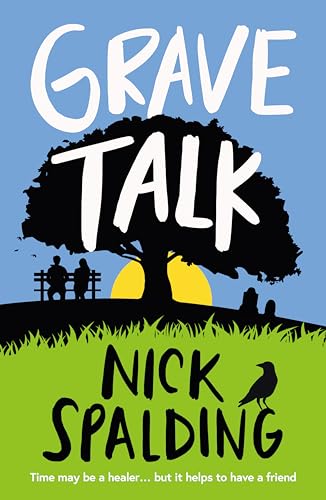
I am always a fan of a good title, and this one works on a couple of levels. Nick Spalding has created an interesting premise for discussing life and death and grief in this book that documents the interaction of two people who have recently lost loved ones and are having an impossible time moving past the experience.
Alice’s husband Joe died of a heart attack in his early 40s, and she didn’t make it to the hospital in time. She has a feeling that something or someone messed up when Joe came into the emergency room for treatment, because why else would such a young man go like that? Ben’s brother Harry, a rising young surgeon, was diagnosed with leukemia and succumbed rather abruptly, and Ben, who is struggling with his need to live up to the rest of his family (they’re all doctors), is especially bereft because Harry was the one who was there for him when his parents were absent or too busy for their younger son. One day, the two mourners visit the cemetery where their people are buried, and the coincidence of the grave sites being closely adjacent brings them together in an oddly freeing ritual of friendship.

There is a certain comedic element to the book, based on Harry’s last wish left for Ben in his will. Harry asks Ben to visit the cemetery yearly, dressed each time as a different character dictated by Harry and carrying out a ritual that is meaningful to the two of them. So on that first fateful day when Ben meets Alice, she is prodded out of her focus on her own all-encompassing grief by the unusual experience of sharing the cemetery with a man dressed in a Kermit the Frog costume, standing at attention and humming the song “We Are the Champions” under his breath. Once Ben manages to convince her that he’s not a weirdo but rather the victim of his sadistic dead brother’s practical joke, the two of them have a meaningful conversation about their losses and agree to meet up at the graves on the same day each year to check in on each other.
This goes on for some time, and the once-a-year encounter showcases for Ben and Alice and also for the reader how uneven is the movement away from grief and how prolonged it can be, far beyond the expectations of those who haven’t experienced bereavement firsthand.
I liked the characters and felt that for the most part their development over the once-yearly visits was believable. I would have liked a little more detail about each of them than the bits they were able to convey in that annual conversation with one another, but the characters did develop and grow and remain interesting. Their respective resolutions felt a tiny bit facile to me, but over all I empathized with them and found the story engrossing, if not riveting. Er, ribbeting?
Slog in the woods
I just finished The God of the Woods, by Liz Moore, and perhaps my headline has telegraphed my reaction?
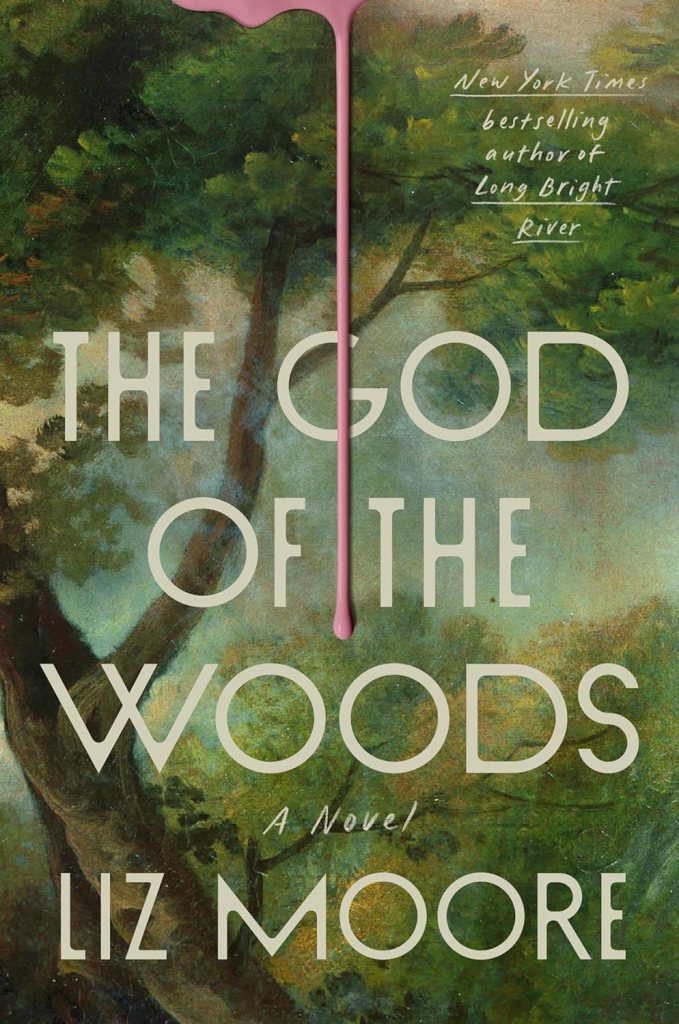
It’s not a bad book. It’s actually an intriguing story, at least initially. It takes place at a summer camp in the Adirondacks owned by the wealthy Van Laar family. This summer is the first time in three generations that any Van Laar child has ever expressed a desire to attend the camp, and ordinarily the family wouldn’t encourage their offspring to mix with the mundanes; but Barbara Van Laar has been such a problem for the past year or so that her parents are happy to put her in this controlled environment at a certain distance from home. She’s still close by—the camp is on one-half of the vast acreage owned by the family—but she’s not underfoot, sulking about in her all-black punk get-up, provoking her father and slamming doors, so all parties are happy with this solution. Until, that is, she goes missing.
Then we get the previous history of the family, which includes a son, Bear, who himself went missing (though not from camp) before Barbara was born, and was never found. A local man was blamed for his disappearance and assumed death, only to himself die before anything could be proved. The family believed he was the culprit, and let the whole thing go until Barbara’s disappearance sparks new interest in that similar set of circumstances, leading to speculation that someone else might have been at fault and is still out there preying on Van Laar children.
The problem is not with the storyline, it’s with how we glean each small morsel of information a teaspoonful at a time. There are seven points of view in this novel, and also a timeline that jumps from the ’50s to the ’60s to the ’70s (present day is 1975) to “day one” etc. of the search for Barbara, and both the narrator and the timeline switch in almost every one of the rather short chapters.
We get the story from the POV of Barbara’s camp counselor, Louise; from her bunkmate Tracy; from Bear and Barbara’s mother, Alice; from Judyta, a junior inspector on the case; from the widow of the presumed kidnapper of Bear; from the manager of the local motel at which the inspector is staying…. And it’s not just the current story regarding Barbara, or even the past story of Bear, it’s also the events leading up to the marriage of Alice into the Van Laar family, the relationship between that family and the managers (current and past) of the camps and with the police officers (current and past) of each investigation. The suspects include a boyfriend of Louise’s who is also the son of the Van Laars’ closest friends, who may have been double-dipping (or taking smorgasbord) in the pool of available females (including Barbara); we get the perspective of Jacob Sluiter, a serial killer (and an initial suspect in Bear’s disappearance) who has escaped from jail and is headed for the Van Laar preserve…kitchen sink doesn’t begin to describe the cast of characters here. The jumping around from person to person and era to era is disconcerting and ultimately offputting—or at least it was to me.
The resolution has a tender, ah-hah moment attached to it that made me momentarily soften toward the story, but there is also an implausibility about it that stuck with me longer than did that small detail, and I finished the book feeling frustrated—unsatisfied by the consequences meted out (or not) to various characters and dismayed by the cynicism surrounding the treatment of the rich vs. the “regular” people, even though I know that differentiation to be all too true in real life.
I do think that this is one of those books to which reactions will be diverse; certainly there are many people who adored it and gave it top marks. I will say that the writing is good, and the characters she develops beyond a certain point are believable and sympathetic; but much of the supporting cast struck me as cardboard clichés who took away from the total effect and made me wish they had either been developed more fully or left out altogether. I think a final pass by an editor determined to trim about 100 pages would have greatly benefited this book. It felt like the author couldn’t quite decide whether to write literary fiction, a mystery, or a full-on thriller, and cutting out some of the extraneous material might have propelled it towards a more defined identity. I was sufficiently engaged that I pushed to finish the book today before it went to the next person on the library check-out list tomorrow when my turn is up, but not so much that I will necessarily seek out this author again.
Meant to be
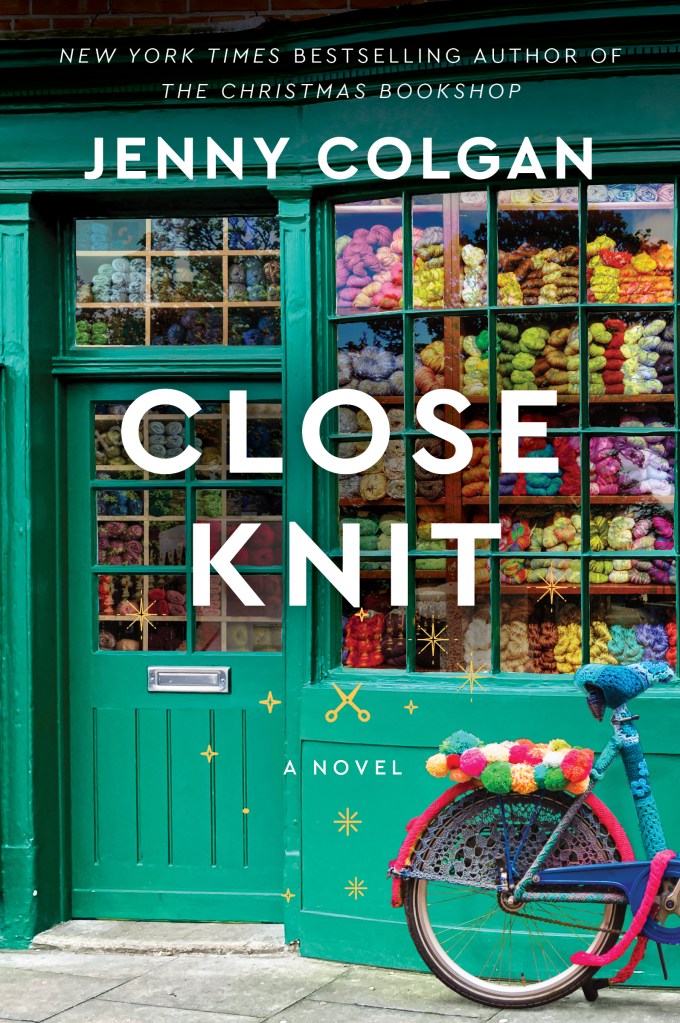
I don’t in general believe that anything is “meant to be.” But if anything could convince a cynic that there is such a thing as destiny, it would be one of Jenny Colgan’s novels. Close Knit was particularly illustrative of that theme, in that it was perhaps a little more transparent than its author might have intended in telescoping the story. I pretty much knew who the protagonist would end up with from about the third chapter (despite various rather transparent red herrings), and spent the rest of the book waiting for her to figure it out for herself and/or for the author to put her and her intended in the right kind of meet-cute circumstances to make it happen.
I didn’t know that there is a book—The Summer Skies—that precedes this one and stars another main character (the pilot) as its protagonist. But this read perfectly well as a stand-alone, and now I can go back and enjoy that one too.
As is usual with Colgan’s books, the beautiful, bare, wind-swept islands of northern Scotland are as much a character as anybody else in the book, and reading her lyrical descriptions almost persuades me that I would love to live in a locale that is fairly constantly beset by frigid winds, in almost total darkness during the winter and perpetual light in summer due to its place far above the equator. Likewise, the people with whom she populates the small towns and villages of the islands are in equal parts ordinary and distinctive, most of them sounding like the perfect neighbors and friends, with a curmudgeon or a crank thrown in here and there for ballast.
Authors should have to vet the copy written to describe their books on Goodreads (or does it come from the publisher? if so, shame on them!), because there were many inaccuracies in the details of this one. First of all, it’s described as a summer novel, which I suppose you could marginally support, since some of the action takes place in May; but in a clime where May can bring rain, hail, or even snow, it’s not exactly a typical summer vacay beach read! Second, the main character is described as having many friends, but the truth is, everyone in her knitting club is her mother’s age (or older), and Gertie is more their pet project than their contemporary. She is actually rather isolated, being a shy, dreamy “girl” of 30 who has no girlfriends or dates her own age. Third, when Gertie decides to take on a new job, it’s described as air stewardess on a small plane, but in fact her actual primary task is to run the desk at the tiny terminal, checking in the passengers and their belongings and making sure everything goes smoothly in the run-up to each flight. She is required to go up in the plane in order to understand aspects of her job and to occasionally serve as crew, but that’s a much less important function.
A final pet peeve is the cover design: While there is a knit shop in the village similar to the one depicted on the cover, the women of the knitting club have a persistent feud with its owner and, in fact, hardly frequent it, so to give it pride of place as the cover design is as bad as the stationary bookstore on a street corner that appears on one of Colgan’s other books about a mobile bookmobile that travels around an island supplying reading wherever it goes.
The story line that propels the action of Close Knit is that Gertie has somehow let her life slip through her fingers. She lives at home with her mother and grandmother, and her friends are their knitting club ladies, so she has no significant men in her life. She got a job 10 years ago at the local market and somehow the time has passed her by while she unloaded groceries, dusted shelves, and worked the till. Her only real entertainment is knitting beautiful scarves, socks, and hats, and the only place she experiences excitement is in her romance novel-driven dreams. Then she’s given the opportunity to switch jobs, which she does partly because there is a handsome and charismatic airline owner whose planes and helicopters use the terminal and she thinks this might be an opportunity to get to know him. But fate has something different in mind for Gertie…
Even knowing what would probably happen, I thoroughly enjoyed going through the process, as one enjoys a cup of cocoa and some warm slippers at the end of a long, cold afternoon. That’s probably more than half the appeal of a Colgan novel—the tactile and culinary descriptions set in the perfect atmosphere in which to enjoy them. The designation “cozy” was meant for her books.
Slow burn
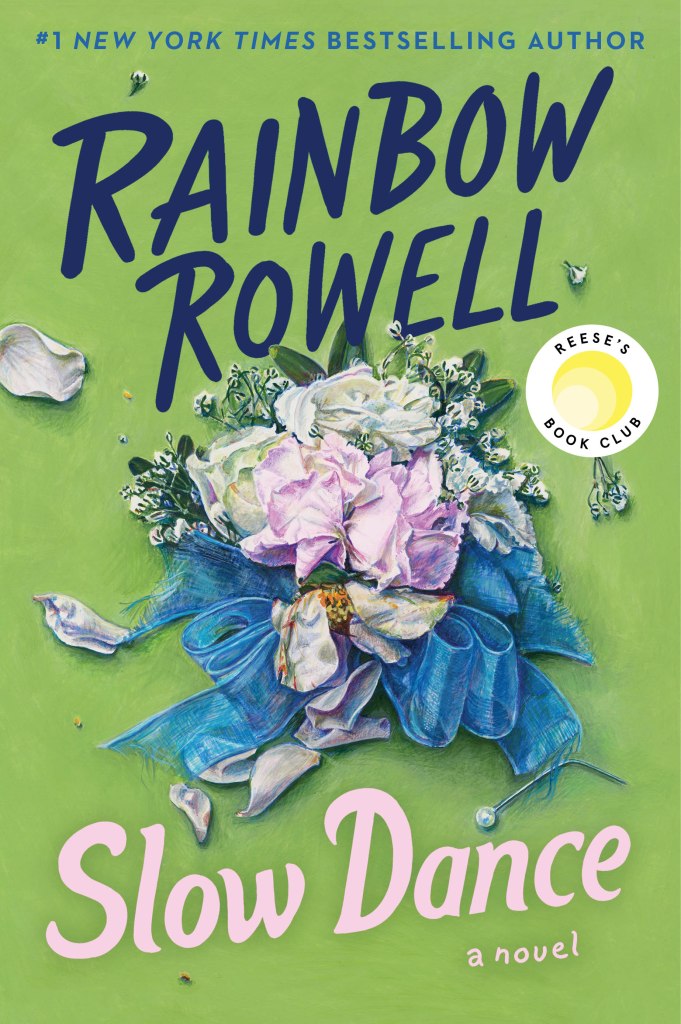
I just finished Rainbow Rowell’s newest novel for adults, called Slow Dance. Back when I was a brand-new teen librarian, her book Eleanor and Park hit the top of the chart for teen novels, and I read it with my high school book club and fell in love—with her characters and their story, and with her writing. This book could be about Eleanor and Park at 33, if they followed certain trajectories that first took them away from one another and then brought them back together after a fair number of life experiences, although Eleanor and Park had the sense to figure out just how much they liked each other, while Shiloh and Cary (despite one experience during their college-age years) are frustratingly obtuse about their feelings.
This is a longer novel than it needs to be, and I say that out of a fair amount of impatience at certain points with the sheer pigheaded insistence both characters show when it comes to misunderstanding one another’s motives, thoughts, and feelings. But at the same time, I got it; if you have ever been in a one-sided relationship—or even one that you thought was one-sided—and struggled with how much or how little to reveal, and whether to go for it or keep it to yourself forever, you will get it too.
Shiloh and Cary were best friends in high school, part of a steadfast trio with their pal Mikey, and while they were inseparable and had secret feelings for each other, they never managed to make it out of the “friend zone,” except for a weekend of bliss coupled with massive misunderstandings during Shiloh’s college years. They grew up on the poor side of Omaha, and both had plans to escape; Shiloh was going to be an actress and probably head for New York City, while Cary’s exit plan was to join the Navy. Cary fulfilled his objective, but Shiloh dabbled in theater until she met an acting teacher with partner potential, then produced two children followed by a divorce, and remained stuck in Omaha, living with her mom and kids in the house where she grew up. Fourteen years later, they both attend a second wedding for their friend Mikey, and reconnect—sort of. The old feelings resurface, along with the misunderstandings, the ambivalence, the life conflicts, the water under the bridge…in short, they have a lot to get over and get past if they are ever to share something meaningful. The will-they won’t-they, combined with the flashback story of how they got to this point in their lives, is the story here.
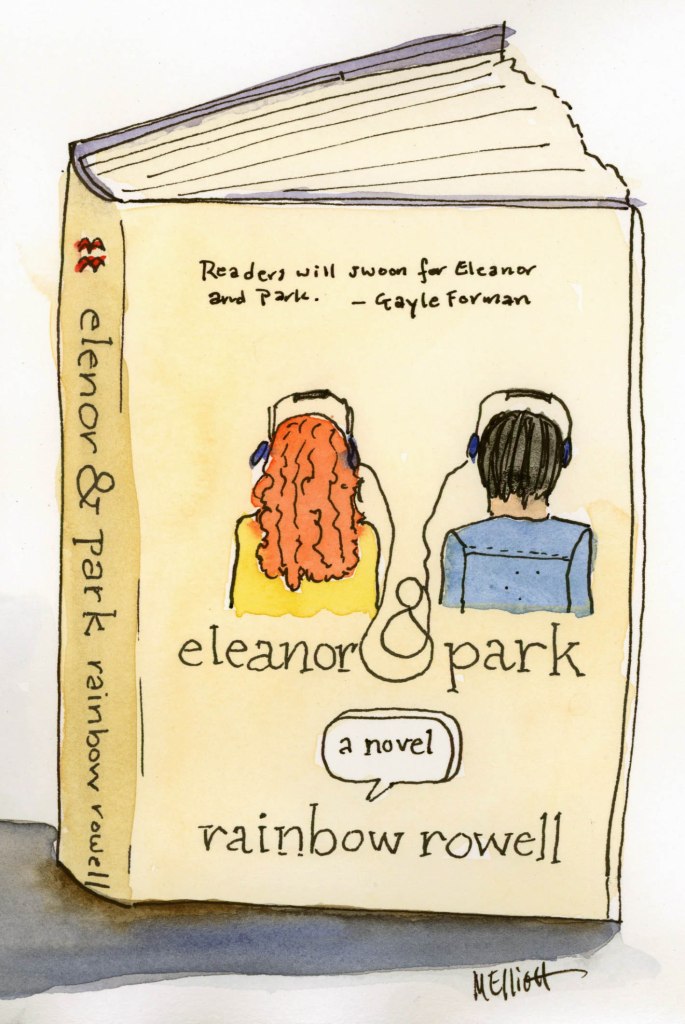
The saucy banter, the genuine emotions, and the honesty of expression brought back the best parts of Eleanor and Park; and although there are moments when you want to take one or both of them by the shoulders and give them a good shake, you’re mostly rooting for Cary and Shiloh to get it together and succeed at this second-chance romance. (And you also want a happily ever after for Shiloh’s extremely engaging children, Juniper and Gus.) A solid entry for Rowell’s adult realistic fiction shelf.

 The Book Adept