Last book of the year

My last book of the year was The Secret Christmas Library, by Jenny Colgan, and I almost didn’t read it. I usually love discovering a new Colgan book, especially the ones that take place up in the wilds of Scotland (which this did), but then I found out it was a sequel to last year’s novella The Christmas Book Hunt, which wasn’t one of my favorites because of the exceedingly obnoxious male lead and, sure enough, that character was equally distasteful in this one.
Fortunately, he wasn’t the only guy on the scene for Mirren, the female lead in both, to moon over, but it took about 85 percent of the story to get to the romance. The setting and atmosphere saved it for me, since it took place in a remote rundown castle on a loch, with its own train stop and maze, and had a resident poverty-stricken laird in search of a rare book hidden somewhere in the “pile.”
The major bone I had to pick with this one was the lack of editing and proofreading. I came across at least five misspellings and/or misuses of words, and it was also apparent that neither the author nor the editor had gone back and perused the work for repetition; on the very first page there was a sentence repeated verbatim twice, just two paragraphs apart, and about 30 pages later she used the word “immaculate” to describe three separate things, again all on one page. The overall impression was that this was dashed off to satisfy the holiday market.
Colgan has written many Christmas books (most as sequels to various series), and any of those is preferable.
Christmas past
I find myself, on the 18th of December, woefully unprepared to offer up Christmas reads here on the blog. I haven’t exactly been busy, but I also haven’t been much in the holiday mood, so I have read nothing relateable to share. But I did do a search on my own blog, which I encourage you to do as well if you are in need of a festive book to read, and found a bunch of suggestions I featured from Christmases past. Just put “Christmas” in the search box and you will find at least five separate lists.
In case you are too lethargic to do that, here’s one that I mentioned before and will share again—a novella with minimal effort and maximum payoff from one of my favorite authors, sci fi writer Connie Willis. I knew that Willis herself collected Christmas stories, having come across a comprehensive list she made some years ago of all her can’t-miss favorites, but I didn’t know she had written one until a few years ago.
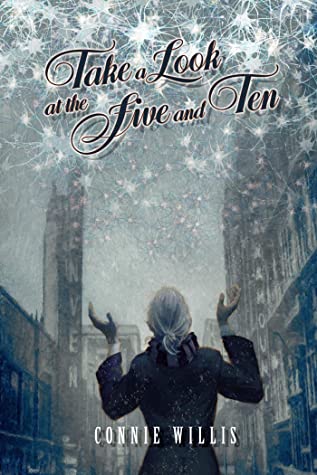
Take a Look at the Five and Ten is pure nostalgia in its subject matter while being scientific in its methodology. It adopts the premise of her book Passage, wherein a neuroscientist is conducting research on a particular aspect of memory. In that book it’s all about dreams, while in this one the topic is the TFBM: Traumatic Flashbulb Moment. A Ph.D. student, Lassiter, is doing a study of people who have experienced one of these; imagine his delight when he meets a new and potentially perfect subject at Christmas dinner with his new girlfriend’s family.
Ori begins dreading each year’s holiday season (Thanksgiving to New Year’s Day) in July. Her one-time stepfather, Dave, never lets go of the people from his past, so even though he’s working on his sixth marriage (his union with Ori’s mom ended when she was eight years old)), he never forgets to include in his celebratory invitations the in-laws he collected along the way, including Ori, Aunt Mildred (the great-aunt of his second wife), and Grandma Elving (the grandmother of his fourth). Dave’s latest bride, Jillian, cooks elaborately awful trendy food, and invites her snotty daughter Sloane, along with Sloane’s current boyfriend and her own stuck-up friends, and they all, with the exception of Grandma Elving, treat Ori as if she is a combination of charity case and the hired help.
Grandma Elving presents her own trying behavior, as she insists on telling the same story each year of how she worked at F. W. Woolworth’s “five and dime” store in downtown Denver one Christmas in the 1950s. Everyone else in the family is fed up to the gills with hearing it, but Sloane’s new boyfriend is fascinated by Grandma’s extraordinary ability to remember each and every vivid detail about her experiences at Woolworth’s, since clarity and consistency of a particular memory are hallmarks of a TFBM. Lassiter invites Grandma to be one of his test subjects, and the two of them elicit assistance from Ori to get Grandma to and from her appointments at the clinic where Lassiter is conducting the experiment. Ori quickly begins to have what she knows are ill-fated feelings for Lassiter as their proximity grows….
This is a cute and humorous Christmas tale reminiscent of the French farce-like quality of Willis’s time-travel book, To Say Nothing of the Dog. It’s short (140 pages), qualifying more as a novella than a full-length book, and you can get it for Kindle too, so if you’re trying to hit your 2025 Goodreads Challenge quota, it’s a quick read that counts. But best of all, it’s an unconventional Christmas story that will give you even more appreciation for Willis’s whimsy and heart.
Person, place, thing
I wrapped up my wallow through the writings of familiar authors by reading two books that I really should have saved for six weeks or so but, once discovered, I couldn’t resist them. These were Jenny Colgan’s latest, a two-parter with the same characters and location, The Christmas Bookshop and Midnight at the Christmas Bookshop. Colgan has made a habit out of returning to the scene of a previous novel but setting the action at Christmas (Christmas at the Cupcake Café, Christmas on the Island, Christmas at Rosie Hopkins’ Sweetshop, etc.) but these sequels usually arrive after she has segued to another story or two and then returned. This two-fer is an almost-continuous tale all taking place within about a one-year period bracketed by Christmas seasons, so I was glad that I discovered them both at once and could read straight through from page one of #1 to the last page of #2.
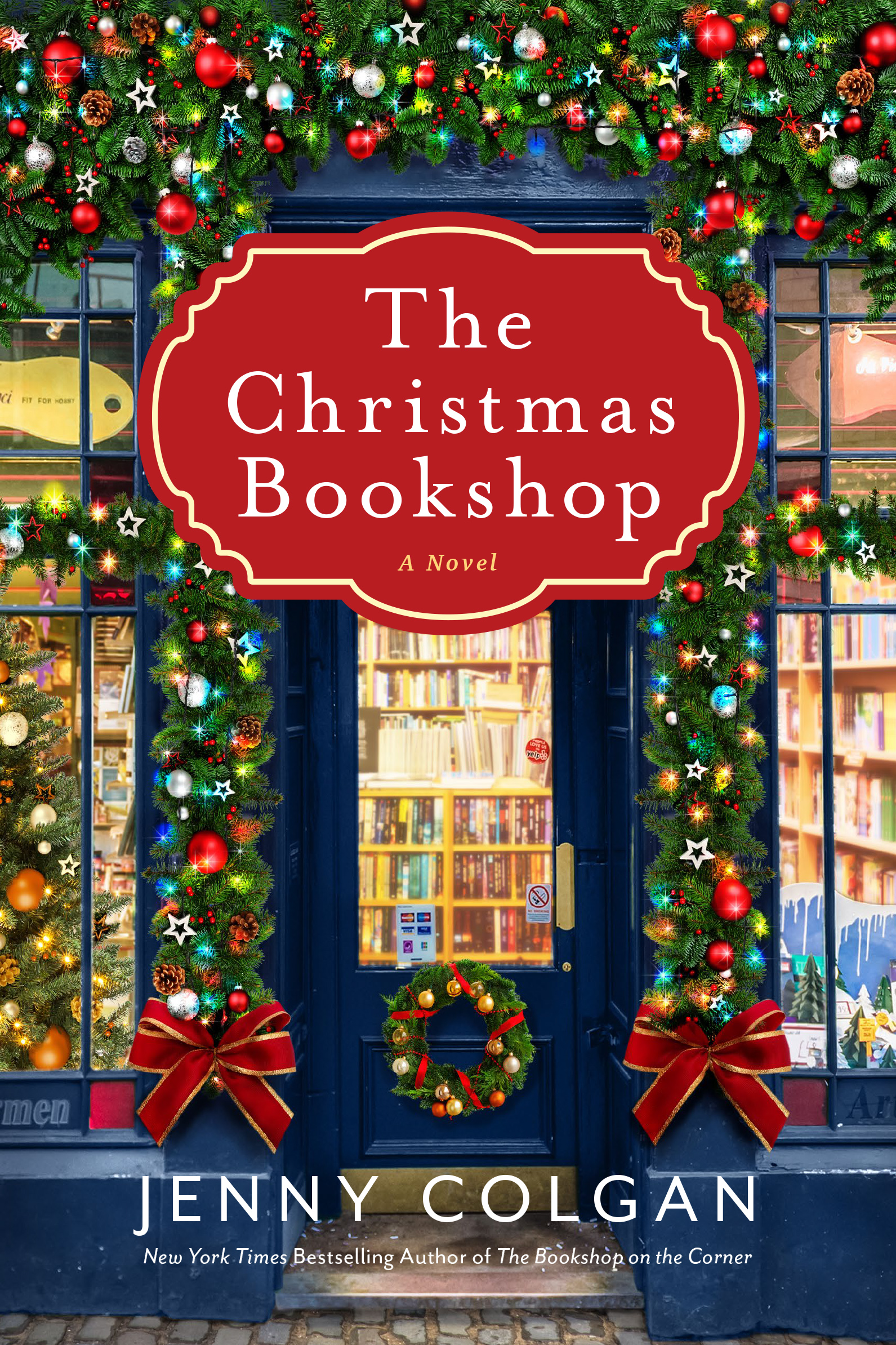
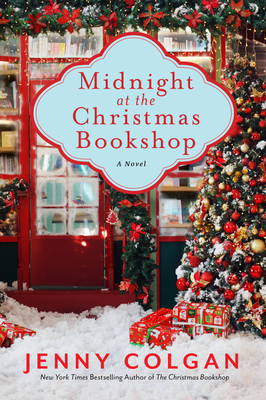
My title for this review takes into account a particular skill of Colgan’s, which is to present us with compelling characters with a specific objective in a spectacular setting that becomes every bit as important to the story as the protagonists. In this case it’s the city of Edinburgh, specifically the Old Town shopping district, so far holding out (for the most part) against the store chains and gimmicky tourist fare to present an authentic experience of one-off original shops, from a hardware store to a chic dress shop to a witch’s herbarium. The focus for Colgan’s bevy of characters is, as frequently happens in her books, a bookshop, in this instance a failing one. Mr. McCredie’s ancestors started the rare book store on the rambling bottom floor of their home, and he has lived and worked there his whole life but, despite his affinity for and encyclopedic knowledge about every sort of book, he’s a terrible salesman, a worse marketer, and is on the verge of forfeiting everything. Enter Carmen Hogan.
Carmen has, in rapid succession, lost her boyfriend, her job, and her apartment, and has been living in a state of denial at her parents’ place, tediously and repetitively grousing about everything and eating way too much junk food. Carmen’s parents are rather desperate to get her out of their house and back on her feet, and enlist Carmen’s sister, Sofia, to help them.
Sofia and Carmen have always been polar opposites: Sofia is the elder type A overachiever, and is now a successful lawyer with a happy marriage, three children (and another on the way), and a beautiful home in Edinburgh, and Mr. McCredie is one of her clients at the law firm. Carmen decided to skip college, and has worked in retail in a large department store since high school until the store closed and made her redundant. Sofia somewhat reluctantly asks Carmen to come live with her family, telling Carmen there is a job for her revamping an Edinburgh rare bookshop; what she doesn’t tell Carmen is that the sole objective is to get the store to turn enough of a profit during the next three months so as to make it an appealing prospect to a buyer, and that as soon as a sale takes place, Carmen will again be out of a job (and presumably a place to live).
While initially reluctant to go live with her sister, Carmen sees that she needs a change, and she loves books, so off she goes to Edinburgh. She is horrified by the magnitude of the job she has taken on: The store is in an advanced state of disrepair and disorganization, and Mr. McCredie is absolutely no use unless someone comes in looking for that one eclectic title about which he happens to know something. But she takes a deep breath and pitches in, and starts to make some headway, particularly when she is able to get a famous writer of self-help books to do a signing at the store. This guy and a student/lecturer at the college are the two love interests in the story, and Carmen goes back and forth between the glamour of the first, with his casual attention and expensive dinners, and the quiet regard of the second, a young Quaker with an intensity she has never experienced.
Carmen and Sofia continue to be mostly at odds, but Carmen discovers an affinity for children, specifically her young nieces and nephew, that she didn’t expect, and bonds particularly with the second daughter, Phoebe, who shares many character similarities with her Auntie Carmen.
There are other fun, although somewhat over the top, characters such as Skylar, Sofia’s yogini nanny, and Jackson, the millionaire who is out to ruin the quaint shopping district by remaking all the stores into purveyors of cheap “tourist tat” sporting too much Scottish tartan, and there are a few improbable story elements that made me say “hmm.” But…
I was truly astounded to see a bunch of two- and three-star ratings of these books on Goodreads, where Colgan normally has solid fours and fives. I thoroughly enjoyed both of them; the magical descriptions of Edinburgh in winter at Christmas made me want to go there despite an almost pathological dislike of cold weather; the children were funny and endearing and memorable; the bookshop’s problems and mysteries were involving; and I liked Carmen as the protagonist and driver of the narrative. I was totally immersed in this two-part story for four days, and was sorry when it ended. I’m hoping, as she occasionally does, that Colgan will go back for a third installment set in this world with these people, because I’d love to know what happens in their next chapters. If you’re looking for something to read to put you in the holiday mood, look no further.

Predictable cheer
That was precisely what I was wanting, a few days before Christmas, considering that my “celebration” was going to be an hour on Zoom with my family instead of an in-person exchange of gifts followed by a sumptuous meal prepared by all of us. So I sought out the latest of Jenny Colgan’s books, #4 in her Mure Island series, conveniently just published in October of this year to be served up for holiday consolation.

I did enjoy it quite a lot. It included the regular cast of characters from Mure: Flora, owner of the only bakery/café on this tiny outpost in the middle of the ocean halfway between Scotland and Norway; Fintan, her gay brother, who has recently inherited “the Rock,” now re-christened the Island Hotel, from his recently deceased husband, the millionaire businessman Colton; and my personal favorite, Flora’s small but incredibly vocal niece, Agot, who is about five years old in this one.
The central activity of this book concerns the Christmas opening of the Island Hotel, and involves all the characters in the anxiety-producing activity of finding such essentials as a world-class chef who doesn’t mind living in such a remote corner of the north. Fintan, still grieving from the loss of his first and biggest love, isn’t much use, although he does manage to find and hire a rude and irritating but highly accomplished Frenchman; Flora, supposedly on maternity leave after giving birth to hers and Joel’s son, Douglas, is finding that Joel is better at motherhood and she is better at getting the hotel up and running, so despite massive feelings of guilt, that’s what she does.
But the central actors in this volume of Mure life are a shy employee from Flora’s Seaside Kitchen, the always-blushing and mostly silent Isla; and a new face to the island, Konstantin, a rich Norwegian playboy whose wealthy royal father exiles him to Mure (Joel has a hand in this, doing a favor for a friend of a friend) to work as a “pot boy” (dishwasher) in the kitchen of the new hotel. He’s never had a job, doesn’t know how to do anything, and thinks the world owes him a living, so to be cast ashore on this tiny island with no money, no phone, and no recourse is a major shock. But gradually he learns the pleasure of knowing how to do things, and his initial bad attitude dissolves as he makes friends with Isla (while hoping for something more), garners some hard-won praise from chef Gaspard, and begins to fit in on the island.
Although clichés abound, some of which were a little cringey, I would have enjoyed this fourth book in Colgan’s series pretty unreservedly except for several inconsistencies that couldn’t help but irritate: After three books featuring minor characters Charlie and his wife, Jan, who lead Outward Bound-type holidays for needy orphan boys on the island, Jan has suddenly been rechristened Pam; when she appeared in the story she seemed familiar, but I kept straining to remember, Who is Pam again? Likewise, the island doctor, Saif Hassan, in this book has the last name Hussein; and the main character’s partner, Joel, goes from Binder to Booker. What the hell, Jenny? Do you not even remember your memorable characters’ names? and do your editors not check these things? This is incredibly sloppy.
Overlooking those details, this was a fun read and a nice extension of the series. The ending was a bit sappy, but at Christmas, needs must.
It’s all Christmas
For those who want to use these last 10 days before Christmas to get themselves in the mood (or to dwell in a more traditional head space in the midst of this unquestionably nontraditional year), I thought I would remind readers of all the many holiday short stories, novellas, novels, and nonfiction offerings out there. I did a pretty comprehensive overview last year of a bunch of alternatives, so let me just give you those urls with a brief explanation and you can explore your options!
For a classic Christmas, check out this list of beloved read-alouds and come-back-tos:
Christmas classics
For a book-length experience, here are some novels and true-life experiences:
Novel Christmas
And for those who want something unsentimental, here are some that are a bit more tart than sweet:
Alternate Christmas
Finally, to hark back to a recent find, read Connie Willis’s latest Christmas offering:
Christmas joy

Have yourselves a lovely reading holiday, while I attempt to finish Troubled Blood in time to make it #130 on my Goodreads Challenge for 2020!
Christmas treats
I ended up taking a longer break than I had planned from the gigantic Cormoran Strike mystery (Troubled Blood) I thought was going to be occupying my week: I read with great enjoyment to page 152, whereupon my copy of the book started over again at page 121, went to 152 again, and then skipped to page 185! Two identical signatures followed by a missing one. True to signature sequencing, there were probably other errors later on, but I didn’t bother to find them, I just told Amazon to send me a new one tout de suite. But while I waited, I needed something to read.
People on “What should I read next?” have been asking for Christmas or holiday books to fill their Decembers with better stories than the real one in which they are isolated at home with Covid-19, and I have been suggesting that they read Jenny Colgan‘s half-dozen second books that are the Christmas stories attached to her regular novels. She has one for the Cupcake Café, one for the Little Beach Street Bakery, two for the Island of Mure, and two more attached to Rosie Hopkins’ Sweet Shop. The double gift here is that if you haven’t read the first, non-Christmas book, you can easily fill up your entire month of December by reading #1 and #2 of each of them, and then go on to round it out with the remaining sequels.

I myself had not read either of the Rosie Hopkins set that follow Welcome to Rosie Hopkins’ Sweet Shop of Dreams, mentioned here in last year’s wrap-up of Christmas reading, so while waiting on Amazon and Cormoran to get back to me, I picked up Christmas at Rosie Hopkins’ Sweet Shop. It begins shortly after the first book left off, and includes all the same characters with their relationships one to another and also to the Derbyshire village of Lipton, now buried under a blanket of snow unfamiliar to former city girl Rosie. We get to see the progression of Rosie’s relationship with new beau Stephen, her aunt Lilian’s adaptation to relocating from her cottage to the elder-care facility, and renew acquaintance with all the quirky (and otherwise) characters from the village. In addition, Rosie’s mother, brother, sister-in-law, and nephew/nieces descend from faraway Australia for the Christmas season. But just before they are about to arrive, a tragedy, with Stephen at its core, strikes in the village, and Rosie is so distracted and upset by current events that it promises to be a less than stellar Christmas. This is, however, a Jenny Colgan book, so you know that somehow joy will prevail. There are some surprises based on the pasts of a couple of the characters, and all in all it’s a satisfying story arc.
Having gotten into this holiday mood, I decided (despite the arrival on the front porch of my replacement book) to continue by reading The Christmas Surprise, the third book in this group—which actually begins a couple of weeks after Christmas. Who knows, Cormoran and Robin may have to wait until January at this rate. Which may be good for my Goodreads challenge, since I can get in three books for the “price” of one by pursuing all the Colgans instead of the single volume of 944 pages offered by Rowling, er, Galbraith!
We’ll see what happens.
Christmas joy
True to my prediction, I took a small break between the gargantuan novels awaiting my attention (just finished Addie LaRue at 442 pages, and embarking next on Troubled Blood,
at 944!) to read a small but delightful Christmas story. I knew that Connie Willis collected such stories, having come across a comprehensive list she made some years ago of all her can’t-miss favorites, but I didn’t know she had written one,
until now.
Take a Look at the Five and Ten is pure nostalgia in its subject matter while being scientific in its methodology. It adopts the premise of her book Passage, wherein a neuroscientist is conducting research on a particular aspect of memory. In that book it’s all about dreams, while in this one the topic is the TFBM: Traumatic Flashbulb Moment. A Ph.D. student, Lassiter, is doing a study of people who have experienced one of these; imagine his delight when he meets a new and potentially perfect subject at Christmas dinner with his new girlfriend’s family.
Ori begins dreading each year’s holiday season (Thanksgiving to New Year’s Day) in July. Her one-time stepfather, Dave, never lets go of the people from his past, so even though he’s working on his sixth marriage (his union with Ori’s mom ended when she was eight years old)), he never forgets to include in his celebratory invitations the in-laws he collected along the way, including Ori, Aunt Mildred (the great-aunt of his second wife), and Grandma Elving (the grandmother of his fourth). Dave’s latest bride, Jillian, cooks elaborately awful trendy food, and invites her snotty daughter Sloane, along with Sloane’s current boyfriend and her own stuck-up friends, and they all, with the exception of Grandma Elving, treat Ori as if she is a combination of charity case and the hired help.
Grandma Elving presents her own trying behavior, as she insists on telling the same story each year of how she worked at F. W. Woolworth’s “five and dime” store in downtown Denver one Christmas in the 1950s. Everyone else in the family is fed up to the gills with hearing it, but Sloane’s new boyfriend is fascinated by Grandma’s extraordinary ability to remember each and every vivid detail about her experiences at Woolworth’s, since clarity and consistency of a particular memory are hallmarks of a TFBM. Lassiter invites Grandma to be one of his test subjects, and the two of them elicit assistance from Ori to get Grandma to and from her appointments at the clinic where Lassiter is conducting the experiment. Ori quickly begins to have what she knows are ill-fated feelings for Lassiter as their proximity grows….
This is a cute and humorous Christmas tale reminiscent of the French farce-like quality of Willis’s time-travel book, To Say Nothing of the Dog. It’s short (140 pages), qualifying more as a novella than a full-length book, and you can get it for Kindle too, so if you’re trying to hit your 2020 Goodreads Challenge quota, it’s a quick read that counts. But best of all, it’s an unconventional Christmas story that will give you even more appreciation for Willis’s whimsy and heart.
 The Book Adept