Resolution

I just finished reading the last two books in Elly Griffiths’s Ruth Galloway mystery series: The Locked Room, and The Last Remains. For those who aren’t familiar, Ruth is (now) a 40-something archaeologist/professor at the University of North Norfolk, and lives in a cottage overlooking the Fens (marshlands) and the ocean. Norfolk was settled in pre-Roman times and then taken over by the Romans; during the Middle Ages it was a center for the wool trade, resulting in the building of many churches. Since it has remained a largely rural county, this makes the area a rich archaeological source of artifacts and, as Ruth discovers in her role as a forensic consultant to the police, bodies both ancient and modern.
I don’t want to get too spoiler-y in this post, but the arc of the books is partly professional and partly personal, and it is the personal for which all we fans and readers have been waiting resolution for many years and volumes. In her role as a consultant, Ruth is thrown into the company of Detective Chief Inspector (DCI) Harry Nelson, a married man with a couple of children, and an impulsive one-night stand results in a pregnancy for Ruth. She doesn’t ask for anything to change, knowing how deeply dug into married life is Nelson, and although she has doubts about her own abilities to raise a child effectively by herself, her love for her daughter, Kate, conquers all.
Kate is born at the end of book #2, and there are 13 books that follow after. In each one, the discovery of a body or bodies draws Ruth into the subsequent police investigations, regularly renewing questions about her relationship to Nelson. There are at least two books that constitute partial departures from proximity: In one, Ruth and Kate travel to Italy without Nelson, while in another they actually move away from Norfolk to Cambridge and in with a “boyfriend” of Ruth’s for a period of time. But if you are a long-term reader of this blog, you will perhaps remember how many times I have complained about the on-again, off-again nature of their interactions, the glacial slowness with which things have moved, and the constant wondering: Will they ever get together? Will Nelson get up the courage to leave his wife for Ruth? Will Ruth ever let her growing exasperation prompt her to kick Nelson to the curb for good? This speculation has overshadowed the mysteries in more than one book in this series and has caused me to swear off reading them on several occasions, but there’s something appealing about the awkward archaeologist that I have found hard to resist, and I have always come back to get caught up.
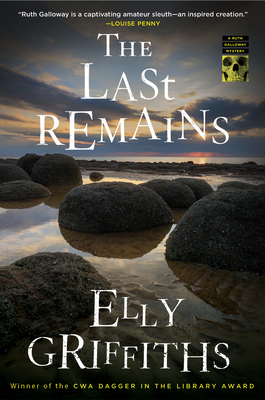
At last, however, that is at an end: Book #15 is the last in the series, and finally we have resolution to the decade-long question: Will they or won’t they? But first we have to participate in the perpetual angst throughout Book #14 and part of the last.
I’m not going to reveal anything else here, so let’s take a look at the mysteries detailed in these two books. As I have commented before, the books have seemed to alternate, throughout the series, between one that is compelling and one that phones it in, to the point where there were at least two books I recommended that readers skip, going instead to a synopsis to find out the details about the personal relationships while avoiding the somewhat boring plots. That has held true to the end; The Locked Room‘s mystery is both confusing and slight, while The Last Remains has a tight, interesting story line that includes several characters both new and old and nicely ties up some dangling questions by taking us back to the very first mystery on which Ruth and Nelson collaborated. The one thing that does distinguish The Locked Room is that Griffiths set it during the recent pandemic and imbued her story with all the inconveniences and tragedies we experienced during that time period, which was both refreshingly real and disturbingly uncomfortable, a reminder of all that we did and didn’t do and all that we lost.
I still struggle a bit with the idea that Ruth and Harry have taken 15 years to confront their feelings, but I congratulate Elly Griffiths on a largely successful and mostly involving mystery series. I hope with her Harbinder Kaur books that she draws us into many more murderous adventures.
A book about books

If you, like me, enjoy reading books featuring a bookstore, a library, an author, or, in this case, a bookbinder, you might enjoy the one I just finished—The Echo of Old Books, by Barbara Davis. I last encountered Davis as the author of The Keeper of Happy Endings, which featured another of my passions (Paris), and although that one wasn’t a favorite, it was well written enough that I was willing to give another book of hers a try, particularly given the theme.
Ashlyn Greer is a dealer in rare books, whose small, eclectic New Hampshire shop sits in the front room of her real income-generating activity, the restoration of old or damaged volumes. In addition to doing custom work by request, Ashlyn is constantly on the lookout for some rare find in a remainders box at the local library or thrift shop that she can restore and sell. Ashlyn has a secret gift whose scientific name is psychometry…
the ability to discover facts about an event or person by touching inanimate objects associated with them.”
In Ashlyn’s case, this extrasensory perception is limited to books. She can feel an echo of the owner or reader of the book, if their emotions were strong enough while the book was in their possession.
One day Ashlyn lucks into a find of two beautifully bound books that present something of a mystery: There are no authors listed, nor publishers nor dates, and the books are apparently the story of a doomed romance told from either side, one by the woman, the other by the man involved, each addressing the other in the first person as if writing a long letter. Ashlyn is intrigued by what purpose these books could have served, and overwhelmed by the raw emotion she feels pulsating from both of them.
She starts to investigate the mystery, first by reading the books and then by attempting to find out where they came from before she found them in a box of otherwise worthless donations at her friend Kevin’s store. The dual story takes her back four decades (The Echo of Old Books is set in 1984, and the books in the story were written in 1941) to a love affair between unequal partners—a pampered heiress and a footloose newspaperman—and also leads her to a descendent of one of these lovers, in the course of her quest to get more information.
I really liked the way the book was laid out—the scene-setting in 1984, followed by alternating chapters of the two mystery books and then a new chapter with Ashlyn’s reaction to what she has read. There are powerful themes expressed in the two old books: They explore the growing anti-Semitism amongst some wealthy and influential Americans in the ramp-up to World War II, and also comment extensively on the roles of affluent women, who seemingly had it all but were in fact marriageable chess pieces used by their fathers to capture more wealth and power.
The book was a little long, and the beginning was drawn out to the point where I almost lost interest, but that interest was renewed by some book-binding details and the introduction of an intriguing new character, and I’m glad I kept reading this story about tragic endings and second chances. I will happily add it to my Goodreads list of “books about books.”
Completist?
My reading habits have changed over the years, partly because I’m not as willing as I was when younger to stick out a book I am not enjoying, and partly because (I like to think) I’ve become a bit less of a control freak. It used to be that if I found an author I liked, I had to read absolutely every book they had ever written, so as to know their complete catalog. I learned that this was sometimes a mistake; it can become disillusioning if you have idealized or even idolized that author to read, for instance, one of their early, less well formed works, or (in the case of some long-time authors) one of the later ones when they quit trying and phoned it in. So I have become more interested in reviews, and I look for red flags to warn me off certain books.
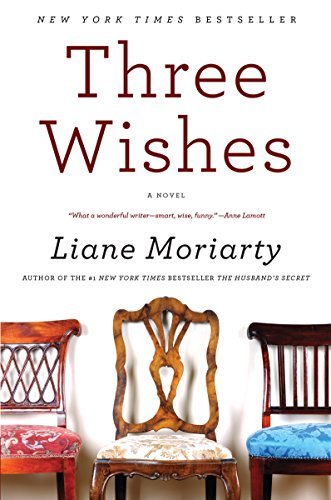
I missed that cue on a book I read lately, and it wasn’t a catastrophe—I enjoyed the book for what it was—but when I belatedly looked it up on Goodreads and found out that Three Wishes was Liane Moriarty’s first novel, I wasn’t surprised.
The book is about the Kettle sisters, Lynn, Cat, and Gemma—
a set of triplets who have just turned 33—and follows the lives of each of them as they confront challenges separately and together. Moriarty also cleverly includes in the narrative some “remote” views of the triplets at various ages from the perspective of outsiders who run into them at the park or see them in a restaurant and then comment about the experience to someone else.
Although I found all the various relationships—between the sisters, with their spouses, children, parents, outsiders—involving, there were a few things not to like about the book, that echoed my response to the early works of another novelist, Jenny Colgan. Whenever I recommend Colgan’s books, which I like very much, I always add hastily, read everything after 2012. That seemed to be a turning point for her, when she quit writing about shallow, artificial, unlikeable characters and started embracing her now-trademark touching, empathetic, and charming ones. I’m not saying she went over the sappy line, just that they quit being actively annoying and started exhibiting positive qualities. That was the main problem I had with Three Wishes: I didn’t much like any of the three sisters, so it was hard to invest and sometimes even to keep reading about them. I also felt like one of them got a raw deal from the other two that didn’t get resolved by the end, and since she was the one with whom I had the most sympathy, that was off-putting.
There’s none of the intrigue or thrill of Big Little Lies or the unexpected plot twist of What Alice Forgot here; it’s a simple relationship novel. (I did prefer it to Nine Perfect Strangers, however!) There’s nothing wrong with that; I have just come to expect a little something extra from Moriarty. But I’d say it’s worth reading, with the words “first novel” always in the back of your mind.
Quirky?
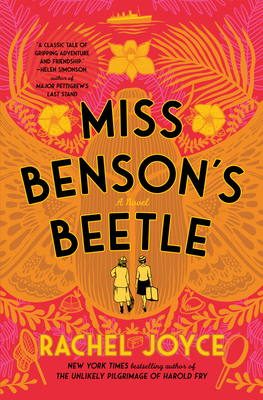
On the strength of enthusiastic comments on What Should I Read Next?, I picked up Miss Benson’s Beetle, by Rachel Joyce. I haven’t read anything by her before, but saw some raves for two of her previous books, and I’m usually a fan of quirky characters—Eleanor Oliphant, Fern Castle, Don Tillman, Leonard Peacock, A. J. Fikry, have all figured on the list of characters’ stories I have enjoyed.
While there were parts of this book in which the characters rose to the level of those, some of the events of the story, paired with uneven character development, made it not quite my cup of tea.
Margery Benson owns a certain level of eccentricity (for instance, in the seminal moment when she steals a pair of lacrosse boots from a fellow teacher), but she is largely too dour and sad to be considered quirky. The assistant she ultimately hires to go with her to New Caledonia in search of the golden beetle is obviously written to up the quirkiness factor exponentially, but Enid Pretty is so frenetically over the top for about 90 percent of the book that rather than being engaging, she just makes you tired. And the story line takes the serendipity one would expect in an offbeat novel and turns it into caricature or farce, with aspects that are simply unbelievable, not to mention contradictory. I know I’m sounding like a curmudgeon here, and perhaps it just wasn’t my week to read this book, but honestly it was all too much.
The story isn’t without its merits; there are some genuinely amusing situations, and also some truly touching moments. The best part about it is the evolution of the friendship between the unlikely adventurers (Margery and Enid), and I would have enjoyed learning more about the two of them, as well as about Gloria, and even Dolly. But there was also a subplot involving a former prisoner of war who became obsessed with and was stalking Miss Benson that I found both unpleasant and unnecessary, and I ended up highly resentful of how this ultimately affected the plot. So while I appreciated the beautiful language Ms. Joyce uses to describe Margery’s experience of the natural world, and really liked the evolution of Margery from a passive, uptight, somewhat frightened person into the take-charge, open individual she becomes, my reaction to the novel as a whole was a little sad with a touch of frustration. Over all, not a particularly pleasant experience.

Authenticity rant
I just finished reading a book that’s popular on the Facebook page “What Should I Read Next?” (The Reading List, by Sara Nisha Adams), and although I quite enjoyed the concept of someone finding someone else’s reading list and following in their steps by reading all the books on it, and also sharing and discussing the list with others, some of the simplistic details of the book were so flat-out wrong that I feel the need to correct them here, at least.

For any other venue or atmosphere chosen as the backdrop to the action in a book, the author would probably take at least minimal pains to research the details of the world-building. But everyone in America apparently believes they all know how libraries work, and this presumption has perpetuated a lot of stereotypes that are highly inaccurate. Even those who profess to love the library, as both the author and the characters in this story do, are doing their local library and its staff a disservice when portraying them in this way. The flyers being passed out to “Save our library!” in this story become necessary when people fail to realize exactly what a library is or can be, depending on who staffs it.
One of the two main characters in this book, a teenager named Aleisha, gets a part-time job for the summer at the local branch library. Her brother, Aidan, has always loved the library, so when she can’t get the retail job she’s been trying for (clothing discounts being important to teenagers), he encourages her to take the position at the library. She designates it in at least one conversation as a “shit summer job,” and is no way invested in it, to the point where she sits at the information desk with headphones on and pointedly ignores a patron (the other protagonist, Mukesh, an elderly Indian man) who can’t figure out how to operate the automatic door opener. When this man then approaches her at the desk to ask for reading recommendations, she summarily dismisses him by saying she doesn’t read “stories,” she only reads true things, so she can’t help him, sorry.
Throughout the rest of the book, this person is referred to, by both the public and by her co-workers in the library, as a librarian.
It should be obvious, but I’m going to make it crystal clear: Not every person who works in a library is a librarian, just as not every person who works in a law firm is a lawyer. Just as with a lawyer, a librarian is a trained professional. Being a professional means that your work depends on special skills and qualifications you have acquired through study and practice, and involves holding that work to a specific standard.
In order to achieve the title of “librarian” in most related venues, you must have a bachelor’s degree in an unspecified area (English literature, art history, or science are helpful, depending on your future plans), followed by a two-year master’s degree in library information studies that will include acquiring such areas of expertise as cataloging, collection development, services specific to a particular demographic (for instance, children’s librarian or teen librarian), and readers’ advisory. There are also a variety of categories and kinds of librarian—archivist, information specialist, public librarian, college or university librarian, law librarian, and so on—that require further special training in that area of knowledge.
I have that master’s degree, plus at least half a dozen upgrades via individual classes in specific subjects, and I also teach in the masters program at the University of California in two areas of special knowledge—Young Adult Literature, and Readers’ Advisory. And the idea that the way librarians recommend books, as is presented in The Reading List—they read the books themselves so they have something to recommend—is inaccurate and misleading. Do I recommend books I have enjoyed to others looking for a good read? Sure. But I don’t do so without first performing an extensive deep dive into their personality, reading preferences, and previous reading experiences, because until you know with what kind of reader you are interacting, it is impossible—unless you’re exceedingly lucky—to hit on the perfect book for them. Further, if I relied only on the books I had actually read in order to satisfy the requests of my patrons, it would be severely limiting to what’s actually out there in the world. A trained librarian finds books for any and all purposes and tastes, regardless if she has read them or not.
This is one of the things that frustrates me about such interactions as “What Should I Read Next?” on Facebook. Someone puts out a reading request with minimal parameters, and 300 people immediately proffer their favorite book. No one stops to ask, What kind of experience are you looking for? What elements of a book are most important to you: characters? world-building? mood? Are there specific genres you like, and why? Do you read to gain knowledge or to experience emotion? and any of the dozens of other questions that make it possible for one person to recommend a book to another with any hope of success. What people without librarian training fail to realize is that the recommendation of a book must be preceded by knowledge about that reader.
Why is success so important? Well, what happens if this person hasn’t been much of a reader but is resolved to do more reading? They take multiple recommendations from people touting their own favorites and, one after another, find them disappointing because the books are not to their taste. Do you think that person will become discouraged and maybe believe that reading just isn’t for them? That’s what happens with many children or teenagers who get frustrated after the second or third book that doesn’t resonate. They give up on reading forever—or maybe, if luck plays a hand, they come around to the idea again in their 40s when some book grabs them by surprise.
Although I certainly wouldn’t put librarians’ level of professionalism on the same par with, say, a doctor or a lawyer (considering their many extra years of study and also the relative importance of their actions), it is every bit as offensive to us as a profession for others to assume that anyone could do our job. Furthermore, the misrepresentation of every library employee as a librarian would never happen in real life. If you work in a public library as a page (one of the people who shelves books and does auditorium set-ups) or a circulation clerk (one of the people who checks books in and out and maintains the integrity of the books), one of the first things you are trained to do, should a patron ask an information-related question, is to send them to the reference or information desk to speak with a librarian who is qualified to answer that question.
Non-librarian staff are sometimes even discouraged from providing simple directions, because they can’t know what informational needs back up that query. Someone might ask, Where is the history section? and you as a page know where it is, so you escort them there. But what they really wanted was guidance in finding a book about a particular battle that took place during World War II, and being escorted to the history section did exactly nothing for them on that quest besides narrow down their choice of books from millions to thousands or from thousands to hundreds. If they had been directed to a librarian, who would have drawn them out about the exact nature of what they were looking for, they would be standing in the history section with three books on that subject in their hands for further consideration.
So, Sara Nisha Adams, although there are parts of your book that are personally compelling, evocative, and engaging, you have done yet another disservice to the profession of librarian by perpetuating all the misinformation that puts our libraries in constant peril of being shut down. Yes, a library is (or can be) a dynamic community space. Yes, it can serve many functions for its neighborhood. But the reading-specific needs that it fulfills are best realized by the participation of real librarians, whose purpose in taking on this career is to find the right book for the right person by using training and experience, not random personal preference, as their methodology.
Secondary characters

Do you ever love a book not for its main protagonists but for its secondary characters? I think that was the case with me and JoJo Moyes’s new book, Someone Else’s Shoes. The two protagonists, Nisha and Samantha, certainly drive all the action with their stories, but it is when the secondary and peripheral people get involved that those stories really come to life.
Part of this is because neither of the protagonists is particularly likeable. Samantha’s okay, I guess, but she spends so much of her downtrodden existence reacting like a confused limp noodle that it’s easy to grow impatient with her and snap “Buck up!” every time you encounter her on the page. With Nisha, it’s the opposite problem—she’s so entitled that your constant response is to want to do anything to stymie her, and follow up by smacking her silly. So when you first start reading this book, it may make you wonder why you should keep going. The answer is the others.
The basic story: Sam and Nisha are at the same gym. After their respective workouts, somehow they end up accidentally switching gym bags. Nisha’s contains a Chanel jacket and a pair of custom red crocodile Christian Louboutin high heels, while Sam’s has a pair of practical black flats and the British equivalent of an outfit bought at Target.
The switch proves initially beneficial for Sam, because she’s teed up for a series of business meetings and, forced to don the Louboutins (or wear gym flip-flops), she gains some needed confidence and lands three deals in a row for the printing company for which she works.
Nisha, on the other hand, wouldn’t otherwise be caught dead in Sam’s flats, but when she steps outside the gym wearing those and a bathrobe only to discover that her car and driver are nowhere in sight and she can’t raise anyone on her phone, she’s stuck. Little does she know how stuck, however, until it becomes clear that her husband has taken this inopportune moment to shut her out—out of her penthouse suite at London’s poshest hotel, out of her custom wardrobe, out of her bank accounts and credit cards—she’s literally destitute in the space of a few minutes, and has no idea how to recover.
She’s such an unlikeable character that you almost revel in the desperate straits she finds herself; fortunately for her, surrounding folk aren’t as gleefully vindictive as you are! She meets Jasmine, one of the head housekeepers at the hotel where Nisha and her husband Carl are staying, and Jasmine, at least initially, pretty much saves the day. Sam is similarly blessed, by a co-worker, Joel, who buoys her up when her confidence is lagging in the face of abuse from their new supervisor, Simon, and also by her best friend, Andrea, who is undergoing cancer treatment but can still be counted on to give sage advice about Sam’s depressed, unemployed husband.
Both women make an initial attempt to return the bags to the gym and retrieve their own, only to discover that the gym has financial woes and is closed until further notice, cutting off their access to the possibility of identifying who is now holding their belongings. The rest of the book is a sometimes funny, sometimes grim French farce about the efforts each woman makes to get her life back on track and retrieve the things that are important to her, enabled by the aforementioned wonderful secondary characters.
As you can guess, there is a fair share of heartwarming personal transformation, but it’s not maudlin, nor is it cute, so it rings true. The contrast in status of each woman with the people surrounding her and how that matters (or doesn’t) in the scheme of things is a big theme, as is discovering what each truly wants as opposed to what they have been accustomed to receiving as their due or enduring as their punishment. There are hints of developing romantic relationships between various characters, which is always nice if done properly, and also some comeuppance results, which are gratifying. All in all, I really enjoyed this latest from Moyes.

Two added notes: First, I am bemused by the choice of artwork for the cover. With a book completely centered around those shoes, why aren’t they on display in all their wildly expensive glory? Second, after finishing this I scanned the next five books up on my Kindle, wondering which to read, and noticed that The Reading List, which will be due at the library in a week so should probably be first, was written by Sara NISHA Adams. Having never previously encountered the name Nisha only to read a book with one as the protagonist, it seems too serendipitous that the following novel should be written by someone of the same name, doesn’t it? That’s my reading life…
Standards, genres
I find I don’t often enjoy the books that mainstream book clubs are out there touting like mad; or sometimes I do enjoy them, but it’s more like an unhealthy sugar rush than a savored meal, something you may regret later. Part of the reason usually turns out to be the frantic push to define a book as something more than it is.

That was the case when I read The Last Thing He Told Me, by Laura Dave. It’s not without merit: The central decision of the main character to do something that will forever deprive her of the thing she has discovered she wants was, to me, a compelling plot twist and the best part of the book. But the efforts of the publisher, the book clubs, and now Apple TV+ to convince us that this is an explosive mystery/thriller do a disservice to what is basically a domestic drama.
Hannah, a woman with an established life and an involving and creative career, meets Owen, and finds for the first time in her life that she can put aside all her reservations and enter wholly into a relationship. They take it to the next step, Hannah leaving her base in New York City for life on a houseboat in Sausalito with Owen and his 15-year-old daughter, Bailey. Her stepdaughter doesn’t warm up to her, and Hannah is, quite frankly, somewhat pathetic in the ways she tries to win Bailey over. Then, one day, Owen disappears, leaving behind a cryptic note that says “Protect her.” Bailey is the most important person in his life and, finding himself unable to be there for her himself, he asks Hannah to step up. This is where the contrived plot started to lose me because, as we discover as the story proceeds, there are specific people from whom Bailey needs protecting, but since Owen fails to mention any of them (a simple addendum of “Don’t go to this city!” would have sufficed), that leaves Hannah and Bailey walking right into danger as they do their amateur sleuth routine trying to find out why Owen has disappeared. For a person with as much talent for deception as Owen turns out to be, you’d think he would have thought ahead a little?
There were some nice moments as Bailey and Hannah come to trust each other (or more likely realize that there is no one else) and their relationship starts to unfold, but other aspects of the story (such as the involvement of the FBI and the ineffectiveness of the Witness Protection Program) are dealt with summarily to the story’s disadvantage. I did enjoy the sleuthing parts as they research Owen’s (and Bailey’s) past (probably the librarian in me), but the detecting bits don’t make this a mystery any more than the drama makes this a thriller. Many of the reviewers I saw on Goodreads disliked the book not because of its own inherent merits or failings but because its genre was misrepresented by the hype.
If you do decide to read it, therefore, go into it as an example of relationship fiction with a little extra excitement provided by the circumstances surrounding the central theme, and put those other genre labels out of your head. As a “What if?” story, it’s quite engaging enough to provide a pleasant afternoon’s read, but if you pick it up expecting Jennifer Hillier or Sharon Bolton-level thrills, you will be disappointed.
How’s the weather?
I may have mentioned (once or twice or a dozen times) that I am not much of a romance reader. I’m not fond of the prevailing tropes of enemies-to-friends or city-folk-migrate-to-a-small-town-and-fall-in-love; I find the ways many romance authors choose to put their protagonists together to be manipulative in the extreme and not particularly clever; and a lot of the sex scenes turn out to be cringeworthy. But occasionally I come across one that feels genuine, despite itself, and worms its way into my affections, and that is the case with my most recent gamble on Kindle deals, Weather Girl, by Rachel Lynn Solomon.
Interestingly (to me, at least), many readers, both newbies and former fans of this author, did not like this book. But I guess I am usually the contrarian, so what the hey. I thought it was cute, poignant, more realistic than many, and included some elements not usually found in romance novels that made it appealing.
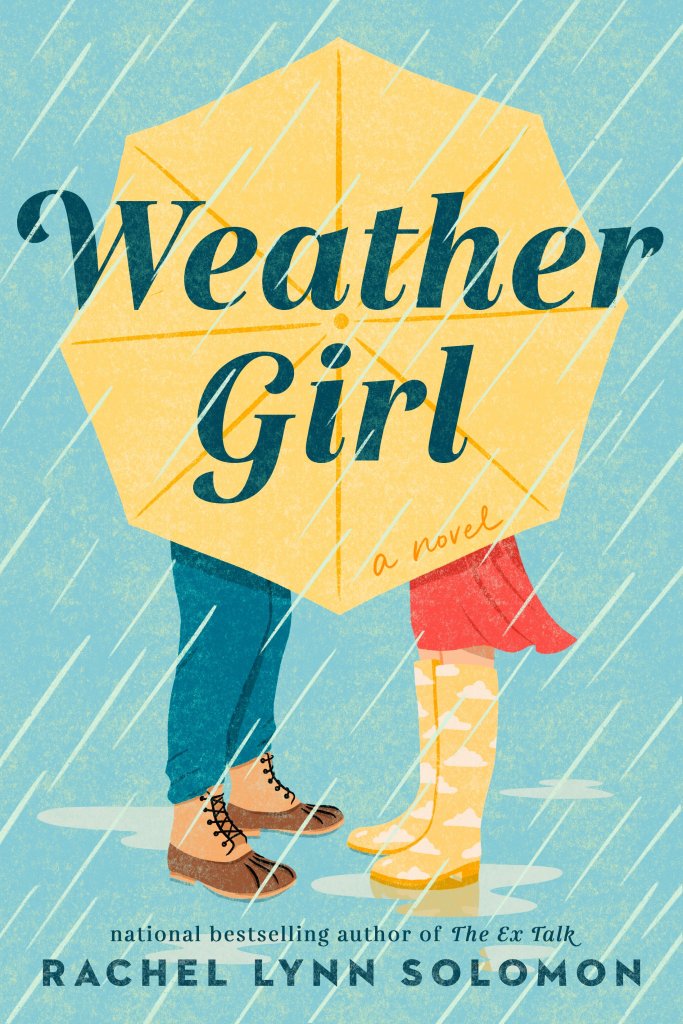
Ari Abrams is, first of all, a Jewish protagonist, which is rare; she is also a successful young TV meteorologist with a depression problem, who portrays herself as all sunshine and hides her dark side. Her love interest, Russell Barringer, also Jewish, is a sports reporter, a big teddy bear of a guy who is self-conscious about his weight. These two departures from the norm made me much more likely to enjoy this book.
Then there is the plot, which is silly enough to be light entertainment but plausible enough to carry the story: The two “bosses” of the TV station are a phenomenally popular meteorologist and her former husband, her producer, who make the station their daily battleground to the discomfort of all the other employees. But Ari and Russell see glimpses of former love and passion between these two and decide to “Parent Trap” them by trying to encourage them to renew/salvage their relationship; in the process, Ari and Russell also begin to find one another more appealing than their initial friendship would have indicated.
I enjoyed getting inside the head of someone who was fighting depression, mostly successfully, but who had deep doubts about her ability to be real with anyone and still be loved. I also liked finding out Russell’s secrets and wondering how they would fit into the mix. And finally, the sex scenes were steamy and appealing and not at all creepy, which is a big hurdle in most rom-coms.
So—a rare recommendation from me for a mostly cute, mostly light romance with some unexpectedly well handled serious subjects.
A certain kind of story
I discovered Jodi Picoult’s books back when I was on the cusp of 40, with her book Mercy (I think). I may have read one of the ones before that, but the descriptions on Goodreads don’t spark any memories. But I have read so many books over the years that sometimes I come to an old one thinking it is new, only to vaguely recognize the story as I get further into it, so I’m not sure. Anyway, after that I made a habit of picking up her books until somewhere around My Sister’s Keeper, in 2004, and after that I lost interest and quit reading them.
It wasn’t because she wasn’t a good writer, and in fact I enjoyed the story in My Sister’s Keeper; but her books increasingly reminded me of my least favorite young adult novels—those the library profession calls “problem novels.” Somehow, even though her characters remained fairly compelling, her books began to seem to me like those preachy tomes written for teens that turned out to be about a condition, or a social concern, rather than a person; as Michael Cart says in his history of teen fiction,
“The problem novel stems from the writer’s social conscience. It gave the frisson of reading about darkness from the comfort of a clean, well lit room.”
Young Adult Literature: From Romance to Realism, p. 35
Rather than telling realistic stories about the teens who experienced certain aspects of life, the books focused on such subjects as drug abuse, abortion, unwed motherhood, and so on, using a formula that approached the feeling of an old-fashioned morality play. Problem novels sought to illustrate the perils inherent in poor life choices, and every time I opened a Picoult novel, it was with the unspoken question: What is the problem/flavor of the month in this one? They became repetitive and increasingly uninteresting to me (although a certain segment of readers continued to eagerly devour every word).
There were a few things that enticed me to once more read a Picoult bestseller: One of the characters is a bee-keeper, which profession has always fascinated me; Picoult co-wrote it with someone rather unexpected, about whom I wanted to know more; and the “What Should I Read Next?” crowd on Facebook pretty much raved unequivocally about Mad Honey, Picoult’s latest hit with Jennifer Finney Boylan.

There were parts of this book that I liked very much. The bee-keeping was, as anticipated, as enthralling as always. The back stories and characters of the two moms were compelling, as was the head-rush of a romance between the two teens, Asher and Lily. The authors wrote both their main and subsidiary characters with conviction and believability. But there was a fatal flaw within the story that really bothered me.
The basic outline is this: Olivia McAfee took her six-year-old son Asher and ran from an abusive husband back to the New Hampshire town where she grew up, inheriting her father’s bee-keeping operation. Asher is now in high school, a star of the hockey team, a good student, and a kind son and friend, having grown up in Olivia’s sole custody.
Ava Campanello fled with her daughter, Lily, from her own marital trials and more, and her employment options with the park service landed her in the same town in New Hampshire just in time for Lily’s senior year, hoping for a fresh start for the both of them.
Asher and Lily are almost immediately drawn to one another, and begin an intense relationship that lasts about four months before Lily ends up dead, having fallen down the stairs in her own home, and Asher is the one who finds her and is discovered weeping and clutching her body—but not calling for an ambulance. After a brief investigation, the police come for Asher and he is charged with first-degree murder.
Thus far, the whole plot worked for me, even the crazy timeline about which some complain, which jumped from before to after “the event” in almost every chapter, and also switched narrators/viewpoints—Olivia to Lily. Then we get to the trial. Olivia’s brother, Jordan, is, serendipitously, a rather famous defense attorney, and immediately comes to the rescue, agreeing to represent Asher pro bono. We go through all the details of a murder case—expert witnesses, character witnesses, the prosecution’s efforts to make the defendant look as guilty as possible by characterizing him as a violent, impulsive liar with both motive and opportunity. Then we get to the defense and Jordan completely falls down on the job.
The question that is never, ever asked by anyone—Asher, his lawyer, his mother or, apparently, the police—is the one that would have been central to the defense in any halfway well written murder mystery. Can you guess what it is? In his Dismas Hardy legal thriller series, author John Lescroart characterizes it as the “SODDIT” defense: Some Other Dude Did It. In Mad Honey, Asher adamantly maintains his innocence: When he walked in the (slightly ajar) front door, Lily was lying at the foot of the stairs, her head bleeding. His uncle/lawyer and his mother believe him, despite his mother’s secret fears that genetics have won out and he is violent like his gas-lighter of a father. The prosecution is insisting that he did do it, based almost solely on circumstantial evidence—some DNA, some texts, a scandal in his past that brands him as a liar. But not one person who believed he didn’t do it (including Asher himself!) spoke up to say, If Asher didn’t kill her, then who did?
Jordan should have been all over that—questioning the police and detectives to see whether they had considered any alternate person and scenario, having his investigator look into others who might have been suspicious, checking neighbors and traffic cams to determine whether anyone else visited the house that day, but…crickets. No mention of an alternative theory of who the murderer could be. That’s pretty much when the story lost me, and should have been when Asher, fighting for the rest of his life, or his mother, with her greater adult wisdom, sat up and said Jordan! WTF?
It didn’t totally ruin the rest for me—I still liked the characters (particularly Lily), the story, and the twists, small and large, and might recommend it based on those things. (And you should know that, despite all the surface details cataloged in this review, I have kept all the big secrets of the book.) But that one omission, paired with the way the book ends, made me realize that perhaps my initial conclusion—that Picoult is too focused on the social concerns she wants to highlight to truly immerse herself in the meat of the story—was not off base. I won’t say I’ll never read another from the Picoult oeuvre, but it will take something extraordinary to convince me.

Books about/with books, writers
I picked up a bargain e-book last week, a “relationship fiction” novel by author Susan Mallery. I hadn’t read Mallery before, but she’s quite popular, apparently. Most of her books seem to edge over the line into romance, but some are more story- or character-driven. She has quite a few short series and some stand-alones, one of which I chose from the BookBub E-book Deals that arrive in my inbox each day, because I was drawn in by the title: Boardwalk Bookshop. I am a sucker for any book that includes bookstores, libraries, readers, and writers in its title or content, so it was inevitable.
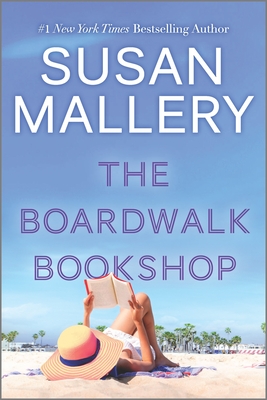
Although supposedly about a bookshop, the store in question is actually one large space divided up into three separate retail establishments (bookstore, bakery, and gift shop) shared by three women who wanted shops on the beachfront but neither needed the larger space nor could afford the price tag on their own. Despite not knowing one another, they impulsively team up to lease the place, installing their three enterprises side by side, each operating independently with their own employees and cash registers but benefitting greatly from the cross traffic of the other two businesses.
Mikki, the gift store owner, is a recently divorced 39-year-old who has two almost-grown children and a comfortable co-parenting arrangement with her ex-husband. Although they have been apart for three years, Mikki has not really moved on; right after the divorce she went on three separate but equally disastrous dates with various partners and gave up. A planned solo trip to Europe has suddenly awakened her to the fact that she could live another 40 or 50 years and doesn’t want to do so alone, but she’s not sure she has it in her to put herself forward again as a single, datable woman, with all the trial-and-error that involves.
Ashley, the baker, is swoonily in love with her live-in boyfriend Seth, who seems like the perfect man and mate except for one large flaw that, when it manifests, throws Ashley for a loop and has her doubting him, herself, and what will ultimately become of their relationship.
Bree, the book purveyor, raised by indifferent, self-involved author parents, met a man equally as brilliant as they were but who seemed to promise what they never gave her—love and a sense of belonging. Instead, he betrayed her rather spectacularly and then died, leaving her a young widow whose walls don’t come down for anyone—even Ashley’s persistently interested brother, Harding (who is also a writer).
The three women, initially bonded over their joint enterprise, slowly become friends and weigh in on each other’s options for romance, personal growth, and more. There is a dynamic, well-fleshed-out cast of secondary characters to interact with them, and the Los Angeles seaside setting is well utilized.
I liked this book, with some reservations: I thought both the narrative and the language could have been more nuanced. I found each of the women in turn to be dithery about her choices and actions. The three kept circling around to the same indecisiveness again and again, and while this may be how real life goes, in a novel it became repetitive and a little irritating. But the growth and change ultimately exhibited by each of them, while uneven, did move along to satisfying conclusions for all, and I mostly enjoyed the reading experience. I could be persuaded to try some other Mallery titles, probably when I am looking for a light, fast read as a palate cleanser between more serious novels.
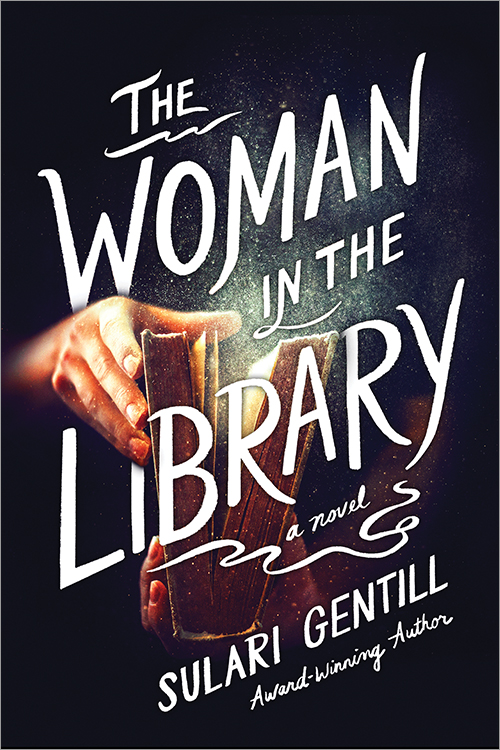
The second book-oriented story I read this week was The Woman in the Library, by Sulari Gentill, and it was a cat of a different color! I don’t remember where I came across this—it might have been on the readers’ Facebook group—but I’m so glad I picked it up, although others were not so happy with it. This is one of those books that (on Goodreads) either gets a five-star exclamation of “Yes!” from its reader, or a one-star “too weird for me.” I fell into the former group, with a few reservations—but mostly I was enthralled.
This book is the ultimate in meta, and the jump between reality and fiction is what kept me reading. The real-life set-up is that an Australian author of mysteries, Hannah Tigone, is writing a novel set in Boston, but she can’t travel from Sydney to do any on-site research due to Covid quarantine restrictions. Enter email pen pal Leo Johnson. Leo is initially introduced as an author trying to get his book published and reaching out to Ms. Tigone, a writer he admires, for suggestions or, preferably, actual assistance with finding an agent. But then Leo moves on to suggest that since he lives in Boston, he can easily assist with on-the-ground research, acting as a beta reader to give her information about locations and also vetting her language, since American slang differs markedly from Australian and it’s easy to slip up (calling a sweater a jumper, for instance) if you’re not paying attention.
After Leo’s initial email, the book moves into Hannah’s writing of her mystery. Her protagonist is Australian Winifred “Freddie” Kincaid, working on her own novel, living in Boston courtesy of the Marriott Scholarship, a writer’s grant that comes with a brownstone in Carrington Square. In the opening, Freddie has gone to the Boston Public Library for the day, planning to work on her book in its famous Reading Room, but is distracted by the three other people sitting at her table. She idly jots down notes on each of them as possible characters—she calls them Handsome Man, Heroic Chin, and Freud Girl—but then all four, along with the rest of the library users, are startled by a terrified scream coming from somewhere nearby. The library is locked down while security searches for the woman who cried out, and the four begin to chat about their immediate circumstance and a little about themselves; when they are released, they decide to go together to get something to eat, and this is the beginning of a four-way friendship.

It becomes harder as you go on to remember that Freddie is not the true protagonist, nor are these others real people—all are a part of Hannah’s story—but at the end of each chapter, the reader is yanked back to that reality by Leo’s comments on the last chapter Hannah has sent to him. Leo becomes increasingly invested in the contents of Hannah’s book, and…but that would be telling, and I have revealed enough. There are two stories here (or are there three?) and their juxtaposition and relation to one another kept me reading to finish this book in 48 hours.
The reservations I mentioned: The pacing wavers here and there, and sometimes the characters are a little flat—not well enough fleshed out. Also, insta-love rears its weary head. But these things didn’t bother me because they are, after all, part of a first draft of a manuscript! Remembering that as you go along makes everything completely believable, because Hannah still has the opportunity to come back and fix or change any of the details.
Hoping you pick this one up and are as delighted by it as I was, rather than falling into the group who considered it “weird.” The truth is, it IS weird and that’s what I liked!
 The Book Adept