Book pharmacy
The pandemic did something to our libraries from which I’m not sure they will ever recover completely: It made the in-person experience first precarious, then impossible, and then precarious again, as libraries first changed policies to prevent close contact, then completely closed their doors, and finally opened again only to discover that their patrons were either still being cautious or had completely changed their methods of book access and weren’t readily returning to their former habits.

My experience has been particularly acute, since, in the year after the formal lockdown when we were all mostly still staying away from any public place with more than half a dozen people in it, my disability began to ramp up to the point where making my weekly rounds to the market, the post office, the feed store, and the library became at first painful and then fairly impossible. The only time I go to the library nowadays is if I am booked to teach an art workshop at one of the local branches, and it takes me two hours to get ready and a double dose of Tylenol to weather climbing in and out of the car four times (leave-arrive, leave-arrive) and walking from the parking lot to the meeting room to set up for contour drawing or watercolor or T-shirt stenciling.
My previous library habits were filled with serendipity for my reading life; I had a particular routine that varied but usually included most of the same checkpoints. I would return my books and then look at the return shelves to see what “everyone else” had been reading and whether any of it looked intriguing to me. I would check the new books shelves and grab at least one or two unknown and untried authors. I would look to see if the latest volume in half a dozen mystery series I read had arrived, or if there was new science fiction, and I would visit the YA section for fantasy, because some of the best fantasy writers live there. And if all that failed to garner me at least half a dozen books to take home, I would stroll languidly up and down the aisles, looking for beloved authors, and would consider re-reading one of their books; but then I would also look around them on the shelves to see who I might discover because they were shelved close by. That’s how, while looking to see if there were any Rumer Goddens I hadn’t read, I noticed and borrowed the books of Robert Goddard. That’s how, while standing by the shelf containing Betty Smith and Dodie Smith, I found A Simple Plan, by Scott Smith. The books of Robert Heinlein led me to the Dune saga by Frank Herbert “next door.” In short, I can’t say enough about the expansion of one’s reading life through the luxury of browsing.
In my readers’ advisory class at UCLA, I used the book Reading Still Matters, by Catherine Sheldrick Ross, as one of the texts; Ross and her colleagues did multiple in-depth surveys and studies of thousands of readers to discover how they select, but I never realized, until I just now took the time to describe my own exact experience, that I almost perfectly characterize the habits of the successful readers she catalogues. Part of that book is also dedicated to the purpose of discovering what happens when a person’s own habits and methods fail them and they are flailing about trying to find a book. And now, I can relate to that, too….
These days, being so nearly housebound as I am, my choices suffer from a certain paucity. Although I belong to a couple of Facebook groups of avid readers, most of the time they all seem to be reading the same two dozen or so books, many of which are not to my taste. I have never been a peruser of the bestseller or award-winner lists in the newspaper or online, mostly because long experience has shown me that the former are not as good as their publisher’s blurbs declare, while the latter have won awards simply because some esoteric bunch of people decided they should, and we apparently have little in common! So without my library routine, I struggle to find what I want, just as much as any more naive reader with fewer developed resources. I wasn’t conscious of this until my annual Goodreads challenge (how many books you read in a year) began to number fewer and fewer books, mostly because I am not finding the ones that would hold my attention and keep me reading on a continuous basis. One year, while working full-time (at the library) with a long commute, I nonetheless managed to clock more than 150 books; but last year I struggled to complete 80, despite being retired and mostly at loose ends. Part of it, of course, is a certain lack of concentration that comes with my physical challenges, but I blame most of it on the functional lack of choice.
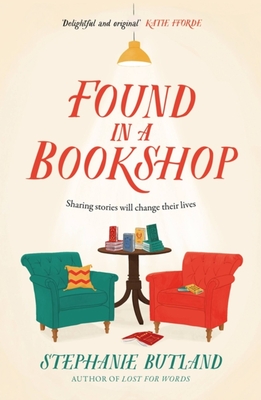
Being a readers’ advisor carries a certain amount of responsibility with it to keep up with current literary output while having a deep base of older choices on which to fall back, and I confess that I’m not as good at it as I have been in the past. But I still manage, in the Facebook reading groups (and sometimes on Goodreads) to find the books people want, if they give the slightest bit of personal information that would lead me to their preferences. And that brings me to the book I am currently reading (at last! you may be exclaiming with relief), which is called Found in a Bookshop, by Stephanie Butland, and which is resonating so closely with certain parts of my own personal experience that I am finding it positively cathartic.
I didn’t know, until I had already reached chapter 11, that it is actually a sequel to Butland’s book The Lost for Words Bookshop. But several Goodreads reviewers said you could read the second as a stand-alone, and I somehow couldn’t bring myself to stop, once started, so I’ll get to the first one when I am done with the second. (EDITED TO ADD: I apparently did read the first book, back in 2018, and gave it five stars. I didn’t review it here, since I hadn’t yet started this blog, and I don’t remember a thing about it! That’s kinda scary….)
A couple of Goodreads reviewers groused about the book being set during the Covid lockdown (“outdated” said one, while the other elaborated: “Boring. Too many characters. Hate Covid books. Could do without the author’s opinions. Glad I only spent 99 cents.”) but that was precisely what I loved most about it. Butland so perfectly captures the feeling of being isolated from everyone, from standing on one side of a door but not allowed to open it, the nervous retreat from other people when encountering them in public places, the quiet of the streets with nothing but essential traffic…it brought the whole thing back with complete clarity. I suppose some people wouldn’t want to experience that again, and while I didn’t precisely crave it, I found it comforting, in a way, to recognize that this author’s experience (and that of her characters) so perfectly echoed my own.
The description of the pervasive quiet of the bookshop without any of its customers and the nervousness of its proprietor and her employees as the lockdown went from weeks to months with no sign of abatement was evocative and painful. The vignettes of the various people who were tenuously connected through their previous status as customers of the bookshop were likewise poignant and familiar. But the thing that really got me, in the end, was that this was a story not just about Covid but about readers’ advisory. At some point, after one long-time patron mails a check and requests that the bookshop send her books each week—leaving the selection up to the staff—the owner, Loveday Carew, decides that she will enlist her employee, Kelly, to craft more of a presence on social media and then to advertise their services as a “book pharmacy.” Basically, they tell the town of York that they will be happy to select books for people who aren’t sure what it is they want or need, a sort of reading prescription, and either deliver them to their porch via bicycle, make them available for pickup, or send them in the post. And then the emails and letters start to arrive, some requesting specific genres or types of reading but others simply describing the feeling the reader wishes to experience and hoping the bookshop staff can figure out what book will produce that. The books couldn’t cure Covid, but they could do something about fear, boredom, loneliness, and the desire for escape. It was like this author took my favorite area of study—and my life’s preferred work—and laid it all out on the pages of her book.
In addition to all of this synchronicity with my own life’s experience, I love that in the “prescriptions” the bookshop staff write out for their customers I discovered at least a dozen intriguing titles with which I was unfamiliar, and which I promptly noted and added to my Goodreads “want to read” list. After doubling back to peruse the first book in this duology, I can scarcely wait to explore that extra list of smart suggestions from an author who has obviously done her homework. Great work, Ms. Butland!
Retrograde
The blurb for this book describes it as “funny and heartfelt.” It’s also supposed to be a romance about a woman who writes romances for a living and wants to open a romance-only bookstore with her two best friends, also authors. So you would think I would love it, or at least find it charming and/or germane to my interests. I’m beginning to think all the books I want to read have banded together to evade me on purpose, leaving me with a bunch of hopeful choices that don’t quite pan out.
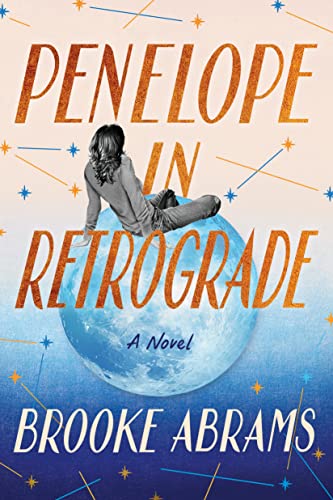
Penelope in Retrograde, by Brooke Abrams, isn’t a bad book, and I didn’t hate it; but it’s too slight to make much of an impression. It’s also annoying in some specific ways. I feel like the author is trying too hard to include all the romance memes, from the meet-cute to the friends-to-enemies-to-friends, and throwing in a conflicted familial situation to spice it all up—none of which turns out to be satisfying.
The main character, Penelope (Penny) has been, not exactly estranged from her family, but out of regular contact for about a decade. Her father is a workaholic businessman in finance; her twin, Phoebe, graduated with honors from college and works in his firm; and Penny has always been the odd one out. Phoebe is successful, Phoebe has a relationship, Phoebe lives close to her parents and sees them on a regular basis, while Penny lives more than half the state of California away from them, and writes romance novels. She is so insecure about her lack of acceptance from her family (her mother wants her to dress better and get a husband and maybe have some kids) that she hasn’t even told them the pen name she uses to write her books.
Once upon a time, Penny was briefly married to Smith, with whom she grew up. She had a better relationship with his family than she does with hers, and mourns the loss of them more than the marriage. The present-day setting of the book is the Thanksgiving holiday, for which Penny is finally returning home after 10 years of avoiding every family gathering. And why is she gracing them with her presence? She needs money to open her bookstore. This immediately made me think poorly of her, since the only reason she’s willing to connect again is to get the funding.
Karma trips her up when she phones for a rideshare from the airport and ends up sharing the Úber with her ex, Smith, who is also returning home to spend the holiday with his sister. Penny then discovers two things: Her parents have invited a young and handsome colleague from her father’s company to dinner, because they never give up matchmaking (even after 10 years of no contact?), and Smith is dating someone new. So Penny immediately decides it’s a good idea for Martin, the set-up guy, to pretend to be her boyfriend. The problem is, her whole family knows he’s not, so he has to convince Smith without revealing what he’s doing in front of her family. The whole thing is cloyingly cute. (Sorry, that was all a little spoiler-y.)
Basically, I agreed with one Goodreads reviewer who said that the story tries way too hard to be funny. Penny’s compulsive avoidance of any genuine conversational moment by turning everything into a joke is grating, while the ride-share scene stretches out forever and is patently silly. Penny’s narrative paints her as the victim of her family’s rigid expectations, but her own behavior shows her up as kind of selfish, and definitely as tone-deaf to their needs as she feels they are to hers. And everybody fights nonstop, which is likewise wearing.
The other thing about this story is that it’s so, so easy. Martin immediately falls in with her plans; Smith turns out not to be plotting what she thinks he is; her father has changed drastically in completely implausible ways while her mother has remained distressingly static; and Nana Rosie as the comic relief is too, too coy. And even though her sister is justifiably irate at how Penny is constantly stealing her thunder, forgiveness also comes easily. Despite Penny raging about how they are all hostile to her, everybody cooperates with hardly a whimper, and then when a stressful life event occurs, Penny transforms into someone else and we have a qualified HEA like all good romance novels. I was surprised when I discovered I had already turned the last page, because I kept expecting things to become, well, more. The desire for more seems to be the one bell I keep ringing lately.
Can anybody recommend something to me that will generate some genuine feelings of joy when I read it?
Darlings
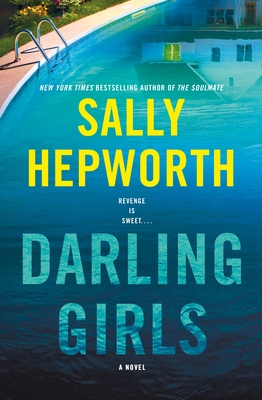
The title of this book is pretty good at pointing up the false affection shown to three foster children by a deeply narcissistic sociopath masquerading as a loving foster mother. I don’t have a lot to say about this book; I enjoyed it less than my favorite of Sally Hepworth’s (that would be The Good Sister) and more than my least favorite (The Mother-in-Law), so it falls somewhere in the middle with the others of hers I have read (three to date).
I did like the format Hepworth chose, in which we get the alternating point of view of each of the three foster sisters—Jessica, Alicia, and Norah—in adulthood and also in childhood (present and past). I didn’t care much for the psychiatrist session segments of the book, mostly because I was so uncomfortable with the way she wrote the therapist’s part (he was so repellent!), but it did render a little more intrigue as the story went on. I felt like the murder mystery was a bit generic—I mean, after we get an idea of who Miss Fairchild (the foster mother) is underneath her sugary sweet façade, it’s hard to believe any red herrings about who could have been responsible for the body buried under the house (that’s a minor spoiler, we find out about the body almost immediately). But the thought that the killer (if there is one) might get away with it definitely carried the suspense further, a good move on the author’s part.
I think part of the reason I didn’t love this book, apart from it feeling obvious in some respects, is that I didn’t feel a strong connection to at least one of the foster children (which turned out to have some basis in reality). I won’t say which one, because that would spoil things further. But it was a fairly engrossing read, and I think most people would find it a quite satisfying example of relationship fiction with a suspense twist. It also points up the ongoing problem of the way fostering is handled and the many opportunities for abuse of that system, which I appreciate.
Three stars out of five for me. But you might like it better.
Piglet
When they talk about reading this book, people have a lot to say about misogyny, about agency, about maintaining façades, but not so much about the thing that struck me, something pretty literal about the whole plot as it relates to the main character: People are failing her, life is failing her, and she is failing herself because she is trying to make and keep herself small.

A few people on Goodreads reacted negatively to this book as just another eating disorder saga. I didn’t read it like that at all. Yes, she has an intense relationship with food, but if everything else were copacetic, that would be considered normal—she’s a cookbook editor and a foodie, so what? But everything else isn’t right in Piglet’s life (imagine, for instance, going through life being called “Piglet” by all your loved ones!), and the common denominator is that she’s too big for the life she has been seeking.
She’s too big for the lower-middle-class background into which her parents and sister expect her to continue to fit herself; she’s too big for the upper-class environment to which she aspires—too flamboyant, too expressive, too filled with emotions. She’s too big to fit into the expectations of her fiancé, who wants her to act appropriately despite his own bad behavior. She’s too big physically—tall, awkward, a little overweight. And everyone faults her for this, and keeps encouraging her to cram herself into roles, relationships, corsets, dresses, mindsets, all of which goes against her nature. But it takes her just a little bit too long to figure out that none of the behavior she is forcing upon herself will fill up her hunger for love, for acceptance, for recognition. So she makes a series of disastrous decisions that feel inevitable in the moment, until they don’t and she rebels.
She has one voice of reason in all of this—her pregnant maid of honor, Margo, who ends up going into labor early and has to miss the wedding, but who persists in telling Piglet that she deserves more. Piglet doesn’t listen, but when she upends everything, Margo is the one she seeks out.

This is being touted as literary fiction, and I wouldn’t quite go there, but…the author is immensely skillful in the way she gets the reader to think about big-picture decisions by dwelling on seemingly incidental conversations and descriptions of food—choosing it, preparing it, eating it. She is also really good at creating essentially unlikeable characters and getting you to care about them. The book tells a story that is in one way small in scope, but in another is about a very big question: What’s the point? What do we want? In certain moments I felt an overwhelming impatience with Pippa’s choices (yes, that’s her real name)—or lack of them—but I have to confess that I mostly loved this book and found it as satisfying as one of the meals she makes during the course of the story.
Addendum: I found it fascinating that this novel was written by Lottie Hazell in conjunction with, and inspired by, getting her Ph.D. in Creative Writing, with a focus on food-writing in twenty-first-century fiction. I would definitely read another book by this author.
Faint praise
The phrase “damning with faint praise” (from a poem by Alexander Pope) keeps coming to mind as I think about the book The 100 Years of Lenni and Margot, by Marianne Cronin. But I think what my reaction to this book really suffers from is damning from excessive praise!

It’s just another lesson to me to go my own way when I pick things to read instead of following the popularity contest of a narrow number of books that “everyone” on Facebook is reading and about which they are raving.
I did love the opening lines, in which Lenni hears the word “Terminal” (in reference to her condition, from her doctors and nurses in the hospital in which she now lives) but instead pictures an airline terminal, where she is awaiting imminent departure on a flight to…somewhere.
I also liked Lenni’s narrative about the life she was living in that hospital, with its boredom occasionally alleviated by an interesting person (like an old woman wearing a purple bathrobe and clinging to the side of a trash bin while trying to reach something within its depths, or a priest who doesn’t know what to make of Lenni and her questions). But once Lenni, the 17-year-old terminal patient, and Margo, her 83-year-old friend, met and became friends, I felt the focus moved so much more toward Margo that further character development of Lenni was suspended until near the end of the book, to its detriment.
As a painter, I loved the concept that the pair came up with as a project for their art class. Added together, their ages (17 + 83) made 100, a nice round number on which to base a goal, which they do:
So, we will paint a picture for every year we have been alive. One hundred paintings for one hundred years. And even if they all end up in the bin, the cleaner who has to put them there will think, Hey, that’s a lot of paintings. And we will have told our story, scratching out one hundred pictures intended to say: Lenni and Margot were here.
As an artist, I wish there had been more detail about the individual paintings. They were supposedly each based on an event from one year in the life of each person, but the stories themselves took precedence and there were mere glimpses of the art, not the full descriptions they deserved as the central theme! I also felt like the narrative kept pulling and pushing between the two characters while giving Margot the advantage, with the result that I never felt fully engaged and emotionally invested like all the other people who loved this book seemed to be. I felt like too much importance was given to Lenni’s interactions with Father Arthur, the hospital priest, and too little to her own personal story; and Margot’s tales were all over the map—as they would be covering an 83-year span—taking too much away from the present-day events.
The language was lovely, and there was a lot to like about the book, but it didn’t wow me the way I expected. On to the next….
Jakarta farce

I just finished reading The Good, the Bad, and the Aunties, the third book in the series by Jesse Q. Sutanto, and I have to say I am glad the trilogy ends here. Again, as in the second book, it wasn’t bad…but it didn’t make it to great either. The book suffers from the droning extended inner dialogue of its main character, Meddy, who is a mass of frets and worries about everything under the sun, with no real ideas of her own for how to combat them. She has been dominated her whole life by her Ma and her four aunties, and while one would hope to see some evolution from the first book to the third—particularly because during that timespan she has reconnected with her long-lost love, gotten married, and killed and disposed of at least two people—she’s essentially the same self-deprecating bundle of nerves we met on page one of the first book.
Similarly, the aunties are characterized each by their one or two distinguishing qualities, and never expand into fully fleshed-out human beings. Big Aunt is dictatorial and imposing, Second Aunt is sly and competitive, Ma is loud and bossy, and Fourth Aunt, the most cosmopolitan of the women, fancies herself as the coolest (she is a singer) and comes across as disdainful and dismissive. They have a few wee moments, here and there, of dropping out of character to become more humanized, but the overall picture hasn’t changed.
Nathan is a nice addition to the family, now that we are past the wedding, but his personality is mainly filtered to us through Meddy’s astonishment at how well he is getting along with her crazy family, and aside from some random observations by Meddy on the excellence of his abs, is likewise kind of faceless
The premise of this one is that Meddy and Nathan, after an extended honeymoon tour around Europe, have met up with the aunties in Jakarta to spend Chinese New Year with the Indonesian side of the family, which is vast and lively and shares many of the qualities we have come to expect from the aunties themselves—overly concerned with things like good manners, saving face, being extravagantly hospitable, and so on. I did enjoy the group scene of them all celebrating together, the cousins and children bonding over food and fun and much eye-rolling over the burden of dealing with the older generation. But this isn’t enough to carry the rather silly plot, and all too soon it’s back to the aunties doing the wrong thing in the clutch and Meddy having to figure out how to save the day despite her crippling anxiety and low self-esteem.
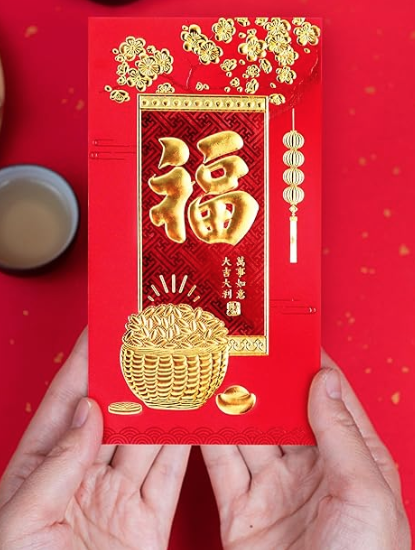
At the big celebration, an old beau of Second Aunt’s shows up to reclaim her affection, bearing extravagant gifts. “Red envelopes” are given out to the children—packets of cash that are traditional gifts for the new year—but there is one packet amongst them that was intended for someone else entirely (a business associate of the beau’s) but got mistakenly gifted to who knows who in the confusion of the celebration. Now those in the know (the beau, the aunties, and Meddy and Nathan) have to figure out who has it, get it back, and give it to the business rival to avoid dire consequences. But, as is usual with this cast of characters, things go typically awry and get ever more complicated.
Maybe I’m just in a weird mood—not the one to sufficiently appreciate this book—since many people gave it four and five stars. I found it more stressful than enjoyably chaotic, and was glad when it was over. I vastly preferred her stand-alone book that I read a few weeks ago, and hope she writes more like that one.
Finlay’s road trip

I was excited to get the notice from the library that Finlay Donovan Rolls the Dice, the latest in the series by Elle Cosimano, had landed on my Kindle this week. The overwrought novelist-turned-criminal’s story continues right from where Book #3—Finlay Donovan Jumps the Gun—left off. The open questions at the end of that book: Will Finlay’s nanny, Vero, get out from under her debts to low-life underworld characters? Will her sister Georgia manage to make things last with new FBI girlfriend Sam? Will Finlay convince ex-hubby Steve that things are over between them, and will she finally manage to have a real relationship with police detective Nick—a problematic quandary since she has participated in so many criminal activities to which she can’t “cop,” pardon the pun. Will Finlay and Vero take back the Aston Martin that someone stole from them and also rescue Vero’s crush, kidnap victim Javi? There were so many dangling threads to remember that I almost immediately wished I had stopped to reread #3 before assaying #4!
Because I had read that book within days of its release more than a year ago, it took me a while to get into the rhythm of this new book. The series is really one long story, so you have to be up on all the events from page one of Book #1 in order to really get what’s going on. You also have to understand what this series is and what it is not; while there is a boatload of illegal activity taking place on its pages, it’s really more of a French farce than it is a mystery or thriller, although the fast pace and quick twists and turns certainly make it exciting. Someone on Goodreads compared Finlay and Vero to Lucy Ricardo and Ethel Mertz and, although they are smarter and more savvy, the relationship between them and among all the other disparate characters, from teen hackers to police officers to mob bosses, does bear a certain similarity—and that chemistry is Cosimano’s real advantage.
In Book #4, the cast all take a complicated road trip to Atlantic City in pursuit of their various objectives—and everybody, and I mean everybody, comes along, from Finlay’s mom, kids, and ex-husband to all the cops (crooked and straight) and criminals (major and minor). There are numerous misdirections of everyone involved, no one seems to have a real handle on what’s going on, and all are giving a good imitation of chickens minus their heads.
My ultimate conclusion after reading this chapter in Finlay Donovan’s story is that it was a little too busy. There were so many things happening to so many people all at once, and their connections were sometimes so confusing (wait—who is Ricky, again?) that it was hard to keep straight at times, which meant there was less focus on the strengths of the franchise—the snarky banter, the romantic entanglements, the misunder-standings that propel the heroine and her cohorts. I did enjoy it, but I’m glad that a few characters permanently exited the page (no, I’m not saying who, though some will be a surprise and others not) so that perhaps the next book will be less frenetic and more tightly focused. I did enjoy getting to know Finlay’s mom, Susan, but I also wanted a little more of the Nick/Finlay inter-action, I wanted to hear about Zach’s progress with potty training and Delia’s latest faux pas; and the characters’ days-long lack of sleep and irregular meals made me almost as tired as they were!
I hope that Elle takes a deep breath and keeps everyone closer to home for the next one. Yes, there will be a next one—there was a significant cliffhanger at the end of Dice about nosy neighbor Mrs. Haggerty that leaves us waiting eagerly for its resolution in (sigh) another year!
Delightful whodunnit
I guess that headline makes my blog post kind of unnecessary; but I could not wait to offer up a reaction to Vera Wong;s Unsolicited Advice for Murderers, by Jesse Q. Sutanto.
Let me start by saying something unrelated about the text of this post: I had a rain leak in my roof right above my computer yesterday, and my keyboard got drenched. It is dried out now and still mostly works, but there are a couple of significant issues: The backspace (delete) key instead turns off the sound, and the apostrophe either appears as a semicolon or not at all. So as much as it pains me to write a review in which there are no apostrophes, since the book title itself contains one then needs must if I want to write it before I have access to a new keyboard, which I do! I will attempt to write without contractions as much as possible, apart from the book title, seen above with semicolon.

I previously reviewed two other books by Sutanto, and I liked them well enough (the first better than the second), but this one feels like a whole different level of enjoyment. It is as quirky as those, for sure, but it is less frenetic, more logical, and abounds with interesting and likable characters. The book is solidly based on the main title protagonist, while all others revolve around both her and a circumstance in which she finds herself embroiled; but there is no lack of either detail or interest in every other actor in this little play Vera Wong is creating in her attempt to solve a murder.
Vera is a small but intense lady with a tea shop in the middle of Chinatown in San Francisco. For the past few years her clientele has dwindled down to a single visitor per day, but Vera has not let this discourage her: She still arises before dawn, dons her athletic costume and gets in a brisk walk before opening the tea shop in anticipation of composing the perfect brew for every need from her vast store of jars and bottles full of exotic ingredients. But one morning Vera descends from her apartment to her shop to discover a body on the floor! Mostly unperturbed but intensely curious about who he is and how and why this young man has ended up dead inside her shop, Vera decides she is the ideal person to help the police investigate, and takes a few things into her own hands that would better have gone to the detectives who later respond. But when those detectives are then unable (or, in her view, uninterested and/or unwilling) to solve what Vera has decided must be a murder, Vera waits to see who else arrives and begins to compile her suspect list based on the level of interest each person shows. In her view, nobody is better suited to this task than a Chinese mother of a certain age!
Each of the people who subsequently turns up has some sort of connection to the dead man, and Vera is in her element as she alternatively prods and snoops in her attempts to get at the truth. The fact that she makes a friend out of each of them in the process (and also tries her hand at matchmaking) is not, in her eyes, a deterrent to exposing one of them as the killer. The humor and inevitability of her progression is equal parts poignant and hilarious.
The sole bone I have to pick about this story (and with this author) is the way Vera is persistently described—as a little old lady. The descriptions of Vera—her hair, her clothes, her mannerisms—suit the picture, but then Sutanto reveals her age and everyone reading this book above that age is going to be outraged, because Vera is 60! I think you have to add on a minimum of a decade, and probably half again or even double that, in order to legitimately be referred to in that precise way. As a woman of 68, I feel elderly in some ways (mainly in my crackly knees and blips in short-term memory), but I do not think I will consider myself as a little old lady until about the age of 84! Yes, Vera is a granny, but a little old lady she is not! Read it and see if you agree…
Mistaken identity
The ratings and comments on Goodreads for On Rotation, by Shirlene Obuobi, are so spot-on to illustrate why publishing companies have to be held accountable for the way they promote a book. There were a few people who thoroughly appreciated the story for what it was, which was a combination of “relationship fiction” and and the immigrant experience, with coming-of-age (early 20s variety) thrown in; the rest were disgruntled and showed that in their ratings, because the blurbs had led them to believe this was a rom-com.

Don’t get me wrong: There is a romance in this book that takes up a significant amount of air. But it isn’t a comedy (although there are a few funny moments), and it doesn’t have that coy, somewhat self-conscious vibe that lets you know when you’re supposed to acknowledge the ironies or coincidences or other plot points common to the specific rom-com subgenre.
Instead, it’s a narrative about the experiences of a young black woman in medical school; but moderating that more generic scenario is the specificity of being a first-generation Ghanian, seeing how that sensibility and those traditions differentiate a part-West African, part-British heritage from that of the American descendents of slaves. It’s a showcase for the immigrant point of view—the older generation who gave up much to move their lives to a new arena having hefty, sometimes crushing expectations of and for their children, who are perceived to have every advantage and are expected to make perfect choices. It’s an examination of friendship and love and what place and importance those two levels of engagement can have in life. And yes, it’s also a romance, but from a more complicated context than the usual rom-com fare.
On Rotation focuses on Angie, a 20-something black woman who is prioritizing her career goals and having to juggle wildly to keep up with everything else. The style is engaging, and the cast of characters is lively, diverse, and inclusive. I liked the detail of the story where she decides to enhance her chances at getting a plum residency by doing a study about how the black experience with doctors and hospitals differs from that of white patients. While I am a white woman, the fact that I have a health condition about which many doctors are ignorant and/or dismissive made me able to relate to and appreciate the information she gathered.
The challenges of trying to live up to her parents’ expectations, which are many and encompass both the significant and the trivial—including everything from her success as a doctor and her choice of romantic partner down to the tidiness of her apartment and how she wears her hair—will probably ring true for many of us, but there is definitely an added amount of pressure for children of immigrants. I loved the connections she had and maintained within her circle of “ride or die” friends, and the bewilderment and grief with which she faces the possible ending of one of those relationships. And the shallowness of her past dealings with men who appreciated certain aspects but couldn’t embrace the whole of Angie were a nice contrast to the relationship she wants but doesn’t trust with a man who may be different.
I confess that I would have preferred a little less of what was going on inside Angie’s head at all times for a little more of what was happening in the thoughts or behind the scenes of certain other characters; but this is a minor caveat—it was, after all, Angie’s story.
There was one truly irritating aspect of the book and, perhaps blessedly, something I could blithely choose to ignore: The author appends footnotes to almost every page, in which she didactically explains medical terms, Ghanian customs, black hair, contemporary slang, and everything else she must have believed the reader was either too ignorant to get or too lazy to research. But because I read this as an e-book, the footnotes all appeared sequentially at the very end of the book and, rather than jumping back and forth between whatever page I was on and the last 20 pages of footnotes, which is a major pain when reading on a Kindle, I simply gave up on knowing what she was choosing to share in those addenda, which probably saved the book for me. Footnotes in fiction are almost never a good idea unless they serve an alternate purpose, such as the ones in Jonathan Stroud’s Bartimaeus saga, wherein the main story is about the boy magician Nathaniel who summons an ancient genii, while the footnotes contain the sly side commentary of the genii himself. So I guess my recommendation for enjoying Obuobi’s book is to read the Kindle version and ignore the asterisks liberally seeded throughout the text!
Silly sequel
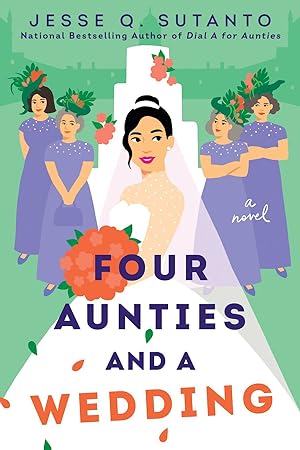
I just finished the sequel—Four Aunties and a Wedding—to yesterday’s book by Jesse Sutanto. It was, like the first, full of the antics of Medellin “Meddy” Chan and her idiosyncratic Indo-Chinese aunties, this time on her wedding day, and although it still had the trademark 2nd-language bloopers and irrational beliefs and superstitions of the first, it was even more frenetic.
Perhaps too frenetic. On the one hand, the descriptions of the aunties’ signature wedding-day outfits and their acquisition of vernacular Brit-speak so as to fit in when they go to London and meet Nathan’s family (their most favored expression being “the dog’s bollocks”) was highly entertaining, and the few interactions between Meddy and bridegroom Nathan were sweet and soulful. But these things were overwhelmed by a plot that took the hard-to-believe events of the first book to a whole less plausible level. (What I’m trying to say here is, it was way over the top.)
Meddy and Nathan are getting married at Christ Church, Oxford, which solves several problems: It’s the hometown of Meddy’s uptight new in-laws, which makes them happy (plus being a beautiful venue), but it lets her off the hook regarding inviting everyone in her entire insanely extended Chinese-Indonesian family, cutting the guest list from the thousands to a mere 200+. She and Nathan want the aunties to enjoy being guests at the wedding, so they have decided to find other vendors to supply the wedding with cake, flowers, makeup, photography, etc. But, as is typical in Meddy’s life, the aunts have worked out a “surprise” for her that she can’t be appropriately filial and still turn down: They have found another Chinese-Indonesian family of five who also do weddings, and hired them on the couple’s behalf.
The first meeting and all the planning goes unexpectedly smoothly, but then Meddy overhears her contemporary, the photographer Staphanie (yes, it’s spelled that way), talking about “taking someone out” on her big day and learns, to her horror, that the family of wedding vendors is Mafia and will reveal her family’s secret (from the first book) if she tells anyone. After this the entire book kicks up the adrenaline to a ridiculous degree as the aunties and Meddy scramble to keep anyone from killing anyone else while keeping it all from Nathan and his parents.
The parts with which I had the most trouble were the actual mechanics of the wedding day. First of all, if any bride spent this much time behind the scenes, ignoring her bridegroom and her guests in favor of running around with her aunts, neither the groom nor the guests would remain so sanguine. Second, about those guests: A few of Nathan’s business investors are highlighted as Meddy and the aunts try to figure out the intended target of the Mafia “hit,” but the rest remain a faceless mass, which is a bit antithetical to the whole idea of only close family and friends attending the wedding. Where were they, and what was their response when Meddy kept disappearing and the aunts became increasingly more embarrassing? And after the description of Meddy’s dress as being tightly corseted on the top half and unbelievably tulle-heavy (and too wide to fit in elevators) on the bottom half, it was hard to believe the things she was accomplishing while wearing it, especially without ripping it or getting it dirty. The thing that bothered me the most, though, was the thought of the total ruin of what was supposed to be a joyful and important occasion. It leant an air of melancholy to this slapstick comedy that lessened its potential impact.
But…I can’t say I didn’t enjoy it, because I did. One thing I liked about both of these books was the highlighting of Indonesian and Chinese cultures, with the contrasts between the lower and upper socioeconomic families and how different they can be despite common descent. The author states that she hoped to create sympathy and understanding without verging on stereotype, and for the most part she pulled it off, although better in the first book than in the second. I’m a little concerned that venturing on volume three may top off my tolerance for quirky mayhem and send me over the edge into annoyance, but I will probably still read it and then complain about it because hey, that’s what I do!
If you enjoyed such reads as the Finlay Donovan series by Elle Cosimano, as I mentioned in my last review, then the Aunties books may be something you would also want to read.

