The Empyrean “trilogy”
This series by Rebecca Yarros has been hyped a lot. I usually shy away from that, because I have discovered it’s more often than not the kiss of death to my enjoyment. But…dragons. I love dragons. I read all of Anne McCaffrey’s Pern books at least three times. I adore the dragons of Patricia Wrede, Bruce Coville, Diana Wynne Jones, and Angie Sage, and also those in Tolkien’s The Hobbit and Farmer Giles of Ham. I put up with Jane Yolen for the sake of dragons. Dragons gave added value in Ursula LeGuin’s Earthsea books and in the various trilogies by Robin Hobb. One of my favorite series is The Last Dragonslayer and sequels, by Jasper Fforde. I was intrigued by Rachel Hartman’s dragon/human shapeshifters in Seraphina and Shadow Scale. Robin McKinley’s Damar books use dragons as more of an excuse for a story than as a major plot element, but I still loved them. So. I was perhaps predestined to read these.


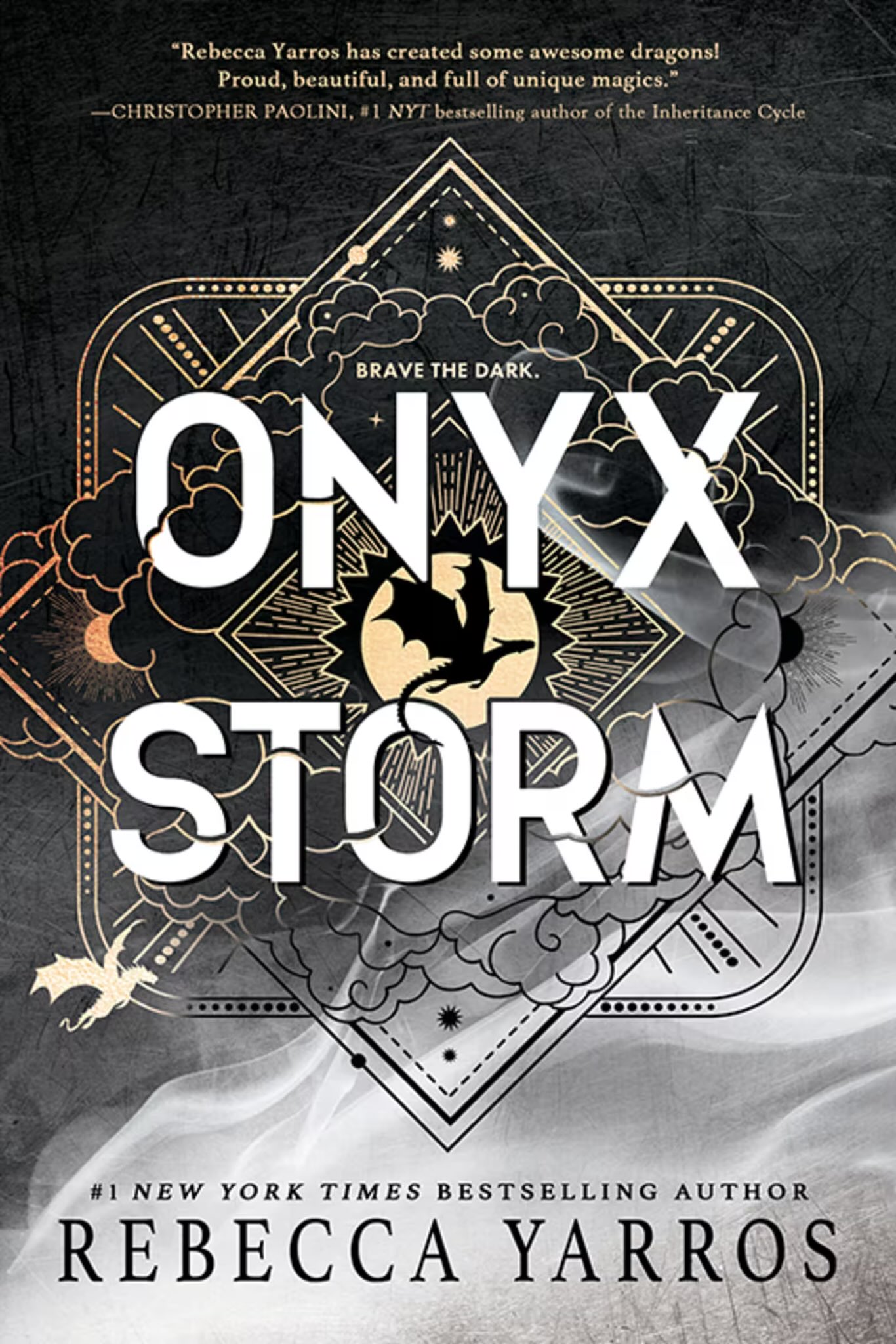
I will say that I was not initially disappointed by the dragons themselves. They are pretty cool, and the two we get to know more intimately through their association with main character Violet Sorrengail (Tairn and Andarna) have real personality. But there was much less thought put into all the rest of the dragons who appear in the books and, aside from their names being linked as a bonded pair with various characters, they were sadly both interchangeable and underutilized.
As for everything else, well, let’s break it down:
The writing was somewhat pedestrian—way too much exposition, language that was overly ornate but never coming to the point, and modern anachronisms (“for the win” and “shit’s about to get real” are the biggies that come to mind) that took me right out of the fantasy illusion. Sentence structure was awkward. (One reviewer actually counted and said “Yarros used 493 ellipses and 1,089 em-dashes in the 634 pages of Iron Flame.”) Both the meandering plots and the effusive, exclamatory style made me wonder how much power the editor was given over the content of these books (and why it likewise went underutilized).
The character building was good in the first half of the first book, and then disintegrated with each subsequent encounter. The protagonists, Violet and Xaden, had great potential, but knowledge of them stays on a shallow level because the author keeps describing them over and over without adding anything new, and the encounters between them are equally as repetitive. Both the heroism and the villainy become boring, because there’s little depth or explanation. And we might as well go on here to talk about the “romance” between the main characters, because this was an element that made them work even less for me. The first (explicit) physical encounter between them felt hot and daring, but by the time I got through the third book I was cringing and skipping the sex scenes because they were unoriginal replays both physically and verbally.
The secondary characters (Violet’s squad and siblings, the rebels closest to Xaden) had individual quirks that made them lovable or frustrating or inspiring or whatever, but I was disappointed that there was so little growth beyond the naming of that one element that characterized each of them. Much like the dragons, their characters and camaraderie could have been so much more of a feature, had the author cared more, but they were essentially one-dimensional.
The world-building was sloppy. It seemed like the only time it happened was when it was bolstering some plot point, so it became wearisome, for instance, to find out brand-new information well into the second or even third book simply because it was necessary to further the story. The fact that magic dwells only on the main continent, protected by wards, but there are whole archipelagos of islands without it, or that dragons are companions to the people in the warded lands but hated, feared, and targeted by the others would have been enlightening to know halfway through book one, not two-thirds of the way through book two (or later). And as for what magical abilities everybody has, it definitely felt like Yarros was making that up as she went along and needed a Hail Mary to get her out of the situation into which she had written herself. Everything we learned seemed less like a planned surprise and more like a decision in the moment as the author thought of some way to turn the story—oh, did I forget to mention this? Well, let me explain it here for you and then we can move on.
I will also say that since I am not a big fan of romance, maybe “romantasy” wasn’t as appealing to me as it might be to some; but I don’t think that’s really the problem. The problem is the endless, repetitive nature of the supposedly romantic encounters, which is a euphemism for the fact that every time the two protagonists saw each other, it was immediately sexual. Some non-fraught conversation would have been nice. Some peeks into childhood, some sharing of philosophy, a picnic, a book recommendation? Something.
Fourth Wing was good, despite some of these deficits, because we were discovering brand-new information—the challenges of getting into and surviving battle school, the intricacies of bonding with dragons, learning how to navigate the politics of both school and kingdom. It was interesting to learn that Violet had planned and thought she was destined to be a Scholar but was forced, despite her physical frailties (readers said the description of these sounded like she had Ehlers-Danlos Syndrome) and small stature, to choose to be a dragon-riding warrior because her mother was a big-deal commander and wanted all her children to choose that path. The details about Xaden and the other tattoo-marked riders being the children of rebels, basically conscripted into the dragon army to atone for the sins of their (deceased, executed) parents were intriguing. And the physical and mental obstacles Yarros sets up to test the potential riders to prove they could do the job were exciting.
But after the first shocks of a new environment, a new protocol, a forbidden love, the rest seems disappointingly like nothing but reiteration, filler, and false obstacles created to provide constant peaks and valleys in the relationships and the plot without ever taking us much of anywhere new. So (for instance) every time Xaden appears on the page, Violet has to lustfully re-react to his physique, his tattoos, his smoldering expression, his shadow-wielding. Every action or battle scene exists so that brave, impulsive but fragile Violet can be in peril or injured and Xaden can magically turn up to save her, scold her, and have his way with her (after the healers put her back together). And both the action and the storyline depend way too heavily on the life stories of just these two characters. It makes a dull read out of what could have had more significance and nuance.

My biggest beef, however, is that I was ignorant of what was apparently some fairly recent news. This was billed as a trilogy and I was, frankly, delighted to hear that. I wanted to read a series that had a beginning, a middle, and an end within a limited framework. So many fantasies just keep going until they exhaust either their author or their readers, but I thought I had discovered a tale that would be neatly told in three admittedly long but finite books. Nope. I kept reading book #3, at first thinking I should surely be farther along than 37 percent because what was left to say? and then thinking oh, there has to be at least 20 percent more to go because this doesn’t feel anywhere close to wrapping up, and then turning a page to discover, uh-oh, it’s over; WHAT?! I reread the ending of Onyx Storm three times and could make no sense out of it, only to discover (in a footnote on Goodreads on Yarros’s author page) that the rather cryptic close of that book was intentional because…dum dum DUM…there are two more books slated to be published. And after struggling through all the sturm und drang of book three without getting resolution of the central issue in a whopping 527 pages, I was, frankly, pissed off. I think I am done with Rebecca Yarros, despite the dragons. And that’s a big, big deal. Phooey.
Breaking a curse
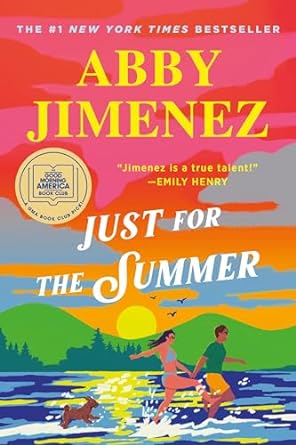
I picked up Abby Jimenez’s book Just for the Summer from Kindle Unlimited thinking it was written by Abbi Waxman, whose books I have enjoyed twice before. I later figured it out, but the plot sounded sufficiently appealing that I read it anyway, and I’m glad I did, because I really enjoyed it. It’s a “relationship” story along the lines of Emily Henry or Christina Lauren, some sort of meet-cute with complications and a hopefully HEA ending, but it’s better than many/most I have read.
It’s billed as third in a series, but it’s not one that is dependent on having read the others; they share some characters in common, but there’s not really a through-story here. This one is about Justin and Emma, two unfortunates who suffer from the same “curse”: Whenever they date anyone and then break up, their exes go on to find their “soulmates” in the very next person they date. (There’s a 2007 movie called Good Luck Chuck with this same “syndrome,” but in that case only the guy exhibits it.)
Justin does a funny “am I the asshole?” post about this on Reddit, Emma replies by saying she has the same problem, and after enjoying chatting with one another, they come up with a plan: They will date each other, break up, and cancel out the curse, so that each will then meet the love of his/her life. They do some calculating and figure out all the common denominators: They have to go out at least four times, communicate daily by text or by phone over the course of a month, kiss once, and then break up.
It’s a great plan, but there are a few problems: Emma is a traveling nurse, currently located in Colorado and planning to go with her friend Maddy (also a traveling nurse) to Hawaii for a three-month gig as their next stop, while Justin, who lives in Minnesota, has a big life-change coming up that will limit his freedom, so he can’t follow Emma to Hawaii even if he wanted to, and certainly not to stay for a month. So Emma persuades Maddy (with some judicious bribery) to go to Minnesota for the summer, and the experiment is set. But an unforeseen complication in Emma’s life plus the possibility of actual feelings between the two threaten the whole plan…

This was a story with a little more depth than some from this category; I liked the characters, who were all delineated precisely and filled out their roles in the plot. I liked that the complications weren’t manufactured but were things that actually happen to people, messy events and emotions with which they struggle. And the story arc was really well distributed, not building up to a rushed and idyllic ending—the pacing was measured, something that, again, felt real. Sure, there are a few of the standard clichés, but in this case they are made to work with the story and not against it.
Based on this book, I would definitely consider reading others by Jimenez.
Meant to be
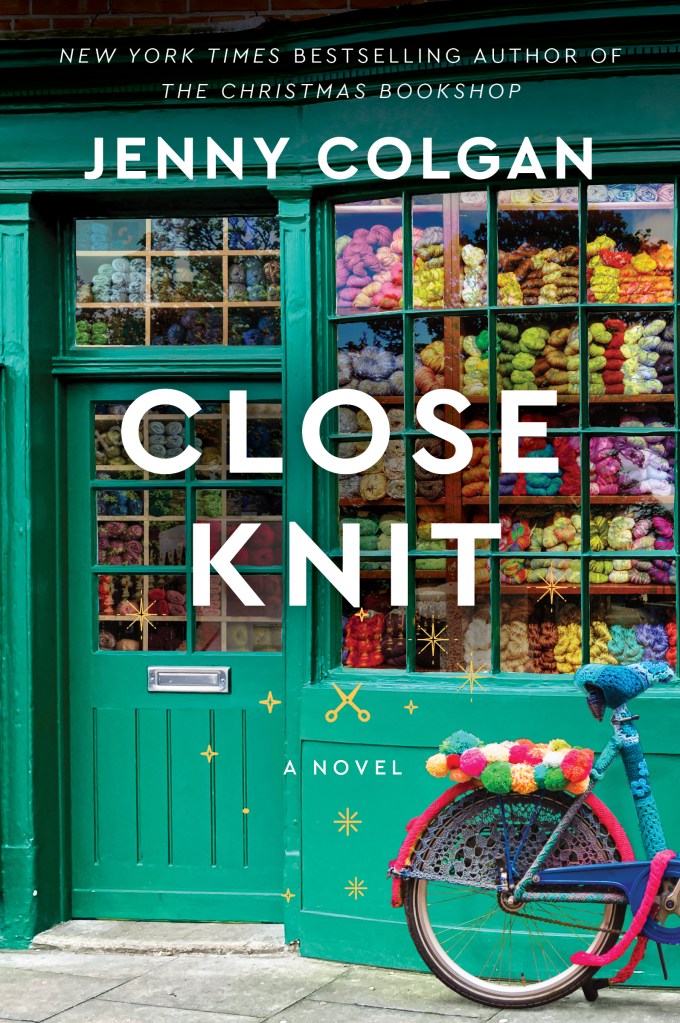
I don’t in general believe that anything is “meant to be.” But if anything could convince a cynic that there is such a thing as destiny, it would be one of Jenny Colgan’s novels. Close Knit was particularly illustrative of that theme, in that it was perhaps a little more transparent than its author might have intended in telescoping the story. I pretty much knew who the protagonist would end up with from about the third chapter (despite various rather transparent red herrings), and spent the rest of the book waiting for her to figure it out for herself and/or for the author to put her and her intended in the right kind of meet-cute circumstances to make it happen.
I didn’t know that there is a book—The Summer Skies—that precedes this one and stars another main character (the pilot) as its protagonist. But this read perfectly well as a stand-alone, and now I can go back and enjoy that one too.
As is usual with Colgan’s books, the beautiful, bare, wind-swept islands of northern Scotland are as much a character as anybody else in the book, and reading her lyrical descriptions almost persuades me that I would love to live in a locale that is fairly constantly beset by frigid winds, in almost total darkness during the winter and perpetual light in summer due to its place far above the equator. Likewise, the people with whom she populates the small towns and villages of the islands are in equal parts ordinary and distinctive, most of them sounding like the perfect neighbors and friends, with a curmudgeon or a crank thrown in here and there for ballast.
Authors should have to vet the copy written to describe their books on Goodreads (or does it come from the publisher? if so, shame on them!), because there were many inaccuracies in the details of this one. First of all, it’s described as a summer novel, which I suppose you could marginally support, since some of the action takes place in May; but in a clime where May can bring rain, hail, or even snow, it’s not exactly a typical summer vacay beach read! Second, the main character is described as having many friends, but the truth is, everyone in her knitting club is her mother’s age (or older), and Gertie is more their pet project than their contemporary. She is actually rather isolated, being a shy, dreamy “girl” of 30 who has no girlfriends or dates her own age. Third, when Gertie decides to take on a new job, it’s described as air stewardess on a small plane, but in fact her actual primary task is to run the desk at the tiny terminal, checking in the passengers and their belongings and making sure everything goes smoothly in the run-up to each flight. She is required to go up in the plane in order to understand aspects of her job and to occasionally serve as crew, but that’s a much less important function.
A final pet peeve is the cover design: While there is a knit shop in the village similar to the one depicted on the cover, the women of the knitting club have a persistent feud with its owner and, in fact, hardly frequent it, so to give it pride of place as the cover design is as bad as the stationary bookstore on a street corner that appears on one of Colgan’s other books about a mobile bookmobile that travels around an island supplying reading wherever it goes.
The story line that propels the action of Close Knit is that Gertie has somehow let her life slip through her fingers. She lives at home with her mother and grandmother, and her friends are their knitting club ladies, so she has no significant men in her life. She got a job 10 years ago at the local market and somehow the time has passed her by while she unloaded groceries, dusted shelves, and worked the till. Her only real entertainment is knitting beautiful scarves, socks, and hats, and the only place she experiences excitement is in her romance novel-driven dreams. Then she’s given the opportunity to switch jobs, which she does partly because there is a handsome and charismatic airline owner whose planes and helicopters use the terminal and she thinks this might be an opportunity to get to know him. But fate has something different in mind for Gertie…
Even knowing what would probably happen, I thoroughly enjoyed going through the process, as one enjoys a cup of cocoa and some warm slippers at the end of a long, cold afternoon. That’s probably more than half the appeal of a Colgan novel—the tactile and culinary descriptions set in the perfect atmosphere in which to enjoy them. The designation “cozy” was meant for her books.
Slow burn
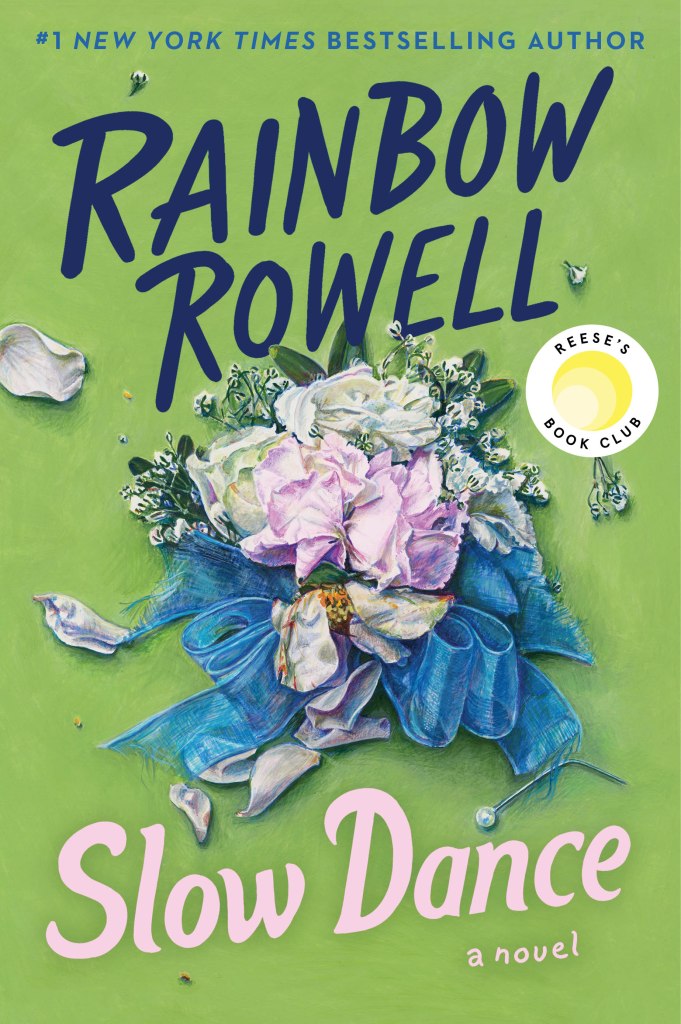
I just finished Rainbow Rowell’s newest novel for adults, called Slow Dance. Back when I was a brand-new teen librarian, her book Eleanor and Park hit the top of the chart for teen novels, and I read it with my high school book club and fell in love—with her characters and their story, and with her writing. This book could be about Eleanor and Park at 33, if they followed certain trajectories that first took them away from one another and then brought them back together after a fair number of life experiences, although Eleanor and Park had the sense to figure out just how much they liked each other, while Shiloh and Cary (despite one experience during their college-age years) are frustratingly obtuse about their feelings.
This is a longer novel than it needs to be, and I say that out of a fair amount of impatience at certain points with the sheer pigheaded insistence both characters show when it comes to misunderstanding one another’s motives, thoughts, and feelings. But at the same time, I got it; if you have ever been in a one-sided relationship—or even one that you thought was one-sided—and struggled with how much or how little to reveal, and whether to go for it or keep it to yourself forever, you will get it too.
Shiloh and Cary were best friends in high school, part of a steadfast trio with their pal Mikey, and while they were inseparable and had secret feelings for each other, they never managed to make it out of the “friend zone,” except for a weekend of bliss coupled with massive misunderstandings during Shiloh’s college years. They grew up on the poor side of Omaha, and both had plans to escape; Shiloh was going to be an actress and probably head for New York City, while Cary’s exit plan was to join the Navy. Cary fulfilled his objective, but Shiloh dabbled in theater until she met an acting teacher with partner potential, then produced two children followed by a divorce, and remained stuck in Omaha, living with her mom and kids in the house where she grew up. Fourteen years later, they both attend a second wedding for their friend Mikey, and reconnect—sort of. The old feelings resurface, along with the misunderstandings, the ambivalence, the life conflicts, the water under the bridge…in short, they have a lot to get over and get past if they are ever to share something meaningful. The will-they won’t-they, combined with the flashback story of how they got to this point in their lives, is the story here.
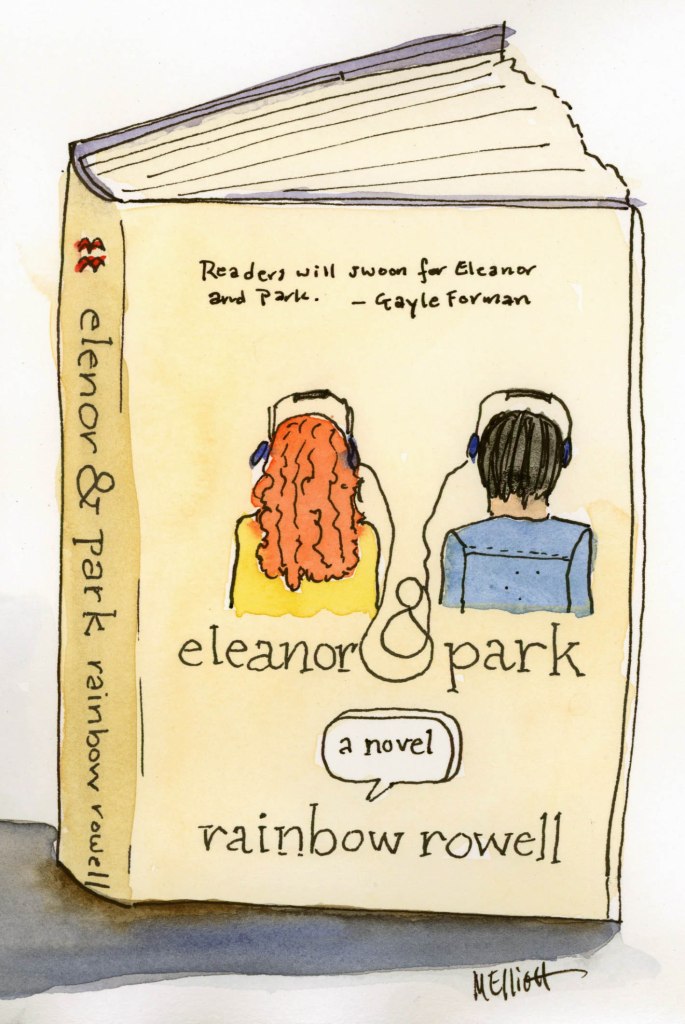
The saucy banter, the genuine emotions, and the honesty of expression brought back the best parts of Eleanor and Park; and although there are moments when you want to take one or both of them by the shoulders and give them a good shake, you’re mostly rooting for Cary and Shiloh to get it together and succeed at this second-chance romance. (And you also want a happily ever after for Shiloh’s extremely engaging children, Juniper and Gus.) A solid entry for Rowell’s adult realistic fiction shelf.
Funny story
I was headed towards a long, intense perusal of Paolo Bacigalupi’s latest, Navola, but just as I was about to open it, the library popped up in my email to tell me this Emily Henry book was now available for checkout, and I decided to prioritize a shorter, lighter read in the midst of ranting about the Republican convention and scolding Democrats trying to ditch Biden in a last-minute bid for the nonexistent “perfect” candidate. And I’m glad I did.

I was surprised by this one, because I have read four other Emily Henry books and enjoyed them all, but so far Funny Story is my favorite. It’s surprising because a bunch of die-hard Emily fans gave it a low rating and found many things to pick at about the protagonists, the set-up, the story, the writing…not a bestie for many.
I may have been prejudiced by a few things: Daphne, the protagonist, is a somewhat buttoned-up children’s librarian. Miles, the other MC, is scruffy, mischievous, but also deep and troubled, and dead sexy. I also liked the opening premise: Daphne is engaged to Peter, and the wedding is imminent. Peter has a lifelong best friend named Petra, who is dating/living with Miles. Everything is on track when Peter and Petra decide, at his bachelor’s party no less (to which she was, of course, invited), that they are in love with each other, and dump Daphne and Miles. Peter then gives Daphne a week to move out of “their” house, to which he holds exclusive title and, given her limited options as a poorly paid librarian (trust me, there is no other kind), she moves into the second bedroom of Miles’s apartment. So yeah, she’s now living with her ex-fiancé’s new fiancée’s ex…
The next inevitable step is that Daphne, motivated by panic (and by revenge fantasies), intimates to Peter that she and Miles are a couple, and then she has to confess this to Miles. He is surprisingly sanguine about this lie, and promptly starts taking couples selfies to post on Daphne’s social media. And…you can probably guess the rest, although it’s nicely written and plotted, with a fair number of roadblocks in various directions, and also features some wonderful side characters, such as Miles’s sister Julia and Daphne’s new friend Ashleigh, and explores familial issues that illustrate why the MCs are the way they are.
The title may have been misleading for some, hence the disappointment when the book didn’t turn out to be particularly humorous (although it has its moments). It alludes to the story that all couples have and, if it’s a good one, like to tell, about the moment they met. Peter was fond of recounting his with Daphne, but it turns out not to hold a candle to how Daphne and Miles start their relationship. I really liked this book, beginning to end; some of Henry’s others have lagged for me at key points, but this one kept me going, start to finish. Don’t listen to the naysayers on Goodreads—check it out!
Retrograde
The blurb for this book describes it as “funny and heartfelt.” It’s also supposed to be a romance about a woman who writes romances for a living and wants to open a romance-only bookstore with her two best friends, also authors. So you would think I would love it, or at least find it charming and/or germane to my interests. I’m beginning to think all the books I want to read have banded together to evade me on purpose, leaving me with a bunch of hopeful choices that don’t quite pan out.
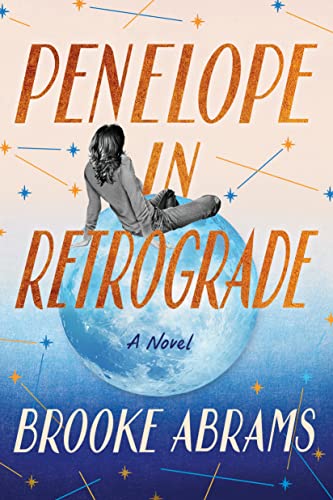
Penelope in Retrograde, by Brooke Abrams, isn’t a bad book, and I didn’t hate it; but it’s too slight to make much of an impression. It’s also annoying in some specific ways. I feel like the author is trying too hard to include all the romance memes, from the meet-cute to the friends-to-enemies-to-friends, and throwing in a conflicted familial situation to spice it all up—none of which turns out to be satisfying.
The main character, Penelope (Penny) has been, not exactly estranged from her family, but out of regular contact for about a decade. Her father is a workaholic businessman in finance; her twin, Phoebe, graduated with honors from college and works in his firm; and Penny has always been the odd one out. Phoebe is successful, Phoebe has a relationship, Phoebe lives close to her parents and sees them on a regular basis, while Penny lives more than half the state of California away from them, and writes romance novels. She is so insecure about her lack of acceptance from her family (her mother wants her to dress better and get a husband and maybe have some kids) that she hasn’t even told them the pen name she uses to write her books.
Once upon a time, Penny was briefly married to Smith, with whom she grew up. She had a better relationship with his family than she does with hers, and mourns the loss of them more than the marriage. The present-day setting of the book is the Thanksgiving holiday, for which Penny is finally returning home after 10 years of avoiding every family gathering. And why is she gracing them with her presence? She needs money to open her bookstore. This immediately made me think poorly of her, since the only reason she’s willing to connect again is to get the funding.
Karma trips her up when she phones for a rideshare from the airport and ends up sharing the Úber with her ex, Smith, who is also returning home to spend the holiday with his sister. Penny then discovers two things: Her parents have invited a young and handsome colleague from her father’s company to dinner, because they never give up matchmaking (even after 10 years of no contact?), and Smith is dating someone new. So Penny immediately decides it’s a good idea for Martin, the set-up guy, to pretend to be her boyfriend. The problem is, her whole family knows he’s not, so he has to convince Smith without revealing what he’s doing in front of her family. The whole thing is cloyingly cute. (Sorry, that was all a little spoiler-y.)
Basically, I agreed with one Goodreads reviewer who said that the story tries way too hard to be funny. Penny’s compulsive avoidance of any genuine conversational moment by turning everything into a joke is grating, while the ride-share scene stretches out forever and is patently silly. Penny’s narrative paints her as the victim of her family’s rigid expectations, but her own behavior shows her up as kind of selfish, and definitely as tone-deaf to their needs as she feels they are to hers. And everybody fights nonstop, which is likewise wearing.
The other thing about this story is that it’s so, so easy. Martin immediately falls in with her plans; Smith turns out not to be plotting what she thinks he is; her father has changed drastically in completely implausible ways while her mother has remained distressingly static; and Nana Rosie as the comic relief is too, too coy. And even though her sister is justifiably irate at how Penny is constantly stealing her thunder, forgiveness also comes easily. Despite Penny raging about how they are all hostile to her, everybody cooperates with hardly a whimper, and then when a stressful life event occurs, Penny transforms into someone else and we have a qualified HEA like all good romance novels. I was surprised when I discovered I had already turned the last page, because I kept expecting things to become, well, more. The desire for more seems to be the one bell I keep ringing lately.
Can anybody recommend something to me that will generate some genuine feelings of joy when I read it?
Mistaken identity
The ratings and comments on Goodreads for On Rotation, by Shirlene Obuobi, are so spot-on to illustrate why publishing companies have to be held accountable for the way they promote a book. There were a few people who thoroughly appreciated the story for what it was, which was a combination of “relationship fiction” and and the immigrant experience, with coming-of-age (early 20s variety) thrown in; the rest were disgruntled and showed that in their ratings, because the blurbs had led them to believe this was a rom-com.

Don’t get me wrong: There is a romance in this book that takes up a significant amount of air. But it isn’t a comedy (although there are a few funny moments), and it doesn’t have that coy, somewhat self-conscious vibe that lets you know when you’re supposed to acknowledge the ironies or coincidences or other plot points common to the specific rom-com subgenre.
Instead, it’s a narrative about the experiences of a young black woman in medical school; but moderating that more generic scenario is the specificity of being a first-generation Ghanian, seeing how that sensibility and those traditions differentiate a part-West African, part-British heritage from that of the American descendents of slaves. It’s a showcase for the immigrant point of view—the older generation who gave up much to move their lives to a new arena having hefty, sometimes crushing expectations of and for their children, who are perceived to have every advantage and are expected to make perfect choices. It’s an examination of friendship and love and what place and importance those two levels of engagement can have in life. And yes, it’s also a romance, but from a more complicated context than the usual rom-com fare.
On Rotation focuses on Angie, a 20-something black woman who is prioritizing her career goals and having to juggle wildly to keep up with everything else. The style is engaging, and the cast of characters is lively, diverse, and inclusive. I liked the detail of the story where she decides to enhance her chances at getting a plum residency by doing a study about how the black experience with doctors and hospitals differs from that of white patients. While I am a white woman, the fact that I have a health condition about which many doctors are ignorant and/or dismissive made me able to relate to and appreciate the information she gathered.
The challenges of trying to live up to her parents’ expectations, which are many and encompass both the significant and the trivial—including everything from her success as a doctor and her choice of romantic partner down to the tidiness of her apartment and how she wears her hair—will probably ring true for many of us, but there is definitely an added amount of pressure for children of immigrants. I loved the connections she had and maintained within her circle of “ride or die” friends, and the bewilderment and grief with which she faces the possible ending of one of those relationships. And the shallowness of her past dealings with men who appreciated certain aspects but couldn’t embrace the whole of Angie were a nice contrast to the relationship she wants but doesn’t trust with a man who may be different.
I confess that I would have preferred a little less of what was going on inside Angie’s head at all times for a little more of what was happening in the thoughts or behind the scenes of certain other characters; but this is a minor caveat—it was, after all, Angie’s story.
There was one truly irritating aspect of the book and, perhaps blessedly, something I could blithely choose to ignore: The author appends footnotes to almost every page, in which she didactically explains medical terms, Ghanian customs, black hair, contemporary slang, and everything else she must have believed the reader was either too ignorant to get or too lazy to research. But because I read this as an e-book, the footnotes all appeared sequentially at the very end of the book and, rather than jumping back and forth between whatever page I was on and the last 20 pages of footnotes, which is a major pain when reading on a Kindle, I simply gave up on knowing what she was choosing to share in those addenda, which probably saved the book for me. Footnotes in fiction are almost never a good idea unless they serve an alternate purpose, such as the ones in Jonathan Stroud’s Bartimaeus saga, wherein the main story is about the boy magician Nathaniel who summons an ancient genii, while the footnotes contain the sly side commentary of the genii himself. So I guess my recommendation for enjoying Obuobi’s book is to read the Kindle version and ignore the asterisks liberally seeded throughout the text!
Lighthearted…and also dark?
I love finding a book that successfully combines light and dark humor. The last book/series I read that did that was the Finlay Donovan series by Elle Cosimano, and I have now found another: the “aunties” books by Jesse Q. Sutanto. i just finished the first and liked it enough that I immediately went to my library website and checked out #2 in the series to start on tomorrow morning with breakfast.

In Dial A for Aunties, Meddelin Chan is the third-generation American 20-something from a mixed-race Indonesian/Chinese family of women who all live in close proximity in Glendale, California, and work together in the family wedding business. Big Aunt does the cakes and food, Second Aunt the makeup and hair, Third Aunt (Meddy’s Ma) the flowers, and Fourth Aunt is the entertainment, a singer at the after-wedding reception, while Meddy herself is the wedding photographer. While she loves photography and does enjoy certain aspects of her job, she didn’t really plan for her future to consist of living and working with the aunties (“Don’t leave your big day to chance, leave it to the Chans!“); but she is a dutiful (and guilt-ridden) daughter, and when her (mostly male) cousins all decamped to other cities or states after college, she swore she wouldn’t likewise desert the aunties.
This led to major heartbreak for Meddy, though, because Nathan, her college love and, she believes, the love of her life, was offered a prestigious job in New York City and, rather than disappoint the aunts or hold him back from choosing success on the other side of the country, Meddy breaks up with him so he is free to pursue his dream while she can keep her promises to the family.
The story begins a few years after the breakup. Meddy has dated a few guys in the meantime, but her heart isn’t in it, and her Ma and aunties have begun to despair of ever having grandbabies. So Ma signs up for online dating posing as Meddy, cultivates a relationship with the rich and handsome Jason, and then springs a date on Meddy that’s “blind” for her but not for Jason, as he feels they have really gotten to know one another online and through texts! Meddy reluctantly agrees to the date, which is to take place the night before the family does their thing at a huge society wedding on a resort island off the coast of California. The evening ends up going horribly wrong, leaving Meddy in a panic, needing the aunties to bail her out of trouble in the midst of preparing for their big job.
I don’t want to say much more than this, because the pleasure of this book is in discovering the mishaps as they occur and trying to figure out how the clueless yet ingenious aunties will fix them. The publishers did a disservice to the reader in outlining too much of the story on Goodreads, so don’t read it if you prefer to be surprised, as I do. It’s well worth the wait! Let’s just say it’s an exciting wedding weekend, and there’s a reason for the title being reminiscent of “Dial M for Murder.” I laughed out loud or shrieked in disbelief several times.
What I wished for
The Unmaking of June Farrow, by Adrienne Young, is the book I have been wishing to read. It’s both an elegantly written and a beautifully told story that incorporates a curse, a murder, something sort of like time travel but not exactly, and an emotionally complex web of relationships that are a pleasure to try to untangle. If I had to label it, I guess I would call it magical realism.

June Farrow was born into a family in which the women are believed to be cursed, and June intends to be the last member of this family in order to break that curse, resolving never to marry nor have children.
At some point in each of their lives, the Farrow women are overcome by madness—seeing, hearing, and experiencing things that aren’t there as their minds slowly unravel. June’s own mother, Susanna, became increasingly troubled, finally abandoning the infant June to be raised by her grandmother, then disappearing, never to be seen again. In the past year, June, 34, has begun to experience the warning signs that she, too, is beginning to lose touch with reality. She’s hearing phantom wind chimes, seeing a man’s silhouette looming and smelling cigarette smoke on the breeze from the open window, but there’s no one there. And then there is the red door that appears, standing in the middle of a field of tobacco or at the side of the road outside of Jasper, North Carolina, as if waiting for her to walk up, turn the knob, and step across the threshold. This is the story of what happens when she yields to that impulse.
I don’t want to tell much more than this, because you should be allowed, as I was, to unwrap this tale for yourself. I think it will be enough to say that it is immersive, atmospheric, romantic, and mysterious, and I thoroughly enjoyed it from beginning to unexpected end.

Unhappy fans
I miraculously got a checkout from my library for Emily Henry‘s latest, Happy Place, in about a third of the time I expected to wait. Then I read the reviews on Goodreads, which may furnish some explanation. Don’t get me wrong, every second or third review awarded five stars, but there were also those critical reviews between them for three, or even two or one star, a phenomenon I believe has not previously been experienced by this popular author.
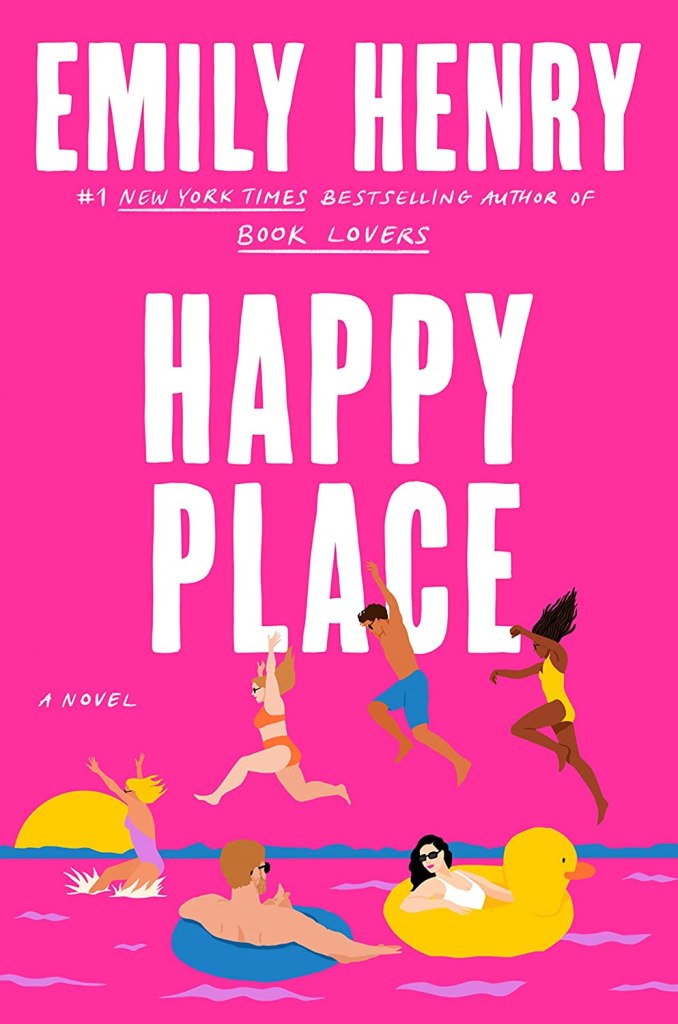
The story involves six friends, five of whom bonded in college and have remained uncommonly close, and one extra who was pulled into the group when she became part of a couple with one member. In fact, four of the original five have coupled up with one of the others, and this is the source of the current problem.
Their “leader,” Sabrina (I call her that because she’s the impetus behind keeping them all together), comes from wealth, and a tradition the group has had for their entire friendship has been to spend a summer week together at her father’s Maine “cottage.” But her dad’s most recent spouse doesn’t want to maintain the association of the cottage to his first wife and insists that he sell it, so this is the friend-group’s last gasp at a holiday together there, fraught with all of the traditions they have created over the years.
Sabrina and Parth have made the week into even more of an event by surprising their friends with their engagement, with a wedding planned for the end of the week on Saturday before they all pack up to leave the cottage forever on Sunday. Given this special occasion, none of the friends feels like they can refuse the invitation, let alone spoil it with bad news, so this makes it difficult for Harriet and Wyndham, who broke up four months ago but haven’t told anyone. Their plan was for Wyn to bow out of the week with some excuse while Harriet broke the news to the rest of them, but instead they are both on premises with nothing revealed, and have been awarded the best room together, a double en suite featuring a bathroom with no door. Awkward. And painful, and sensitive, and embarrassing and almost impossible to endure. But Harriet and Wyn don’t want to spoil the week for the others, and they do want to be at the wedding, so they are gritting their teeth and playing a part in public while taking turns sleeping on the floor in private. The third couple, Cleo and Kimmy, have secrets of their own, and there is building resentment between Cleo and Sabrina to cap off the basic tension in the air.
Harriet is a surgical resident in a prestigious program in San Francisco, and Wyn was living with her before going home to Montana to deal with family issues and never coming back. The two had been together for eight years, and happy for the first six, but once they relocated to San Francisco everything seemed to go wrong for them, as individuals and as a couple. But Harriet never dreamed the result would be a few devastating sentences on the phone that severed their connection permanently.
I personally enjoyed the book, both because I am apparently a hopeless romantic at heart and because I relished the vicarious experience of having a solid group of friends on whom I felt like I could depend forever. Who doesn’t want people in their lives who know you, are there for you, and will reliably show up for your highs and your lows? It threw me back to seeing the movie The Big Chill in 1983 and wondering, 10 years after high school graduation and five years after college, who of my friends I would still know 10, 15, or 20 years later (answer: one). So I liked being immersed in the group dynamic.
I also found Harriet’s and Wyn’s descriptions and chemistry with one another compelling, and cringed at what they had to go through as they maintained a façade for their friends. And I coveted everything about that vacay in Maine, from the weather to the food to the Lobster Festival to the opulent yet cozy cottage. Basically, I plopped myself down in the middle of the plot and went with it.
Others, however, were not pleased. One pointed out that “miscommunication” was the worst trope ever, and when I reflected on it, I had to agree; I realized that I myself didn’t identify that as a problem because I, like Harriet, tend to hang back, keep my mouth shut, and wait for someone else to make the important moves, so it seemed familiar and therefore not bad. But it was! They were both thinking one thing in their heads and allowing different information to come out of their mouths; they were both pretending to be happy while being oh so sad; they were lying a lot; and if, after eight years together, neither of them could bring themselves, through embarrassment or shame or fear, to fight for the other person or for the relationship, they probably deserved to be unhappy. Another reader actually said “The pacing of this book, the alternating timelines, the character development, the relationships were all beautifully and expertly written,” and then gave it three stars because of that trope. Finally, one of the one-star awarders said “Fake, awkward, contrived, and so, so dull. I simply cannot read another novel held together by the characters’ absolute refusal to communicate.” So there’s that…
Someone else said they felt the side characters had no personality, that they had been crafted as one-note cardboard characters whose most prominent feature was anxiety, and then left to function on their own. Another called them “unlikeable and underdeveloped…I just didn’t feel like I could root for them as I have others of Emily Henry’s characters.” I certainly didn’t feel this way about the characters during the flashback portions of the book, but in the present-day renderings I could kind of see it.
Finally, a surprising number of people found fault with the sex scenes, which I personally thought were both convincing and, well, sultry!
My conclusion is that with this story you will either identify with some/one of the characters and go with the flow, or you will get caught up in the frustration presented by the miscommunication trope and dislike it. I imagine that my review and thoughts will have absolutely no affect on those who are die-hard fans, while others may broach the book out of curiosity, taking a 50-50 chance on their reaction. Feel free to comment below on which person you ended up being!
 The Book Adept